

CCSD code G5100: Bypass of duodenum billing guide
CCSD code G5100 bills a bypass that leaves the duodenum in place CCSD code G5100...

Last Updated: Oct 16, 2026
J1675 is the HCPCS Level II code for injection, histrelin acetate, 10 micrograms.
Medicare Part B pays for J1675 under the ASP+6% methodology, and the rate changes every quarter. It also covers NDC reporting and the self-administered drug exclusion that decides whether Part B pays at all.
Let Pabau's smart automation suggest the right codes, reduce claim denials, and keep your practice compliant—effortlessly.
Automate repetitive tasks and focus on what matters most—your patients.
Reduce coding errors and ensure compliance with the latest regulations.
Clean claims, fewer denials, and faster reimbursements.
Powerful insights and reporting to help your practice thrive.
HIPAA compliant SOC 2 certified GDPR-compliant Trusted by 4,000+ clinics worldwide

HCPCS code J1675 covers an injection of histrelin acetate at 10 micrograms. It is a Level II J-code for a GnRH agonist given in an office or outpatient setting.
Medicare Part B covers J1675 when a physician or qualified provider administers the injection. Self-administered formulations are excluded under CMS Article A53066.
In the office setting Medicare pays the drug and the administration code as two separate line items, not as one bundled payment.
Reimbursement follows the ASP+6% methodology and CMS updates the rate every quarter. Report the NDC alongside J1675, and pair the code with a supporting ICD-10 diagnosis.
Practice management software like Pabau lets oncology and urology practices attach the J-code, the NDC, and the diagnosis to one claim.
Histrelin acetate is a synthetic gonadotropin-releasing hormone (GnRH) agonist used to treat advanced prostate cancer and central precocious puberty. Continuous exposure to a GnRH agonist suppresses pituitary LH and FSH secretion, which in turn reduces sex hormone production. That hormonal suppression is what makes histrelin useful in two very different clinical settings.
The brand names Vantas and Supprelin LA refer to implantable subcutaneous pellet formulations of histrelin, not the injection form. The injection coded under J1675 is the aqueous formulation.
Coders who see a Vantas or Supprelin LA chart note should confirm the route and formulation before applying J1675. Implant placement maps instead to a procedure code for surgical implantation.
Medicare Part B covers J1675 when a physician or qualified non-physician practitioner administers the injection directly. Coverage does not extend to self-administered forms. Payment follows the Average Sales Price (ASP) methodology that CMS uses for Part B drugs. The allowed amount is ASP plus 6% of the ASP value.
Because ASP rates change every quarter, any dollar figure you have on file may already be out of date. Always pull the current rate from the CMS quarterly ASP pricing file before you calculate expected reimbursement. Reconciling remittances against expected ASP amounts is easier when a system imports electronic remittance advice automatically.
Most J1675 claim errors fall into one of four categories: Wrong unit count, missing NDC, absent administration code, or an unsupported diagnosis pairing. Fixing all four before submission is the fastest path to a paid claim. The visual below sets out each field, the entry it takes, and the rejection it prevents.
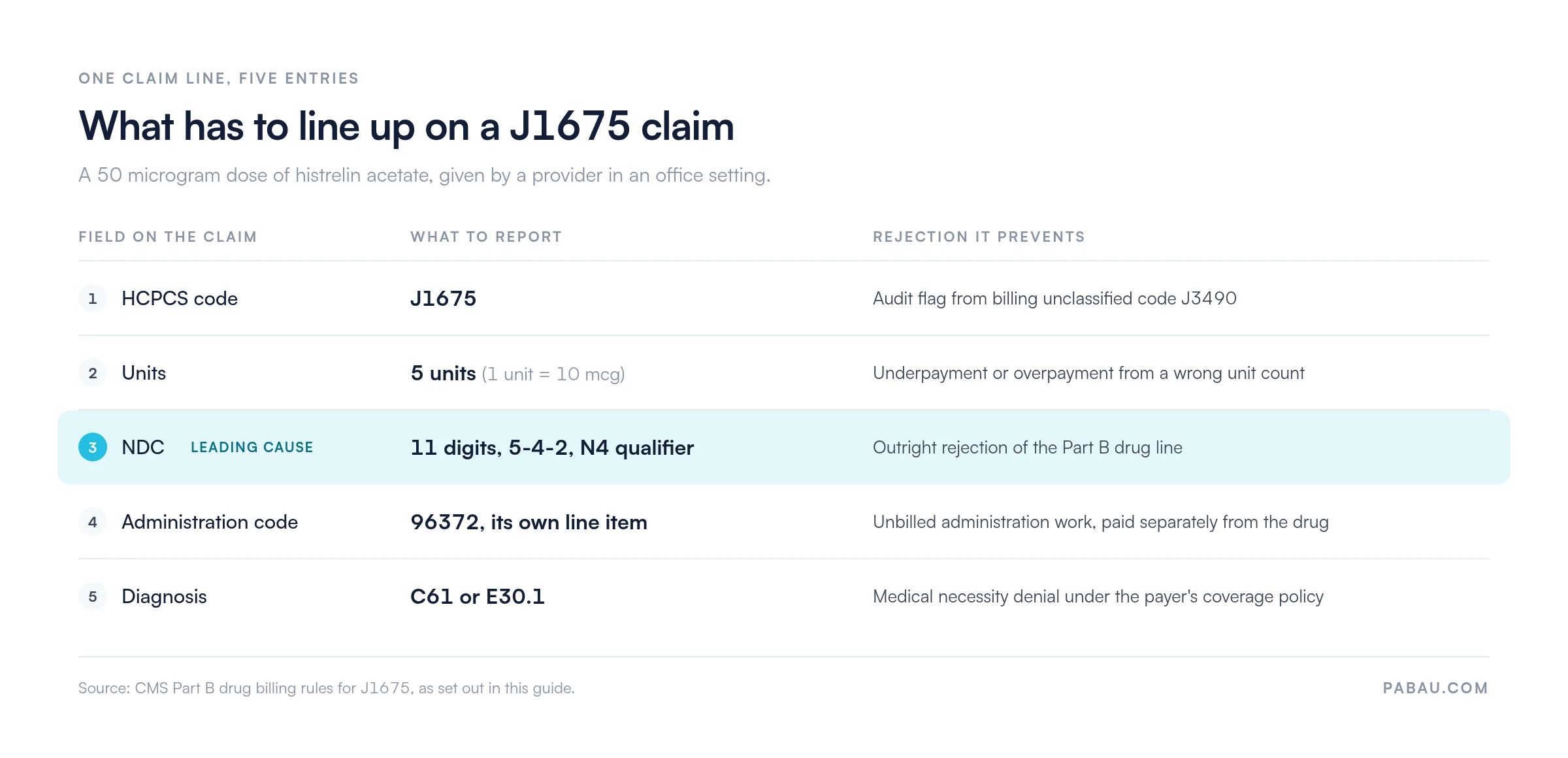
J1675 is billed in units of 10 micrograms, so a dose of 50 mcg requires 5 units. Report the administration separately using the appropriate injection administration CPT code, typically 96372 for a therapeutic subcutaneous or intramuscular injection.
In the office setting Medicare pays the drug line and the administration line independently, so neither one absorbs the other. Both belong on the same claim, each with its own charge.
Traditional Medicare Part B does not run a prior authorization program for J-code drugs. Medicare Advantage plans, commercial insurers, and state Medicaid programs often do. Several publish J1675 on their drug prior authorization lists, so a claim submitted without an approval number is denied on receipt. Check the plan’s current list before the injection is given, not after.
Every J1675 claim needs a supporting ICD-10 diagnosis that establishes medical necessity. The table below lists the most commonly paired codes, and our full ICD-10 code reference covers each one in more depth.
Payers may accept related codes depending on the local coverage determination (LCD) from your Medicare Administrative Contractor. Always verify with the applicable MAC LCD before you bill a diagnosis not shown here.
Document the specific diagnosis clearly in the medical record. A claim pairing J1675 with a diagnosis that does not reflect the patient’s condition is a compliance risk. Link the procedure, the drug code, and the diagnosis on the charge sheet before the claim is generated. That step removes most of this error category.
Check your MAC’s local coverage determination for J1675 before billing for indications beyond advanced prostate cancer and CPP. Some MACs publish specific coverage articles for GnRH agonist injections that list every covered ICD-10 code and documentation requirement. Billing without confirming the LCD is the most common reason J1675 claims face medical necessity denials.
No. The physician-administered injection form is not excluded, so Part B covers J1675 when a provider gives the injection. CMS Article A53066 documents the self-administered drug exclusion list, and that exclusion targets formulations a patient takes at home.
The distinction is route of administration. When a physician or qualified practitioner injects histrelin acetate in a clinical setting, the drug is not being self-administered, and Part B coverage applies. The exclusion covers oral or self-injectable formulations a patient would take at home without a provider present.
Route-of-administration documentation is what protects the practice at post-payment audit. The note must state that a provider administered the injection in the office. Wording that suggests the drug went home with the patient undercuts the claim.
CMS requires that National Drug Code (NDC) numbers be reported on Medicare Part B drug claims. The NDC identifies the product, manufacturer, and package size dispensed, which gives the claim traceability back to the dispensed unit.
Omitting the NDC or reporting an incorrect one is a leading cause of Part B drug claim rejections. Practices holding first-pass acceptance above 95% treat NDC reporting as a fixed step in the pre-billing checklist.
Histrelin acetate is available in a limited number of commercially marketed formulations. The table below is a reference crosswalk. NDC numbers change when manufacturers update packaging or discontinue products, so verify the current NDC against the product vial before each claim.
Confirm the specific NDC from the product vial received from your pharmacy or distributor. Manufacturers occasionally reassign NDC numbers, and billing a superseded NDC triggers a rejection even when the drug and the HCPCS code are correct.
CMS updates ASP-based reimbursement rates for all Part B drugs quarterly, so the rate in effect for Q1 differs from Q3. Publishing a specific dollar figure here would be out of date by the time most readers see it. Pull the rate directly from CMS instead.
A quarterly check of the ASP pricing file, reconciled against remittances, shows where payment diverged from the expected amount. Check the AAPC HCPCS code reference at the same time to confirm J1675 remains active and unchanged for the billing year.
Coders working with GnRH agonist and hormone therapy injections regularly meet adjacent J-codes. Knowing the distinctions prevents picking the wrong code when several drugs appear on the same encounter. Reworking a wrong-code submission takes far longer than getting the code right at entry.
Never use J3490 (unclassified drugs) for histrelin acetate. J1675 is the specific code and must be used when the drug is histrelin acetate injection at the 10-microgram dosage unit. Using an unclassified code when a specific code exists can trigger an audit flag. It also tends to result in a lower payment rate, or a denial that needs extra documentation.
Drug injection claims carry more data points than a typical office visit claim. The J-code, the NDC, the dosage units, the administration code, and the diagnosis all have to agree. A single missing field is enough to generate a rejection.
Practice management software like Pabau keeps those fields together. Pabau’s claims tools for billers let oncology and urology practices build a procedure template carrying the J-code, the NDC, and the diagnosis together. The biller then fills one form instead of five fields across five screens.
A dispensing record linked to the billing record creates a traceable path from the drug received to the claim submitted. For practices running high volumes of ADT injections, that audit trail is worth having when a payer requests records. You can book a demo to see how Pabau handles J-code workflows in urology and oncology practices.


Pabau’s claims management tools help oncology and urology practices attach J-codes, NDC numbers, and ICD-10 diagnoses to claims in one workflow. That reduces manual errors and speeds up reimbursement.

J1675 rewards a routine more than it rewards expertise. Five entries have to agree on each claim, and the rate underneath them moves every quarter. Practices that lose money on this code usually lose it to a stale ASP figure, or an NDC that was never checked against the vial.
So build the check into the calendar, not into someone’s memory. Pull the ASP file at the start of every quarter. Read the NDC off the vial at the point of administration. Confirm the MAC’s coverage article before you bill a new indication.
Every item on that list is data entry, not clinical judgment. That makes it the part of the revenue cycle software can carry for you. Book a demo to see how Pabau keeps the J-code, the NDC, and the diagnosis on one claim line for oncology and urology practices.

Need to understand how denial codes affect J-code reimbursement? Denial codes in medical billing covers the most common remittance adjustment reason codes and how to respond to each.
Want a reference for how drug claims move through the revenue cycle? What is revenue cycle management explains each stage from charge capture through payment posting.
Looking to improve first-pass clean claim rates? Clean claim submission details the checklist every billing team should use before transmitting drug injection claims.
HCPCS code J1675 bills an injection of histrelin acetate at 10 micrograms, given by a physician or qualified provider. It is used for androgen deprivation therapy in advanced prostate cancer, and to suppress central precocious puberty.
One unit of J1675 equals 10 micrograms of histrelin acetate. Bill the number of units matching the dose administered, so a 50 mcg dose requires 5 units.
Yes, Medicare Part B covers histrelin acetate when a physician or qualified practitioner administers the injection in a clinical setting. Self-administered forms are excluded from Part B coverage under CMS Article A53066 and may instead be covered under Part D.
The physician-administered injection form of histrelin acetate is not excluded. Part B covers it. The exclusion in CMS Article A53066 targets formulations a patient could self-administer at home. Documenting that the injection was provider-administered in the clinical note is essential to support Part B coverage.
Traditional Medicare Part B does not run a prior authorization program for J-code drugs. Medicare Advantage plans, commercial insurers, and state Medicaid programs often list J1675 on their prior authorization requirements. Check the plan’s current list before the injection.
CMS publishes quarterly ASP pricing files on its website. Search for “CMS ASP drug pricing” to find the current quarter’s Excel file. The allowed amount changes each quarter, so always use the rate in effect on the date of service rather than a cached or prior-quarter figure.
Yes, J1675 is an active HCPCS Level II code for both 2025 and 2026. Verify the annual CMS HCPCS code file each January to confirm continued active status, as CMS does make periodic code additions, revisions, and deletions.
The closest related codes are J9217 and J9218 for leuprolide acetate, another GnRH agonist used in prostate cancer. J1950 covers leuprolide 3.75 mg for endometriosis. J3490 (unclassified drugs) should never be used when J1675 is the correct specific code.



