

HCPCS code E0198: Water pressure pad billing guide
HCPCS code E0198 is a water pad for a standard mattress HCPCS code E0198 is the ...

Last Updated: Oct 13, 2026
92025 is the CPT code for computerized corneal topography, unilateral or bilateral, with interpretation and report. It is reported once per session, as one unit, whether one eye or both are studied.
Ophthalmology and optometry practices bill it when the study produces a topographic map and the physician documents an interpretation and report in the medical record. Medicare covers it for diagnosed corneal disease such as keratoconus, not for contact lens fitting or refractive surgery screening.
Let Pabau's smart automation suggest the right codes, reduce claim denials, and keep your practice compliant—effortlessly.
Automate repetitive tasks and focus on what matters most—your patients.
Reduce coding errors and ensure compliance with the latest regulations.
Clean claims, fewer denials, and faster reimbursements.
Powerful insights and reporting to help your practice thrive.
HIPAA compliant SOC 2 certified GDPR-compliant Trusted by 4,000+ clinics worldwide

CPT code 92025 covers computerized corneal topography, unilateral or bilateral, with interpretation and report. It is reported once per session, as one unit, for one or both eyes.
Keratoconus (H18.60-H18.62) is the strongest ICD-10 pairing, and Medicare does not cover a study done only for contact lens fitting.
Missing the physician’s interpretation and report in the chart is the leading cause of 92025 claim denials.
Medicare pays the same for a one-eye or two-eye study, so 92025 never takes Modifier 50, two units, or separate right and left lines.
CPT code 92025 describes “computerized corneal topography, unilateral or bilateral, with interpretation and report.”
The procedure uses a computerized videokeratography system to map the anterior corneal surface. It measures thousands of data points across the cornea’s curvature, elevation, and refractive power. It is a diagnostic imaging code, and a physician or qualified health professional must write an interpretation narrative for each study.
The output that qualifies for 92025 is a printed or electronic topographic map accompanied by a documented interpretation. A topography printout filed in the chart without any physician commentary does not satisfy the code requirements. The American Medical Association’s CPT code set classifies 92025 under the Ophthalmology subsection of Medicine.
Medical necessity is the threshold question for every CPT code 92025 claim. Payers want the chart to show a clinical reason for the study beyond a routine exam. The conditions below are the strongest supported indications, drawn from First Coast’s billing article A57699.
Medicare does not cover CPT code 92025 when the sole purpose is contact lens fitting. Routine contact lens fitting has its own codes, 92310-92317, and billing 92025 for it draws a non-covered service denial. Codes 92071 and 92072 are separate again, covering lens fitting for ocular surface disease and for keratoconus.
CPT code 92025 is reported once per session, as one unit, whether the study covers one eye or both. The descriptor reads “unilateral or bilateral,” so that single unit already includes both eyes.
The Medicare Physician Fee Schedule assigns 92025 bilateral indicator 2. Its RVUs already reflect a bilateral service, so the 150% bilateral payment rule does not apply. Medicare pays the same amount for a one-eye study as for a two-eye study. The panel below sets the one correct claim line beside the four that fail.
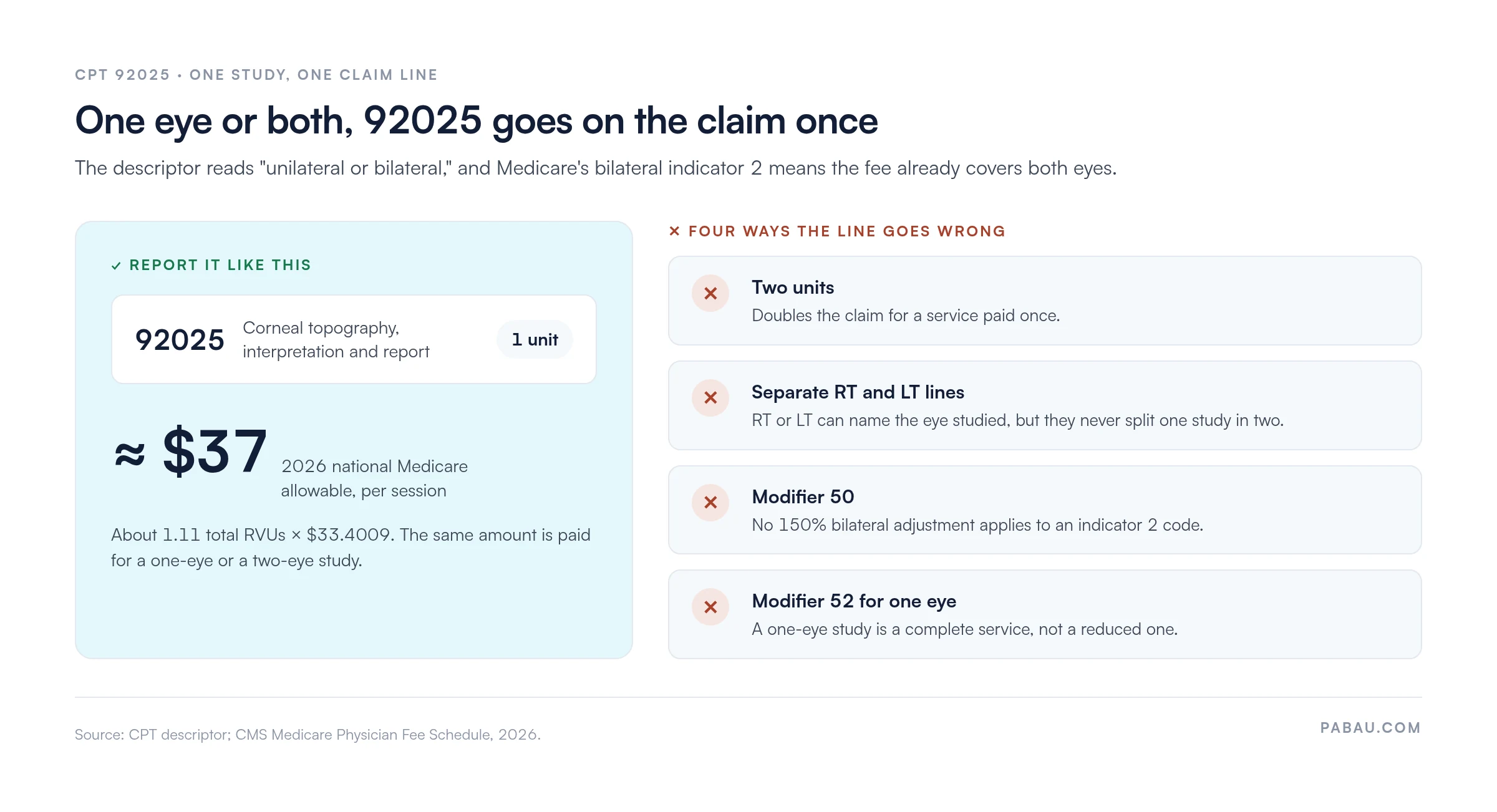
Two errors cause most problems. Billing two units, or two lines for the right and left eye, doubles the claim for a service paid once. Appending Modifier 50 has the same effect, and payers reject it on a code that is already bilateral.
The AAPC Ophthalmology Coding Alert confirms that codes described as “unilateral or bilateral” take no bilateral modifier. First Coast’s corneal topography billing article A57699 gives a Medicare contractor’s billing guidance for the same code.
A complete documentation package for CPT code 92025 includes more than the topography printout. A one-word note such as “abnormal” does not count as an interpretation. Check that every chart holds all five elements below before the claim goes out.
Practices that use clean claim submission workflows flag incomplete records before the claim leaves the practice, which cuts documentation-related denials.
Medicare Part B covers CPT code 92025 when medical necessity is established through an appropriate ICD-10-CM diagnosis code and a documented clinical indication. Coverage is subject to Local Coverage Determinations (LCDs) issued by each Medicare Administrative Contractor (MAC). First Coast’s LCD L33810 is one example, so check your own MAC’s corneal topography LCD before assuming coverage.
The Medicare Physician Fee Schedule (MPFS) sets the national allowable for 92025. Rates vary by locality and change every year, so the CMS Physician Fee Schedule lookup tool is the reliable source for a practice’s own allowable. For 2026, the total RVU for 92025 is about 1.11. At the 2026 conversion factor of $33.4009, that comes to roughly $37 nationally per session.
The amount is the same whether one eye or both are studied. When 92025 is one of several imaging tests on the same day, Medicare’s multiple procedure payment reduction trims the technical component of the lower-valued test.
Commercial payers typically contract at rates based on a percentage of Medicare. That percentage varies by plan and contract year, so check the individual contract rather than applying one multiplier to every plan. A clearinghouse with real-time eligibility checks shows plan-specific benefit details before the patient is seen.
Medicare never pays 92025 for pre-refractive surgery screening, because NCD 80.7 excludes refractive surgery and its tests. Collect the fee as a patient charge, and append modifier GY if the patient asks you to file. Commercial plans set their own rules, so check the policy before the visit.
Medicare typically does not require prior authorization for CPT code 92025. Post-payment audits are common, though, particularly for pre-refractive surgery workups or repeat studies within a short interval. Commercial and managed care plans are less uniform.
Running insurance eligibility verification at scheduling catches PA requirements before the patient arrives. That way, no study is performed and then denied for a missing authorization.
Several ophthalmology imaging codes sound alike, and picking the wrong one is an easy denial. CPT code 92025 maps the anterior corneal surface only. It does not capture the posterior segment, the lens, or the optic nerve, and the table below draws the key distinctions.
Yes, CPT code 92025 can be billed on the same day as a comprehensive eye exam (92004 or 92014) and a visual field study (92083). Each service needs its own medical indication, and the chart has to show it. The exam code covers the evaluation, while the topography code covers the imaging study.
Medicare’s NCCI edits don’t bundle 92025 into the eye exam codes, so that pairing needs no modifier. The bundles that do apply are narrower. CPT says not to report 92025 with keratoplasty codes 65710-65771, and Medicare bundles a technician visit (99211) into the test.
Modifier 59, or the more specific XE, XS, XP, or XU, belongs only on a code pair that an NCCI edit allows to be split. Check the current procedure-to-procedure table before adding one, and make sure the chart shows a distinct service. A commercial payer that bundles the pair under its own edits says so in its policy, and that policy decides whether a modifier is accepted.
The six denial reasons below cover the usual CPT code 92025 problems, and each one has a predictable fix. Practices with structured denial management workflows resolve them faster, because the right documentation is queued before the appeal deadline passes.
For CARC codes returned with denied claims, the medical billing denial codes guide maps common CARC and RARC reason codes to corrective action steps.
No universal AMA frequency limit applies to CPT code 92025. Individual payers apply their own edits through LCDs and coverage policies. Each repeat study needs a documented clinical reason in the chart, such as keratoconus progression or a new post-surgical finding. The MAC LCD for your region is the binding reference, and the Medicare Coverage Database lists each MAC’s policy.
Pabau, the practice management platform we build, keeps the 92025 workflow in one place, from booking the study to tracking the claim. Topography printouts and the physician’s signed interpretation can be kept in the patient’s file, next to the note for that visit. When a payer asks for records, they are in one place.
In the US, Pabau’s claims management connects to Claim.MD. Your team submits electronic CMS-1500 claims, runs real-time eligibility checks, and tracks each claim’s status. Electronic remittance advice (ERA) comes back into Pabau, so a 92025 denial shows up in the same dashboard.
A front-office team that knows the medical billing fundamentals catches unit and modifier errors before a 92025 claim goes out.

Submit 92025 claims through Claim.MD, check eligibility before the visit, and track every claim’s status from one dashboard.

CPT code 92025 pays once per session, so the unit decision is simpler than many billing guides suggest. Report one unit for one or both eyes, leave off Modifier 50, and make sure the physician’s interpretation is in the chart. Settle those at charge entry, and the remaining denial risk comes down to medical necessity, which the diagnosis code and chart note decide.
To see how Pabau handles claim submission, eligibility checks, and claim tracking for an eye care practice, book a demo with the team.

Need a framework for reducing claim rejections across all billing codes? Denial management in healthcare covers the operational steps for building a structured appeals and prevention workflow.
Submitting claims through a clearinghouse for the first time? How a medical claims clearinghouse works explains the role of clearinghouses in the US claims lifecycle, from 837 file submission to ERA receipt.
Want to understand what makes a claim clean before it leaves the practice? Superbill documentation guide outlines what each field on a superbill must contain to avoid front-end rejections.
Adding an optic nerve OCT to the same visit? CPT code 92133 explains how optic nerve imaging is billed and documented.
CPT code 92025 covers computerized corneal topography, unilateral or bilateral, with interpretation and report. This diagnostic imaging study maps the curvature and surface irregularities of the anterior cornea. The code requires both the instrument-generated topographic map and a documented physician interpretation to be present in the medical record.
CPT 92025 covers both, because its descriptor reads “unilateral or bilateral.” Report it once, as one unit, whether one eye or both are studied. Medicare pays the same amount either way, and Modifier 50 is not used.
Yes, Medicare Part B covers CPT code 92025 when an ICD-10-CM code establishes medical necessity. Keratoconus (H18.60-) and irregular astigmatism (H52.21-) are typical examples. Medicare does not cover corneal topography performed solely for contact lens fitting, which has its own contact lens codes.
CPT 92025 images the anterior corneal surface using videokeratography to map curvature and elevation. CPT 92134 is scanning computerized ophthalmic diagnostic imaging of the posterior segment, retina, captured by OCT. Optic nerve imaging is a separate code, 92133. They measure different anatomical structures and can be billed on the same day when each has a distinct medically necessary indication.
No modifier is needed to show a single-eye study, because 92025 already covers one or both eyes. Report one unit without Modifier 52, since a one-eye study is a complete service. Add RT or LT only if the payer requires laterality, so check its policy first.
Medicare typically does not require prior authorization for CPT 92025, but many commercial and managed care plans do. That is most common when the indication is pre-refractive screening rather than a diagnosed corneal condition. Verify authorization requirements at the time of scheduling by running an eligibility check against the patient’s specific plan.



