

CCSD code G5100: Bypass of duodenum billing guide
CCSD code G5100 bills a bypass that leaves the duodenum in place CCSD code G5100...

Last Updated: Oct 16, 2026
90713 is the CPT code for poliovirus vaccine, inactivated (IPV), for subcutaneous or intramuscular use. It reports the standalone IPV product (IPOL) only, not the injection.
Per the AMA's CPT code set, 90713 falls within 90476-90749, the vaccine and toxoid product codes. Administration is billed separately, with 90460 for patients 18 and under who receive counseling, or 90471 otherwise. Two common errors are leaving out the administration line and charging for VFC-supplied stock.
Let Pabau's smart automation suggest the right codes, reduce claim denials, and keep your practice compliant—effortlessly.
Automate repetitive tasks and focus on what matters most—your patients.
Reduce coding errors and ensure compliance with the latest regulations.
Clean claims, fewer denials, and faster reimbursements.
Powerful insights and reporting to help your practice thrive.
HIPAA compliant SOC 2 certified GDPR-compliant Trusted by 4,000+ clinics worldwide

CPT Code 90713 covers the IPV vaccine product only. The administration fee needs a separate code, 90460 or 90471.
The code covers IPV given by subcutaneous or intramuscular injection, so the note must record whichever route was used.
VFC-enrolled practices do not charge for VFC-supplied IPV. Follow the payer’s rule on reporting 90713 at $0 with modifier SL.
ICD-10-CM code Z23 (encounter for immunization) is the standard diagnosis code paired with 90713.
Pabau, our practice management platform, pre-fills claims from invoice data and submits them through Claim.MD. Your biller still checks the code pairings.
CPT Code 90713 reports the inactivated poliovirus vaccine (IPV) product, given by subcutaneous or intramuscular injection. It is a Category I vaccine product code maintained by the AMA, and it never includes the administration fee. The table below lists the attributes coders confirm before submitting a 90713 claim.
The AMA’s official descriptor for CPT Code 90713 is: Poliovirus vaccine, inactivated (IPV), for subcutaneous or intramuscular use. Each part of it shapes how the claim is built.
The code covers one dose of IPV. Multiple IPV doses on the same date are unusual. If it happens, each dose is billed as a separate line item with the same code.
The inactivated poliovirus vaccine CPT code applies to the vaccine product regardless of the patient’s age. The Advisory Committee on Immunization Practices (ACIP) schedule governs when the dose is medically appropriate. Most claims for 90713 arise from routine pediatric encounters following the ACIP-recommended four-dose series.
Check the current CDC immunization schedule before citing age ranges in documentation, because ACIP can update timing guidance each year. Catch-up doses for older children and adults who are unvaccinated or incompletely vaccinated also fall under 90713, provided the vaccine used is standalone IPV.
CPT Code 90713 covers only the vaccine product. Every claim must include a paired administration code on a separate line. The correct administration code depends on the patient’s age and whether vaccine information statement (VIS) counseling was provided and documented.
Here is a typical claim line layout for a 6-month-old receiving IPV and hepatitis B at the same visit.
All four lines share the same date of service. Before the claim is transmitted, the biller confirms that every vaccine product line has a matching administration line.
Where the dose came from changes how the product line is reported, as the diagram below shows. The administration line stays on the claim either way.
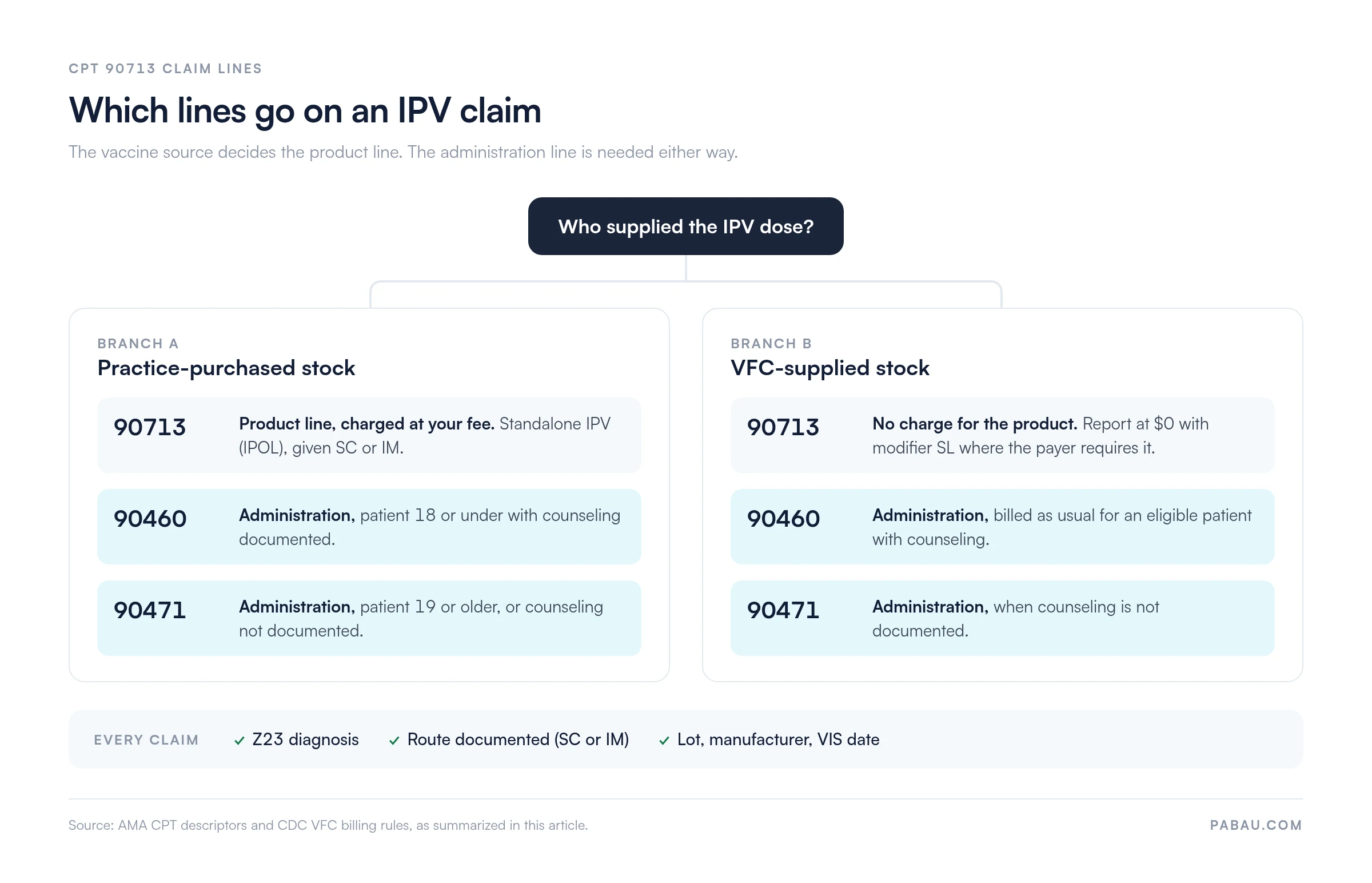
If a provider documents VIS counseling but the biller submits 90471 instead of 90460, the practice loses the higher administration reimbursement. Train clinical staff to always document counseling explicitly so the correct administration code can be applied.
The 907xx family contains dozens of codes that look similar in the chargemaster. The table below covers the codes most frequently confused with 90713 in pediatric and preventive care billing.
One costly mix-up is billing 90715 (Tdap) when the patient received IPV, or vice versa. Both codes produce a paid claim under many commercial plans, but they represent different vaccines and the error will surface on a payer audit. Always confirm the administered vaccine name against the charge before submitting.
A missing or incorrect diagnosis code is a common trigger for a 90713 denial. Most payers require at least one ICD-10-CM code that establishes the reason for the encounter before they will process the vaccine claim.
Z23 is almost always listed first when the visit’s sole purpose is immunization. Sometimes a well-child or wellness exam is the primary reason for the encounter, and the vaccine is given during that visit. In that case, list the well-visit code first (Z00.00 or Z00.129) and Z23 as an additional diagnosis. Confirm payer-specific sequencing requirements before submission, as some Medicaid managed care plans have their own rules.
Reimbursement for CPT Code 90713 varies significantly by payer type. Use insurance eligibility verification before every immunization encounter to confirm the patient’s active coverage and which vaccine benefit applies.
Medicare Part B generally does not cover routine childhood vaccines like IPV (90713). Part B vaccine coverage is limited primarily to influenza, pneumococcal, and hepatitis B vaccines under specific eligibility criteria. Practices billing Medicare for 90713 should verify current coverage rules in the CMS Physician Fee Schedule lookup tool. National average allowable rates are updated annually and vary by geographic locality. Billing 90713 to Medicare without confirming coverage is a common source of non-covered service denials.
VFC-enrolled practices receive IPV at no cost from the federal program. When VFC-supplied stock is used, the practice must not charge for the vaccine product. Charging for it is overbilling and creates compliance exposure under the VFC program’s fraud and abuse guidelines.
Practices that treat both VFC-eligible and commercially insured patients must keep their vaccine stock segregated and their billing logic separate. Commingling VFC stock and charging for VFC-supplied doses is one of the most frequently cited VFC audit findings.
Most 90713 denials are preventable. A solid denial management workflow catches these patterns before they become write-offs. The table below lists the most frequent denial triggers and their fixes.
See the full list of common denial codes in medical billing for CARC/RARC definitions and appeal language templates.
Submitting a clean claim for 90713 requires the clinical record to contain all the elements payers expect before processing the vaccine product code. Missing any one of these is sufficient grounds for denial on audit.
Building an accurate superbill at the point of care captures lot number, manufacturer, route, and VIS date. That saves re-keying the note into the claim. A clearinghouse then checks for missing required fields before the claim reaches the payer.
Yes. CPT Code 90713 can be billed on the same date of service as other vaccine product codes. Pediatric well-child visits routinely involve three to five vaccines administered on the same day, so the administration codes have to stack correctly.
No NCCI bundling edit stops 90713 from appearing on the same claim as HepB (90744), Hib (90647/90648), or DTaP (90700) product codes. Each is a distinct vaccine product and is billable independently. Confirm with the AAPC Codify CPT lookup that the specific vaccine product codes for any co-administered vaccines are current for the date of service.
The National Correct Coding Initiative (NCCI) maintains code-pair edits that CMS updates quarterly. Two pairings come up on 90713 claims.
NCCI edit tables are published by CMS and updated quarterly. Always verify current edit pairs via the CMS NCCI portal before applying modifiers to override a bundle. A modifier applied without checking the current NCCI table can result in an improper payment recovery audit. Practices can flag potential NCCI conflicts at the clearinghouse level. The 837 electronic claim file format includes fields for modifier codes; correct modifier placement in the 837P loop prevents the edit from triggering at adjudication.
Review your NCCI edit pairs at the start of each quarter, not only after a denial. CMS publishes updated tables 30 days before they take effect, giving practices time to update charge master rules before new edits go live.
Without an integrated system, a biller re-keys each vaccine invoice into a clearinghouse portal and checks payer status in a separate tab. Every hand-off is another chance to drop an administration line or mistype a lot number.
In Pabau’s claims management software, invoice details pre-fill the claim. Background checks confirm required fields are complete before you send it, and US claims go out through the Claim.MD integration.
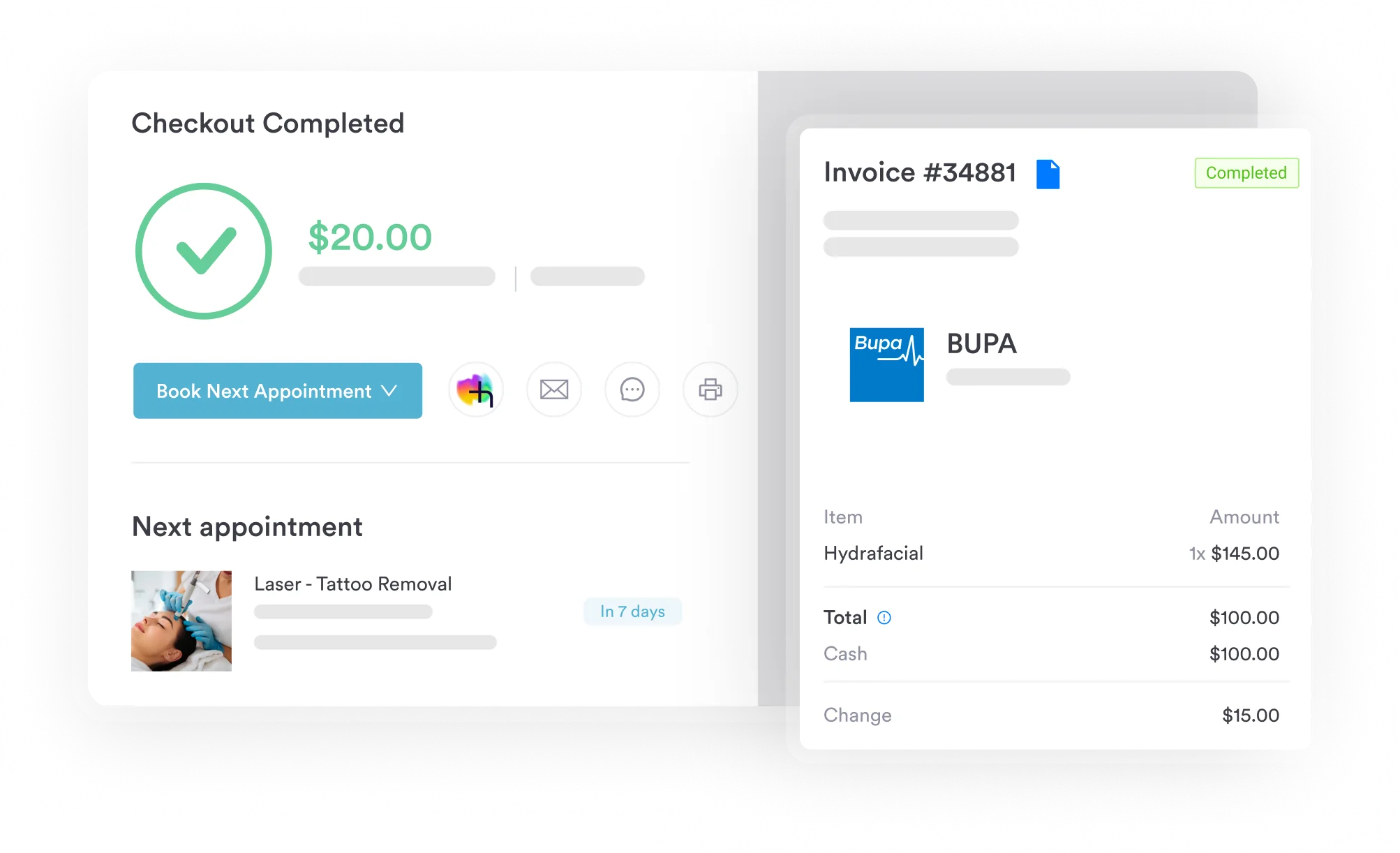
Eligibility checks, claim status and ERA posting sit on the same dashboard. Pabau doesn’t choose codes or apply VFC rules, so your biller still confirms each 90713 line and its administration code. Those checks happen on the same screen the claim is sent from.

Pabau pre-fills each claim from the invoice, checks required fields, and submits it through Claim.MD. Your team stops re-keying immunization claims.

Treat 90713 as a product line that never travels alone. Each IPV claim needs its administration line, a documented route, and a deliberate decision about who supplied the dose.
Settle the VFC question before the visit, not at the claim. Practices that segregate stock and know each payer’s $0 SL rule avoid the audit findings that follow charging for federally supplied vaccine.
The trade-off is more care in documentation and stock control up front, in exchange for fewer reworked claims later. Book a demo to see how Pabau keeps vaccine invoices, claims and remittances on one dashboard.

Need to understand how claims flow from your EHR to a payer? Medical claims clearinghouse guide explains how clearinghouses validate, translate, and route claims before payer adjudication.
Want to reduce your denial rate beyond vaccine codes? Revenue cycle management fundamentals covers the end-to-end billing workflow from eligibility to payment posting.
Looking for electronic remittance guidance? Electronic remittance advice (ERA) overview explains how 835 remittance files map denial codes back to your original claim lines.
Billing an IPV dose for an adult? CPT code 90471 covers the administration code used when 90460’s age or counseling criteria are not met.
CPT code 90713 covers the inactivated poliovirus vaccine (IPV) product itself, given by subcutaneous or intramuscular injection. It does not include the administration fee. Bill that separately with 90460 (for patients 18 and under with documented counseling) or 90471 (for adults or when counseling is not documented).
Bill 90713 and 90460 on separate lines of the same claim with the same date of service. Use 90460 when the patient is 18 or younger and VIS counseling is documented in the encounter note. For each additional vaccine administered on the same visit, add 90461 as an add-on code.
VFC-enrolled practices receive IPV at no charge and must not charge for VFC-supplied doses. The administration code (90460 or 90471) is billed as usual. Many Medicaid plans also require 90713 on the claim at $0 with modifier SL, so follow the payer’s rule. Charging for a VFC-supplied dose is overbilling and creates compliance exposure.
Required documentation includes the vaccine lot number, manufacturer, expiration date, route (subcutaneous or intramuscular) and injection site. Add the date of service, the VIS date (for 90460 eligibility), and the administering clinician’s signature. Missing any of these elements is sufficient grounds for a payer denial on audit.



