CCSD code E2940: Partial laryngectomy billing guide
CCSD code E2940: what the code covers CCSD code E2940 is the procedure code for ...

Last Updated: Oct 15, 2026
90700 is the CPT code for diphtheria, tetanus toxoids, and acellular pertussis vaccine (DTaP), when administered to individuals younger than 7 years, for intramuscular use.
It covers stand-alone DTaP products such as Daptacel and Infanrix, and it bills the vaccine product only. Report it with an administration code, 90471 or 90460, and link it to diagnosis code Z23.
Let Pabau's smart automation suggest the right codes, reduce claim denials, and keep your practice compliant—effortlessly.
Automate repetitive tasks and focus on what matters most—your patients.
Reduce coding errors and ensure compliance with the latest regulations.
Clean claims, fewer denials, and faster reimbursements.
Powerful insights and reporting to help your practice thrive.
HIPAA compliant SOC 2 certified GDPR-compliant Trusted by 4,000+ clinics worldwide

CPT Code 90700 covers the stand-alone DTaP vaccine for children under 7 years old, not adolescents or adults.
A separate administration code (90471 or 90460) is always billed alongside 90700. The vaccine and administration components are never bundled.
Vaccines for Children (VFC) stock is free and reserved for VFC-eligible children. For a VFC dose, only the administration fee is billable.
Pabau’s claims management software runs validation checks before each claim is sent and, through Claim.MD, checks patient eligibility in real time.
CPT Code 90700 bills the stand-alone DTaP vaccine given by intramuscular injection to children under 7, and it covers the vaccine product only. The official descriptor comes from the American Medical Association. It reads: Diphtheria, tetanus toxoids, and acellular pertussis vaccine (DTaP), when administered to individuals younger than 7 years, for intramuscular use.
Two brand-name products fall under this code: Daptacel (Sanofi Pasteur) and Infanrix (GSK). The code does not apply when a combination product is used. If you administer Pediarix (DTaP-HepB-IPV), the correct code is 90723, not 90700. Billing 90700 when a combination product was given is an unbundling compliance risk.
The DTaP CPT code, 90700, is for children under 7. CPT 90715 covers Tdap for patients 7 years and older, and Td without pertussis is 90714. A code that doesn’t match the patient’s age on the date of service gets the line denied for age eligibility.
Combination products carry their own codes, so check the product against the CDC CVX-to-CPT mapping before coding.
CPT Code 90700 covers the vaccine product only. A separate administration code is always required. The choice between 90471 and 90460 depends on whether a physician or qualified healthcare professional provided face-to-face counseling during the visit.
The counseling requirement for 90460 is strict. The service must be provided by a physician or other qualified healthcare professional, and most payer policies don’t let it be delegated to nursing staff. Document the counseling note, who provided it, and the topics covered. Without that documentation, 90460 will be downcoded to 90471 on audit.
Every 90700 claim needs a valid ICD-10-CM diagnosis code as a diagnosis pointer on the CMS-1500 (Box 21) or 837P transaction. Z23 is the primary code for preventive vaccine administration, as confirmed in the CDC/NCHS ICD-10-CM web tool.
When the vaccine is given at a well-child visit, both Z00.12x and Z23 may be reported. Z23 should be the diagnosis pointer linked to 90700 on the claim. A missing or mismatched diagnosis pointer gets the 90700 line denied. Before submitting, confirm that Box 24E points to the Z23 entry in Box 21.
Run a monthly audit on 90700 claims denied for diagnosis pointer errors. Filter your billing report by denial code CO-11 (diagnosis inconsistent with the procedure) or CO-16 (missing information). The fix is usually pointing Box 24E to Z23 and resubmitting, with no change to the clinical documentation.
Vaccine billing separates the product cost (90700) from the administration cost (90471 or 90460). Each is reimbursed independently. CMS publishes the Medicare Physician Fee Schedule rates for 90700 each year, and they change every January. Verify the 2026 rate against the CMS Physician Fee Schedule lookup tool at the time of billing.
Commercial reimbursement for the vaccine component is set by each payer contract. Confirm contracted rates separately, and don’t assume Medicare rates apply to commercial plans.
Some DTaP doses come from the Vaccines for Children (VFC) program. Providers who draw that federal stock cannot bill the 90700 vaccine component to Medicaid or any other payer. VFC vaccine is free, so only the administration fee (90471 or 90460) is billable. The stock is reserved for VFC-eligible children: Medicaid-enrolled, uninsured, underinsured, or American Indian or Alaska Native.
Stock source is the third of four checks that decide which lines a DTaP claim carries. The decision path below puts all four in the order a coder meets them.
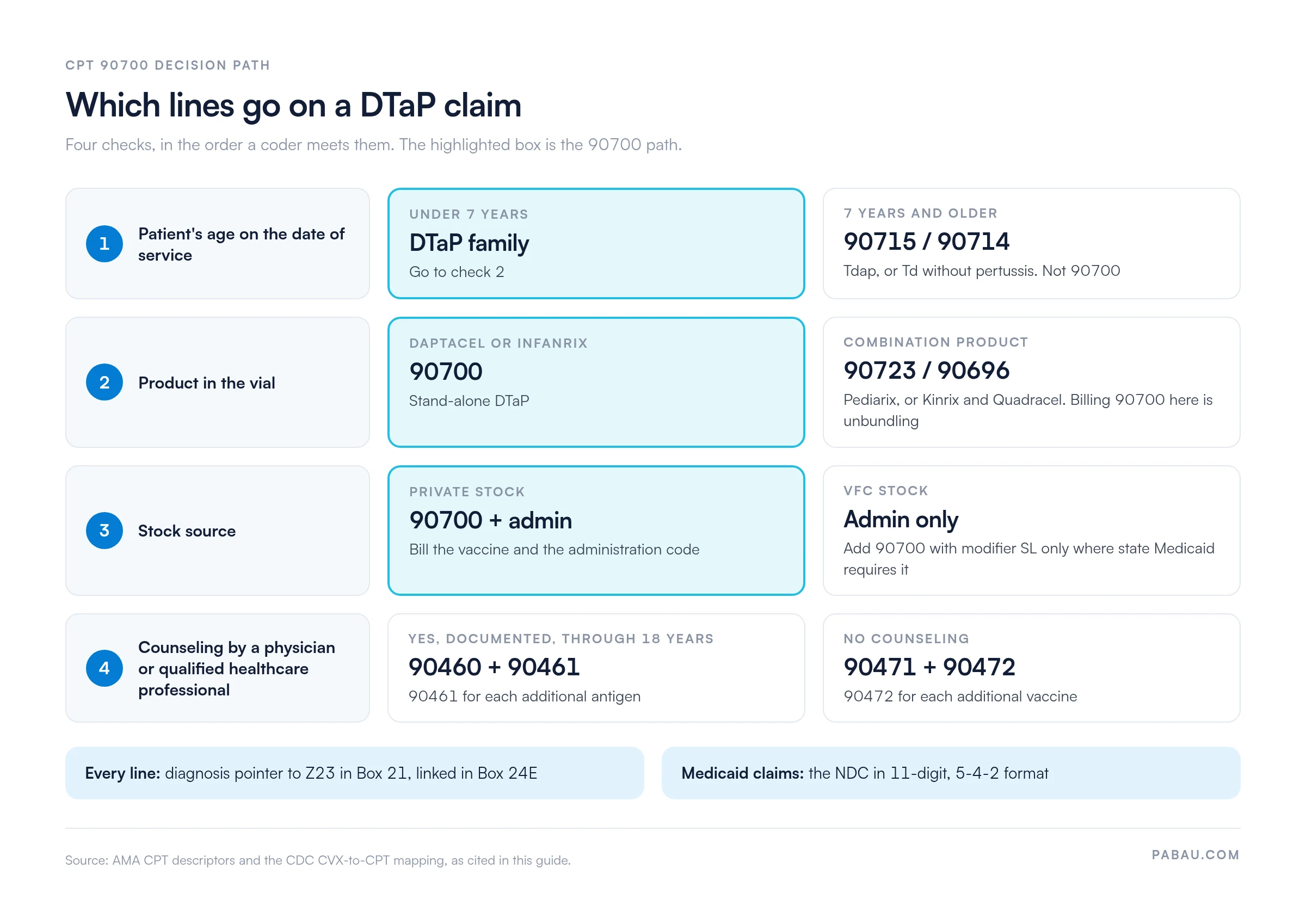
Modifier selection for 90700 depends on two questions. Where did the vaccine stock come from, and was a significant, separately identifiable evaluation and management (E/M) service provided the same day?
Payers treat modifier SL differently. Some carriers don’t recognize it, and others require it only on Medicaid claims. Check each payer’s modifier rules before submitting, because SL on a commercial claim that doesn’t accept it can trigger a rejection.
Adequate documentation protects the claim on audit and supports medical necessity. Every 90700 encounter should have these elements in the chart before the claim is submitted.
National Drug Code (NDC) reporting is mandatory on Medicaid vaccine claims and required by some commercial payers. The NDC must be in 11-digit format on the claim (5-4-2 format: labeler-product-package).
Each of the six denial reasons below is preventable, and each has a fix you can apply before the claim is sent.
Practices using integrated claims management software can set claim edits to flag missing NDCs and incorrect diagnosis pointers before the claim is transmitted. Without automated scrubbing, a manual review against the table above is the fallback. When a denial does come back, the adjustment reason code tells you which row applies, and medical billing denial codes explains each one.
Well-child visits routinely involve several vaccines in a single encounter. The childhood schedule from the Advisory Committee on Immunization Practices (ACIP) groups several antigens at the 2-, 4-, 6- and 15–18-month visits. At the 4–6 year visit, the fifth DTaP dose and the second MMR dose both fall due, and MMR bills as 90707. Each additional vaccine needs its own CPT code plus an add-on administration code (90472 or 90461).
When 90460 is used for the first vaccine, 90461 is appended for each additional antigen component. For three antigens on the counseling path, expect 90460 + 90461 + 90461. Confirm the antigen count against what the specific combination products contain before submitting add-on codes. Knowing how the 837 electronic claim file is structured helps you verify that all vaccine/administration pairs are transmitted correctly.
Build a per-visit vaccine code cheat sheet for your most common well-child visit types (2-month, 4-month, 12-month, etc.). List the exact CPT codes, administration add-ons, and diagnosis pointers for each. Update it each January when the ACIP schedule and fee schedule are refreshed. This prevents mis-selection under time pressure during busy immunization days.
On a busy immunization day, the checks in this guide usually happen by hand after the visit. A biller compares the code with the patient’s age, the NDC with the vial, and the pointer with Box 21.
Pabau’s claims management tools run validation checks in the background every time a claim is sent. They also track each claim from submission through payment or denial. The Claim.MD clearinghouse integration adds real-time eligibility checks before treatment, so a coverage problem surfaces while the family is still in the room.
Remittances come back into Pabau as electronic remittance advice, tied to the claims they settle. Your team sees which 90700 lines paid and which were denied, without reconciling a separate report.

Pabau runs validation checks on every claim before it is sent and checks eligibility in real time through Claim.MD. Remittances post back to the claims they settle. See how it works for your pediatric or primary care practice.

CPT Code 90700 looks simple on paper. The claim only goes through clean when four details agree: the patient’s age, the product in the vial, the stock source, and the administration path.
Capture those details at the point of care, not at the billing desk. The nurse holding the vial can read the NDC and lot number in seconds, while a coder rebuilding them a week later is guessing.
The trade-off is a few extra fields per dose in the chart, which takes less time than working a denied claim back through the payer. Book a demo to see how Pabau checks a full day of well-child vaccine claims before they go out.

Need to understand how clean claims are built before submission? Clean claim requirements in medical billing walks through the elements every claim must carry to clear payer edits on the first pass.
Billing the first vaccine without counseling? CPT code 90471 covers the administration code that pairs with 90700 when no physician counseling is documented.
Coding the well-child exam at the same visit? ICD-10 code Z00.129 explains the routine child health exam code that sits alongside Z23.
Want to understand how superbills connect to your vaccine claims? How superbills work in medical practices explains how superbill entries feed the CMS-1500 claim.
Managing denials across multiple vaccine codes? Denial codes in medical billing covers the CARC and RARC codes payers return when a claim is denied.
CPT Code 90700 is the billing code for the diphtheria, tetanus, and acellular pertussis (DTaP) vaccine given intramuscularly to patients under 7. It covers stand-alone DTaP products such as Daptacel and Infanrix. It must always be paired with a separate administration code (90471 or 90460) on the same claim.
CPT 90700 covers DTaP for children under 7. CPT 90715 covers Tdap (tetanus, diphtheria, acellular pertussis) for patients 7 years and older. Using 90715 for a child under 7, or 90700 for an adult, produces an age-eligibility denial.
Use 90471 when no face-to-face counseling is provided, or 90460 when a physician or qualified healthcare professional provides documented counseling during the visit. Add 90472 (or 90461 if using the counseling path) for each additional vaccine given in the same encounter.
Modifier SL marks state-supplied (VFC) vaccine on the 90700 line. State Medicaid policy decides whether that line is submitted and whether it carries a $0 charge. Modifier 25 applies to the E/M code (not 90700) when a significant, separately identifiable office visit occurs on the same day as the vaccine. Modifier JW applies to Medicare Part B drugs and generally not to vaccine product codes.
Yes. Bill 90700 paired with 90460 when a physician or other qualified healthcare professional provides face-to-face vaccine counseling during the visit. That counseling must be documented in the chart. If counseling is not provided or not documented, use 90471 instead of 90460.
The MMR (measles, mumps, rubella) vaccine is billed under CPT 90707. The first MMR dose is due at 12–15 months, and the fourth DTaP dose at 15–18 months, so the two often share the 15-month visit. They also share the 4–6 year visit. Each additional vaccine given in the same encounter adds an administration add-on code (90472 or 90461 depending on the administration path used).