HCPCS Code E0272: Foam rubber mattress billing guide
HCPCS Code E0272: official descriptor and code overview HCPCS Code E0272 is the ...

Last Updated: Nov 6, 2026
90636 is the CPT code for hepatitis A and hepatitis B vaccine (HepA-HepB), adult dosage, for intramuscular use. It reports the vaccine product for each dose, on the standard 3-dose schedule or the 4-dose accelerated schedule.
A common source of errors is the companion administration line. Coders pick the wrong administration code for the patient's age, or put the administration charge on the vaccine's line. The code sits in the CPT Vaccines, Toxoids range (90476-90759), maintained by the American Medical Association. Giving the injection is billed separately with its own administration code.
Let Pabau's smart automation suggest the right codes, reduce claim denials, and keep your practice compliant—effortlessly.
Automate repetitive tasks and focus on what matters most—your patients.
Reduce coding errors and ensure compliance with the latest regulations.
Clean claims, fewer denials, and faster reimbursements.
Powerful insights and reporting to help your practice thrive.
HIPAA compliant SOC 2 certified GDPR-compliant Trusted by 4,000+ clinics worldwide

CPT Code 90636 reports the adult combined hepatitis A and B vaccine product (Twinrix), not the act of giving the injection.
Each dose needs its own administration line. Most adults take 90471, while an 18-year-old counseled at the visit can take 90460 and 90461.
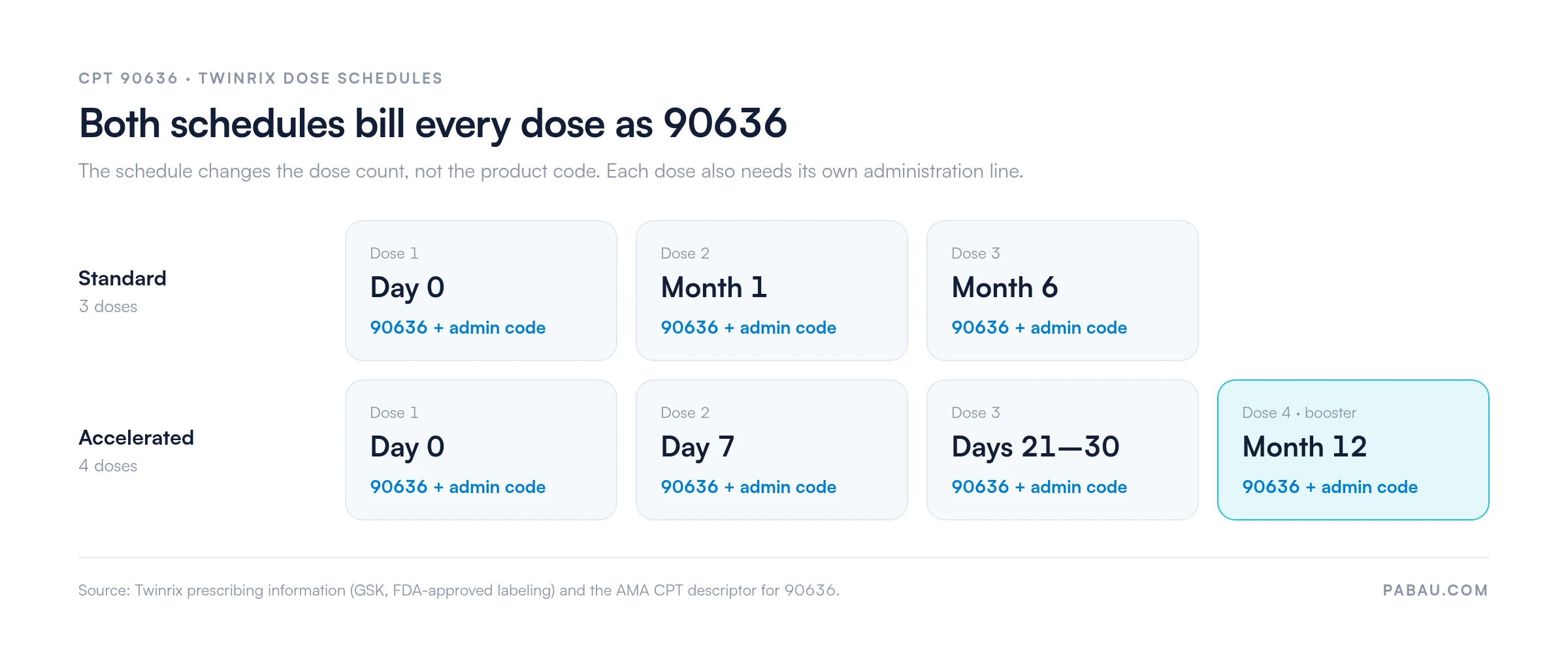
The standard 3-dose schedule and the 4-dose accelerated schedule both bill every dose as 90636.
Some payers require an NDC on the vaccine claim line, so check each payer’s policy before you submit.
Pabau, the practice management platform we build, tracks claim status through Claim.MD, runs eligibility checks, and flags denied claims for follow-up.
CPT Code 90636 is the American Medical Association’s code for the combined hepatitis A and hepatitis B vaccine in its adult dosage. It reports the vaccine product only, given by intramuscular injection. The code sits in the Vaccines, Toxoids subsection of the CPT Medicine section.
The code reports the product only, so the administration service goes on its own line. Pediatric and adolescent hepatitis vaccines and single-antigen HepA or HepB products have their own codes. Each dose in the series is billed under 90636 on the date it is given.
The schedule does not change the code. The FDA labeling for Twinrix allows a standard series at 0, 1 and 6 months. It also allows an accelerated series at Days 0, 7 and 21 to 30, with a booster at Month 12. All four accelerated doses are still billed as 90636, as the two schedules below show.
For an adult, 90471 is the usual administration code to pair with 90636. It goes on its own claim line, because 90636 covers the vaccine product only.
A claim with no administration line shows a product charge with no service charge, which often ends in a rejection or partial payment. The patient’s age and whether they were counseled decide which administration code applies.
Twinrix is licensed for adults 18 and older, so 90460 and 90461 apply only to an 18-year-old who is counseled at the visit. Every other patient takes 90471. Add 90472 for a second vaccine at the same visit, such as a flu shot. The 90636 line and its 90471 line must share the same date of service.
The clinical record has to support two things, the vaccine product given and the act of administration. Payers that audit vaccine claims look for both, and a missing element gives them grounds to recoup payment.
These are the documentation elements to capture for every Twinrix dose:
The superbill generated at checkout should capture the NDC alongside the CPT code. Many practice management systems tie the NDC to the vaccine inventory record, which removes manual transcription at claim time.
Audit your vaccine documentation template before the next dose round. Confirm it captures the NDC, lot number, and VIS date as structured fields. Some payers require an NDC on the claim line, so check each payer’s policy and build the field in before you need it.
Several CPT codes cover hepatitis vaccines, split by antigen, patient population and dose schedule. Coders reach for 90636 when only one antigen was given, or pick single-antigen codes when the combined product was used. The table lines them up so the right code follows from the documentation.
If the record shows only one antigen was given, 90636 is the wrong code. Confirm the vial NDC against the Twinrix NDC before you select the combined code. An adult who gets standalone HepA at one visit and HepB at a later one is billed with the two single-antigen codes, not 90636.
For a child or adolescent, HepA falls under 90633 on the 2-dose schedule or 90634 on the 3-dose schedule.
Medicare Part B covers the hepatitis B vaccine, with G0010 for its administration, for beneficiaries at intermediate or high risk. The combined 90636 product is generally a Part D vaccine instead. Its administration is not billed to Part B, so check the patient’s Part D plan before the visit.
Key reimbursement rules across payer types:
The six denial patterns below each come with a prevention step. Knowing which ones hit your practice is the first step in a denial management workflow.
A pre-submission claim check catches the first three issues when your billing software is set to look for NDC fields and duplicate lines.
Prior authorization for CPT 90636 is uncommon. Medicare Part B does not require it for the preventive vaccines it covers. When a commercial payer does ask for it, the usual settings are occupational health and travel medicine visits outside primary care.
When a PA is required, payers typically want the following before approving the vaccine series claim:
Running insurance eligibility verification at scheduling surfaces vaccine benefit exclusions and PA triggers before the first dose. That avoids giving a full series only to find the payer wanted authorization it rarely grants after the fact.
Check payer-specific vaccine PA policies quarterly. Plan years reset and PA thresholds change. A commercial plan that did not require authorization for hepatitis vaccine series last year may add the requirement in the current benefit year. Build this audit into your billing calendar.
The diagnosis code on a 90636 claim tells the payer why the vaccine was given. Z23 is the standard encounter code for most adult immunization visits. Exposure and travel visits may need a more specific code to support medical necessity. The CDC ICD-10-CM lookup tool confirms current descriptors for each scenario.
Z23 alone covers most routine adult immunizations. A documented hepatitis exposure supports adding Z20.5, which strengthens medical necessity and lowers recoupment risk. Z76.89 remains a catch-all fallback only when no specific code fits. Review diagnosis codes at charge entry, so an audit months later finds every claim supported.
Vaccine billing tends to break down between the exam room and the clearinghouse. The NDC sits on the vial, the dose number sits in the chart, and claim status lives on each payer’s portal.
Pabau, the practice management platform we build, keeps the dose record, the invoice and the claim on one patient file. Its claims management software tracks each 90636 claim as pending, paid or denied, and flags denied claims for follow-up.
Claims go out through the Claim.MD clearinghouse, which reaches thousands of US payers. Eligibility checks run before the appointment, and claim status and remittance flow back into Pabau.
Your team sees which Twinrix doses are paid without logging in to each portal. Coverage questions surface before the injection, not after the denial.

Pabau sends claims to thousands of US payers through Claim.MD and runs eligibility checks before the appointment. Claim status and remittance flow back, and denied claims are flagged for follow-up.

Code the product first, then the person. 90636 stays the same across both Twinrix schedules, while the administration code and the payer change with the patient’s age and coverage.
For a Medicare patient, the choice of vaccine also decides the payer. A single-antigen hepatitis B vaccine bills to Part B for at-risk patients, while Twinrix generally bills to the patient’s Part D plan. Check which benefit applies before you draw up the dose.
Book a demo to see how Pabau tracks each vaccine claim from eligibility check to remittance.

Need a clearinghouse that handles vaccine claims at scale? Medical claims clearinghouse guide explains how clearinghouses validate codes before payer submission.
Getting repeat denials with no clear pattern? Denial codes in medical billing maps the most common CARC codes and what each one requires to resolve.
Want to understand what ERA files show after adjudication? Electronic remittance advice explained breaks down the 835 transaction and how to read ERA data against your vaccine claims.
Want fewer vaccine claims stopped at the first payer edit? Clean claim standards explains what gets a claim through initial payer edits to adjudication.
Capturing the NDC and dose at checkout? What a superbill includes shows the fields a superbill carries so the claim goes out complete.
CPT Code 90636 reports the combined hepatitis A and hepatitis B vaccine in its adult dosage, given by intramuscular injection. It is billed for each dose, on the standard 3-dose schedule at 0, 1 and 6 months or the 4-dose accelerated schedule. The code covers the product only, so an administration code such as 90471 goes on a second claim line.
Twinrix (GlaxoSmithKline) is the brand-name combined hepatitis A and B vaccine billed under 90636. No other product currently maps to this code. Confirm the vial NDC matches the GlaxoSmithKline Twinrix Adult NDC before selecting the code.
Part B generally does not cover it. Part B pays for the hepatitis B vaccine, with G0010 for its administration, for intermediate- and high-risk beneficiaries. The combined 90636 product is generally a Part D vaccine, and Part B does not pay for its administration. Check the patient’s Part D plan for coverage and cost sharing.
CPT 90636 covers the combined adult hepatitis A and B vaccine (Twinrix). CPT 90746 covers the standalone adult hepatitis B vaccine on a 3-dose schedule. The difference is the antigen count, combined versus single. Billing 90746 when Twinrix was given is a coding error, and it becomes unbundling if the HepA component is billed separately.