HCPCS Code Q4185: Cellesta flowable amnion billing guide
HCPCS Code Q4185: definition and official descriptor HCPCS Code Q4185 is the Lev...

Last Updated: Nov 20, 2026
90739 is the CPT code for hepatitis B vaccine (HepB), CpG-adjuvanted, adult dosage, 2 dose or 4 dose schedule, for intramuscular use. Heplisav-B is the product it describes, usually given to adults as two intramuscular doses one month apart.
The code covers the vaccine product only. Bill the injection separately with 90471, or with HCPCS G0010 on a Medicare Part B claim.
Let Pabau's smart automation suggest the right codes, reduce claim denials, and keep your practice compliant—effortlessly.
Automate repetitive tasks and focus on what matters most—your patients.
Reduce coding errors and ensure compliance with the latest regulations.
Clean claims, fewer denials, and faster reimbursements.
Powerful insights and reporting to help your practice thrive.
HIPAA compliant SOC 2 certified GDPR-compliant Trusted by 4,000+ clinics worldwide

CPT 90739 reports Heplisav-B, the CpG-adjuvanted adult hepatitis B vaccine, usually given as two intramuscular doses one month apart.
The code covers the vaccine product only, so bill 90471 for the injection, or HCPCS G0010 on a Medicare Part B claim.
Since January 1, 2025, Medicare Part B covers the vaccine for beneficiaries who never completed a hepatitis B series or whose history is unknown.
Report the 11-digit NDC on every claim, because a missing NDC is a common reason vaccine claims come back unpaid.
A 3-dose adult product belongs under 90746, and dialysis or immunosuppressed dosing belongs under 90740 or 90747.
CPT code 90739 is the AMA code for the hepatitis B vaccine (HepB), CpG-adjuvanted, adult dosage, 2 dose or 4 dose schedule, for intramuscular use. CDC’s CPT-to-CVX code table lists that descriptor and maps the code to CVX 189, HepB-CpG. Heplisav-B (Dynavax Technologies) is the product it describes. FDA approved it in 2017 as the first 2-dose hepatitis B vaccine for adults.
Adult dosage and the dose schedule set 90739 apart from 90746, the 3-dose adult code. Heplisav-B is the product that fits the 90739 descriptor, so bill the code only when the vial you administered matches it. A 3-dose adult product such as ENGERIX-B or RECOMBIVAX HB goes under 90746 instead.
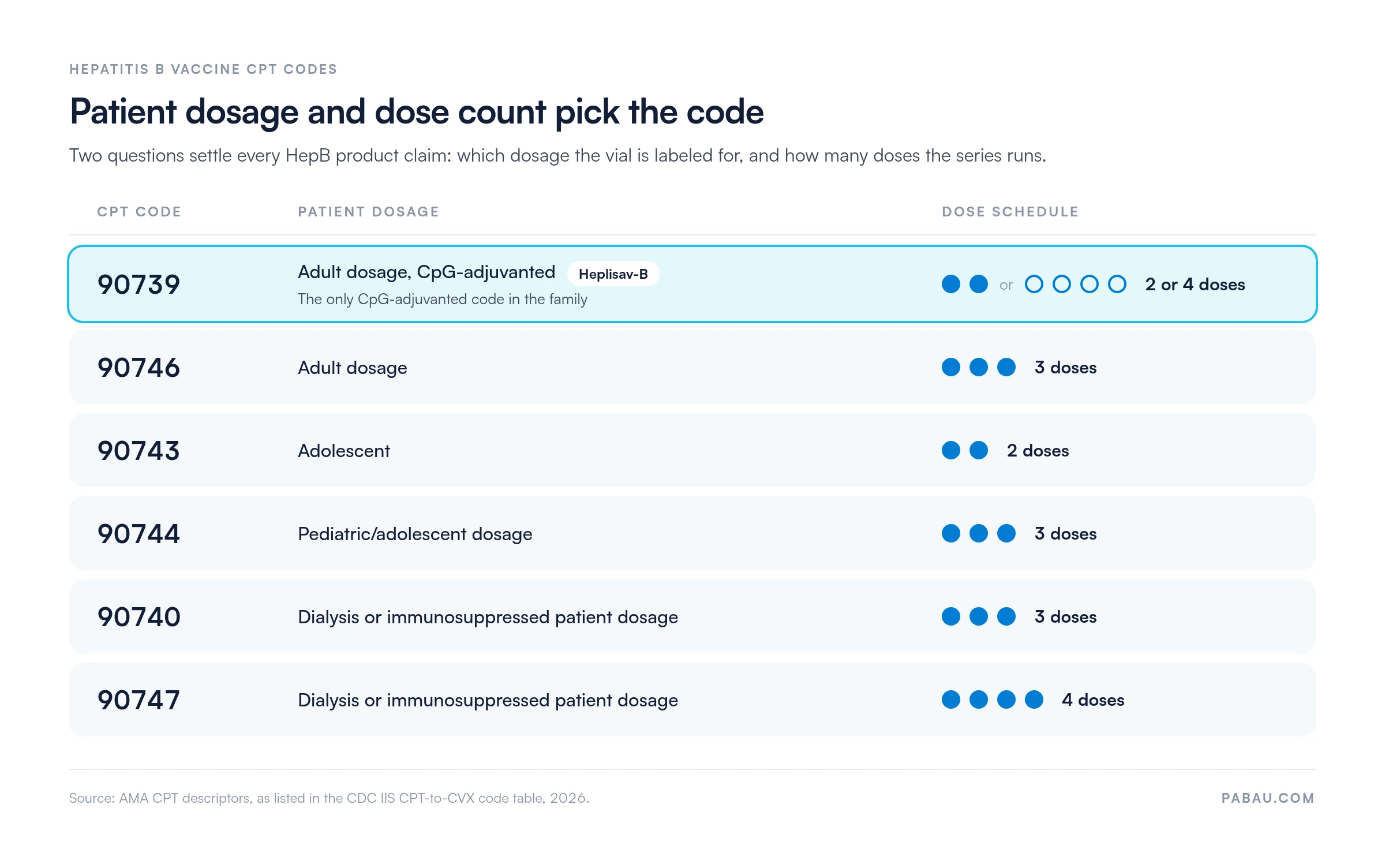
Patient dosage and the number of doses in the series drive hepatitis B code selection, and each code’s descriptor names both. The table below uses the official descriptors for every code in the family.
Decision rule: Ask two questions before you select the code. Which patient dosage is the vial labeled for, and how many doses does the series run? An adult receiving Heplisav-B on the 2-dose schedule is 90739. An adult receiving ENGERIX-B or RECOMBIVAX HB adult dosage on the 3-dose schedule is 90746.
A patient on dialysis or immunosuppression who receives the dialysis dosage is 90740 for a 3-dose series and 90747 for a 4-dose series. Children and adolescents on the 3-dose pediatric/adolescent dosage fall under 90744, and the adolescent 2-dose schedule is 90743. Set side by side, the six codes split on just those two attributes.
CPT 90739 covers only the vaccine product. Giving the injection is a separate service with its own code, billed on the same claim.
On a commercial claim, bill 90471 alongside 90739 when it is the only vaccine given. Medicare Part B uses HCPCS G0010 for hepatitis B vaccine administration instead of 90471. If the patient also receives another vaccine at the same visit, such as an influenza shot, add 90472 for the second product.
Some commercial payers bundle the administration fee into the vaccine product rate. Check your payer contract, or run an insurance eligibility verification before the encounter, to confirm how the plan pays.
Incomplete documentation is a frequent reason 90739 claims fail. Every element below belongs in the medical record and, where applicable, on the claim form before submission.
ACIP recommends universal HepB vaccination for adults aged 19-59 and for adults 60 and older with risk factors. Heplisav-B is FDA-approved for ages 18 and older, given at 0 and 1 month. Document the dose number at every encounter to avoid dose-sequence denials on the second claim.
A missing or mismatched ICD-10 code is another common cause of 90739 denials. The diagnosis code must reflect the clinical reason the patient is receiving the vaccine at this encounter.
Z23 is the correct first-listed diagnosis for most routine 90739 encounters. On a Medicare claim, add a secondary code when a qualifying condition such as diabetes or end-stage renal disease is the basis for coverage. Since 2025, an unvaccinated beneficiary qualifies on vaccination history alone, so record that history in the note.
Medicare Part B covers CPT 90739 for beneficiaries at high or intermediate hepatitis B risk. Since January 1, 2025, that includes anyone who has not completed a hepatitis B vaccine series or whose vaccination history is unknown.
The rule sits in the Medicare Benefit Policy Manual, chapter 15, section 50.4.4.2, and billing instructions are in the Claims Processing Manual, chapter 18. CMS transmittal 13248 made the 2025 change and dropped the physician’s order requirement. The beneficiary pays no cost sharing for the vaccine or its administration.
The manual lists these high-risk groups:
The intermediate-risk groups are:
A beneficiary with laboratory evidence of hepatitis B antibodies does not count as high or intermediate risk. A claim for that patient, or for one whose record shows a completed series, draws a medical necessity denial such as CO-50. Check CMS.gov for the current list before you rely on it.
Medicaid billing rules for 90739 vary by state. Some states cover adult HepB vaccination broadly, and others set narrower criteria. Check the state’s Medicaid provider manual for the vaccine and administration codes it accepts before you submit.
Reimbursement for CPT 90739 flows through two separate payments, one for the vaccine product and one for administration. Each needs its own claim line.
Vaccine product payment: Medicare does not pay the vaccine product from the Medicare Physician Fee Schedule (MPFS). CMS sets hepatitis B vaccine payment at 95% of the average wholesale price, updated quarterly. Look up the current payment limit for 90739 in the Medicare Part B drug payment limit files (the ASP pricing files).
Administration payment: On Medicare, the administration is paid under G0010. Commercial payers pay 90471 at their contracted rate. Use the CMS Physician Fee Schedule lookup tool to check the current Medicare rate for your locality.
Commercial payer rates: Commercial insurers reimburse 90739 at contract rates negotiated separately from Medicare, and rates vary by payer and market. Some contracts pay vaccine products at average wholesale price minus a discount, while others use a flat fee schedule. Compare each remittance against your contracted rate.
Verify 90739 reimbursement rates quarterly, not annually. CMS updates vaccine payment limits every quarter, and commercial contract amendments can shift vaccine product rates mid-year. Flag any 90739 remittances that pay below your contracted rate for immediate follow-up.
The patterns below show up repeatedly on 90739 claims. Each one has a fix you can apply before the claim goes out.
For what each CARC requires on appeal, see the reference on medical billing denial codes. Most of the rows above are cheaper to prevent than to appeal, because the fix is one field on the claim.
Most commercial payers do not require prior authorization for routine adult HepB immunization billed under 90739. High-risk and occupational health encounters carry different rules.
Several 90739 billing situations fall outside the routine immunization encounter. Each has documentation and coding requirements that differ from the baseline workflow.
Revaccination after confirmed non-response: ACIP does not recommend a booster after a completed series. When anti-HBs stays below 10 mIU/mL, CDC guidance calls for a second complete series, or one extra dose followed by retesting 1-2 months later. A second Heplisav-B series runs two doses, and each dose is billed under 90739.
The titer result must be in the medical record before you bill the repeat doses. The titer test itself is billed separately, typically under 86706. Billing a repeat series without documented non-response is a compliance risk under payer medical necessity rules.
Catch-up dosing mid-series: A patient who received dose 1 at another practice and returns for dose 2 is billed the same way. Use 90739 for the product, plus 90471 for administration, or G0010 on Medicare. Confirm from the record that dose 1 was Heplisav-B, and report the NDC of the product actually given.
Concurrent vaccination with other products: When 90739 is given alongside another vaccine, such as Tdap or influenza, bill each product on its own claim line. The first administration is 90471 and each subsequent one is 90472. Some commercial payers cap reimbursement at two administration codes per encounter, so check your contracts.
Refugee and international patient vaccination: Refugees arriving in the US may need catch-up HepB vaccination when records from the country of origin are unavailable. Document the absence of prior vaccination records and bill 90739 with Z23 as the first-listed diagnosis. Some state refugee health programs have their own billing pathways, so verify with the program coordinator.
Pair every repeat-series claim with its 86706 titer result in the record. A repeat 90739 claim without a documented anti-HBs result below 10 mIU/mL invites a medical necessity denial, so audit those pairs quarterly.
Vaccine claims fail on details captured at the chair: the NDC on the vial, the lot number, and whether dose 2 ever gets booked. When those live in a paper log and a separate billing tool, the coder retypes each one.
Pabau, our practice management and billing platform, keeps those details on the patient record. Stock carries a batch number and expiry date, and the lot is recorded against the patient and the appointment. Recall Workflows then message the patient when dose 2 falls due, and skip anyone already booked.
For US claims, Pabau’s claims management software submits CMS-1500 and 837P claims through Claim.MD. It runs eligibility checks before the visit and returns ERA remittances afterward. Your coder still chooses 90739, the administration code, and the diagnosis, and the claim carries exactly what they entered.

Pabau records the vaccine lot against the patient, sends dose 2 recall reminders through Workflows, and submits claims through Claim.MD. Eligibility checks and ERA remittances run through the same connection.

CPT 90739 is narrow by design. It fits one product, Heplisav-B, so the vial in your hand settles the code before any payer rule does.
The bigger change sits on the Medicare side. Since 2025, an unvaccinated beneficiary qualifies for Part B coverage, so writing off routine adult doses now leaves money on the table. Bill G0010 with the product, report the NDC, and book dose 2 for one month out.
Book a demo to see how Pabau keeps vaccine lots, dose 2 recalls, and Claim.MD submissions on one patient record.

Billing the pediatric series instead? CPT code 90744 covers the 3-dose pediatric/adolescent hepatitis B vaccine and how it differs from the adult codes.
Billing the Medicare administration? HCPCS code G0010 explains the hepatitis B administration code Medicare Part B expects in place of 90471.
Need the diagnosis that pairs with the vaccine? ICD-10 code Z23 walks through the encounter-for-immunization code used on most 90739 claims.
Submitting vaccine claims electronically? Claim.MD clearinghouse guide explains how Pabau submits claims through Claim.MD and returns ERA remittances.
Fighting repeat vaccine denials? Denial management in healthcare sets out a workflow for tracking, appealing, and preventing denied claims.
CPT code 90739 covers the hepatitis B vaccine described as CpG-adjuvanted, adult dosage, 2 dose or 4 dose schedule, for intramuscular use. Heplisav-B is the product that fits it. ACIP recommends universal HepB vaccination for adults aged 19-59 and for adults 60 and older with risk factors. Heplisav-B is FDA-approved for ages 18 and older. Administration is billed separately with 90471, or with G0010 on Medicare.
CPT 90739 is the CpG-adjuvanted adult dosage on a 2 or 4 dose schedule. CPT 90740 is the dialysis or immunosuppressed patient dosage on a 3 dose schedule, and 90747 is the same dosage on a 4 dose schedule. The dosage the vial is labeled for and the length of the series decide which code applies.
Yes, for beneficiaries at high or intermediate risk of hepatitis B, under the Medicare Benefit Policy Manual, chapter 15, section 50.4.4.2. Since January 1, 2025, that includes anyone who has not completed a hepatitis B series or whose history is unknown. High-risk groups include ESRD patients and people with diabetes. Bill the administration with G0010, and the beneficiary pays no cost sharing.
Yes, but not as a booster, because ACIP does not recommend boosters after a completed series. When anti-HBs stays below 10 mIU/mL, CDC guidance calls for a second complete series, or one extra dose followed by retesting. Bill each Heplisav-B dose in that series under 90739, and bill the titer test separately, typically under 86706.