HCPCS code J3471: Hyaluronidase ovine injection billing guide
HCPCS code J3471: Descriptor, code type, and quick-reference data HCPCS code J34...

Last Updated: Oct 14, 2026
90633 is the CPT code for hepatitis A vaccine, pediatric/adolescent dosage-2 dose schedule, for intramuscular use.
Three mistakes cause most 90633 denials. The first is billing the product code with no paired administration code. The second is picking the adult code 90632 for a pediatric patient. The third is leaving Z23 off the claim as the first-listed diagnosis. Catching these at charge capture beats reworking denials later.
Let Pabau's smart automation suggest the right codes, reduce claim denials, and keep your practice compliant—effortlessly.
Automate repetitive tasks and focus on what matters most—your patients.
Reduce coding errors and ensure compliance with the latest regulations.
Clean claims, fewer denials, and faster reimbursements.
Powerful insights and reporting to help your practice thrive.
HIPAA compliant SOC 2 certified GDPR-compliant Trusted by 4,000+ clinics worldwide

90633 covers the pediatric and adolescent hepatitis A vaccine, supplied as 720 EL.U/0.5 mL or 25 U/0.5 mL.
90632 is the adult single-dose formulation, so the product administered decides the code, not the patient’s age alone.
Every 90633 claim line needs a paired administration code, either 90471 or 90460, on the same date of service.
When VFC supplies the vaccine, bill only the administration code and append modifier SL where the payer asks for it.
Medicare Part B does not cover hepatitis A vaccination preventively, so preventive doses go to the patient’s Part D plan.
CPT code 90633 is the vaccine product code for hepatitis A, pediatric/adolescent dosage, for intramuscular use.
The code sits in the Vaccines and Toxoids section of the CPT codebook (range 90476-90759), maintained by the American Medical Association.
Two FDA-approved vaccine products map to this code: HAVRIX 720 EL.U/0.5 mL (GSK) and VAQTA 25 U/0.5 mL (Merck). Both are two-dose series formulations dosed at 0 and 6-18 months.
90632 covers the adult hepatitis A vaccine, a single dose of 1440 EL.U/1.0 mL. 90633 covers the pediatric and adolescent formulation, a 2-dose series of 720 EL.U/0.5 mL. Picking the wrong one is the most common audit trigger on hepatitis A vaccine claims.
Select the code from the vaccine product administered, not from the patient’s age alone. An 18-year-old who receives the pediatric formulation still maps to 90633.
CPT code 90633 is a product-only code and cannot be submitted on its own. Every 90633 claim line requires a paired administration code on the same date of service.
Use 90460 and 90461 only when documented counseling is provided and the patient is 18 or younger. For adult high-risk administration such as travelers, where 90633 is used off-label, 90471 is the standard pairing. Payers reject 90460 for patients over 18.
On the claim, sequence 90633 before the administration code. Some payers require them on separate claim lines, while others accept them on the same line. Check payer-specific billing manuals before submitting electronically through a clearinghouse.
Three questions asked at the point of care settle every line on the claim. The chart below takes them in the order a nurse meets them.
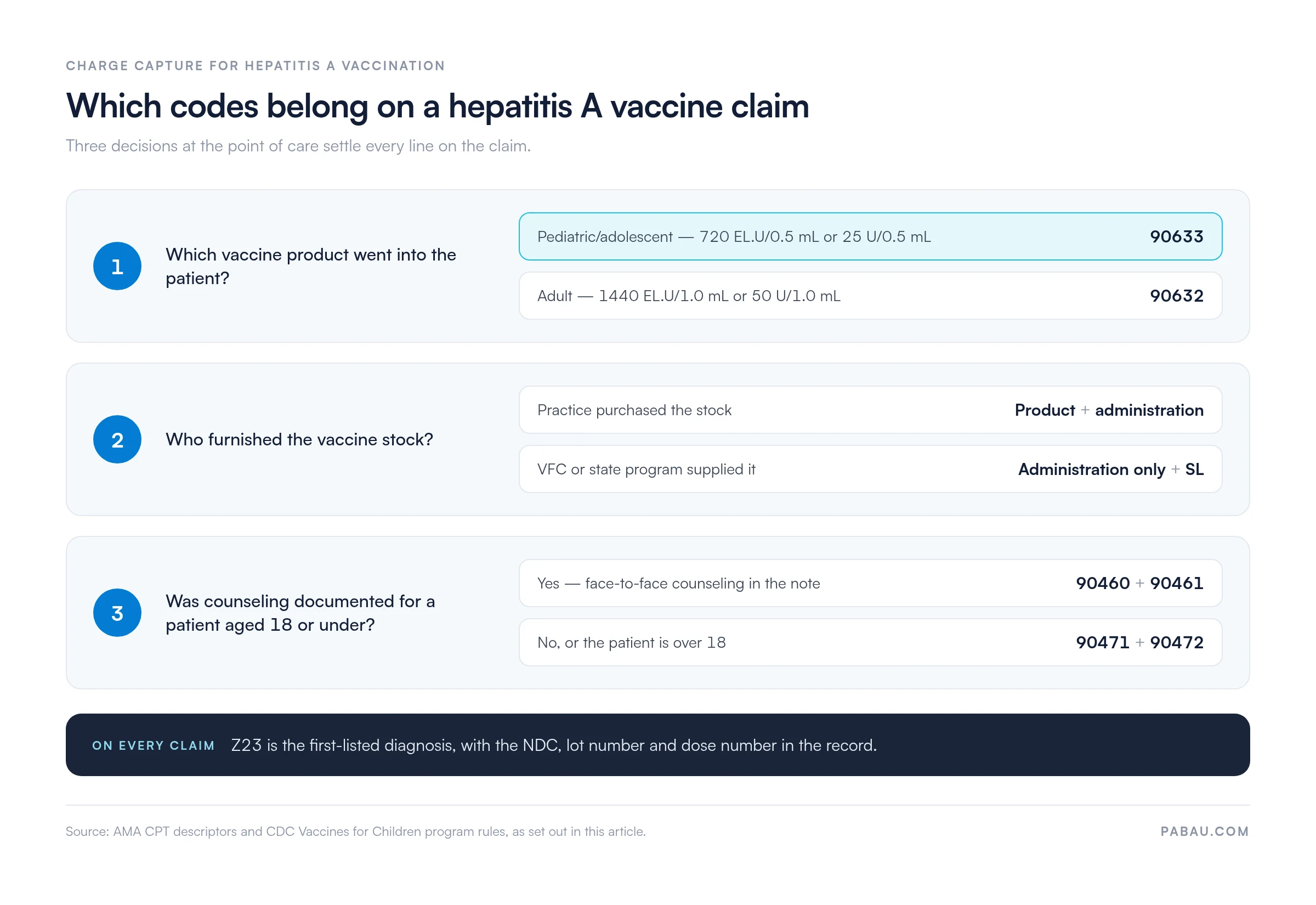
Z23 (encounter for immunization) is the primary ICD-10-CM diagnosis code for hepatitis A vaccine administration. It must appear on every 90633 claim as the first-listed diagnosis.
Some commercial payers and state Medicaid programs accept additional risk codes as secondary diagnoses alongside Z23, such as international travel or food-handler status. Check the payer’s own diagnosis requirements first, and confirm the wording against the current ICD-10-CM code reference.
Most 90633 claims submit without a modifier. Three modifiers apply in specific circumstances, and omitting them when they are required causes preventable denials.
Modifier 25 goes on the E/M code, not on 90633 or 90471. Attaching it to the vaccine product code causes a technical edit denial at most payers. Document the separate medical reason for the visit in the chart before appending modifier 25.
Medicare Part B does not cover hepatitis A vaccination as a preventive service. That high-risk carve-out belongs to the hepatitis B vaccine instead. Part B pays for a hepatitis A dose only when it treats an injury or a documented exposure to the virus. Preventive and risk-based doses sit under the Part D drug benefit.
Practices with a high volume of pediatric immunizations should verify VFC enrollment status annually. Billing 90633 to Medicaid for a VFC-eligible patient, when the vaccine was government-furnished, is an audit risk. Confirm your payer mix before you set default billing rules for this code.
Td vaccination follows the same split. Medicare Part B covers CPT code 90714 when the dose is medically necessary, such as wound prophylaxis. The routine ten-year booster is generally not a Part B preventive benefit.
CMS publishes a Medicare physician fee schedule allowable for 90633 each year. The product code carries a modest allowable on its own, and the administration code is billed separately with an allowable of its own.
Preventive hepatitis A doses fall under the Part D drug benefit. That makes the Part B allowable a reference point rather than the rate most 90633 claims are paid at. Private payer rates typically exceed Medicare allowables for vaccine product codes.
VFC pricing is set separately by the CDC and does not reflect payer reimbursement. Under VFC, the practice bills only for administration. Rates change every January 1, so pull current figures from the CMS Physician Fee Schedule Look-Up Tool before quoting allowables to clinical staff.
A complete medical record and clean claim for 90633 requires specific data elements. Missing any of the following is the fastest path to a downcode or an audit request.
Those fields are also what the broader clean claim requirements come down to. Digital forms that capture lot, NDC and dose-series data at the moment of administration keep the record out of a second system. Copying a paper immunization record onto a claim by hand is where NDC errors start.
Six denial patterns account for most 90633 rejections. Each has a corrective action that prevents recurrence, rather than simply fixing the individual claim.
Sorting a quarter’s 90633 rejections by payer, provider and charge-capture step usually points at one broken step rather than scattered coder error. Review them quarterly and fix the step, not the individual claims.
CPT 90633 is a VFC-eligible vaccine code under the CDC’s Vaccines for Children program. When a VFC-supplied vaccine is administered, one billing rule overrides the rest: bill only the administration code, never the product code.
Practices that treat 90633 as a catch-all vaccine charge are the ones this rule catches. If your practice is VFC-enrolled, your billing system should separate purchased stock from VFC stock at the charge-capture step. Software built for billing teams tracks the stock source, so the wrong product code never reaches the payer.
Most 90633 denials are made at the charge-capture screen, not in the billing office. A nurse records the dose in the immunization log, and someone rebuilds the charge from that log hours later. By then the NDC, the lot number and the stock source have to be remembered rather than read.
Practice management software like Pabau links the vaccine product to its required administration code. A 90633 charge cannot be saved without 90471 or 90460 beside it. The immunization record carries the NDC, lot number and dose number onto the claim, and VFC stock is flagged at the moment it is selected.
Claims then go out through our Claim.MD clearinghouse integration, with eligibility checked first. Coverage problems surface before the visit rather than six weeks later in a denial. Billing staff work exceptions instead of rebuilding charges from the chart.

Pabau captures CPT codes, administration codes, and NDC numbers at the point of care, then submits clean claims through our Claim.MD clearinghouse integration. Fewer denials, less rework.

The preventable 90633 denials share one cause: a charge-capture workflow that does not enforce the product-administration pairing or separate VFC stock from purchased vaccine. Fix that step and most of the rework disappears before it starts.
The Medicare rule is worth committing to memory on its own, because it costs practices whole claims. Part B is not the destination for a preventive hepatitis A dose, and no amount of supporting diagnosis coding will make it one.
Pabau’s claims management tools link CPT product codes to their required administration codes. They capture the NDC and lot number at administration, then submit through Claim.MD with real-time eligibility checks. Book a demo to see how vaccine billing runs when the claim is built at the point of care.

List Item #1
List Item #2
CPT code 90633 covers the hepatitis A vaccine in its pediatric and adolescent formulation. That means the 2-dose series products, HAVRIX 720 EL.U/0.5 mL or VAQTA 25 U/0.5 mL, given intramuscularly. It is a product code only and must always be paired with an administration code on the same claim.
90632 is the adult single-dose hepatitis A vaccine (1440 EL.U/1.0 mL); 90633 is the pediatric/adolescent 2-dose series formulation (720 EL.U/0.5 mL). Select the code based on which vaccine product was administered, not solely on patient age.
HAVRIX 720 EL.U/0.5 mL (manufactured by GSK) and VAQTA 25 U/0.5 mL (manufactured by Merck) are the two FDA-approved products that map to 90633. Both are pediatric/adolescent formulations for the 2-dose series.
Use 90471 for the first vaccine administered without counseling, or 90460 when face-to-face counseling is documented for patients 18 and under. If additional vaccines are given the same day, add 90472 (or 90461 when 90460 applies) for each additional vaccine component.
No, not as a preventive service. Medicare Part B does not cover preventive hepatitis A vaccination, and the high-risk carve-out coders often remember applies to hepatitis B instead. Part B pays only when the vaccine treats an injury or a documented exposure. Preventive doses fall under the Part D drug benefit, so bill the patient’s Part D plan.
Yes, 90633 applies to both doses of the pediatric 2-dose series, including the second dose administered 6-18 months after the first. Document the dose number in the medical record to avoid duplicate-billing edits on the claim.