HCPCS Code Q4185: Cellesta flowable amnion billing guide
HCPCS Code Q4185: definition and official descriptor HCPCS Code Q4185 is the Lev...

Last Updated: Nov 20, 2026
90697 is the CPT code for the DTaP-IPV-Hib-HepB combination vaccine for intramuscular use, sold in the US as Vaxelis. One dose protects against diphtheria, tetanus, pertussis, polio, Haemophilus influenzae type b and hepatitis B.
The code covers the vaccine product only. The injection is billed separately, with 90471, or with 90460 when a physician or other qualified professional counsels. Don't confuse it with 90698, which leaves out the hepatitis B component.
Let Pabau's smart automation suggest the right codes, reduce claim denials, and keep your practice compliant—effortlessly.
Automate repetitive tasks and focus on what matters most—your patients.
Reduce coding errors and ensure compliance with the latest regulations.
Clean claims, fewer denials, and faster reimbursements.
Powerful insights and reporting to help your practice thrive.
HIPAA compliant SOC 2 certified GDPR-compliant Trusted by 4,000+ clinics worldwide

CPT code 90697 reports the Vaxelis product, one shot that covers diphtheria, tetanus, pertussis, polio, Hib and hepatitis B.
The code covers the vaccine only, so every claim also needs an administration code such as 90471 or 90460.
With counseling, one Vaxelis dose takes 90460 once plus five units of 90461, one per additional component.
A VFC-supplied dose bills the product at $0.00, and the practice is paid for the administration alone.
A clean claim carries the NDC in Loop 2410 (LIN03), with the lot, expiration date, site, route and VIS date in the chart.
CPT code 90697 is the product code for Vaxelis, the hexavalent DTaP-IPV-Hib-HepB vaccine given as one intramuscular injection. The CDC’s CPT-to-CVX code table maps 90697 to this exact combination. Infants get it at 2, 4 and 6 months, and the code covers the vaccine itself, never the injection.
The American Medical Association owns the CPT code set, and its descriptor for 90697 reads as follows.
Diphtheria, tetanus toxoids, acellular pertussis vaccine, inactivated poliovirus vaccine, Haemophilus influenzae type b PRP-OMP conjugate vaccine, and hepatitis B vaccine (DTaP-IPV-Hib-HepB), for intramuscular use.
Each antigen targets a different disease. Payers and auditors compare this list against the chart, so it helps to know it cold.
The vaccine goes in the muscle only. Chart the intramuscular route and the site, because both show up in audits and in the claim data.
Think of every Vaxelis claim as at least two lines. 90697 carries the vaccine, and a separate administration code carries the injection.
Included: the Vaxelis formulation, identified by its NDC, for one intramuscular dose with all six components.
Billed separately:
Vaxelis is approved from 6 weeks through 4 years of age. A claim for an older child will usually hit a payer age edit.
Three nearby combination codes look alike on a fee ticket. Count the antigens on the vial, then pick the code.
The 90697 versus 90698 mix-up is the one auditors catch most easily. If your practice stocks Vaxelis and bills 90698, the note lists hepatitis B and the code doesn’t. A post-payment review flags that mismatch straight away.
The administration code turns on one question. Did a physician or other qualified health care professional counsel the patient or family about this vaccine?
Without counseling, report 90471 for the first vaccine and 90472 for each additional one. With counseling, 90460 covers the first component of each vaccine, and the add-on 90461 covers each component after that.
Vaxelis has six components, so a counseled dose takes one unit of 90460 and five units of 90461. That holds even when it’s the only vaccine given that day. The counseling codes apply to patients 18 and under, which every Vaxelis patient is.
With counseling, bill 90460 for each vaccine’s first component and 90461 for each additional component. Without counseling, bill 90471 for the first vaccine and 90472 for each additional one.
The three claim shapes below show how the lines change for one dose. The product line stays the same, while counseling and VFC supply change the rest.
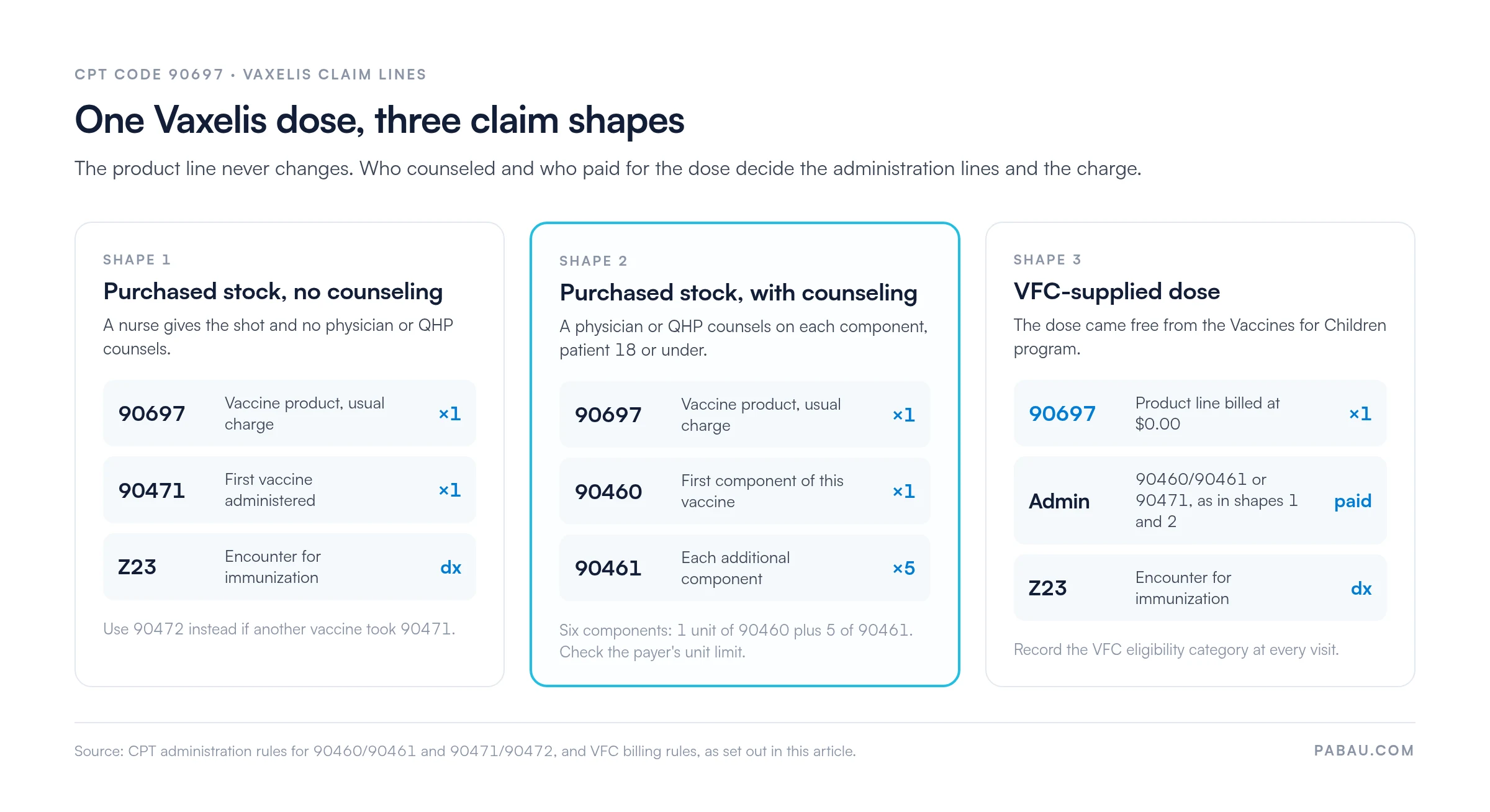
Check the payer’s Medically Unlikely Edit (MUE) for 90461 before you bill five units on one line. If the units go over the payer’s limit, expect the line to deny and plan to split or appeal it.
The CDC’s Advisory Committee on Immunization Practices (ACIP) schedule puts the primary series at 2, 4 and 6 months. The first dose can go in at 6 weeks of age.
The CDC schedule notes say Vaxelis isn’t recommended as the booster dose. The 15- to 18-month dose needs a different Hib-containing vaccine, under its own code.
The hepatitis B birth dose is a separate single-antigen vaccine with its own code, such as 90744. Those notes allow four hepatitis B doses in total when a combination vaccine follows the birth dose.
Payers calculate age from the date of birth and the date of service. A 90697 line for a child past their fifth birthday will usually fail that edit. Check the date of birth before the dose is drawn up.
Coverage for pediatric vaccines varies by payer type, so confirm it before the visit rather than after the denial. Verifying insurance eligibility at scheduling also tells you whether the dose should come from VFC stock.
The CDC’s Vaccines for Children (VFC) program supplies ACIP-recommended vaccines at no cost to enrolled providers for eligible children. The supply changes one line on the claim, the product.
When a Vaxelis dose is VFC-supplied: bill 90697 at $0.00. The administration code (90460 or 90471) is billed at its usual rate, and that fee is the practice’s income from the visit. Charging anything for a VFC-supplied product breaks the VFC provider agreement.
A child is VFC-eligible when they are enrolled in Medicaid, uninsured, or American Indian or Alaska Native. Underinsured children qualify too, when their plan doesn’t cover vaccines. They can only get VFC vaccine at a federally qualified health center (FQHC), a rural health clinic (RHC) or a deputized provider.
Eligibility can change between visits, so screen and document it every time. VFC site visits look at these points:
Most rejected vaccine claims break at a handoff, when the data from the exam room never makes it onto the claim. Here’s the path a clean Vaxelis claim follows.
Run through this list before a Vaxelis claim leaves the practice. Each item is a field a payer or VFC auditor will look for.
For a visit that only gives scheduled vaccines, Z23 (encounter for immunization) is the primary diagnosis. The CDC ICD-10-CM coding tool lists it under the factors influencing health status chapter.
At a well-child visit, sequence Z00.121 or Z00.129 first and add Z23 as a secondary code. Report the preventive visit with 99381-99384 for new patients or 99391-99394 for established ones.
Many payers want modifier 25 on the E/M line when it sits beside administration codes. Check the payer’s policy, and keep a separately documented problem visit on its own E/M code.
Vaxelis denials repeat the same handful of errors. Each one maps to a remittance code, and the denial code guide helps you read what the payer sent back.
One more pattern shows up on appeal. A practice bills five units of 90461 with no counseling note, and the payer takes back the add-on lines.
No single rate applies to the product line. A VFC dose pays $0.00 for the product, Medicaid pays from each state’s fee schedule, and commercial payers pay their contract rate.
The administration codes are a different story. Medicare prices 90460 and 90471 in the CMS Physician Fee Schedule, and many payers key their own rates to it. Look them up each January for your locality, because the amounts change every year.
In many pediatric practices, the vaccine data lives in one place and the claim gets built in another. Someone retypes the lot or the NDC, and the denial shows up weeks later.
Pabau, a practice management and billing platform, records each vaccine’s lot number and expiration date against the patient and the appointment. US practices send claims through automated claims management connected to Claim.MD, as 837P electronic claims.
The same connection runs eligibility checks before the visit and brings back ERA remittances afterwards. Your team checks coverage, submits and posts payments without leaving the patient record.

Pabau sends US claims through Claim.MD as 837P files, checks eligibility before the visit and posts ERA remittances. Your team spends less time chasing vaccine denials.

Billing 90697 well comes down to three decisions made at the point of care. Is this Vaxelis, did someone counsel, and whose stock was it? Answer those in the chart, and the coder has every line the claim needs.
If you change one habit, make it counting components. The 90461 units are easy to leave off, and payers query them whenever the counseling note is thin.
Book a demo to see how Pabau sends your vaccine claims through Claim.MD and posts the payments back to the patient record.

Want every vaccine claim to pass first time? What makes a clean claim lists the fields payers check before they pay.
Need to show families what each vaccine costs? Superbills explained shows how to list product and administration lines separately.
Seeing the same denial twice? Denial management in healthcare sets out a root-cause process for repeat denials.
Billing several codes at one pediatric visit? Revenue cycle management fundamentals covers how vaccine, E/M and administration lines fit into one claim workflow.
Giving a standalone DTaP dose instead? CPT code 90700 covers the three-antigen DTaP product code.
CVX 146 maps to CPT 90697 in the CDC’s code tables. The CPT code goes on the claim, and the CVX code goes to your state immunization registry.
Yes, for children younger than 5. CDC schedule notes allow Vaxelis for catch-up doses in that age group, but not as the Hib booster.
Yes. The birth dose is a separate single-antigen vaccine with its own code. CDC notes allow four hepatitis B doses in total when a combination vaccine follows it.
Rarely. Medicare Part B covers a short list of vaccines, and Vaxelis patients are infants, so Medicaid, CHIP or private insurance usually pays.
CPT 90697 includes hepatitis B, and 90698 doesn’t. If the chart shows Vaxelis, bill 90697, because 90698 would leave out an antigen the patient received.