HCPCS Code L0472: Hyperextension TLSO billing guide
HCPCS code L0472: Official descriptor and device definition HCPCS code L0472 des...

Last Updated: Nov 5, 2026
90647 is the CPT code for Hemophilus influenzae b vaccine (Hib), PRP-OMP conjugate, 3 dose schedule, for intramuscular use. It reports the vaccine product only, which in the US is PedvaxHIB, and is always billed with a separate administration code.
Confusing 90647 with 90648, or omitting the administration code, are common causes of denial. Confirming the formulation first avoids a corrected claim and a payment delay.
Let Pabau's smart automation suggest the right codes, reduce claim denials, and keep your practice compliant—effortlessly.
Automate repetitive tasks and focus on what matters most—your patients.
Reduce coding errors and ensure compliance with the latest regulations.
Clean claims, fewer denials, and faster reimbursements.
Powerful insights and reporting to help your practice thrive.
HIPAA compliant SOC 2 certified GDPR-compliant Trusted by 4,000+ clinics worldwide

CPT code 90647 reports the Hib PRP-OMP vaccine product only, which in the US means PedvaxHIB. PRP-T vaccines such as ActHIB take 90648 instead.
Always pair 90647 with an administration code. Use 90460 with counseling for patients 18 and under, or 90471 otherwise.
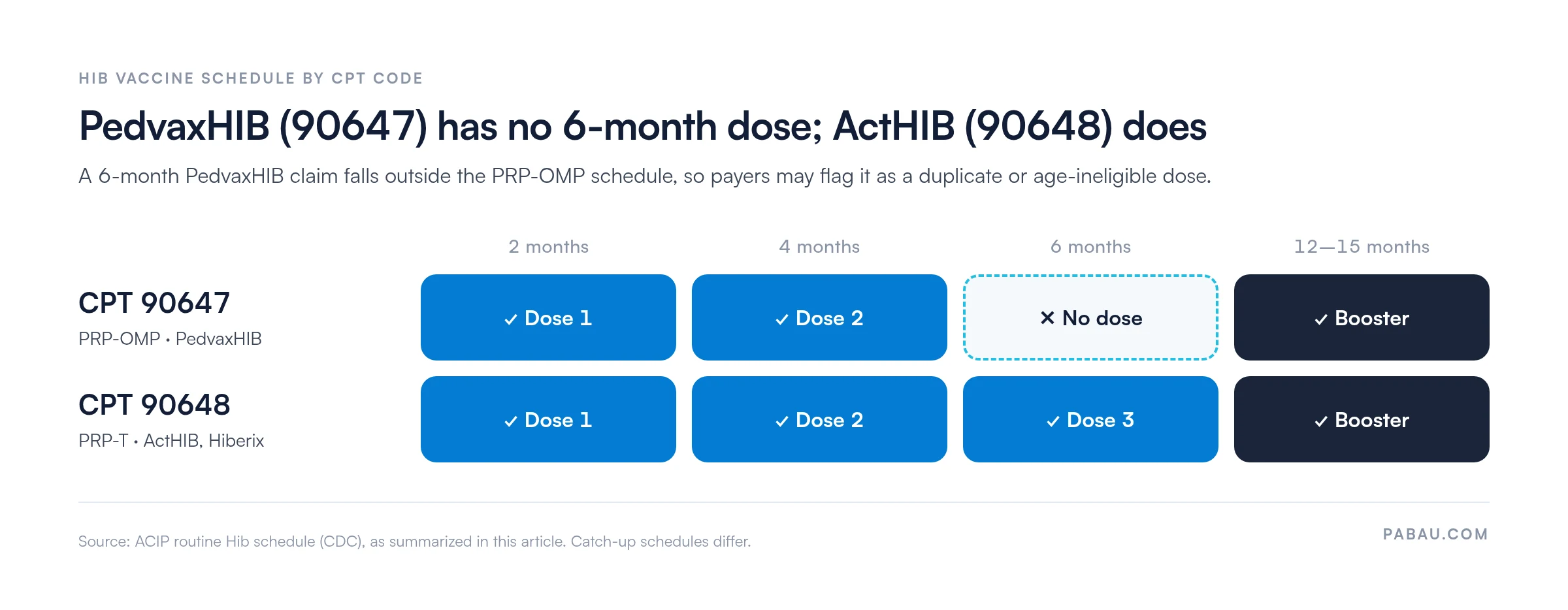
PedvaxHIB has a two-dose primary series, so a 6-month dose billed as 90647 may be flagged as age-ineligible.
Medicare Part B does not cover the adult Hib vaccine, which is generally a Part D benefit. Medicaid and the VFC program cover it for eligible children.
Claims software such as Pabau scrubs each claim before submission and checks eligibility through Claim.MD, so fewer 90647 claims come back denied.
CPT code 90647 is the five-digit procedure code maintained by the American Medical Association for Haemophilus influenzae type b (Hib) vaccine, PRP-OMP conjugate, intramuscular. The official AMA descriptor reads: Hemophilus influenzae b vaccine (Hib), PRP-OMP conjugate, 3 dose schedule, for intramuscular use.
PRP-OMP stands for polyribosylribitol phosphate conjugated to outer membrane protein complex derived from Neisseria meningitidis. This conjugate carrier is what distinguishes 90647 from every other Hib code. In practice, 90647 maps to PedvaxHIB (Merck), the principal PRP-OMP Hib vaccine available in the United States.
This code covers the vaccine product only. It does not include the injection service. Every claim for CPT code 90647 must be accompanied by a separate administration code.
CPT 90647 covers one product given by one route. Every other Hib formulation, and the injection service itself, is reported with a different code.
The “3 dose schedule” language in the descriptor reflects the ACIP-recommended series for PRP-OMP, which is 2 primary doses plus a booster. It does not cap reimbursement at three claims. Each documented, age-appropriate dose is billed on its own.
Choosing between 90647 and 90648 is a frequent coding error on Hib vaccine claims. The right code depends on which formulation was given, and the two differ in carrier protein and dose count.
The clinical record or vaccine administration log must document the specific brand and lot number administered. Code the brand that was given. Never pick a code from the product you usually stock and assume it matches.
Search CPT codes in the AAPC Codify CPT lookup to verify descriptors and crosswalks when preparing claims for either code.
The Advisory Committee on Immunization Practices (ACIP) recommends the PRP-OMP series at specific ages. Claims submitted outside these windows face age-eligibility denials.
PRP-OMP has a two-dose primary series rather than three. PRP-OMP produces protective antibody levels after the first dose, so two primary doses suffice. A practice that gives PedvaxHIB at 2, 4, and 6 months therefore files a third claim. Payers may flag it as a duplicate or age-ineligible dose. The grid below sets the two schedules side by side.
Children who begin the Hib series late (after 7 months) follow a catch-up schedule with fewer doses. Document the patient’s age in months on the date of administration and confirm the dose is consistent with ACIP catch-up guidance before billing.
CPT code 90647 is a vaccine supply code only. Every administration of PedvaxHIB requires a separate administration code, such as 90460, on the same claim. Submitting 90647 without an administration code is incomplete billing and will result in underpayment or denial.
Because 90647 is a single-antigen code, 90461 is almost never applicable unless a combination vaccine is administered on the same visit. The National Correct Coding Initiative (NCCI) does not bundle the administration codes into the vaccine supply code. The two are designed to be billed together. A payer that denies the administration code as a duplicate is misapplying NCCI edits, so appeal with the AMA’s vaccine billing guidance.
Coverage for the Hib vaccine depends on the payer and the patient’s age, so apply the rule that fits each population. Getting medical billing compliance right across payer types also limits audit exposure.
Every CPT code 90647 claim needs a supporting ICD-10-CM diagnosis code, which for a routine dose is Z23. Meeting clean claim requirements from the outset removes the most preventable denial reasons.
Documentation fields that must appear in the clinical record and on the claim:
The NDC requirement is payer-dependent, but the majority of commercial payers and Medicaid programs require it. Submitting without the NDC is a frequent denial trigger. Add the NDC in the appropriate claim field (loop 2410, LIN segment on 837P) rather than as a note or attachment.
Reimbursement for CPT code 90647 varies by payer type and geographic location. Use the CMS Physician Fee Schedule lookup to verify current Medicare allowable amounts, and use the FastRVU 2026 lookup for RVU-based benchmarking. Rates change with each annual fee schedule cycle. Never rely on a prior-year figure without confirming it against the current schedule.
Commercial payers typically reimburse vaccine products at a percentage of the Average Wholesale Price (AWP) or at a negotiated fee schedule rate. The NDC on the claim lets the payer’s system match the product to its allowable. Some payers pay a claim without it at a generic or reduced rate instead of denying it. That underpayment is hard to catch in routine review.
CPT 90647 denials repeat a handful of patterns, and each one shows up as a code on the remittance advice. The guide to medical billing denial codes decodes each CARC and RARC you will see. Structured denial management workflows then turn each diagnosis into a repeatable fix.
Modifier 25 note: A significant, separately identifiable evaluation and management (E&M) service may happen on the vaccination day. In that case, append modifier 25 to the E&M code. Do not append it to 90647. Modifier 59 is rarely needed on vaccine supply codes. NCCI edits do not bundle 90647 with its administration codes, so there is no conflict to override.
Run a monthly audit on 90647 claims using your clearinghouse’s remittance data. Filter for CARC 6 (procedure inconsistent with patient age), CARC 97 (payment included in another service), and CARC 16 with RARC M119 (missing NDC). Fixing the upstream documentation behind these three prevents repeat denials without claim-by-claim rework.
The documentation failures behind CPT code 90647 denials, such as a missing NDC, an absent VIS date, or the wrong Hib code, follow a pattern. They happen when the dose is recorded in one system and the claim is built in another.
Pabau, the practice management platform we build, keeps the visit record and the claim in one system. Its claims management software scrubs each claim before submission. Errors surface while the claim is still in the practice, not weeks later on a denial.
US practices submit claims through Claim.MD, Pabau’s integrated clearinghouse partner, which handles eligibility checks and electronic remittance advice (ERA). Payment discrepancies then show at the claim level, not only in aggregate reports.
Practices that bill Medicaid, VFC, and commercial payers should record whether each dose came from VFC or private stock. Keeping that note in the record the claim is built from prevents a costly pediatric billing error. That error is a commercial claim for a VFC-funded dose.

Pabau scrubs each claim before submission and checks eligibility through Claim.MD. Coding errors on 90647 claims surface in the practice, not on a denial weeks later.

CPT code 90647 rewards the practice that settles the formulation first. Confirm PedvaxHIB from the lot record, then let the patient’s age decide the administration code and the dose count. Several of the denials in this guide start from skipping that first check.
The trade-off is a little more documentation at the point of care in exchange for fewer corrected claims. An NDC, a VIS date, and the SL modifier on VFC stock take seconds to record and weeks to chase.
Book a demo to see how Pabau’s claim scrubbing and Claim.MD eligibility checks keep pediatric vaccine claims clean.

Need a foundation in vaccine billing fundamentals? Medical billing explained covers the full claim lifecycle from service capture through payer payment.
Looking to understand how clearinghouses process vaccine claims? How Claim.MD clearinghouse works explains electronic claim submission and ERA processing for US practices.
Want a structured approach to reducing claim rejections? Superbill documentation guide walks through the fields that eliminate preventable denials at submission.
CPT code 90647 is the billing code for Haemophilus influenzae type b (Hib) vaccine in the PRP-OMP conjugate formulation, given intramuscularly. It covers the vaccine product only and applies to PedvaxHIB (Merck). A separate administration code (90460 or 90471) must be billed on the same claim.
CPT 90647 covers the PRP-OMP Hib formulation (PedvaxHIB, 2-dose primary series), while CPT 90648 covers the PRP-T formulation (ActHIB, Hiberix, 3-dose primary series). The carrier differs too. 90647 uses a meningococcal outer membrane protein, and 90648 uses tetanus toxoid. Use the code that matches the brand given.
Bill 90460 (with physician/QHP counseling) for patients age 18 and under, or 90471 (without counseling or age 19 and over). Because 90647 is a single-antigen code, 90461 (each additional antigen) does not apply unless a combination vaccine is given on the same visit.
Medicare Part B does not cover the adult Hib vaccine, which is generally a Part D benefit instead. Medicaid and CHIP must cover all ACIP-recommended vaccines for eligible children under EPSDT, so 90647 is covered for pediatric Medicaid enrollees. For VFC stock, report 90647 with modifier SL at the payer’s required charge, and bill the administration code.
Yes. When VFC stock is used, report 90647 with modifier SL (state-supplied vaccine) at the payer’s required charge, and bill the administration code (90460 or 90471). The VFC program provides the vaccine at no cost to enrolled providers. Never bill a commercial payer for the supply when VFC-funded product was given.
Common denial triggers include the wrong Hib code (90648 billed instead of 90647), a missing NDC, or a dose outside the ACIP schedule for PRP-OMP. A missing VIS date and a VFC stock billing error are frequent too. Check the CARC on the remittance advice to see which one applies before resubmitting.