HCPCS Code A4627: Spacer and valved holding chamber
HCPCS Code A4627: official descriptor and code definition HCPCS Code A4627 is th...

Last Updated: Oct 21, 2026
90619 is the CPT code for meningococcal conjugate vaccine, serogroups A, C, Y and W-135 (quadrivalent), tetanus toxoid carrier (MenACWY-TT), for intramuscular use. It reports one dose of MenQuadfi.
The code covers the vaccine product only, so bill each dose with an administration code such as 90460 or 90471. Menactra and Menveo use a different carrier protein and are billed under 90734 instead.
Let Pabau's smart automation suggest the right codes, reduce claim denials, and keep your practice compliant—effortlessly.
Automate repetitive tasks and focus on what matters most—your patients.
Reduce coding errors and ensure compliance with the latest regulations.
Clean claims, fewer denials, and faster reimbursements.
Powerful insights and reporting to help your practice thrive.
HIPAA compliant SOC 2 certified GDPR-compliant Trusted by 4,000+ clinics worldwide

CPT code 90619 covers one product, MenQuadfi, the MenACWY vaccine built on a tetanus toxoid carrier. Menactra and Menveo bill under 90734 instead.
Always bill a separate administration code, such as 90471 or 90460, alongside 90619. The vaccine product code never covers the injection itself.
List Z23 first on every 90619 claim, and add a risk code such as D84.1 only to support medical necessity.
Most state Medicaid programs require modifier SL when the dose comes from Vaccines for Children (VFC) stock. Commercial payers should not receive it.
Pabau’s claims management software scrubs each claim for missing or invalid details, which helps catch vaccine coding errors before submission.
CPT code 90619 describes a quadrivalent meningococcal conjugate vaccine for serogroups A, C, Y and W-135, given by intramuscular injection. Its carrier protein is tetanus toxoid, which is why the descriptor ends in MenACWY-TT. The American Medical Association maintains this code within the Vaccines, Toxoids subsection of the Medicine section of the CPT code set. Each unit reports one dose of MenQuadfi, billed with a separate administration code.
MenQuadfi (Sanofi) is the only vaccine that maps to 90619. Menactra (diphtheria toxoid carrier) and Menveo (CRM197 carrier) cover the same four serogroups, but both bill under 90734.
90619 is limited to the MenACWY vaccine conjugated to tetanus toxoid. Several closely related meningococcal codes fall outside its scope.
Meningococcal vaccine codes are easy to confuse, because several products cover the same serogroups. The table below shows what separates each code, so coders can pick the right one at the point of service.
Both 90619 and 90734 cover A, C, Y and W-135, so the carrier protein decides between them. In practice, the brand settles it: MenQuadfi goes to 90619, while Menactra and Menveo go to 90734.
Codes 90620 and 90621 are the serogroup B codes, and patients often get one of them at the same visit. Checking the brand and lot number against the package insert is the fastest way to pick the right code, in the order shown below.
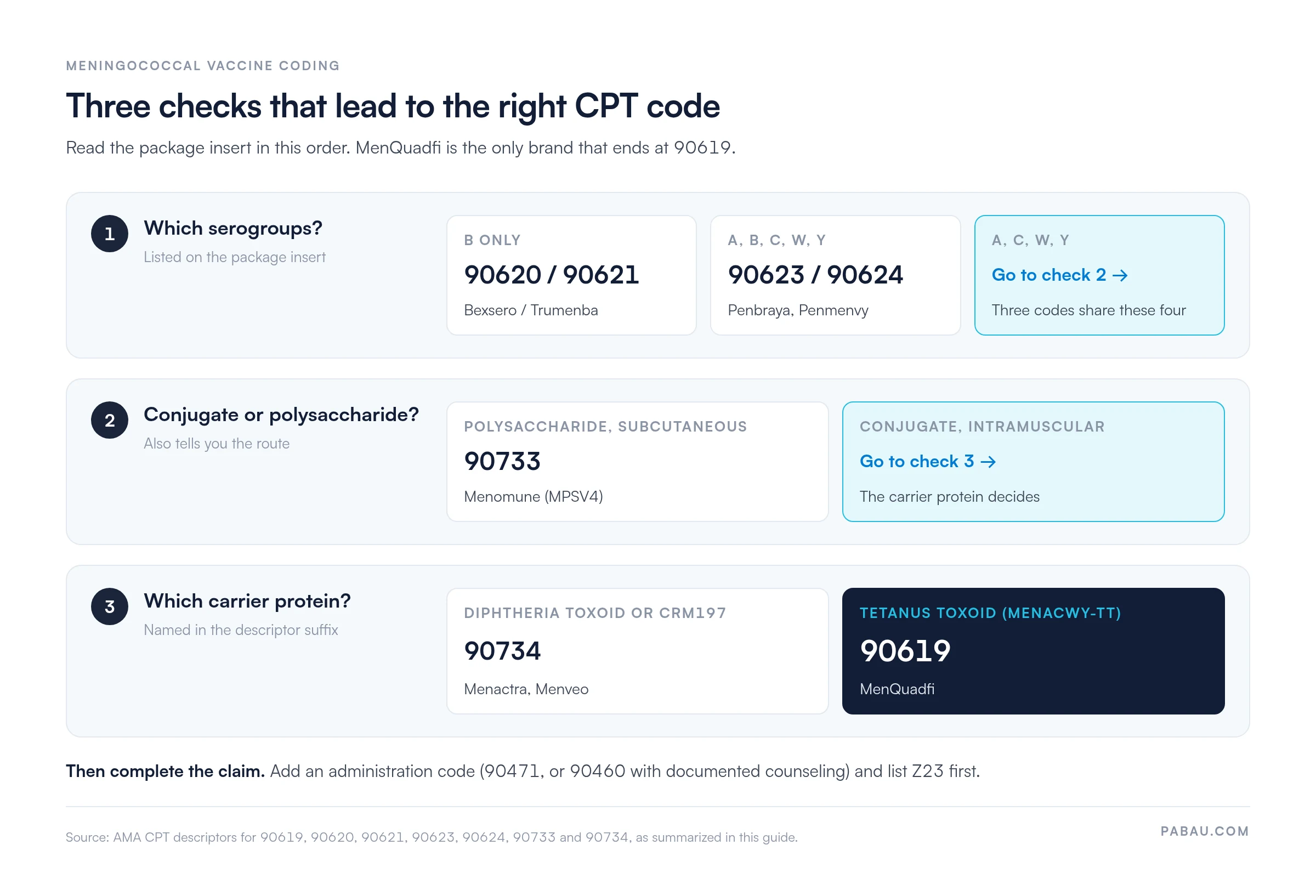
CPT code 90619 is the vaccine product code only. Billing it without a separate administration code leaves the injection service uncompensated and the claim incomplete. The correct administration code depends on patient age and whether counseling was documented.
90460 requires documented face-to-face counseling by the physician or other QHP, per AMA CPT guidelines. If counseling cannot be documented to that standard, 90471 is the correct choice regardless of patient age.
Z23 is the primary ICD-10-CM diagnosis code for any vaccine administration visit, including 90619. It describes an encounter for immunization, and most payers accept it as the sole diagnosis for routine preventive vaccination. Use the CDC/NCHS ICD-10-CM web tool to confirm current-year code validity.
Modifier selection for CPT code 90619 depends on the vaccine supply source and the clinical scenario. Using the wrong modifier, or leaving off a required one, is a common cause of Medicaid denials for this code.
SL is a Medicaid-specific modifier. Commercial payers do not recognize it and should receive claims without SL even when the dose came from VFC stock. Always confirm modifier requirements with the specific payer before submitting.
Before billing 90619 with the SL modifier, confirm the patient’s VFC eligibility in writing in the medical record. State Medicaid auditors look for documented VFC screening at the time of service, not just the modifier on the claim. A missing screening note can be treated as a modifier error, even when the modifier itself is correct.
CPT code 90619 reimbursement reflects vaccine acquisition cost plus a dispensing or handling component rather than a work RVU-based rate. The CMS Physician Fee Schedule lookup tool provides the current national allowable for 90619 under Medicare. Use that tool directly rather than relying on third-party aggregator figures, which may lag behind annual updates.
Missing or incomplete records are a frequent audit finding for vaccine codes. The medical record must support every element of the 90619 claim at the time of service, not after a denial.
Maintaining medical billing compliance for vaccine codes depends on building these steps into the visit itself. They belong in the chart before the patient leaves the room, not in a post-visit charting session.
Vaccine code denials cluster around five error patterns. Each has a straightforward fix when caught before submission.
Clean claim submission workflows that validate modifier and code pairings help catch many of these errors before submission. The AAPC CPT code lookup provides modifier guidance and bundling edits for the 90619 code family when manual verification is needed. Once a denial arrives, the denial codes guide helps staff trace each claim adjustment reason code (CARC) to the error behind it.
Run a monthly audit of your 90619 and 90734 claims. Filter by denial reason code CO-4 (code inconsistent with modifier) and CO-11 (diagnosis inconsistent with procedure). Both point to the coding and modifier errors covered above. Patterns in those denials tell you whether the error is at the coding, modifier, or documentation step.
Many practices still pick vaccine codes from memory and add modifiers after the visit. That is how a MenQuadfi dose ends up billed as 90734, or a VFC dose goes out without modifier SL.
Pabau, our practice management and billing platform, keeps that check inside the visit. Its claims software built for practices includes claim validation, which scrubs each claim for missing or invalid details before submission.
Claim.MD handles eligibility checks and electronic submission. Through it, practices send 90619 claims to thousands of US payers and track remittances through electronic remittance advice (ERA).
That helps catch many of these errors before submission, so your team spends less time reworking meningococcal claims.

Pabau scrubs each vaccine claim for missing or invalid details, then submits it through Claim.MD and tracks the remittance. Your team spends less time reworking denied claims.

CPT code 90619 belongs to one vaccine, MenQuadfi, and many coding errors start when it is confused with 90734. Get the brand right first. The administration code, Z23 as the first diagnosis and SL on Medicaid VFC doses then follow from the visit record.
Practices that give meningococcal vaccines every week gain the most from checking codes and modifiers before a claim leaves the building. Fixing a claim at that point costs minutes, while fixing it after a denial costs weeks.
Book a demo to see how Pabau carries a vaccine claim from the chart to the payer.

Need to understand how clearinghouse edits catch vaccine code errors before submission? How the Claim.MD clearinghouse works explains the validation layer between your practice and thousands of US payers.
Tracking down a denial reason code from a rejected 90619 claim? Denial management in healthcare covers how to read CARC codes and structure an appeal workflow.
Verifying patient insurance eligibility before the vaccine visit? Insurance eligibility verification outlines the real-time eligibility check process for preventive care services.
CPT code 90619 covers the quadrivalent meningococcal conjugate vaccine for serogroups A, C, Y and W-135, given by intramuscular injection. Its carrier protein is tetanus toxoid (MenACWY-TT), and MenQuadfi is the brand that maps to it. Menactra and Menveo bill under 90734, serogroup B vaccines under 90620 or 90621, and polysaccharide vaccine under 90733.
Both 90619 and 90734 cover quadrivalent meningococcal conjugate vaccines for serogroups A, C, Y and W-135, but they differ by carrier protein. 90619 covers the tetanus toxoid conjugate, MenQuadfi. 90734 covers the diphtheria toxoid conjugate, Menactra, and the CRM197 conjugate, Menveo. Confirm the brand from the package insert or lot number before selecting the code.
90471 is billed alongside 90619 for the first vaccine on a date of service when no counseling is billed. For patients under 19 when the physician or qualified health professional documents face-to-face counseling, bill 90460 instead. If a second vaccine is given at the same visit, add 90472 (or 90461 when 90460 is the primary administration code).
Most state Medicaid programs require modifier SL when the dose comes from VFC stock. It tells the payer to reimburse the administration fee only. Modifier 59 applies when payer edits incorrectly bundle 90619 with another procedure billed on the same date. Modifier 76 marks a repeat procedure on the same date, which rarely applies to 90619. A patient does not receive two MenACWY doses at one visit.
Yes, most state Medicaid programs cover CPT code 90619, but coverage terms vary by state. Some state Medicaid programs set age limits for 90619, so check your state’s current policy. Verify the current fee schedule with your state Medicaid program before administering the vaccine.
Z23 (encounter for immunization) is the primary ICD-10-CM diagnosis code for any routine 90619 vaccine visit and must be listed first on the claim. When the payer asks for medical necessity, add secondary codes for at-risk conditions. Examples are D73.0 for hyposplenism (Z90.81 if the spleen was removed) and D84.1 for complement deficiency.
Yes. Giving a MenACWY dose and a serogroup B dose at the same visit is clinically common, especially for adolescents. Bill 90619 for MenQuadfi and 90620 (Bexsero) or 90621 (Trumenba) for the MenB dose on separate lines. Each vaccine also takes its own administration code, such as 90471 plus 90472.