

CCSD code G5100: Bypass of duodenum billing guide
CCSD code G5100 bills a bypass that leaves the duodenum in place CCSD code G5100...

Last Updated: Oct 16, 2026
90473 is the CPT code for immunization administration by intranasal or oral route, covering 1 vaccine (single or combination vaccine/toxoid). It reports giving the first nasal spray or oral vaccine at a visit, such as FluMist or oral rotavirus. The vaccine product is billed separately.
Bill one primary administration code per encounter, and add 90474 for each extra nasal or oral vaccine. The record needs the lot number, manufacturer, route, VIS date and the name of the person who gave the dose.
Let Pabau's smart automation suggest the right codes, reduce claim denials, and keep your practice compliant—effortlessly.
Automate repetitive tasks and focus on what matters most—your patients.
Reduce coding errors and ensure compliance with the latest regulations.
Clean claims, fewer denials, and faster reimbursements.
Powerful insights and reporting to help your practice thrive.
HIPAA compliant SOC 2 certified GDPR-compliant Trusted by 4,000+ clinics worldwide

CPT code 90473 reports the first vaccine given by nasal spray or by mouth at an encounter, never an injection.
Bill 90474 for each additional nasal or oral vaccine, and 90472 for each additional injected vaccine.
Never report 90473 and 90471 together, because CPT allows one primary administration code per encounter.
Always bill the vaccine product code, such as 90660 for FluMist, since a missing product code is a common denial trigger.
Use 90460 instead only when a physician or QHP counsels a patient aged 18 or under about the vaccine.
CPT code 90473 reports the work of giving one vaccine by nasal spray or by mouth. The AMA descriptor reads: Immunization administration by intranasal or oral route; 1 vaccine (single or combination vaccine/toxoid). A combination vaccine still counts as one vaccine, so it takes one unit.
The code pays for administration only. You bill the vaccine itself with its own product code on the same claim.
Counseling is not part of 90473. Codes 90471 through 90474 do not include counseling by a physician or other qualified health care professional (QHP). They can be reported for patients of any age, as the summary below shows.
Billing 90471 for a nasal spray, or 90473 for an injection, is a frequent route error. Route decides the code, not the vaccine brand. 90471 covers injections, while 90473 covers nasal and oral doses.
Here is how a mixed-route visit works. A 30-year-old gets FluMist and a Tdap injection from a nurse, with no physician counseling. You bill 90471 for the Tdap and 90474 for the FluMist, plus both product codes. Billing 90473 plus 90472 is the other valid pairing.
The diagram below walks through the choice in the order a coder makes it.
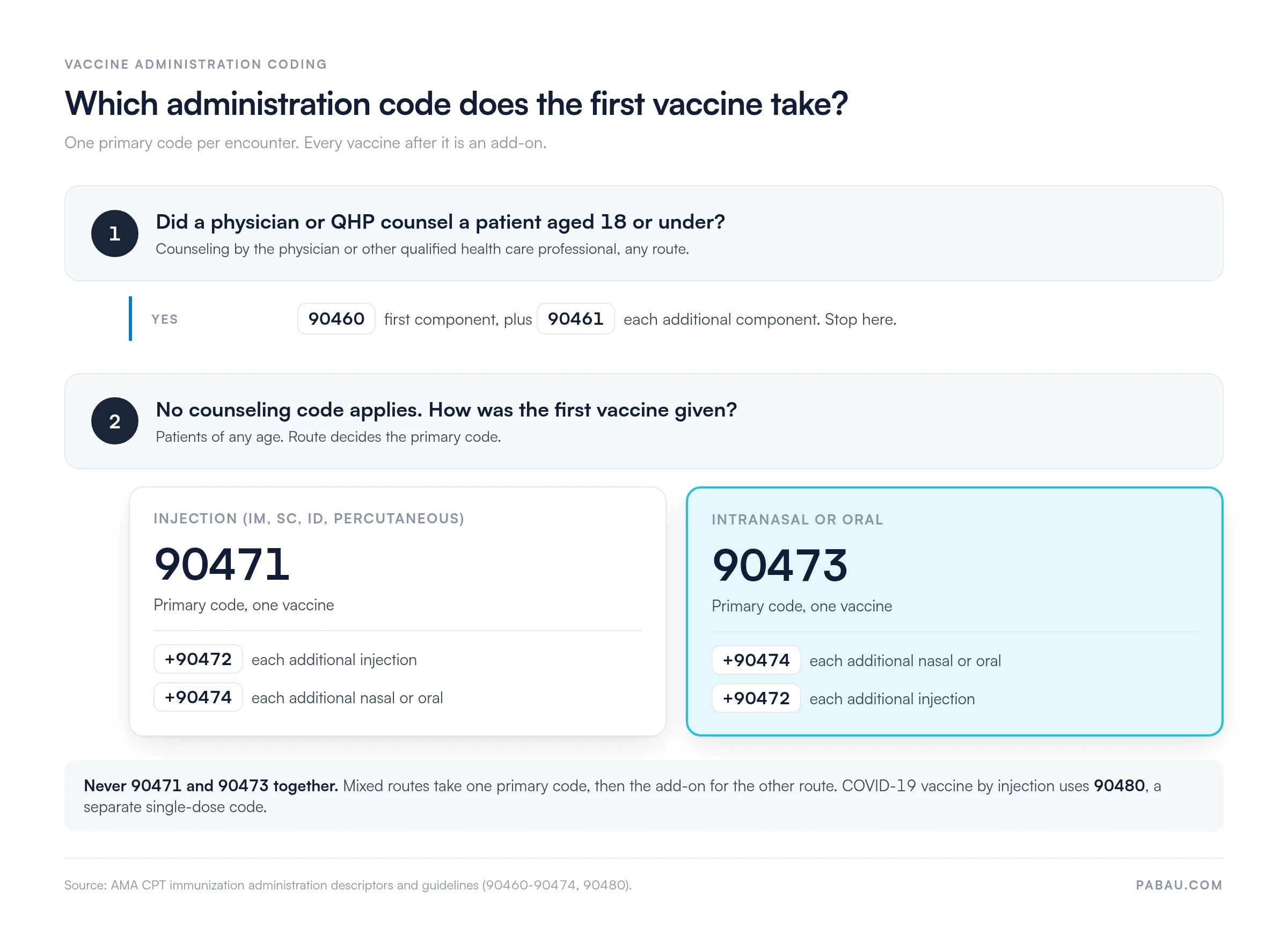
Once the primary code is on the claim, every extra vaccine at that visit is an add-on. The add-on follows the route of the extra vaccine, not the route of the first one.
Units follow the vaccine count. If a second nasal or oral vaccine is given after a 90473 dose, bill 90473 x1 plus 90474 x1. Submitting 90474 without a primary code on the claim leads to a denial.
One neighbor code often gets mixed up here. 90480 reports a single COVID-19 vaccine dose by intramuscular injection, effective September 11, 2023. It has nothing to do with 90474 or extra doses.
Any vaccine given by nasal spray or by mouth uses 90473 as its administration code. In everyday practice that mostly means FluMist and oral rotavirus.
Oral polio vaccine is no longer used in the United States. If you give travel vaccines, confirm the product code for each oral formulation. Codes change each year, so check the AMA CPT coding resources.
Medicare pays 90473 under the Physician Fee Schedule. The code carries 0.52 total RVUs, with 0.17 work RVU. At the 2026 conversion factor of $33.4009, that comes to about $17 nationally.
The 2025 figure was about $16.80, at a conversion factor of $32.3465. Your local rate differs, so check the CMS Physician Fee Schedule lookup for the year you bill.
Medicare also has its own codes for some vaccines. Flu, pneumococcal and hepatitis B administration go on G0008, G0009 and G0010, which carry no patient cost-sharing.
Run a fee schedule verification at the start of each benefit year. Pull the CMS MPFS final rule for the new year and compare your contracted rates against the updated RVUs for 90473 and 90474. Payers that pay a percentage of Medicare shift automatically when CMS updates the conversion factor. Spotting the change early avoids surprises on your remittances.
Most 90473 claims go out with no modifier. The exceptions are a separate E/M service on the same date, or a Medicaid rule for state-supplied vaccines.
A common slip is putting modifier 25 on 90473. Modifier 25 tells the payer the office visit was distinct from the vaccine service. It belongs on the E/M code, and the administration code never needs it.
The record has to prove who gave which vaccine, how, and when. Payers check vaccine records in audits, and missing details lead to recoupments.
Capture these details during the visit, not afterward. Digital intake and consent forms can record the lot number, route and VIS acknowledgment straight into the patient record.
Most 90473 problems start well before the claim is built. Here is the path a clean claim takes.
Vaccine administration denials repeat in a familiar pattern. Practices tend to see the same issues again and again, and each has a direct fix.
When a denial does land, the remark code tells you which fix applies. Our guide to medical billing denial codes explains how to read them.
For repeat problems, a routine for denial management helps your team spot the pattern and fix it at the source.
The National Correct Coding Initiative (NCCI), run by CMS, lists code pairs that cannot be billed together. Checking those pairs prevents both underpayment and later recoupment.
90460 and 90461 apply only when a physician or QHP counsels the patient or family, for patients through age 18, by any route. Without that counseling, 90471 through 90474 apply at any age. An infant given oral rotavirus by a nurse, with no physician counseling, takes 90473.
NCCI edits change every quarter. Check the current CMS NCCI edit files when you set up billing templates. The AAPC Codify CPT lookup also shows related edits beside each code.
Medicare Part B covers flu, pneumococcal and hepatitis B vaccines with no coinsurance or deductible. FluMist is approved only up to age 49, so few Medicare patients receive it.
Medicaid rules vary by state. Several programs want the SL modifier on the product code for VFC vaccines. Some pay a flat administration fee instead of the fee schedule rate, so check your state billing manual.
Commercial plans set their own coverage. Under the Affordable Care Act, most cover recommended preventive vaccines with no cost-sharing. An off-schedule vaccine, such as oral typhoid for travel, may bring cost-sharing or prior authorization.
So confirm benefits before you give a non-routine vaccine. A routine for insurance eligibility verification catches coverage problems before the appointment.
Build a payer matrix for your top five vaccine payers. Document each payer’s administration fee rate for 90473, their stance on same-day E/M billing, and whether they require the SL modifier for VFC vaccines. Revisit it each January when fee schedules reset. One shared reference gives your billing team the answers in one place, instead of a phone call per denial.
In many practices, the vaccine gets recorded in one system and the claim gets typed into another. Every retyped lot number or code is another chance for a mismatch.
Pabau, the practice management and billing platform we build, keeps the visit and the claim in one record. Its digital forms can capture the lot number, route and VIS acknowledgment during the visit.

From there, Pabau’s cleaner claims management pre-fills the claim from the record. CPT and ICD-10 lookup libraries sit beside each line. Pabau also checks that required fields are complete before you can send.
US claims go out through Claim.MD, our clearinghouse partner, with eligibility checks, ERA posting and claim-status tracking. Your biller spends less time retyping and more time on claims that need judgment.
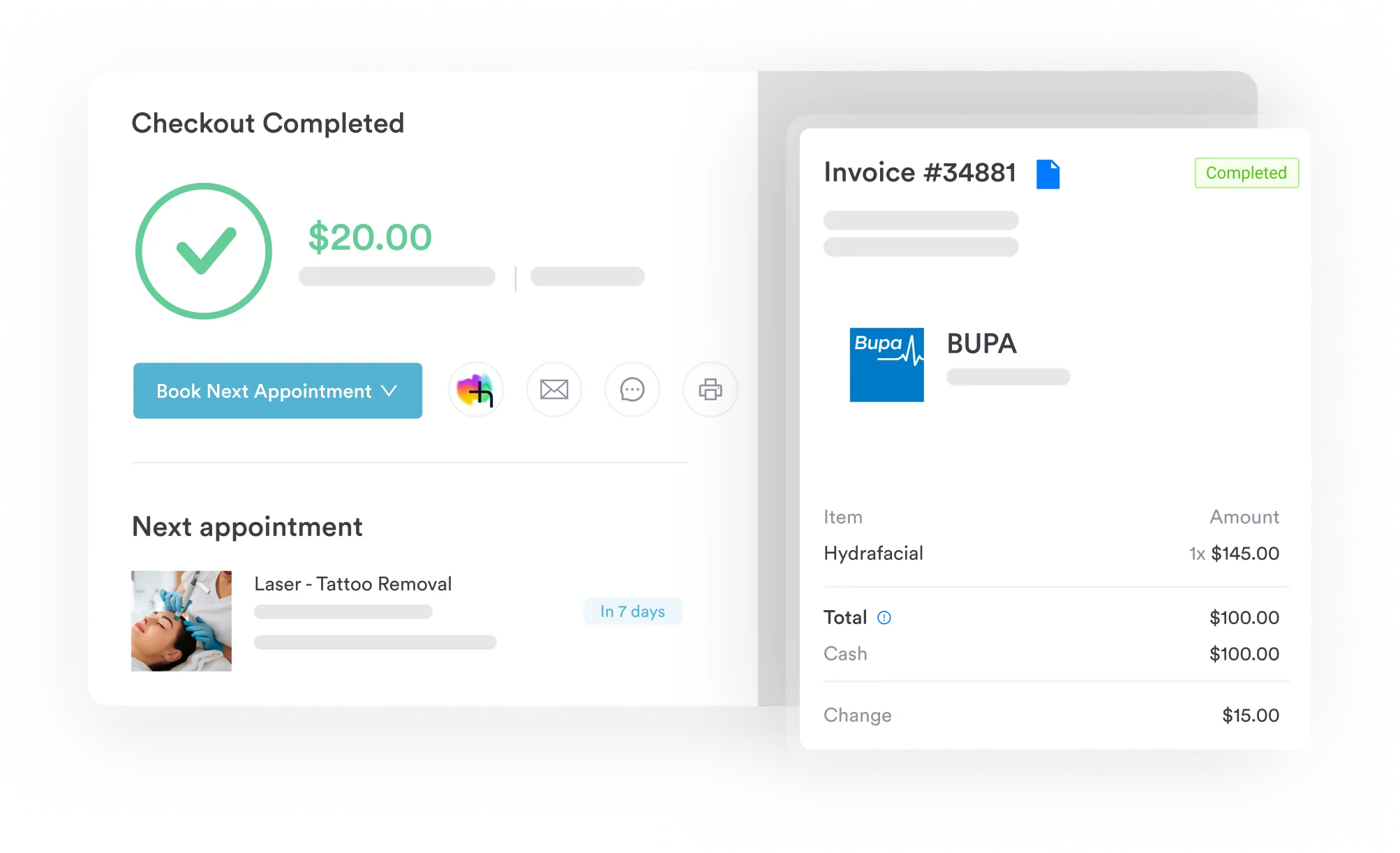

Pabau pre-fills vaccine claims from the patient record and checks required fields before you send. US claims go through Claim.MD, with eligibility checks and ERA tracking.

Treat 90473 as a decision you make once per visit. Settle the counseling question first, then let the first vaccine’s route pick the primary code. Every vaccine after that is an add-on.
The trade-off is small. A minute spent on the lot number, route and VIS date during the visit saves an appeal later. Build that habit into the vaccine workflow, and the claim follows from the record.
Book a demo to see how Pabau turns a vaccine visit into a complete, ready-to-send claim.

Billing the rotavirus product too? CPT code 90680 covers the RotaTeq product code that pairs with 90473 at infant visits.
Giving Tdap at the same visit? CPT code 90715 explains the Tdap product code used in mixed-route claims.
Need to understand how claims flow from practice to payer? Medical claims clearinghouse guide explains how clearinghouses check and route claims before they reach insurers.
Billing several codes on one claim? Clean claim best practices covers the formatting and code-pair rules behind first-pass acceptance.
Want to see how remittances get posted? Electronic remittance advice (ERA) guide walks through how 835 files are processed and denials identified.
Most routine vaccine claims use Z23, Encounter for immunization, as the diagnosis. Link it to both the administration code and the vaccine product code. Add other diagnosis codes only when a separate problem was treated.
No. CPT allows one primary administration code per encounter, so 90473 is not reported with 90471. When a patient gets an injection and a nasal or oral vaccine, bill 90471 plus 90474, or 90473 plus 90472.
No. FluMist is FDA-approved for people aged 2 through 49. Patients outside that range, including most Medicare patients, get an injected flu vaccine instead, which changes the administration code.
Per vaccine, per encounter. One unit of 90473 covers one vaccine, whether single or combination. A rotavirus series given over several visits gets its own administration code at each visit.
The vaccine is free to the practice, so you bill only the administration. Many Medicaid programs want the SL modifier on the product code. VFC patients are 18 or under, so check whether 90460 counseling rules apply first.



