HCPCS Code Q4175: Billing, coverage, and documentation guide
HCPCS code Q4175: Code description and product identity HCPCS Code Q4175 is the ...

Last Updated: Nov 20, 2026
90671 is the CPT code for pneumococcal conjugate vaccine, 15 valent (PCV15), for intramuscular use. It reports the vaccine product only, which is Vaxneuvance from Merck, and a separate administration code is billed with it.
CMS made the code effective for Medicare dates of service from July 16, 2021. Prevnar 20 (90677) and Capvaxive (90684) have their own codes, so the product on the carton decides which code is billed.
Let Pabau's smart automation suggest the right codes, reduce claim denials, and keep your practice compliant—effortlessly.
Automate repetitive tasks and focus on what matters most—your patients.
Reduce coding errors and ensure compliance with the latest regulations.
Clean claims, fewer denials, and faster reimbursements.
Powerful insights and reporting to help your practice thrive.
HIPAA compliant SOC 2 certified GDPR-compliant Trusted by 4,000+ clinics worldwide

CPT code 90671 reports PCV15, the 15-valent pneumococcal conjugate vaccine sold as Vaxneuvance by Merck.
Prevnar 20 bills as 90677, Capvaxive (PCV21) as 90684, and Prevnar 13 as 90670, so the product on the carton decides the code.
The code covers the vaccine product only. Every claim also needs an administration line, which is G0009 for Medicare and 90471 or 90460 for most other payers.
An adult who starts with PCV15 needs a PPSV23 dose (90732) later, so the series produces a second claim on a later date.
Medicare Part B covers the vaccine and its administration with no cost-sharing when the dose follows current ACIP recommendations.
CPT code 90671 is the product code for the 15-valent pneumococcal conjugate vaccine (PCV15), given by intramuscular injection. The CDC’s CPT code list for vaccines maps 90671 to PCV15 and CVX code 215. The one PCV15 product on the US market is Vaxneuvance, made by Merck.
CMS made the code effective for Medicare dates of service from July 16, 2021. It reports the vaccine itself, so the injection is billed on a separate administration line.
What 90671 covers: The PCV15 vaccine supplied by the practice, one code per dose given.
What 90671 excludes: The injection, vaccine counseling, and any separately identifiable evaluation and management service. Each of those carries its own code.
Each pneumococcal conjugate vaccine has its own CPT code, and the valency in the descriptor tells them apart. Bill 90671 only when the dose given was PCV15. A Prevnar 20 dose is 90677, and a Capvaxive dose is 90684.
Two other names still cause mix-ups. 90670 is PCV13 (Prevnar 13), the vaccine PCV15 and PCV20 replaced in routine use. No product called “Prevnar 21” exists, so a reference to one is a sign the source has confused Pfizer’s Prevnar 20 with Merck’s PCV21.
The NDC on the carton is the tiebreaker. Practices that stock more than one pneumococcal vaccine should check the NDC against the billed code on every claim.
Put the CPT code on the shelf label next to each pneumococcal vaccine. When Vaxneuvance and Prevnar 20 sit side by side, that label catches the wrong code at the point of care. Otherwise it surfaces as a denial.
Every 90671 claim needs a second line for giving the injection. The right administration code depends on the payer, and Medicare takes G0009. For a patient aged 18 or under, it also depends on who did the counseling.
PCV15 protects against one disease, so it counts as a single component. A 90671 dose never adds 90461 on its own, however many serotypes it covers.
Place of service: POS 11 (office) covers most vaccine visits in a physician practice. A hospital outpatient department uses POS 22 or bills on its own facility claim. A POS that does not match where the dose was given usually returns a CO-5 denial.
The CDC’s pneumococcal vaccine recommendations name PCV15 as one option for both children and adults. The series that follows a PCV15 dose is what makes it different to bill.
That PPSV23 step is what sets a PCV15 dose apart at billing time. It usually falls at least a year later, so PCV15 creates a second visit and a second claim. A PPSV23 dose billed before the interval ACIP sets is a common frequency denial. The two claims line up like this.
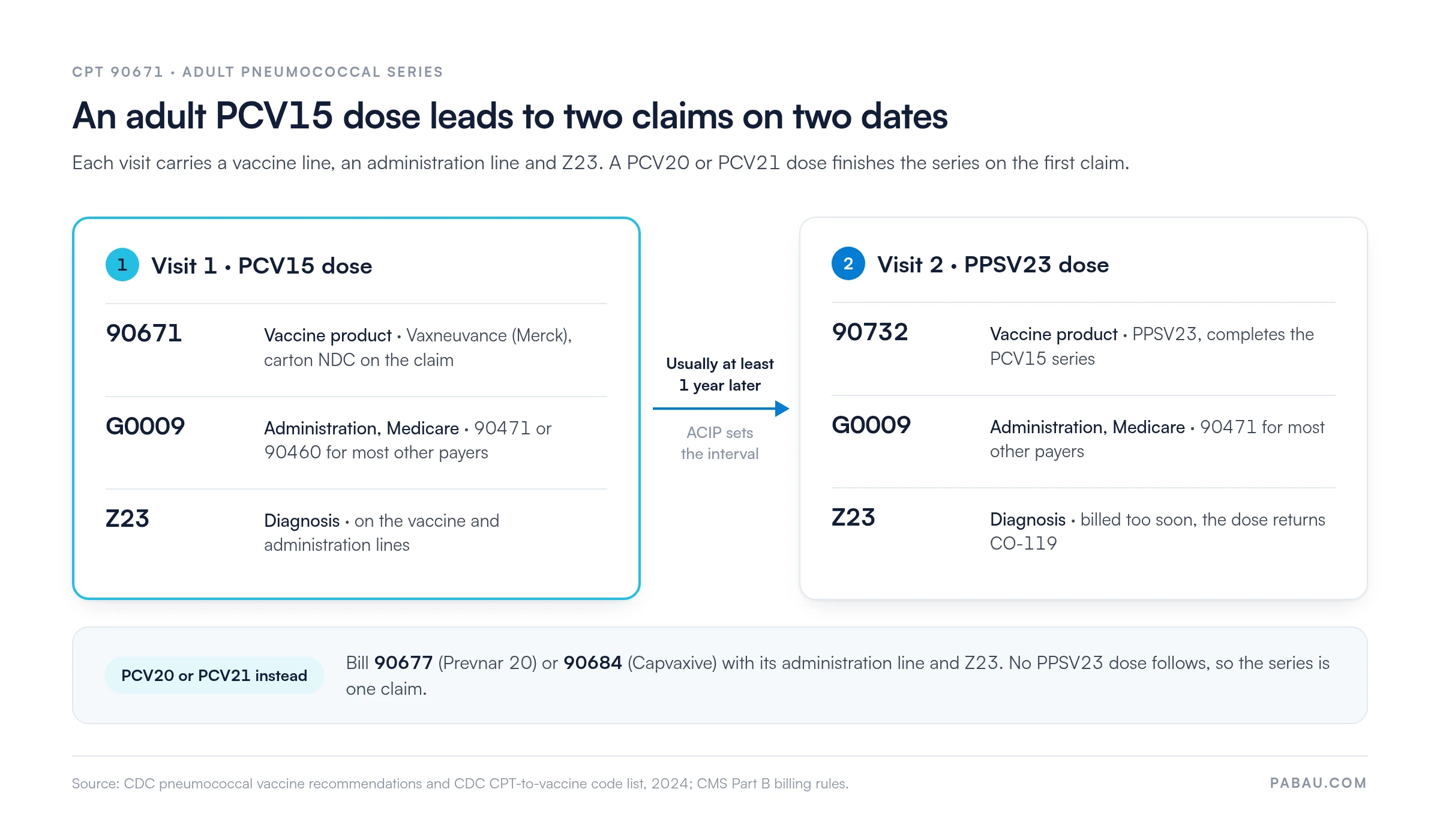
Z23 is the diagnosis code for a 90671 claim, and Medicare expects it on both the vaccine and administration lines. The CDC/NCHS ICD-10-CM browser tool lists Z23 as an encounter for immunization.
Risk-condition codes support a dose outside the age-based recommendation, but they never replace Z23. Some commercial payers ask for one when the patient is under 50, so check the plan’s policy before submission.
Medicare Part B covers pneumococcal vaccines, including 90671, and their administration with no deductible or coinsurance. Insurance eligibility verification before the visit confirms the patient’s coverage and any pneumococcal doses already on record.
ACIP guidance changes more often than most coding references are updated. Build the current schedule into your intake checks rather than relying on a frequency rule copied from an older billing grid.
Medicare Part B does not pay 90671 from the Physician Fee Schedule. Per the CMS Part B vaccine pricing fact sheet, pneumococcal vaccines pay at 95% of average wholesale price. CMS publishes those payment limits in quarterly vaccine pricing files.
Commercial payers pay the product and the administration under each provider contract. Compare those rates against your acquisition cost, since PCV15 stock is a significant line on most practices’ inventory bills.
Most 90671 problems come down to the wrong product code, the wrong administration code for the payer, or a dose billed outside the series. For the remark codes behind each one, see this guide to medical billing denial codes.
Denial management workflows work best when the checks run before submission. A 90671 charge checklist covers the product code, the administration code for that payer, the NDC, Z23, the POS, and the patient’s prior doses.
The record must support every line of the claim, and federal law sets part of what a vaccine note contains. These are the fields to capture at the visit.
Most states require or expect immunization registry reporting. Recording the series plan in the same note keeps the PPSV23 follow-up from depending on someone’s memory.
Audit 90671 documentation every quarter. The NDC, the lot number and the VIS edition date are the fields most often missing in post-payment audits. Make them required on your vaccine administration form.
In many practices the vaccine details live in one place and the claim gets built in another. A biller reads the note, picks a pneumococcal code, and types the NDC by hand. That handover is where 90671 turns into 90677, or where the G0009 line never gets added.
Pabau, a practice management and EHR platform, keeps the vaccine record and the claim in the same patient file. A custom vaccine administration form can make the NDC, lot number and VIS date required fields. Claims then go out through Pabau’s Claim.MD integration, which checks them against payer edits before they reach the payer.
The result is fewer corrected claims and less time spent rebuilding a vaccine visit for an appeal. Pabau’s claims management software also shows which claims are still open, so a rejected 90671 line gets picked up quickly.

Pabau keeps the vaccine note and the claim in the same patient file, and sends claims through its Claim.MD integration. Your 90671 claims leave with the details the payer checks.

CPT code 90671 is PCV15, and treating it as any other pneumococcal vaccine is where the trouble starts. Bill it only for a Vaxneuvance dose, add the administration code your payer expects, and plan the PPSV23 visit for adults before the patient leaves.
Two habits do most of the work. Check the carton NDC against the code before the claim goes out, and write the PPSV23 due date into the note. Book a demo to see how Pabau keeps vaccine records and claims in the same patient file.

Need to understand how clearinghouse submission works? Claim.MD clearinghouse guide covers how electronic claims are validated and routed to payers.
Want to reduce denials across your full billing workflow? Revenue cycle management guide explains how to structure billing operations to catch errors upstream.
Billing other preventive care codes alongside vaccines? Superbill guide covers how to structure multi-code visits for clean submission.
CPT code 90671 is the product code for the 15-valent pneumococcal conjugate vaccine (PCV15), given intramuscularly. The PCV15 product is Vaxneuvance, made by Merck. The code covers the vaccine only, so a separate administration code goes on the same claim.
The three codes report different pneumococcal conjugate vaccines. 90671 is PCV15 (Vaxneuvance), 90677 is PCV20 (Prevnar 20), and 90684 is PCV21 (Capvaxive). Bill the code that matches the product and NDC of the dose given.
Neither. CPT 90671 is PCV15, sold as Vaxneuvance. Prevnar 20 is billed with 90677, and no product called Prevnar 21 exists. The 21-valent vaccine is Merck’s Capvaxive, billed with 90684.
For Medicare Part B, bill G0009 for the injection. For other payers, bill 90471 for the first injected vaccine. Use 90460 instead when a physician or qualified health professional counsels a patient aged 18 or under. PCV15 is a single component, so it does not add 90461.
Yes. Medicare Part B covers PCV15 and its administration with no deductible or coinsurance. Since October 2024, Medicare coverage follows the current ACIP recommendations. Bill the vaccine with 90671, the injection with G0009, and Z23 as the diagnosis.
Yes, for adults. CDC recommends that an adult who receives PCV15 gets one dose of PPSV23 (90732) afterwards, usually at least a year later. PCV20 or PCV21 alone completes the adult series, so no PPSV23 dose follows them.
Use Z23, encounter for immunization, as the first-listed diagnosis on both the vaccine and administration lines. Add a risk-condition code, such as J44.9 or E11.9, when it supports a dose for an adult under 50.