HCPCS Code K0900: Customized DME billing and coding guide
HCPCS Code K0900: Official descriptor and code overview HCPCS Code K0900 is a CM...

Last Updated: Nov 18, 2026
Billable Code
76948 is the CPT code for ultrasonic guidance for aspiration of ova, imaging supervision and interpretation. It covers the physician's real-time ultrasound supervision of the needle during transvaginal oocyte retrieval. It is reported once per retrieval session, alongside CPT 58970 for the aspiration itself.
Common denial causes include missing permanent image documentation and billing 76942 instead of 76948.
Let Pabau's smart automation suggest the right codes, reduce claim denials, and keep your practice compliant—effortlessly.
Automate repetitive tasks and focus on what matters most—your patients.
Reduce coding errors and ensure compliance with the latest regulations.
Clean claims, fewer denials, and faster reimbursements.
Powerful insights and reporting to help your practice thrive.
HIPAA compliant SOC 2 certified GDPR-compliant Trusted by 4,000+ clinics worldwide

CPT code 76948 covers ultrasonic guidance for aspiration of ova, imaging supervision and interpretation. The aspiration procedure itself is CPT 58970.
Every 76948 claim needs permanently recorded images, and missing image documentation is a common denial trigger.
The 2026 Medicare Physician Fee Schedule lists 76948 with a work RVU of 0.65, a total RVU of 2.46, and a global period of XXX.
Medicare generally does not cover IVF retrieval, while commercial coverage and prior authorization rules vary by plan and state mandate.
Fertility practice software such as Pabau keeps the stored images and imaging report with the retrieval encounter the claim is built from.
CPT code 76948 describes ultrasonic guidance for aspiration of ova, imaging supervision and interpretation. ASRM’s 2026 ultrasound coding guide lists it as the ultrasound guidance code for oocyte aspiration. A reproductive endocrinologist (RE) usually performs this imaging work during IVF and other assisted reproductive technology (ART) cycles.
The code belongs to the Diagnostic Ultrasound section of the CPT code set, maintained by the American Medical Association. It is distinct from the surgical aspiration code (CPT 58970) and must be billed separately to capture the physician’s imaging work.
During a transvaginal oocyte retrieval, the RE uses a transvaginal ultrasound probe to guide a needle through the vaginal wall into each ovarian follicle. The imaging work is continuous. The physician monitors the needle tip in real time, identifies each follicle, and confirms complete aspiration before moving to the next. This is the clinical act that CPT code 76948 captures.
Document each retrieval session as its own encounter, recording the number of follicles aspirated, the imaging modality used, and the supervising physician. Payers audit exactly those details when they review 76948 claims.
Code 76948 covers imaging supervision and interpretation only. It does not include the aspiration procedure, sedation, or any embryology laboratory services, and each of those is billed under its own code.
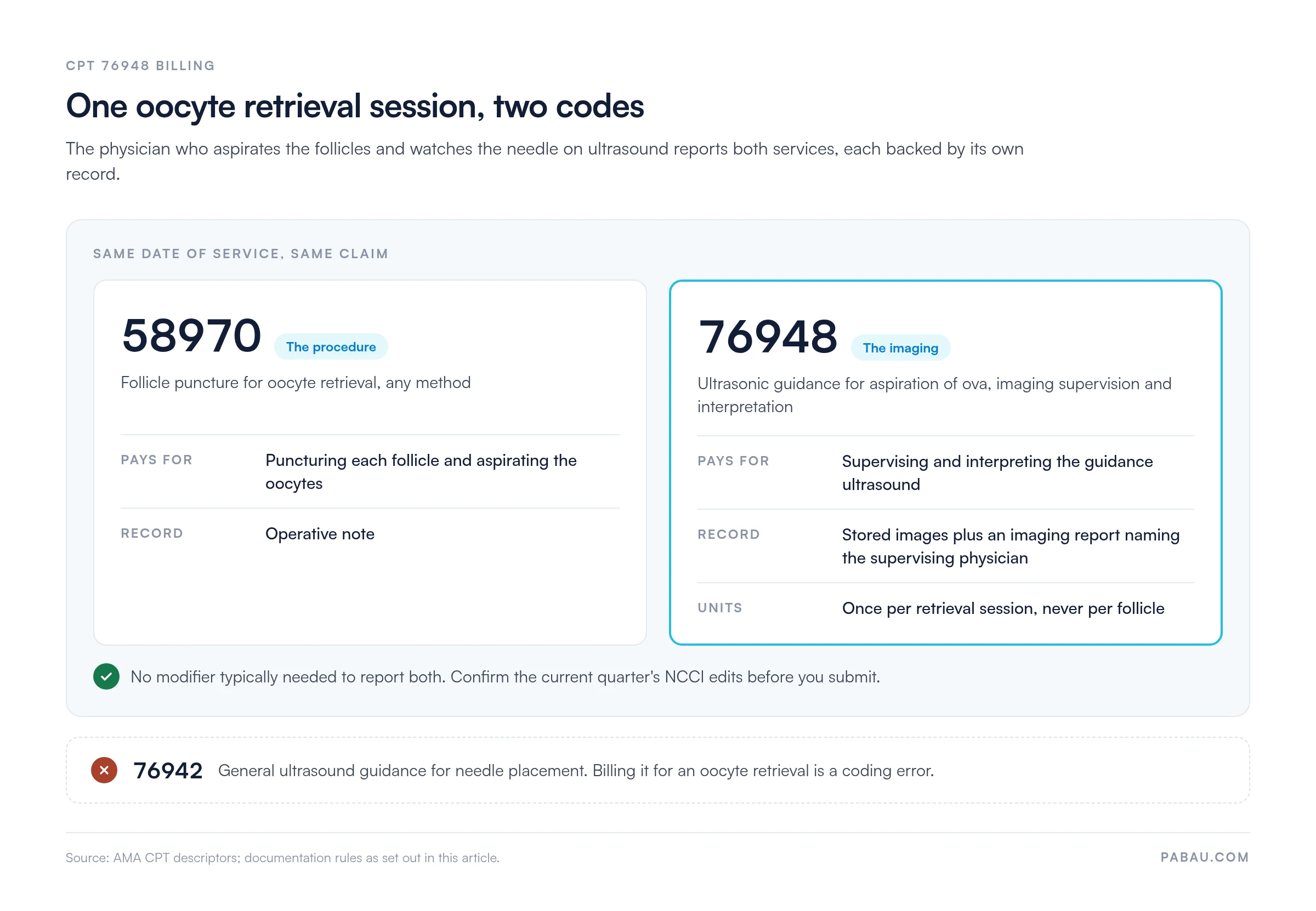
Report 76948 once per retrieval session regardless of how many follicles are aspirated. Billing it per follicle is a known audit trigger and will generate a CCI edit conflict. Confirm that the session date and supervising physician on the claim match the operative note.
CPT 76942 describes ultrasonic guidance for needle placement procedures generally, while CPT code 76948 is specific to guidance for aspiration of ova. Using 76942 for an IVF retrieval is incorrect and is a common denial source. Payers that adjudicate ART claims distinguish the two codes, so 76942 on a documented oocyte retrieval is a coding error.
CPT 58970 describes the follicle puncture for oocyte retrieval procedure itself. In standard ART billing, 76948 and 58970 appear on the same claim. One physician typically performs both the aspiration and the imaging supervision during the same session. See the companion IVF CPT codes reference for the full ART code family.
These two codes are not currently bundled under the National Correct Coding Initiative (NCCI), so they can be reported together without a modifier. CCI edit pairs are updated quarterly, so verify the current edit table before submitting. Code 76948 represents the imaging guidance service, and 58970 represents the aspiration procedure. As the diagram below shows, each one needs its own documentation entry.
Modifier selection for CPT code 76948 depends on the billing arrangement between the physician and the facility where the retrieval occurs. Modifiers 26 and TC split a code only where its MPFS PC/TC indicator allows a split. Check that indicator for 76948 in the current fee schedule before you bill either one.
Payers reviewing CPT 76948 claims look for specific documentation elements in the medical record. A well-structured ART operative note should address each of the following items. Missing any single element is enough to trigger a denial or a request for records.
A clean claim submission for 76948 requires that the documentation be finalized and attached before submission, not added after a denial.
With claims management software, these checks sit in the retrieval encounter, reducing the chance that an imaging report is finalized without the required elements.

Coverage for CPT code 76948 varies significantly by payer. The most important distinction is between Medicare and commercial insurance.
Medicare: Medicare generally does not cover IVF and most ART procedures. Because 76948 is mostly billed during an ART retrieval cycle, it is typically non-covered for Medicare beneficiaries. A standard IVF retrieval claim will be denied. An Advance Beneficiary Notice (ABN) is used where Medicare may deny a service as not reasonable and necessary. It is optional for services Medicare excludes by statute, according to the CMS Claims Processing Manual.
Commercial payers: Coverage varies by state mandate and plan design. States with infertility insurance mandates (such as Illinois, Massachusetts, and New Jersey) typically require commercial plans to cover ART services, which includes 76948. Plans without mandated coverage often exclude ART services altogether.
Prior authorization requirements also differ. Some payers authorize the full IVF cycle, which covers every component code including 76948, while others require code-specific authorization.
Medicare reimbursement rates for CPT code 76948 are published annually in the Medicare Physician Fee Schedule (MPFS). The 2026 MPFS assigns 76948 a work RVU of 0.65 and a total RVU of 2.46, with a global period of XXX. Use the CMS Physician Fee Schedule lookup tool to verify current-year payment for your locality before quoting figures to your practice.
For current RVU values split into work, practice expense, and malpractice, the FastRVU 2026 RVU lookup tool provides searchable access to CMS fee schedule data. Practices handling revenue cycle management for ART programs should check updated MPFS rates each January, when annual fee schedule changes take effect.
Fertility practices submitting through the Claim.MD clearinghouse can send 76948 claims with the right modifiers and verify payer eligibility before the retrieval date. ERA remittances then identify denial reasons at the CARC level, which simplifies follow-up.
CMS can identify any code as potentially mis-valued when its work RVU may no longer reflect the physician’s time, effort, or complexity. A code identified this way goes through a formal review by the AMA/Specialty Society RVS Update Committee (RUC). Knowing how that review works helps you spot a change to 76948 before it reaches your fee schedule.
A “potentially mis-valued” designation does not automatically reduce payment. The RUC reviews the code, collects physician survey data on work effort, and submits a recommendation to CMS. CMS may accept, modify, or reject the recommendation. The result can be a rate increase, a decrease, or no change. The AAPC coding resources and specialty society communications (SREI, ACOG) are the most reliable early-warning channels for proposed rate changes.
Set a calendar reminder for each November when CMS publishes the MPFS final rule. Search for 76948 in the addendum files. If the work RVU changes, update your charge description master before January 1 to avoid under- or over-charging relative to the new allowable.
Denials on CPT code 76948 cluster around a small number of root causes. The table below identifies each one, the typical remittance remark code, and the corrective action. Reviewing your practice’s denial management in healthcare workflow against these patterns helps catch 76948 rejections before they age.
Practices tracking denials at the code level can use the denial codes reference to match each CARC against the corrective actions above. From there, build an appeal letter template for each scenario.
In many fertility practices, one retrieval leaves records in three places. The operative note sits in the EHR, the guidance images sit on the ultrasound system, and the claim is built days later. When the images or the imaging report never reach the billing desk, the 76948 line goes out unsupported.
Pabau, the practice management platform we build for specialist practices, keeps the retrieval encounter in one patient record. The supervising physician, the imaging report, and the stored images sit with the encounter the claim is built from. Denials come back tagged by CARC, so your billing team can work them by cause.
The result is fewer 76948 claims stalled by a records request, and less time spent rebuilding a retrieval session months later.

Pabau helps reproductive endocrinology practices document, code, and submit ART claims from the retrieval encounter. See how it works for your practice.

Treat 76948 as a documentation code first and a coding decision second. The descriptor is narrow, and the code choice rarely goes wrong once 76942 is ruled out. Claims fail when nobody confirmed the stored images, the imaging report, or the payer’s ART coverage before the retrieval.
So move those checks to the start of the cycle, not the billing week after it. Confirm coverage and authorization before stimulation begins, and make image storage a condition of closing the note.
Book a demo to see how Pabau keeps the retrieval record and the 76948 claim together for your fertility practice.

Need a full picture of ART billing codes? IVF CPT codes covers the complete code family for in vitro fertilization procedures, from stimulation monitoring through embryo transfer.
Looking for clearinghouse integration guidance? Claim.MD clearinghouse overview explains how the Pabau and Claim.MD integration handles 837P submissions, ERA processing, and payer enrollment for fertility practices.
Want to reduce claim denials practice-wide? What is medical billing provides a foundational overview of the revenue cycle steps where 76948 and similar ART codes are most vulnerable to errors.
CPT code 76948 covers ultrasonic guidance for aspiration of ova, imaging supervision and interpretation, during oocyte retrieval in ART procedures. It is reported once per retrieval session and needs permanent image documentation to support the claim.
CPT 76948 is specific to ultrasound guidance for aspiration of ova during oocyte retrieval. CPT 76942 covers ultrasonic guidance for general needle placement procedures. Using 76942 for an IVF retrieval is a coding error, so 76948 is the correct code for a documented ART follicle aspiration.
Yes. CPT 76948 (imaging guidance) and CPT 58970 (follicle puncture for oocyte retrieval) are not currently bundled under the NCCI. They can appear on the same claim without a bypass modifier. Confirm the current quarter’s CCI edit table, as bundling rules are updated quarterly.
Generally not in a standard IVF context, because Medicare does not cover most ART procedures. An Advance Beneficiary Notice (ABN) is used where Medicare may deny a service as not reasonable and necessary. It is optional for services Medicare excludes by statute.
The claim needs permanently stored images and an operative note documenting continuous real-time ultrasound guidance. It also needs the supervising physician’s name and a recognized infertility diagnosis code. Some payers also require a separate imaging interpretation report signed by the performing physician.
The 2026 MPFS gives 76948 a work RVU of 0.65 and a total RVU of 2.46, with a global period of XXX. Values can change in any rulemaking cycle, including after a RUC review of a potentially mis-valued code. Check the MPFS proposed rule each summer and the final rule each November.