

HCPCS code E0198: Water pressure pad billing guide
HCPCS code E0198 is a water pad for a standard mattress HCPCS code E0198 is the ...

Last Updated: Oct 13, 2026
88311 is the CPT add-on code for a decalcification procedure, billed with a primary surgical pathology code. Decalcification removes calcium salts from mineralized tissue so it can be cut into thin sections for microscopic review.
Bone biopsies are the usual trigger, but calcified soft tissue, teeth and ossified lesions need it too. The primary code must come from 88302-88309, and the pathology report must state that decalcification was performed.
Let Pabau's smart automation suggest the right codes, reduce claim denials, and keep your practice compliant—effortlessly.
Automate repetitive tasks and focus on what matters most—your patients.
Reduce coding errors and ensure compliance with the latest regulations.
Clean claims, fewer denials, and faster reimbursements.
Powerful insights and reporting to help your practice thrive.
HIPAA compliant SOC 2 certified GDPR-compliant Trusted by 4,000+ clinics worldwide

CPT Code 88311 reports the decalcification step in surgical pathology, not special staining or the primary examination.
88311 is an add-on code (+88311), so it is always reported with an eligible primary code from the 88302-88309 range.
The pathology report must state that decalcification was performed, and a report that leaves it out is a common cause of denial.
Medicare’s national non-facility rate for 88311 is approximately $19.72-$19.73, paid in full on top of the primary code.
Pabau’s claims management software sends claims through its Claim.MD clearinghouse integration and flags denied claims for rework.
CPT Code 88311 is the add-on code for decalcifying a surgical pathology specimen before it can be sectioned. The American Medical Association descriptor reads: Decalcification procedure (List separately in addition to code for surgical pathology examination).
The code sits in the Surgical Pathology subsection (88300-88399) of the Pathology and Laboratory chapter. The + symbol in the CPT code set marks it as an add-on, so it can’t stand alone on a claim.
Decalcification is the histologic process of removing calcium salts from a mineralized tissue specimen. It lets standard microtome blades cut thin, uniform sections suitable for staining and microscopic review. Without it, calcified bone or tooth specimens would shatter or fail to section properly, making histologic diagnosis impossible.
CPT 88311 must always be reported alongside an eligible primary surgical pathology code from the 88302-88309 range on the same claim. It cannot be submitted as the only pathology code on a line item. Payers treat a standalone 88311 claim as an editing error and deny it automatically.
The two codes split the work. The primary code captures the complexity level of the gross and microscopic examination, while 88311 captures the extra preparation that decalcification takes. Both are separately payable, as long as the documentation supports each one.
88300 (gross examination only) is not an eligible primary code in AMA guidance. Gross-only examinations don’t involve the microscopic processing that decalcification supports. If a coder pairs 88311 with 88300, expect a denial on medical-necessity grounds.
Bone biopsies usually land at Level IV, which makes 88305 the pairing coders see most often. The diagram below shows how the lines of a claim with 88311 fit together.
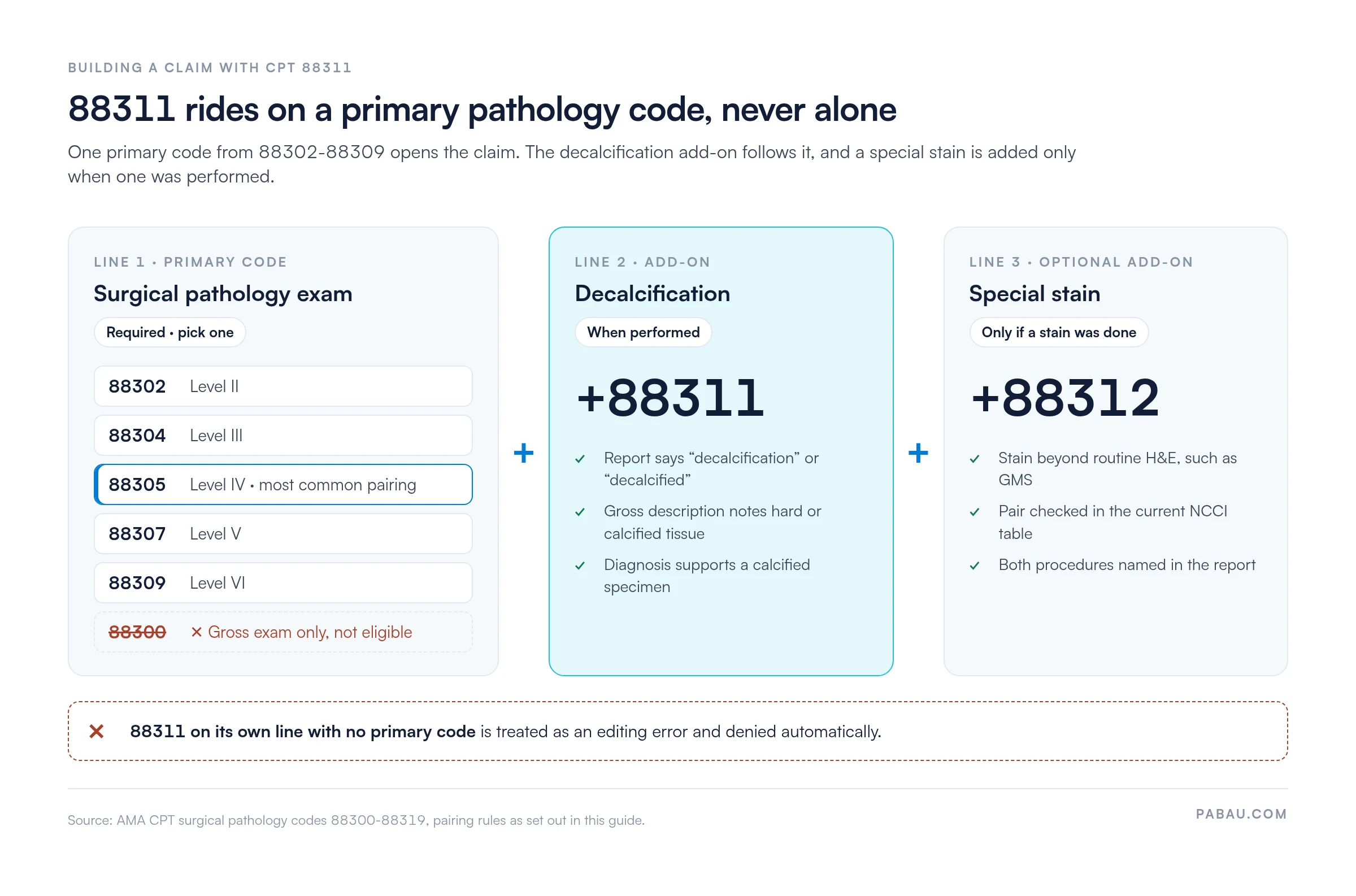
Decalcification is required whenever a specimen contains mineralized tissue that would prevent standard sectioning. Bone biopsies and bone resections are the most common scenario, but calcified soft tissue, teeth and ossified lesions qualify too.
The pathologist determines whether decalcification is necessary after gross inspection of the specimen. If the tissue sections adequately without it, 88311 should not be billed. Medical necessity rides on the pathologist’s documented judgment, not on the specimen type alone.
88311 covers decalcification, and 88312 covers special staining. They’re separate services, so both may be billed when both are performed on the same specimen. NCCI edits must permit the pairing, and the report must document each one.
A bone biopsy may need both decalcification and a special stain to identify an organism, such as GMS for fungal osteomyelitis. In that case, bill both 88311 and 88312 with the primary pathology code. Verify the NCCI edit pair before submitting, and ensure the pathology report documents both procedures explicitly.
Understanding where 88311 sits in the surgical pathology series helps coders select the right primary code and avoid unbundling errors.
Bone biopsies are most often coded to Level IV (88305) or Level V (88307) surgical pathology as the primary code. When a bone biopsy also required decalcification, bill 88305 or 88307 as the primary and append 88311 on a separate line of the same claim. Confirm in the pathology report that both the examination level and the decalcification step are explicitly documented before submitting.
The pathology report must state explicitly that decalcification was performed. A vague mention of “tissue processing” or “specimen preparation” does not satisfy payer requirements. Payers pay only for services the record shows were performed, one of the medical billing fundamentals that applies to every add-on code.
The diagnosis code on a claim containing CPT Code 88311 must support the medical necessity of both the primary examination and the decalcification step.
An unspecified code such as M89.9 is acceptable when specificity can’t be established at the time of biopsy. When the report documents the clinical indication, a more specific code is always preferred.
Medicare reimburses CPT Code 88311 under the Medicare Physician Fee Schedule (MPFS). CMS’s published CY2025/CY2026 national non-facility rate for 88311 is approximately $19.72-$19.73.
Billed with modifier 26 for the professional component, it pays about $11.36-$11.64. With modifier TC for the technical component, it pays about $8.09-$8.36. Fee schedule amounts change every January 1, so confirm the current rate in the CMS MPFS lookup tool before estimating reimbursement.
Add-on codes like 88311 are exempt from the multiple-procedure payment reduction that applies to some other code pairs.
This means that when 88311 is reported alongside an eligible primary pathology code, the full payment rate applies to 88311. It is not subject to the 50% reduction that sometimes affects secondary procedure codes in other code families.
Commercial payers vary considerably. Some follow Medicare rates exactly, while others set proprietary fee schedules that may be higher or lower. When a commercial plan lacks a contracted rate for 88311, use the Medicare allowable as a reference point in negotiation. Document the discussion for audit purposes.
Most commercial payers cover CPT Code 88311 without requiring prior authorization. Decalcification is a routine preparatory step decided at the time of specimen processing, not in advance of the procedure.
Pre-authorizing it would require requesting approval after the surgery but before the lab result, which is not operationally feasible for most pathology workflows.
That said, coverage varies by plan and jurisdiction. A few specific situations warrant a closer look:
The National Correct Coding Initiative (NCCI) Procedure-to-Procedure (PTP) edit tables govern which code pairs may be billed together without a modifier. They also set which pairs require documentation of a distinct service. For CPT Code 88311, the key NCCI considerations are:
Verify current NCCI tables at the CMS website each quarter. The AAPC’s Codify platform cross-references NCCI edit status alongside CPT code details, which can streamline this check for coding teams.
Most 88311 denials fall into six predictable categories. Each one comes back on the remittance as one of the denial codes billers see, so the fix starts from that code. A consistent approach to denial management in healthcare keeps rework and appeals from piling up.
Practices using claims management software can run pre-submission checks for add-on code pairing and missing documentation. Catching those errors before the claim reaches a payer cuts the rework cost of avoidable denials.
Run this checklist before submitting any claim that includes CPT Code 88311. Each step maps to one of the common denial reasons above.
Teams working with the clean claim standard as a benchmark can use this checklist as a pre-submission gate. A claim that passes all seven steps above should clear initial payer adjudication without an add-on code denial.
Run a monthly audit of all 88311 claims submitted in the prior 90 days. Pull the denial rate specifically for add-on code pairing errors (often returned with CARC code 97 or remark code M15). If pairing denials exceed 5% of total 88311 submissions, look at the billing system first. The usual root cause is a missing workflow rule there, not a documentation problem in the lab.
Without a pre-submission check, a missing primary code or an undocumented decalcification step only surfaces when the denial comes back. By then the claim has aged, and the rework eats into the payer’s filing window.
Pabau, the practice management platform we build, turns a completed invoice into an electronic CMS-1500 claim. Its Claim.MD clearinghouse integration sends that claim to thousands of US payers and checks coverage in real time before treatment.
When the payer responds, the electronic remittance advice comes back into Pabau and is matched to the claim it settles. Denied claims are flagged for rework, so a rejected 88311 line is visible the day the ERA arrives.
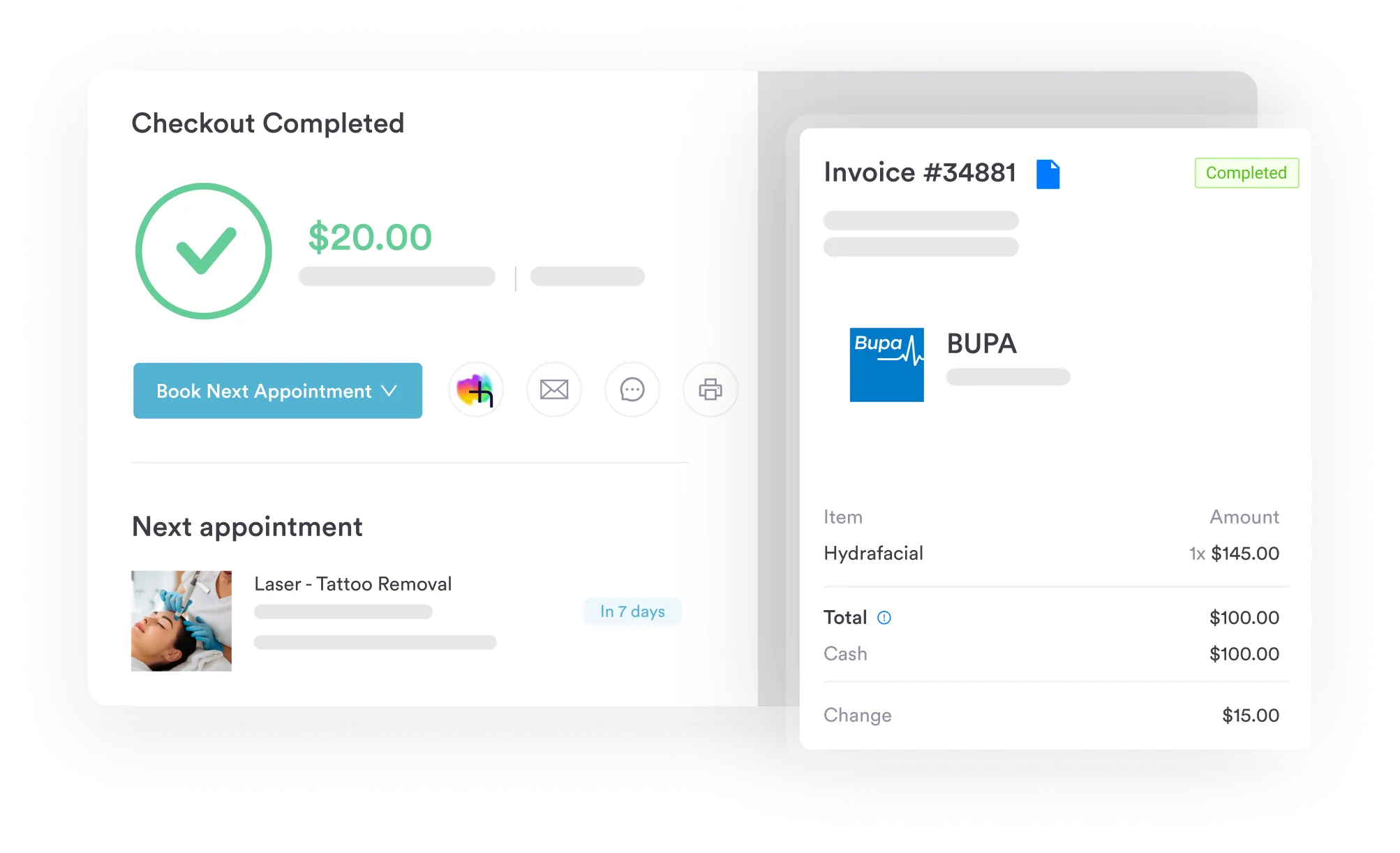

Pabau turns invoices into electronic claims, checks eligibility in real time and matches each remittance to its claim. A denied add-on code like 88311 is flagged for rework the day it comes back.

Medicare’s national rate for 88311 is under $20, so a denied line rarely justifies a long appeal. The savings come from claims that never fail in the first place. Two checks prevent the most common denials. The claim needs a primary code from 88302-88309, and the report needs the word “decalcification”.
If your team bills bone biopsies in volume, make both checks part of pre-submission review instead of relying on memory. A minute per claim costs less than reworking a denial on a code worth under $20. Book a demo to see how Pabau tracks pathology claims from invoice to remittance.

Need to understand how clearinghouse submission works for add-on codes? Medical claims clearinghouse guide explains how electronic claim routing reduces add-on code pairing errors before claims reach payers.
Want to understand the 837P file format for surgical pathology claims? 837 file guide covers how add-on codes like 88311 are structured in the electronic claim transaction standard.
Coding a Level III specimen such as a lymph node biopsy? CPT Code 88304 covers one of the primary codes that 88311 can be billed with.
Unsure whether a gross-only exam can carry an add-on? CPT Code 88300 explains the gross-only examination code, the one 88300-series code that cannot anchor 88311.
CPT Code 88311 describes the decalcification procedure performed in surgical pathology. Calcium salts are chemically removed from a mineralized tissue specimen so that thin sections can be cut and examined microscopically. It is an add-on code that must be reported alongside an eligible primary surgical pathology code (88302-88309).
Yes. CPT 88311 is designated as an add-on code by the AMA, identified by the + symbol in the CPT code set. It cannot be billed as a standalone service. A primary surgical pathology code from the 88302-88309 range must appear on the same claim.
CPT 88311 describes decalcification (chemical removal of calcium from calcified tissue before sectioning), while CPT 88312 describes special staining beyond routine hematoxylin and eosin. They are separate services for separate preparatory procedures. Both may be billed on the same claim when both were performed and documented on the same specimen.
The pathology report must explicitly state that decalcification was performed, using the word “decalcification” or “decalcified.” It must also include the anatomic site, gross and microscopic descriptions, the clinical indication for the biopsy, and the pathologist’s signature. A general reference to “tissue processing” without naming decalcification specifically will not support the claim.
The most common pairings are bone neoplasm codes, such as C40.x and C41.x for primary tumors and C79.51 for metastases. Codes for osteomyelitis (M86.x), bone disorders (M85.x, M89.x) and calcified soft tissue (M61.x) are also common. The diagnosis selected must reflect the clinical reason the specimen was collected and must support the medical necessity of decalcification.
The most common reasons are a missing primary surgical pathology code and decalcification left out of the pathology report. An unsupported ICD-10 code, the wrong place of service and NCCI edit conflicts with other add-on codes also trigger denials. Missing the primary code is the single most frequent cause and the most easily preventable with a pre-submission billing scrubber.
In most cases, no. Decalcification is determined at the time of specimen processing, making advance authorization impractical. However, some Medicaid programs and commercial plans may have specific policies. Always verify with the individual payer before assuming authorization is not required, and check applicable MAC Local Coverage Determinations for Medicare patients.



