



CCSD code G5100: Bypass of duodenum billing guide
CCSD code G5100 bills a bypass that leaves the duodenum in place CCSD code G5100...

Last Updated: Oct 16, 2026
CPT Code 88304 is the surgical pathology code for a Level III gross and microscopic examination of a specimen. It covers a fixed AMA list of roughly 43 specimens, such as gallbladder, hemorrhoids, tonsils and adenoids, and carpal tunnel tissue. The specimen on that list decides the level, so a case cannot move up to 88305 because it took longer to read.
This reference covers the official descriptor, the Level III specimen list, as well as where 88304 sits in the 88300-88309 hierarchy. It also covers the Medicare rate basis, valid modifiers, billing rules, common errors, and the ICD-10 codes that support medical necessity.

CPT Code 88304 covers a Level III surgical pathology examination, so both a gross description and a microscopic examination are required.
Level III specimens include gallbladder, hemorrhoids, tonsils and adenoids, carpal tunnel tissue, and an appendix removed other than incidentally.
The unit of service is the specimen, so extra blocks cut from one specimen add no billable units.
A qualifier often decides the level, since foreskin, newborn is 88302 while foreskin, other than newborn is 88304.
Because these claims move in volume, Pabau’s claims management software helps pathology billing teams track 88304 submissions, modifiers, and remittance status in one place.
CPT Code 88304, as defined by the American Medical Association, carries this official descriptor: “Surgical pathology, gross and microscopic examination; Level III.” So both a gross description and a microscopic examination are required. Where only a gross examination is performed, 88300 applies instead.
Within the AMA CPT code set, 88304 is a standalone service code. The unit of service is the specimen, which the AMA defines as tissue submitted for individual and separate attention. The examination must also be performed and interpreted by a qualified pathologist.
The XXX global period indicator means pre- and post-service work is not bundled into the payment rate. Each pathology service is instead billed on its own merits, with no global surgery package applying.
The AMA publishes a fixed specimen list for each surgical pathology level, and the Level III list runs to about 43 entries. A specimen that is absent from that list is coded at whichever level does carry it. The grouping below follows the AMA list, sorted by body area for quicker lookup.
Many Level III entries carry a qualifier, and that qualifier, rather than the organ itself, separates the specimen from a neighboring level. The pairs below produce most of the level-selection errors seen on surgical pathology claims.
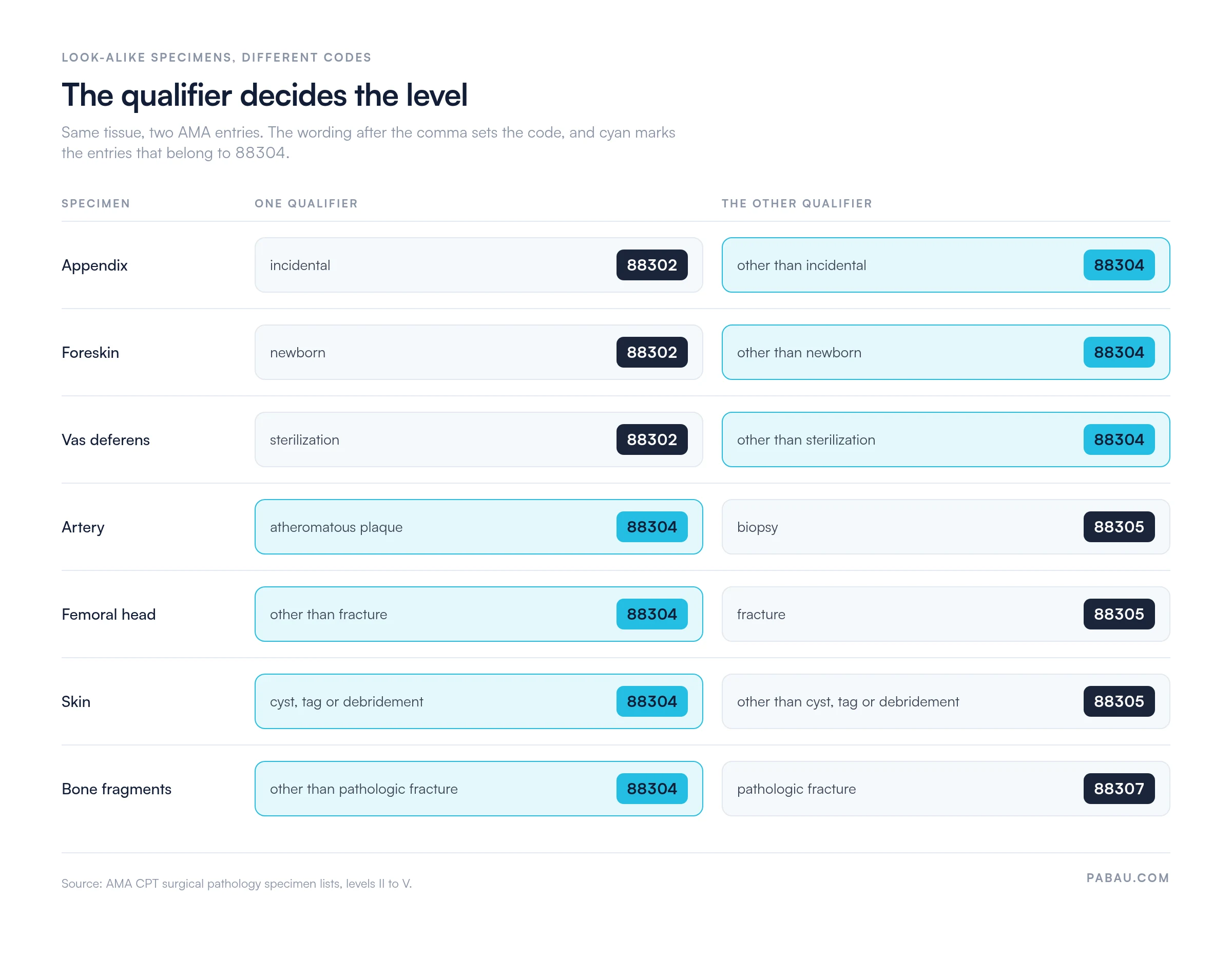
Carpal tunnel tissue, for example, is one of the specimens coders most often drop a level. It belongs at 88304, so billing it as 88302 is downcoding. Check every specimen against the AMA list before the level is assigned.
The surgical pathology codes form a six-level hierarchy, from Level I (gross examination only) to Level VI (the most extensive resections). So knowing where 88304 sits prevents the level-selection errors that trigger denials and repayment demands.
The series runs 88300, 88302, 88304, 88305, 88307 and 88309. Neither 88301 nor 88303 was ever an assigned CPT code, so a claim carrying one of those numbers will reject as invalid. In short, Level II is 88302 and Level III is 88304.
Medicare reimbursement for CPT Code 88304 is set every year by the CMS Physician Fee Schedule. Dollar amounts change each year with the final rule, and geographic practice cost index (GPCI) adjustments apply by Medicare locality. Verify the current figures directly through the CMS PFS Look-Up Tool before you quote a rate.
Facility and non-facility rates also differ for 88304, and the locality adjustment moves the final payment again. A lab billing at volume should reconcile remittances against its own locality rate rather than the national amount.
RVU values are updated each year in the CMS MPFS final rule. The three components for 88304 are the work RVU, the practice expense RVU, and the malpractice RVU. Those are then multiplied by the annual conversion factor to produce the national payment amount. Pull the figures from the CMS relative value files rather than a third-party calculator, because aggregators lag the final rule.
Modifier selection for CPT Code 88304 depends on who owns the laboratory equipment. It also depends on how the service is split between the technical and professional components. Incorrect modifier application is a leading RAC audit finding for pathology claims.
Modifier 91 belongs to clinical diagnostic laboratory testing, so it rarely fits a surgical pathology claim at all. CMS guidance also specifies that modifier 59 should only be used when no other modifier describes the situation. Overuse of 59 to bypass National Correct Coding Initiative (NCCI) edits without a clinical reason is a well-established False Claims Act risk in pathology billing.
The unit of service for 88304 is the specimen, which the AMA defines as tissue submitted for individual and separate attention. Extra blocks, levels or cassettes cut from that same specimen do not create extra units. Two separately identified specimens, though, do.
Each claim line needs the correct place of service code, the rendering provider NPI, and a matching ICD-10 diagnosis. POS 81 is usually the choice for an independent laboratory. High-volume labs tend to route these claims through claims software for practices, so the level, the modifier and the diagnosis are checked together before submission.
Run your 88304 claims through an NCCI edit checker before submission. NCCI edits for the 88300-88309 series are updated quarterly by CMS. Then review your most frequently billed code pairs against the current edit tables each quarter. That stops a systemic denial pattern before it reaches audit thresholds.
The most expensive errors on CPT Code 88304 claims fall into five patterns. Each one can be prevented with a documented pre-billing check, as well as consistent reference to the AMA specimen list. Building those checks into the workflow also beats fixing them after an audit.
Reviewing pathology denials quarterly surfaces systemic level-selection errors before they build into a RAC target. A denial rate above 5% on 88304 lines warrants a full coder audit against the current AMA specimen criteria.
The Level III against Level IV decision is the most common coding error in surgical pathology. Because the AMA descriptor for both codes uses identical language apart from the level number, checking the specimen list settles it.
Clinical complexity, though, does not determine the level. A pathologist who spends an hour on a gallbladder still bills 88304, because gallbladder is a Level III entry. Where the specimen appears on the Level IV list instead, bill 88305.
Diagnosis codes must match the clinical indication documented by the ordering physician, rather than the pathology finding. The pairings below are examples for common Level III specimens. Confirm each one against the current ICD-10-CM codes before the claim goes out, because the annual update adds and retires subcodes.
Diagnosis and procedure mismatches are a leading cause of 88304 denials. The ICD-10 code must reflect the indication on the requisition, rather than the final diagnosis reached after review. Where the ordering physician documents a rule-out, the claim carries that indication code instead of an established diagnosis.
Surgical pathology examinations often require ancillary testing beyond the base gross and microscopic review. These codes are billed separately from CPT Code 88304 and each carries its own documentation trigger.
Group I covers stains for microorganisms, while group II covers the remaining special stains. Immunohistochemistry is coded to 88342 and 88341 rather than to either stain group. Billing 88342 ten times without individual antibody documentation triggers a medical necessity review at most commercial payers.
A Group II stain such as iron or trichrome is billed under CPT code 88313, which includes the pathologist’s interpretation and report. Each distinct stain earns its own unit, provided the signed report documents what the pathologist found.
Most 88304 references stop at the specimen list and say little about the report itself. The College of American Pathologists and the AMA both set minimum documentation standards, and a retrospective review then tests the report against them.
A compliant pathology report for CPT Code 88304 includes all five elements below. A missing element puts the whole claim line at risk on review.
Cross-referencing the accession, the CPT code and the ICD-10 code at the moment of sign-out reduces transcription errors downstream. Confirming documentation completeness at the source costs far less than discovering it during a billing audit weeks later.
Build a pathology report template with required fields for gross description, cassette count, microscopic description and final diagnosis before sign-out is permitted. Requiring each field before the report can be signed off prevents the documentation misses that trigger 88304 denials on retrospective review.
Most pathology billing teams still re-key the code, the modifier and the diagnosis from the signed report into a separate billing system. Practice management software like Pabau keeps the encounter record and the claim in one place, so the submission draws on what was already recorded.
Claims then go out through the Claim.MD clearinghouse integration, which reaches thousands of US payers. Eligibility can be checked in real time before the claim is built. ERA and 835 remittance files come back into the same record, so reconciliation does not need a separate spreadsheet.
The platform submits and tracks the codes your team records. Choosing the level and attaching the diagnosis stays with the pathologist and the coder, working from the AMA specimen list. What Pabau removes is the re-keying and the status chasing on either side of that decision.

Pabau connects your practice management workflows directly to claims submission, modifier tracking and remittance reconciliation. See how it handles surgical pathology billing for your team.

Overall, level selection is what determines whether an 88304 claim survives review. The AMA specimen list settles it, and the qualifier attached to an entry matters as much as the organ named in it. Yet examination time carries no weight at all.
Build the check into sign-out rather than into the appeal. A report that names the specimen, its qualifier, the gross findings and the microscopic findings gives a coder every detail the level assignment depends on.
Pabau’s claims management software submits 88304 claims through the Claim.MD clearinghouse to thousands of US payers. Eligibility checks and ERA remittance are also handled in the same record. Book a demo to see how it fits a pathology billing workflow.

Need help managing claim denials on pathology codes? Denial management in healthcare covers the systematic approaches practices use to track, appeal, and reduce denial rates.
Want to understand how clearinghouses process surgical pathology claims? Medical claims clearinghouse explains how 837 transactions are validated before payer submission.
Building a compliant billing workflow for your lab? Medical billing compliance outlines the documentation and audit-trail requirements for sustainable revenue cycle operations.
CPT Code 88304 is the surgical pathology code for a Level III gross and microscopic examination. So it applies when a pathologist documents both a gross description and a microscopic analysis. The specimen also has to appear on the AMA Level III list, which includes gallbladder, hemorrhoids, tonsils and adenoids, and carpal tunnel tissue.
The AMA Level III list runs to about 43 specimens. Common ones are gallbladder, hemorrhoids, tonsils and adenoids, carpal tunnel tissue, soft tissue lipoma, intervertebral disc, meniscus and an appendix removed other than incidentally. Many entries carry a qualifier that decides the level, such as femoral head, other than fracture. Assignment follows the list, rather than the effort the examination took.
Yes. Modifier 26 is appropriate when the pathologist provides only the professional component and does not own the laboratory equipment used for processing and staining. In that arrangement the lab bills the technical component with TC, while the pathologist bills 88304-26. Where the pathologist owns both components, bill the global code without splitting it.
One unit per specimen. The AMA defines a specimen as tissue submitted for individual and separate attention. So extra blocks, levels or cassettes cut from that specimen add no units. An accession holding three separately identified specimens generates three units, each coded at its own level.



