

CCSD code G5100: Bypass of duodenum billing guide
CCSD code G5100 bills a bypass that leaves the duodenum in place CCSD code G5100...

Last Updated: Oct 16, 2026
CPT code 88302 is the Level II surgical pathology code for a gross and microscopic examination of low-complexity specimens. The AMA ties it to a short list of tissues, such as vas deferens and fallopian tube segments from sterilization, newborn foreskins and hernia sacs.
The specimen and its clinical context set the level, not how simple the tissue looks. A report with gross findings only supports 88300, not 88302. A tissue missing from the Level II list goes to the level whose listed specimens best match the work, often 88305.
Let Pabau's smart automation suggest the right codes, reduce claim denials, and keep your practice compliant—effortlessly.
Automate repetitive tasks and focus on what matters most—your patients.
Reduce coding errors and ensure compliance with the latest regulations.
Clean claims, fewer denials, and faster reimbursements.
Powerful insights and reporting to help your practice thrive.
HIPAA compliant SOC 2 certified GDPR-compliant Trusted by 4,000+ clinics worldwide

CPT code 88302 covers a gross and microscopic examination of the specimens the AMA lists at Level II.
A report with gross findings only supports 88300 (Level I), so the microscopic findings must appear in the report.
The specimen type sets the level, so a tissue missing from the Level II list usually codes higher, often at 88305.
Each specimen submitted and examined separately is one unit, so two labeled sterilization segments support two units.
Medicare pays 88302 less than higher-level codes such as 88305 and 88307, so confirm current rates in the CMS look-up tool.
CPT code 88302 reports a gross and microscopic examination of a Level II surgical pathology specimen. The official descriptor reads Level II, Surgical pathology, gross and microscopic examination. The pathologist describes the tissue by eye, then reviews slides under the microscope before signing the report.
Level II sits low in a six-level series. The specimens are routine and the diagnosis is usually predictable, so the payment is modest. Still, the exam is complete. A specimen that gets only a gross look belongs at Level I, 88300.
The table shows where 88302 fits. Each level is defined by the specimens the AMA assigns to it, not by how long the exam took.
The AMA names the Level II specimens in the CPT code set. If the tissue is on this list, 88302 is the starting point:
Notice the qualifiers. “Incidental”, “sterilization” and “newborn” do the work, and the same organ can land at a different level without them. For a specimen that is not listed, CPT directs you to the level whose specimens best match the work involved. Unless a more specific level fits, that usually means Level IV, 88305.
Put together, the level check comes down to three questions, asked in the order shown below.
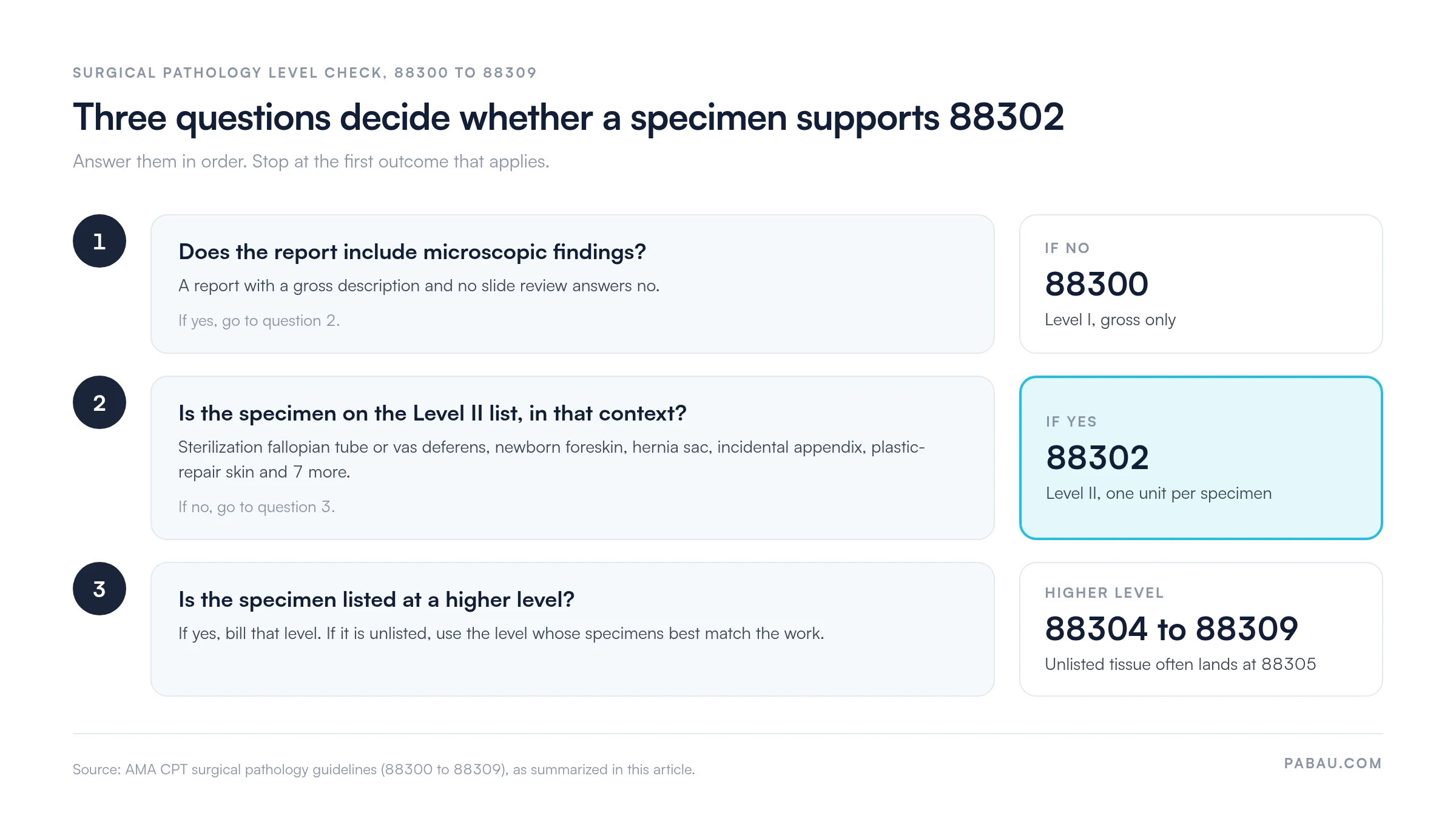
Level errors on 88302 often come from these near-identical pairs. The organ matches, but the clinical context moves the code up.
Here is a worked example. After a vasectomy, the urologist sends the left and right vas deferens segments in two labeled containers. The pathologist examines each one grossly and microscopically, then confirms a full cross-section of vas deferens on both sides. That supports two units of 88302, linked to Z30.2, encounter for sterilization.
Swap the context and the code changes. A segment removed during hernia repair is not a sterilization specimen, so it moves to CPT code 88304. A fallopian tube from an ectopic pregnancy goes to CPT code 88305.
An auditor reads the report to see both halves of the exam. Use this checklist for every Level II specimen:
The microscopic line matters more than it looks. On a sterilization specimen, it is the proof that the right structure was removed. Without it, the report describes a gross-only exam, and the claim should go out as 88300.
Once a quarter, compare 88302 volumes against the OR log for sterilization and hernia cases. A rise in 88302 units without a matching rise in those cases points to miscoded specimens, so you can correct them before a payer review.
Some specimens need more work than the base exam. These codes are reported in addition to 88302 when the service was performed and the report says so:
Level II specimens rarely need stains, so a stain on one should have a clear reason in the report. Check the current NCCI edits before you pair any of these codes with 88302. For decalcification rules in more depth, see the guide to CPT code 88311.
Medicare pays 88302 under the Medicare Physician Fee Schedule. The payment is lower than for higher-level codes such as 88305 and 88307, because Level II carries fewer relative value units.
Who bills which part depends on where the slides are made. An independent lab that processes and reads the specimen bills the global service. In a hospital, the pathologist usually bills the professional component with modifier 26, and the hospital covers the technical side.
CMS updates rates every year in the final fee schedule rule, usually published in November. To get a current figure, search 88302 in the CMS Physician Fee Schedule Look-Up Tool and pick your year and locality. Commercial and Medicaid rates are set separately, so check each contract.
A Level II claim is simple, but each handoff is a chance to lose detail. This is the usual path from container to payment:
Denials on 88302 follow a few patterns. Each one starts upstream of billing, which is why the fix is usually a process change.
When a denial does come back, read its CARC code against a denial codes reference. Then sort repeat causes with a denial management workflow, so one fix covers every similar claim.
A two-minute check catches most of the problems above. Confirm each point before the claim leaves your system:
For the wider claim-quality picture, the clean claim guide shows the fields payers reject most often.
Most 88302 errors are coding decisions, and those stay with your coders and pathologists. What software can take off their plate is the submission work around each claim.
Pabau, the practice management platform we build, brings faster claims management to routine pathology billing. Claims go out as electronic 837P files, and eligibility checks run before the claim is built. Pabau checks that required claim fields are complete before you can send, and submits through Claim.MD.
The result is fewer rejections for reasons unrelated to the specimen. Your team keeps its time for the level and documentation questions that need a person.
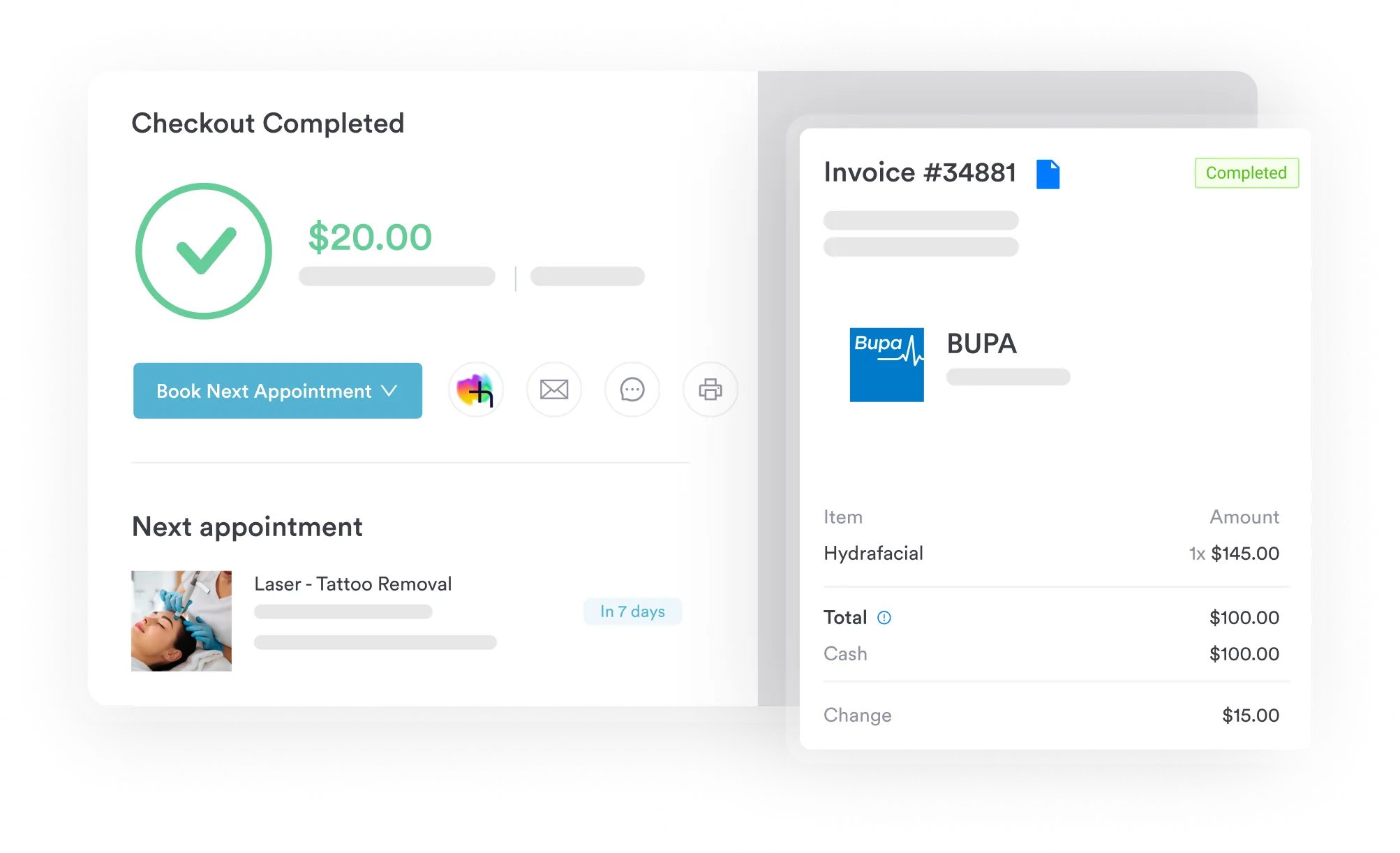

Pabau checks eligibility, confirms required claim fields are complete and submits 837P files through Claim.MD, so your team spends less time on rejected pathology claims.

CPT code 88302 is a small claim that shows up often. That volume is the risk, because one habit repeated across hundreds of specimens becomes a pattern a payer will notice.
The fix sits in two places. Code from the specimen and its context, not from how simple the tissue looks. Then make sure every report shows the microscopic half of the exam. Get those right and 88302 becomes the routine, steady payment it should be.
Book a demo to see how Pabau handles claim submission and eligibility checks for your pathology billing.

Billing the next level up? CPT code 88305 covers the Level IV specimens, including most biopsies.
Need a denial management framework for your lab? Denial management in healthcare shows how to sort, track and resolve claim denials by CARC code.
Wondering how clearinghouse submission works? Medical claims clearinghouse guide explains the 837P flow, scrubbing and payer routing in plain language.
Building claims from a superbill? Superbill guide walks through the fields a superbill needs before it becomes a claim.
Report has gross findings only? CPT code 88300 covers the Level I gross-only exam and when it applies.
The diagnosis should explain why the tissue was removed. Common pairings include Z30.2 for sterilization specimens, Z41.2 for routine newborn circumcision and K40.90 for an inguinal hernia sac. Always code from the clinical record, not from the specimen type alone.
Payers rarely require prior authorization for surgical pathology, because the exam follows a procedure that was already approved. Some commercial plans have their own rules, so check the policy for each payer you bill often.
The AMA updates the CPT code set every year, with changes effective January 1. Review the surgical pathology section each January, and update any specimen-to-code mapping in your lab system at the same time.
Excess skin from a plastic repair is a Level II specimen, but coverage usually follows the surgery. If the payer treats the procedure as cosmetic, it may deny the 88302 claim too. Check coverage before the case when you can.



