HCPCS code J2550: Promethazine HCl injection billing guide
What is HCPCS code J2550? HCPCS code J2550 is a Level II drug supply code descri...

Last Updated: Oct 6, 2026
87631 is the CPT code for nucleic acid detection of several respiratory viruses in one multiplex test, covering 3 to 5 targets. Labs report it for small panels, such as influenza A, influenza B and RSV run together on one swab.
Code choice depends on how many targets the lab reports. Six to 11 targets move the claim to 87632, and 12 to 25 targets move it to 87633. A dedicated SARS-CoV-2, influenza A/B and RSV assay reports as 87637 instead.
Let Pabau's smart automation suggest the right codes, reduce claim denials, and keep your practice compliant—effortlessly.
Automate repetitive tasks and focus on what matters most—your patients.
Reduce coding errors and ensure compliance with the latest regulations.
Clean claims, fewer denials, and faster reimbursements.
Powerful insights and reporting to help your practice thrive.
HIPAA compliant SOC 2 certified GDPR-compliant Trusted by 4,000+ clinics worldwide

CPT code 87631 covers multiplex nucleic acid detection of 3 to 5 respiratory virus targets in a single panel run.
Choose the tier by counting targets: 87631 covers 3 to 5, 87632 covers 6 to 11, and 87633 covers 12 to 25.
A dedicated four-target assay for SARS-CoV-2, influenza A/B and RSV reports under its own code, 87637.
Every 87631 claim needs an ICD-10 diagnosis code that establishes medical necessity, such as J06.9, R05.9 or R50.9.
Pabau’s claims management software submits 87631 claims electronically through Claim.MD, which checks claims for common errors before they reach the payer.
CPT code 87631 is the code for multiplex nucleic acid testing that detects 3 to 5 respiratory virus targets in one run. The American Medical Association’s CPT Editorial Panel maintains it. It sits in the Microbiology subsection (87001-87999) of the Pathology and Laboratory section.
“Multiplex amplified probe technique” means the test looks for several viruses at once in a single specimen. That specimen is usually a nasopharyngeal swab, and the method is a nucleic acid amplification test (NAAT) such as PCR.
The phrase “types or subtypes” decides how you count. Influenza A and influenza B are two separate targets, not one. RSV A and RSV B also count as two. So a panel detecting influenza A, influenza B and RSV A reports as 87631, with three targets.
Any respiratory virus combination that totals 3 to 5 targets falls under 87631. The most common is influenza A, influenza B and RSV, a three-target panel found on many point-of-care and rapid NAAT platforms.
Adding SARS-CoV-2 to that trio changes the code. A dedicated influenza A/B, RSV and SARS-CoV-2 assay reports as 87637. Other combinations of 3 to 5 targets stay with 87631, such as influenza A/B and RSV plus parainfluenza or human metapneumovirus. A sixth target pushes the claim to 87632.
Panels detecting six or more targets fall outside 87631. Adding adenovirus and rhinovirus to a flu, RSV, COVID-19 and metapneumovirus combination is one example. Report those as 87632 or 87633, depending on the total target count.
The three respiratory panel codes share the same NAAT method and differ only by the number of targets detected. Picking the wrong tier is the most common coding error on these claims. It usually happens when coders go by the test’s brand name instead of counting the analytes reported.
The chart below turns that rule into two checks: first rule out the dedicated 87637 assay, then count.
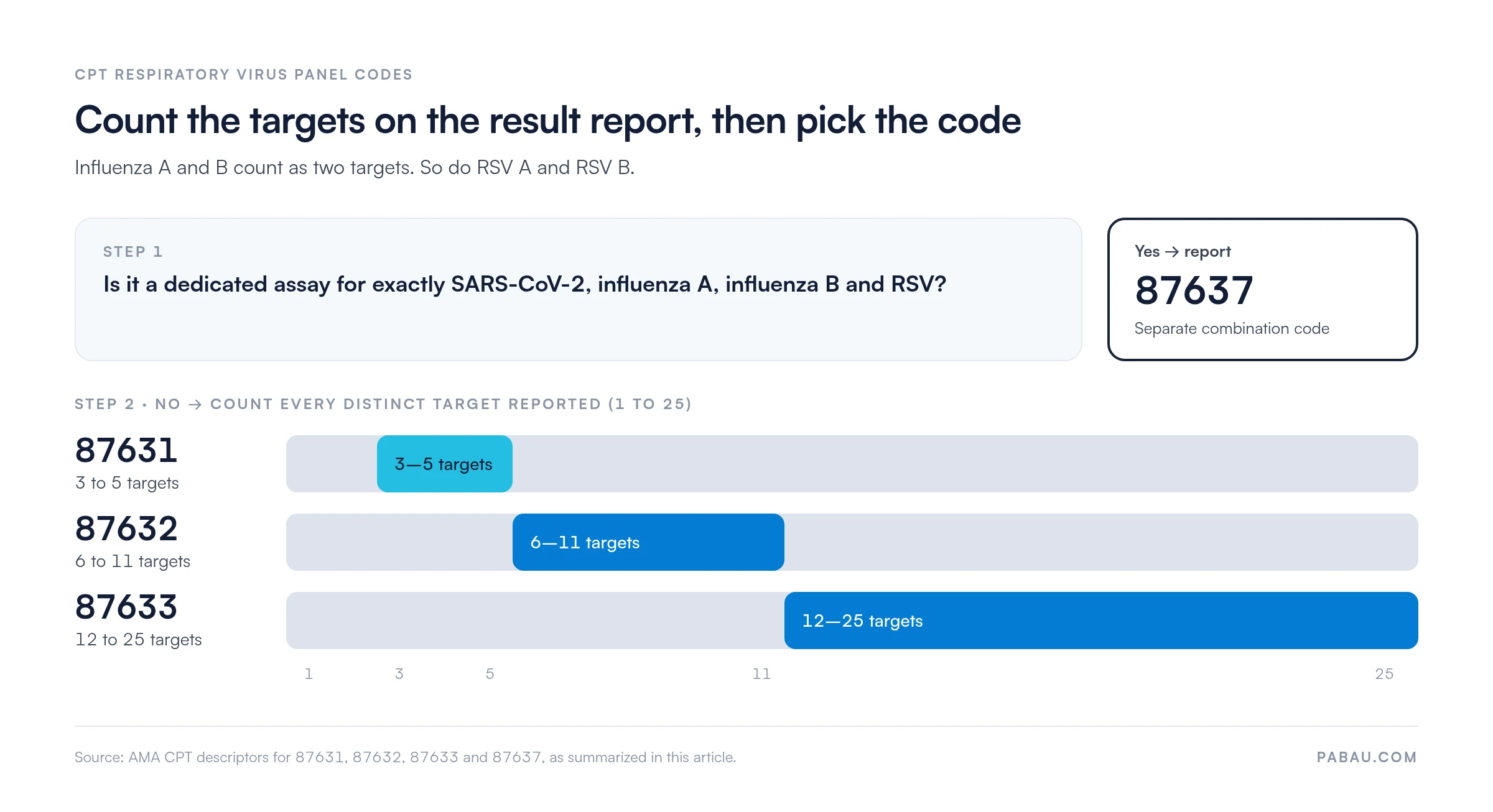
Where 87637 fits: CPT code 87637 covers simultaneous detection of SARS-CoV-2, influenza A/B and RSV as a dedicated combination assay. It sits outside the 87631/87632/87633 tier structure, so the codes are not interchangeable.
A lab running a dedicated assay for exactly those four targets reports 87637. When the same four sit inside a broader respiratory panel, count every target on the report. Report 87631 if the total is 3 to 5 targets, and 87632 if it is 6 to 11.
Count the analytes in the lab’s result report, not the panel trade name. A branded panel like ‘Combo 4 Plus’ may detect five or six targets depending on the software version loaded. Pull the interpretation report, count every distinct pathogen listed, and assign the code to the tier that matches that count.
Medicare pays CPT code 87631 under the Clinical Laboratory Fee Schedule (CLFS), which CMS updates every year. The CLFS pays national limit amounts, with no geographic adjustment.
For the current allowed amount, look up 87631 in the files on the CMS Clinical Laboratory Fee Schedule page. CMS posts a downloadable rate file for each quarter there.
We don’t reproduce a dollar figure for 87631 here, because the CLFS rate changes under PAMA (Protecting Access to Medicare Act) reporting cycles. A stale figure leads to wrong write-off calculations and patient cost estimates. Pull the rate from the current CMS CLFS file for the payment year instead.
Billing CPT code 87631 correctly takes documentation that ties the physician’s clinical decision to the panel ordered and the pathogens the assay targets. Five elements carry most of that weight.
A clean claim for 87631 pairs the CPT code with an ICD-10-CM diagnosis that reflects the clinical reason for testing. The table below lists commonly accepted diagnosis codes. Payer-specific LCDs may expand or restrict this list.
Always check that your MAC’s active LCD for respiratory panel testing includes the diagnosis codes you plan to use. Novitas Solutions (JH and JL jurisdictions) publishes billing article A58575, which accompanies its Respiratory Pathogen Panel Testing LCD (L38916). National Government Services (J6 and JK jurisdictions) maintains its own coverage policy for the same code family.
Coverage for respiratory pathogen panels depends on the payer, and the LCD criteria a practice must meet differ by MAC jurisdiction and plan year. Check the policy that applies to your patient before you bill these tests routinely.
Denials for 87631 trace back to three causes. The diagnosis fails the payer’s LCD criteria, the panel size was miscoded, or a bundled code went out alongside it. Solid denial management workflows catch each of these before remittance. A guide to denial codes in medical billing helps coders read the CARC reason codes that come back with these rejections.
Only when the second test adds clinical information the 87631 panel didn’t already provide. Bundling follows CCI (Correct Coding Initiative) edits and each payer’s own policy, and overlapping targets count as duplicate testing.
CPT code 87635 is a standalone COVID-19 NAAT code. If the 87631 panel already detects SARS-CoV-2, billing 87635 on the same date is duplicate testing, and the payer will deny one of the two.
87635 can stand alongside 87631 when the panel leaves SARS-CoV-2 out. One example is a three-target flu and RSV panel plus a separate COVID-19 test, ordered because the panel result was equivocal. Document that clinical reason clearly.
CPT code 87636 (SARS-CoV-2 and influenza A/B) and 87637 (SARS-CoV-2, influenza A/B and RSV) conflict with 87631 on the same date. Both detect some of the same analytes, so payers treat the pair as unbundling and deny the lower-paid code.
If the clinical picture calls for more targets than 87631 covers, choose the single tier code that fits (87632 or 87633). Don’t stack 87631 with 87636 or 87637.
Check CCI edits before submitting any respiratory panel claim with a second NAAT code on the same date of service. CMS updates the CCI edit tables quarterly. A claims scrubbing tool that flags these conflicts before submission stops the denial before it reaches the MAC.
Many labs and practices raise the invoice in one system, then re-key the claim into a clearinghouse portal. Each re-keyed field is another chance to send the wrong tier code or drop the ordering NPI.
Pabau, the practice management platform with insurance billing built in, turns the invoices you already raise into electronic CMS-1500 claims. Its claims management software submits 87631 claims through Claim.MD, which checks claims for common errors before they reach the payer.
Your front desk can check a patient’s coverage in real time before the swab is taken. Claim statuses and electronic remittance advice then flow back into Pabau, so you can see which panel claims are paid, pending or denied. Our Claim.MD clearinghouse guide explains that submission cycle step by step.

Pabau turns your invoices into electronic claims sent through Claim.MD, with real-time eligibility checks and claim status tracking. See how 87631 claims move from order to payment in your practice.

Treat the result report as the source of truth for 87631. Count the targets it lists, rule out the dedicated 87637 assay, and pair the claim with a diagnosis your MAC’s LCD accepts.
That habit costs a coder a minute per claim. Skipping it costs a denial, a resubmission and weeks of delay before the lab is paid.
Are respiratory panel denials running high at your practice? Book a demo to see how Pabau takes a claim from invoice to payment without re-keying.

Billing the combined COVID, flu and RSV assay? CPT code 87637 covers the dedicated four-target assay that sits outside the 87631 tier structure.
Coding the cough behind the order? ICD-10 code R05.9 covers the unspecified cough code that often sits behind a respiratory panel order.
Need to understand how clearinghouse submission works? Claim.MD clearinghouse overview explains how electronic claim routing, eligibility checks and ERA retrieval work together in one submission cycle.
Looking for denial reason code definitions? Denial codes in medical billing maps the most common CARC and RARC codes to their root causes and the documentation fixes for each.
Want a walkthrough of the 837P claim format? 837P electronic claim filing covers loop structure and segment requirements for electronic professional claims.
CPT code 87631 covers nucleic acid detection of 3 to 5 respiratory virus types or subtypes in one multiplex test from a single specimen. Influenza A, influenza B, RSV, parainfluenza and human metapneumovirus are common targets, depending on the assay platform.
The three codes differ only by target count: 87631 covers 3 to 5 targets, 87632 covers 6 to 11, and 87633 covers 12 to 25. Code selection follows the number of pathogens on the result report, not the panel brand name.
CMS sets the Medicare allowed amount for CPT 87631 on the Clinical Laboratory Fee Schedule (CLFS), and it does not vary by location. Retrieve the current rate from the CMS CLFS file at cms.gov, because PAMA-cycle updates change it.
Yes. Every 87631 claim needs at least one ICD-10-CM diagnosis code that establishes medical necessity under the applicable MAC LCD. Common choices include J06.9 (acute upper respiratory infection), R05.9 (cough), R50.9 (fever) and Z20.828 (exposure to viral communicable disease).
Billing 87631 alongside 87636 or 87637 on the same date typically triggers a CCI edit denial, because the codes detect overlapping analytes. Billing 87635 (standalone COVID-19 NAAT) with 87631 is valid only when the 87631 panel leaves out SARS-CoV-2. Document that distinction clearly.
The most common reasons are a non-covered ICD-10 diagnosis code, a missing ordering provider NPI and a panel size mismatch. Duplicate testing is another, when a bundled code like 87636 or 87637 goes out on the same date.
CPT 87631 applies to any respiratory virus combination that totals 3 to 5 targets. Options include influenza A and B, RSV, SARS-CoV-2, parainfluenza types, human metapneumovirus and adenovirus. A dedicated SARS-CoV-2, influenza A/B and RSV assay reports as 87637 instead.