

CCSD code G5100: Bypass of duodenum billing guide
CCSD code G5100 bills a bypass that leaves the duodenum in place CCSD code G5100...

Last Updated: Oct 16, 2026
L2136 is the HCPCS Level II code for kafo, fracture orthosis, femoral fracture cast orthosis, rigid, prefabricated, includes fitting and adjustment.
That error sends suppliers looking for documentation the code never needed. It also creates a compliance problem in the other direction. A brace that was molded over a model of the femur is not an L2136 device at all.
Let Pabau's smart automation suggest the right codes, reduce claim denials, and keep your practice compliant—effortlessly.
Automate repetitive tasks and focus on what matters most—your patients.
Reduce coding errors and ensure compliance with the latest regulations.
Clean claims, fewer denials, and faster reimbursements.
Powerful insights and reporting to help your practice thrive.
HIPAA compliant SOC 2 certified GDPR-compliant Trusted by 4,000+ clinics worldwide

L2136 is the rigid, prefabricated femoral fracture cast orthosis. It is not a custom-fabricated device, and no cast or scan of the limb is involved
Policy Article A52457 lists L2136 among the off-the-shelf codes, so there is no casting record to produce and fitting is paid inside the base fee
A brace molded over a model of the limb belongs on L2126 or L2128. LCD L33686 sets extra criteria before either code is covered
CMS lists L2136 on the DMEPOS Master List, but prior authorization and a written order prior to delivery are not conditions of payment for it
Practice management software like Pabau keeps the order, the fitting note and the delivery record in one patient file
L2136 is a HCPCS Level II code maintained by the Centers for Medicare and Medicaid Services within the L-code range for orthoses. Its official long descriptor is carried in the annual CMS HCPCS Level II file, and it reads:
Knee ankle foot orthosis (KAFO), fracture orthosis, femoral fracture cast orthosis, rigid, prefabricated, includes fitting and adjustment.
Every qualifier in that line does billing work. Read them one at a time and the code selection stops being a judgment call.
L2136 closes the L2126 to L2136 KAFO fracture orthosis range. Every code in that range describes a femoral fracture cast orthosis. What separates them is fabrication method and, among the prefabricated versions, how rigid the shell is.
A brace that stops below the knee sits in a different family altogether. In that family, the rigid, prefabricated tibial fracture orthosis is L2116. Our HCPCS code guides cover those neighboring L-codes.
A femoral fracture cast orthosis is a functional brace worn during fracture healing. It holds the thigh, crosses the knee and continues to the ankle and foot. The rigid version controls the fracture site while the patient bears weight through a fixed frame.
The device is supplied in manufactured sizes and then fitted to the limb. Straps, liners and panels are adjusted at delivery. No part of that process makes the brace custom, and the descriptor already pays for it.
That is the practical difference from a functional KAFO. A functional KAFO substitutes for muscle control and is often worn for years. A fracture orthosis has a defined job for a defined healing period. That is why coverage turns on the fracture and the patient’s ability to walk.
The confusion comes from the phrase “femoral fracture cast orthosis.” The word cast reads as a plaster mold of the limb. In this descriptor it names the device type, not the fabrication method, and the descriptor spells the method out separately as prefabricated.
The governing document settles it. Policy Article A52457 publishes a list of custom-fabricated orthosis codes. In this family it names L2126 and L2128 only. L2136 is absent from that list and appears instead on the article’s off-the-shelf code list, alongside L2132 and L2134.
Off-the-shelf status carries its own rule. A52457 notes there is no physical difference between a prefabricated orthosis coded as custom fitted and one coded off the shelf. The coding driver is whether fitting needed more than minimal self-adjustment by the beneficiary, a caregiver or the supplier.
If a casting or scanning record sits in the file for an L2136 claim, treat it as a coding flag rather than supporting evidence. It suggests the brace was built over a model of the limb. That points the claim at L2126 or L2128, and at the extra coverage criteria those codes carry.
Picking the right code in this range takes two decisions, and the diagram below runs them in order. First, was the brace built over a model of the patient’s limb? If it was not, the second decision is how rigid the shell is.
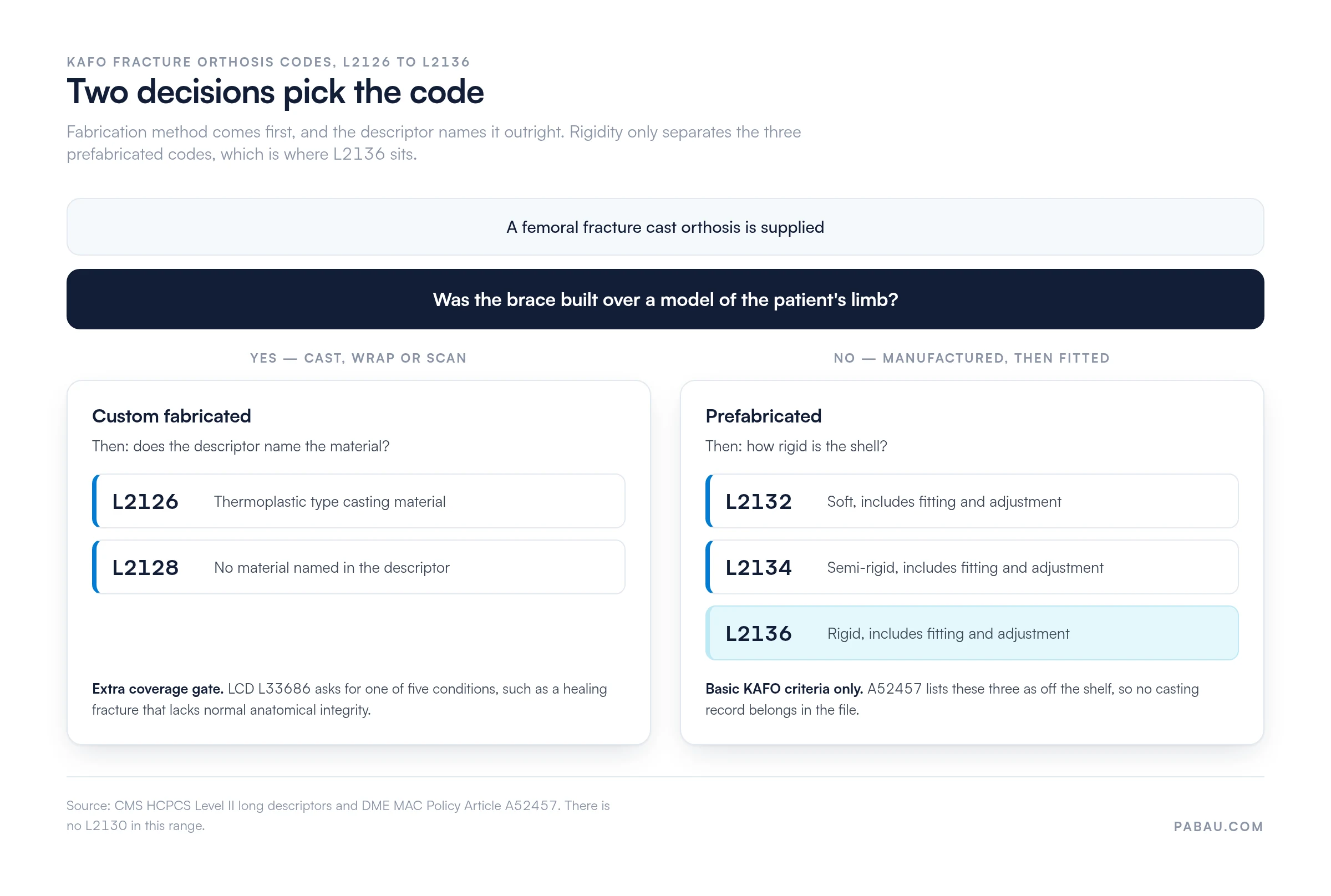
Two things about that table are worth keeping. There is no L2130. The range runs L2126, L2128, L2132, L2134 and L2136, so a claim submitted with L2130 will not process.
The second point is that no descriptor in this range mentions femoral, tibial or ankle control levels. Some third-party summaries invent that scheme. Coding to it produces the wrong code, because CMS separates these five entries by material, fabrication method and rigidity.
If the brace was molded over a model of the limb, the claim belongs on the custom-fabricated pair. Our guide to HCPCS code L2126 covers the material split between L2126 and L2128 and the extra documentation those codes carry.
Coverage runs through LCD L33686, Ankle-Foot/Knee-Ankle-Foot Orthosis, issued by the DME MACs. L2136 has to clear the basic KAFO criteria in that policy. Because it is prefabricated, it never has to clear the additional custom-fabrication criteria.
The LCD builds KAFO coverage on top of the ankle-foot orthosis rule. Three conditions have to be documented together.
The LCD also asks for a reasonable expectation of functional benefit. For a fracture orthosis, that is usually the ability to bear weight and walk during healing rather than a long-term change in muscle control.
LCD L33686 sets a second gate for custom-fabricated orthoses. At least one of five conditions has to be met before a custom code is covered.
That last criterion is the one fracture claims turn on, and it is the reason the custom versus prefabricated question matters here. A healing femoral fracture with distorted anatomy can justify L2126 or L2128. A healing fracture on its own cannot.
Read in that order, the two gates make L2136 the default for a femoral fracture brace. The custom codes are the exception, and the record has to earn them.
L2136 is a femoral fracture device, so the diagnosis has to be a femur fracture. Pairing it with a neurological code such as hemiplegia or multiple sclerosis contradicts the descriptor. Those diagnoses support functional KAFOs elsewhere in the L2000 series, not a fracture orthosis.
The codes below are the femoral fracture entries most often reported with this device. Each one was checked against the current ICD-10-CM file. Right-side examples are shown, and the left-side and laterality-unspecified versions exist for each family.
Two habits keep these claims clean. Code the fracture to the specificity the record actually supports, because an unspecified code invites a request for documentation. Then check that the laterality in the diagnosis matches the RT or LT modifier on the line.
The diagnosis alone never establishes necessity. LCD L33686 runs on the ambulation and stabilization criteria, so the clinical note still has to show that the patient walks and needs knee control.
Because L2136 is prefabricated and off the shelf, the record is lighter than the one a custom code demands. It is also easy to get wrong. Much of the published advice describes requirements that belong to other codes, or that were retired years ago.
Three widely repeated requirements do not attach to this code. Chasing them wastes staff time and, in the first case, points at the wrong code entirely.
Master List inclusion still matters. It means CMS can add the code to those requirements later. Treat the list as a watch item and check it each year before billing season.
L2136 is paid under the Medicare DMEPOS fee schedule, not the Physician Fee Schedule. CMS publishes the allowed amounts in an annual file by state and payment category, and that file is the only figure to bill against.
Off-the-shelf status is a coding rule here rather than a pricing one. DMEPOS competitive bidding has so far reached off-the-shelf back and knee braces, not KAFO fracture orthoses. The categories CMS has announced for the next round leave L2126 to L2136 out as well.
A52457 names five modifiers for ankle-foot and knee-ankle-foot orthosis codes. Two of the rules below are rejection-level, which means the claim never reaches a medical necessity review at all.
A claim line billed without KX, GA or GZ is rejected as missing information. A line billed without RT or LT is rejected as incorrect coding. Neither rejection is a coverage decision, so both are avoidable before submission.
The error pattern on L2136 is unusual. Most of the trouble comes from suppliers treating it as a custom-fabricated code, which produces both overstated claims and wasted documentation effort.
Working the denial queue afterward helps, but the cheaper fix is upstream. Every item on that list is visible in the file before the claim is created.
Audit your L2136 claims once a quarter with one question: does any file contain a casting record, a limb scan or a fabrication note? Those are the claims a reviewer will recode. They may also have been underpaid, because the brace was custom fabricated after all.
Commercial plans and Medicare Advantage plans use the same HCPCS descriptor but write their own coverage rules. Four differences show up most often on orthotic claims.
Where a commercial policy is silent, most payers fall back on the Medicare rules. Documenting to LCD L33686 therefore keeps the claim defensible across the whole payer mix. That is the shortest route to payment on the first pass.
An L2136 claim is not document-heavy, but it is detail-heavy. The order, the ambulatory status, the rigidity of the shell, the fitting note and the delivery confirmation all have to agree. They also have to agree with the modifiers on the line.
Practice management software like Pabau holds those pieces in one patient record. Our claims management software submits the claim and tracks its status, with the order, the fitting note and the delivery record kept alongside it.
Staff can see a claim missing its order or its delivery record before it leaves the building. That means fewer rejections for missing information, and a shorter path to payment on the claims that do go out.
When a records request arrives months later, the file is already assembled. The order, the fitting note and the proof of delivery sit in the patient’s record.

Pabau gives orthotists and DMEPOS suppliers one place to record the order, the fitting and the delivery, then submit the claim and track its status. See how it fits your billing workflow.

L2136 rewards suppliers who read the descriptor before they pick the code. It is the rigid, prefabricated femoral fracture cast orthosis, with fitting and adjustment paid inside the fee. It is not a custom-fabricated device, and Policy Article A52457 lists it as off the shelf.
Once the code is right, three things decide the claim. Document the basic KAFO criteria from LCD L33686. Code the femur fracture to the specificity the record supports. Put KX, GA or GZ alongside RT or LT on every line.
And if the file holds a casting record, stop and check the code. That claim probably belongs on L2126 or L2128 instead.
Pabau keeps the order, the fitting note and the delivery record in the patient’s file, next to the claim you submitted. To see how that works for orthotic billing, book a demo with the team.

Want fewer rejections on the first pass? Submitting a clean claim walks through the pre-submission checks that catch missing orders and modifiers.
Already dealing with denied orthotic claims? Denial management strategies for healthcare practices sets out how to work a DMEPOS denial queue without losing the appeal window.
L2136 bills a rigid, prefabricated femoral fracture cast orthosis. The official descriptor reads: knee ankle foot orthosis (KAFO), fracture orthosis, femoral fracture cast orthosis, rigid, prefabricated, includes fitting and adjustment. DMEPOS suppliers and orthotists use it for a manufactured brace supplied during femoral fracture healing, where fitting and adjustment are paid inside the base fee.
Prefabricated. The long descriptor says so directly, and Policy Article A52457 confirms it. That article publishes a custom-fabricated orthosis code list which names L2126 and L2128 from this family, and L2136 is not on it. L2136 appears instead on the article’s off-the-shelf code list, alongside L2132 and L2134.
Yes. LCD L33686, Ankle-Foot/Knee-Ankle-Foot Orthosis, governs the L2126-L2136 fracture orthosis range, including L2136. Coverage requires an ambulatory beneficiary who would qualify for an ankle-foot orthosis and who needs additional knee stability. Because L2136 is prefabricated, the LCD’s extra custom-fabrication criteria do not apply. The KX modifier attests that the criteria are met.
Not under traditional Medicare. CMS lists L2136 on the DMEPOS Master List of items potentially subject to conditions of payment, but records prior authorization as not required for it. A face-to-face encounter and written order prior to delivery are also not conditions of payment. Medicare Advantage and commercial plans often do require authorization, so verify before dispensing.
Fabrication method. L2136 is a manufactured brace fitted to the patient, so no cast or scan of the limb is involved. L2126 and L2128 are built over a model of the limb, and L2126 additionally names thermoplastic casting material. The custom codes also have to clear an extra LCD gate, such as a healing fracture that lacks normal anatomical integrity.
A standard written order before the claim is submitted, carrying its six required elements. Then a clinical note showing an ambulatory beneficiary with a femoral fracture who needs knee stability. The file also holds a supplier record naming the rigid construction, a fitting note, and proof of delivery. No casting record is needed, and the detailed written order was retired in January 2020.



