

CCSD code G5100: Bypass of duodenum billing guide
CCSD code G5100 bills a bypass that leaves the duodenum in place CCSD code G5100...

Last Updated: Oct 16, 2026
87798 is the CPT code for infectious agent detection by nucleic acid (DNA or RNA); not otherwise specified, amplified probe technique, each organism.
A common cause of 87798 denials is a more specific code that existed and was not used. The code covers direct specimens only, is reported once per organism tested, and is paid under the Clinical Laboratory Fee Schedule.
Let Pabau's smart automation suggest the right codes, reduce claim denials, and keep your practice compliant—effortlessly.
Automate repetitive tasks and focus on what matters most—your patients.
Reduce coding errors and ensure compliance with the latest regulations.
Clean claims, fewer denials, and faster reimbursements.
Powerful insights and reporting to help your practice thrive.
HIPAA compliant SOC 2 certified GDPR-compliant Trusted by 4,000+ clinics worldwide

CPT Code 87798 detects infectious agents by nucleic acid amplification when no specific code exists for that organism
The specific-code-always-wins rule: if a dedicated 87XXX code exists for the target organism, 87798 cannot be used
Bill one unit per analyte tested; Modifier 59 applies when multiple NOS organisms are tested in the same encounter
Pabau’s claims management software supports clean claim submission and tracks denial patterns for molecular lab codes
The American Medical Association describes CPT Code 87798 as follows. Infectious agent detection by nucleic acid (DNA or RNA); not otherwise specified, amplified probe technique, each organism. The code sits in the 87XXX microbiology family and is reported under the Clinical Laboratory Fee Schedule (CLFS), not the Physician Fee Schedule.
CPT 87798 applies when a laboratory runs nucleic acid amplification testing on a direct specimen for an infectious agent with no dedicated CPT code. The organism has to lack a specific code in the 87XXX range.
Where a specific code exists, that code must be used instead. Payer LCD policies treat 87798 reported in place of a specific code as a billing error. Map every organism on your test menu to its code inside the order entry system, so the substitution is caught before the test goes out.
These are organisms for which no specific NAAT CPT code currently exists and where 87798 is the correct choice:
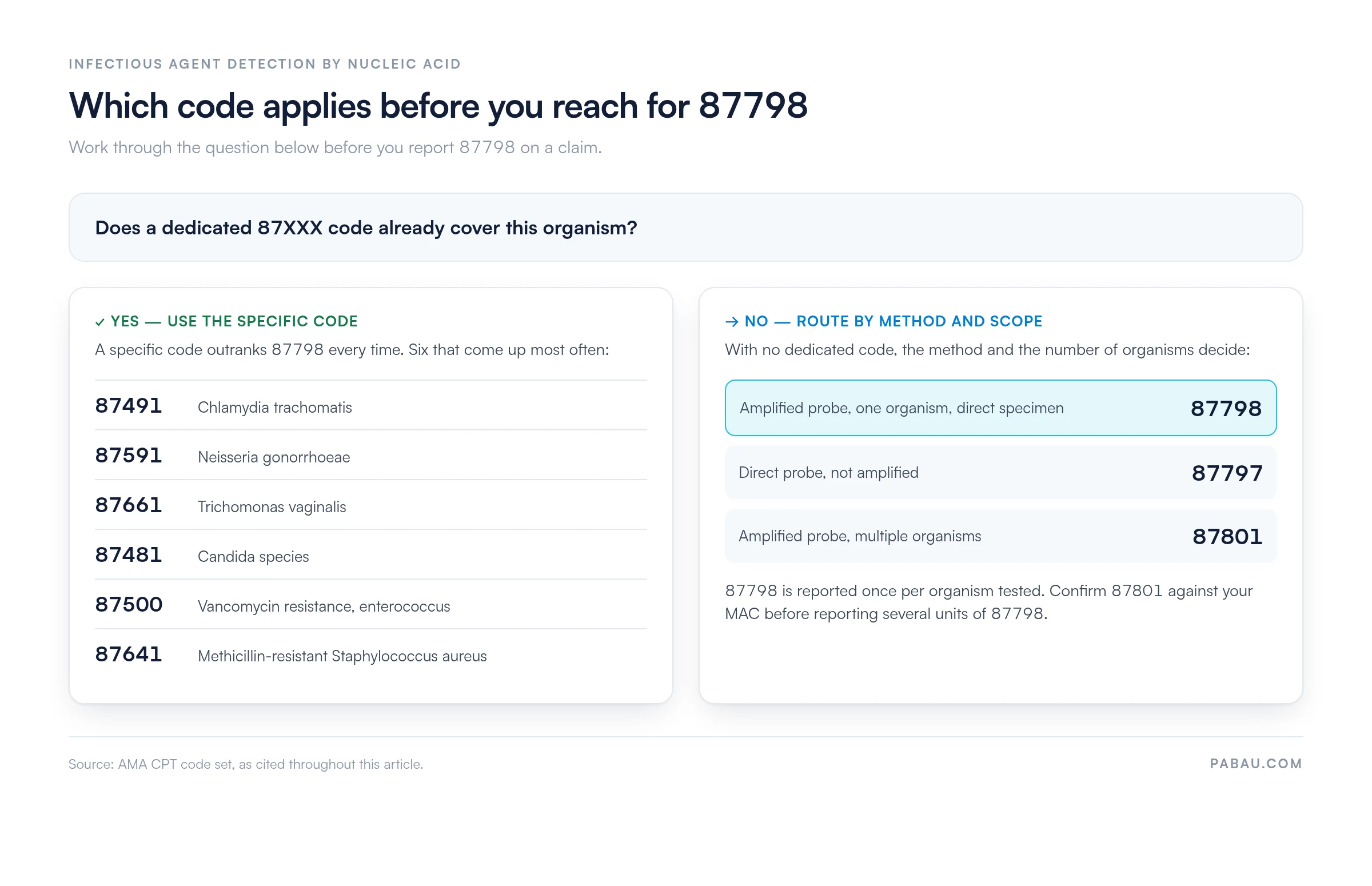
The chart below works through that order in one pass: dedicated code first, then method and organism count.
Understanding medical billing workflows for molecular diagnostics starts with the documentation chain between the ordering provider and the laboratory. For CPT 87798, every claim needs three elements to stand up under audit.
Specimen type matters. Direct clinical specimens (swabs, urine, CSF, tissue) are the appropriate source for 87798. Labs that apply this code to culture isolates rather than direct specimens face recoupment risk under AMA guidance.
The most frequent CPT 87798 errors involve reporting the NOS code when a specific organism code exists. Where a specific code covers both the organism and the method, that code is the one to report. Candida testing, for example, belongs under 87481. 87798 stays billable only for organisms that have no code of their own.
Note on CPT 87801. The code covers infectious agent detection by nucleic acid for multiple organisms, amplified probe technique. Before reporting several units of 87798 for one encounter, confirm with your MAC or the AMA whether 87801 is the correct choice instead. The two are not interchangeable, and the answer turns on what the assay itself reports.
Modifier use for 87798 follows two core scenarios: multiple analytes in the same encounter, and situations where unbundling concerns arise.
CPT 87798 is reported once per organism tested. If a lab tests for three NOS organisms from the same specimen in one encounter, three units of 87798 are billed. Most payers accept this per-analyte billing without a modifier. However, some MACs and commercial payers apply medically unlikely edits (MUEs) that cap units – check your MAC’s MUE table before billing high unit counts.
Modifier 59 (distinct procedural service) applies when 87798 is reported alongside other lab codes and a payer’s bundling edits would otherwise deny the claim. Common scenario: reporting 87798 alongside a specific organism code (e.g., 87491) for a different organism tested in the same encounter. Modifier 59 signals that the services are clinically distinct.
Before appending Modifier 59 to 87798, document which organism each unit corresponds to in the lab report. A claim showing three units of 87798 plus Modifier 59 without organism-level documentation gives auditors an easy denial path. Match every unit to a named pathogen in the record.
CPT 87798 is reimbursed under the CMS Clinical Laboratory Fee Schedule rather than the Physician Fee Schedule. The national limit amount for 87798 is about $35 per unit under the 2025 CLFS, and it carried through unchanged into 2026. Rates are updated each January, so check the current year’s figure in the CMS fee schedule before you quote it.
Labs billing a MolDX-participating Medicare Administrative Contractor (MAC) face requirements beyond the standard Medicare coverage rules. MolDX is a four-MAC program run by Palmetto GBA, Noridian, WPS and CGS, which between them cover 28 states. Novitas and NGS are the two non-MolDX MACs, and they apply standard LCD rules without the DEX Z-Code layer.
Achieving clean claim submission in a MolDX jurisdiction requires completing these steps before billing:
Scope note: MolDX requirements apply in the Palmetto GBA, Noridian, WPS and CGS jurisdictions, covering 28 states between them. If your lab bills Novitas or NGS, standard Medicare LCD rules apply and DEX Z-Code registration is not required for 87798.
CPT 87798 denials cluster around a small set of patterns. Robust denial management workflows catch these before submission rather than after payment is refused.
Matching each rejection to the right denial code helps billing teams categorize molecular diagnostics rejections accurately and route appeals to the right queue.
The Office of Inspector General (OIG) has documented scrutiny of high-volume PCR and NAAT panel billing. UTI panels draw particular attention, because 87798 has been reported there for multiple organisms across large patient populations.
Calling that pattern fraud without a confirmed legal finding would be inaccurate. The OIG identifies it as an audit-risk area and a compliance exposure, which is a different standard. Labs carrying high volumes of 87798 should treat that volume as a self-audit trigger.
Building defensible medical billing compliance programs for molecular diagnostics means addressing four areas proactively:
Run a monthly report showing 87798 units billed per ordering provider and compare against peer benchmarks. A provider consistently ordering 10+ units per encounter may be running a legitimate broad-scope panel with solid documentation. They may also be a liability waiting to surface in a RAC audit. Know which before the payer asks.
In most labs, an 87798 coding error surfaces only when the remittance arrives. By then the claim has been denied and the appeal clock has started. The same error is usually sitting on other claims in the same batch.
Pabau, the practice management platform we build, keeps the order, the clinical documentation and the claim in one patient record. Its claims software for labs submits electronically and processes ERA/835 remittances, so each denial comes back attached to the code that caused it.
That turns the quarterly self-audit into a report you can run. Unit volume by ordering provider, denial reasons by code, and appeal status all sit in the same place. An outlier shows up long before a payer asks about it.

Pabau’s claims management tools help clinical labs submit clean claims for molecular codes like CPT 87798. Denials are tracked by code, and submission connects straight to the clearinghouse.

CPT 87798 is a legitimate, billable code wherever it is used correctly. That means nucleic acid amplification on a direct specimen, for an organism with no dedicated CPT, billed one unit per analyte with medical necessity documented.
Two common causes of denials stand out. The first is a more specific code that existed and was not used. The second is a documentation chain between the ordering provider and the lab that did not support the claim. Close those two and the rest of the denial list gets considerably shorter.
Labs tightening the submission-to-payment cycle on molecular codes get there with revenue cycle management tools. Connecting straight to clearinghouse submission removes the manual rekeying where errors enter. Book a demo to see how Pabau handles claim submission, denial tracking and ERA processing for clinical labs.

Need to understand how denials flow through a clearinghouse? Electronic remittance advice (ERA) explains how 835 remittance files surface denial reason codes and payment adjustments for lab claims.
Want a structured overview of medical billing for lab providers? Superbill in medical billing covers how lab charges flow from the encounter to the payer.
Evaluating clearinghouse options for molecular lab claims? Medical claims clearinghouse guide compares clearinghouse types, payer connectivity, and submission workflows for clinical laboratories.
CPT Code 87798 is an infectious agent detection code for nucleic acid amplification testing (NAAT). The NOS designation means no dedicated CPT code exists for that specific pathogen. It is reported once per organism tested, applies to direct clinical specimens only, and sits in the Clinical Laboratory Fee Schedule.
NOS means the organism being detected has no dedicated CPT code in the 87XXX infectious agent detection range. Where a specific code exists for the organism, such as 87491 for Chlamydia or 87661 for Trichomonas, that code must be used. 87798 is appropriate only when the target pathogen has no code of its own.
Use 87798 only when no specific NAAT CPT code exists for the target organism. Before billing 87798, check the full 87XXX code range for the organism. If a specific code covers it (87491, 87591, 87661, 87481, and others), that code must be used instead. Billing 87798 when a specific code exists is a coding error that triggers claim denial.
Not where the resistance target already has its own code. Vancomycin resistance in enterococcus, including vanA and vanB, is reported with 87500, and methicillin-resistant Staphylococcus aureus is reported with 87641. 87798 applies only to a resistance target with no dedicated code, and that should be confirmed against current AMA guidance before billing.
The Medicare Clinical Laboratory Fee Schedule national limit for CPT 87798 is about $35 per unit under the 2025 CLFS. That figure carried through unchanged into 2026. Rates are updated every January, so verify the current year through the CMS fee schedule lookup before citing a number.
A frequent denial reason is that a more specific CPT code exists for the organism being tested. Other common causes include missing medical necessity documentation and failure to register the test under MolDX where that applies. Billing more units than the MUE threshold allows, or applying the code to culture isolates, will also trigger a denial.



