CPT code 86481: TB IGRA billing guide
CPT code 86481: Official descriptor and procedure description CPT code 86481 des...

Last Updated: Nov 2, 2026
Billable Code
87150 is the CPT code for culture typing by amplified nucleic acid probe. Its official descriptor reads: Culture, typing; identification by nucleic acid (DNA or RNA), probe, amplified probe technique, per culture or isolate, each organism probed.
Labs report it when an organism has already grown in culture and an amplified DNA or RNA probe then identifies it from that isolate. One unit covers one organism probed on one isolate. A direct probe with no amplification is coded 87149, and sequencing is coded 87153. Direct-from-specimen molecular tests skip the culture step and use a separate code family.
Let Pabau's smart automation suggest the right codes, reduce claim denials, and keep your practice compliant—effortlessly.
Automate repetitive tasks and focus on what matters most—your patients.
Reduce coding errors and ensure compliance with the latest regulations.
Clean claims, fewer denials, and faster reimbursements.
Powerful insights and reporting to help your practice thrive.
HIPAA compliant SOC 2 certified GDPR-compliant Trusted by 4,000+ clinics worldwide

CPT code 87150 covers culture typing by amplified nucleic acid probe, billed per culture or isolate for each organism probed.
An organism must grow in culture before the probe step, or the test is direct molecular detection and 87150 does not apply.
87150 differs from 87149 (direct, non-amplified probe) and 87153 (nucleic acid sequencing), so the code must match the method in the lab report.
Multiple units fit only when distinct organisms are each probed and documented separately, subject to NCCI edit review.
Pabau’s claims management software validates each claim and checks eligibility through Claim.MD, so unit and diagnosis errors surface before the payer sees them.
The American Medical Association publishes the official descriptor for CPT code 87150:
Culture, typing; identification by nucleic acid (DNA or RNA), probe, amplified probe technique, per culture or isolate, each organism probed.
In plain terms, a lab reports 87150 when an organism has grown in culture and an amplified DNA or RNA probe then identifies it. Each part of the descriptor shapes how the code is billed.
Three related services sit outside 87150:
The workflow behind 87150 runs in two stages, in a fixed order. The culture grows first, and the probe identifies the isolate second. A lab that skips or reverses a stage cannot claim 87150.
Document the culture growth step separately from the probe step. A lab that goes straight from specimen to molecular probe is running a direct detection test, so 87150 does not apply.
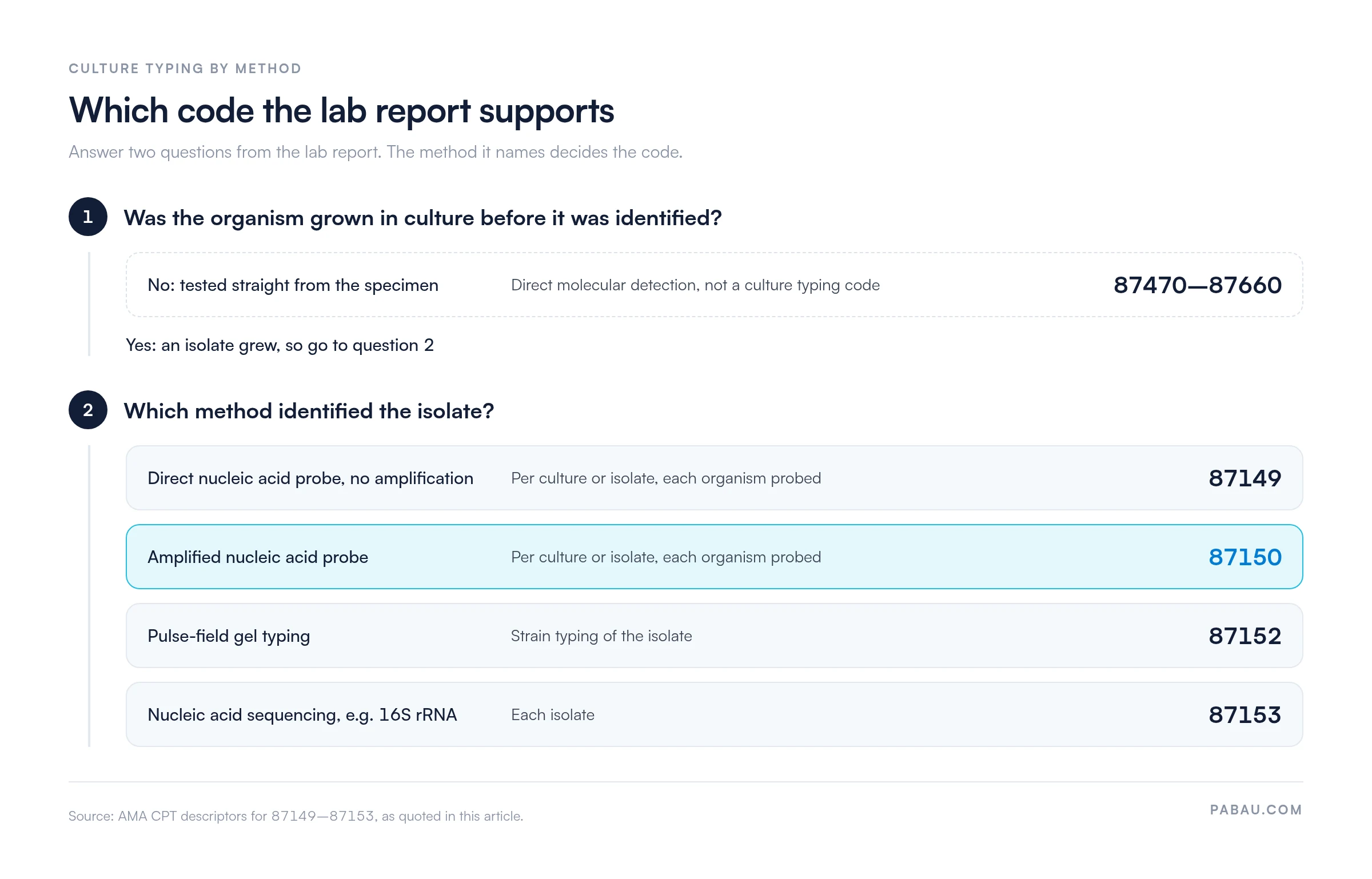
Three culture typing codes identify an organism from an isolate with a nucleic acid method, and they differ mainly by technique. 87149 covers a direct probe, 87150 an amplified probe, and 87153 sequencing. Billing 87150 when 87153 applies, or the reverse, is upcoding or downcoding and exposes the claim to denial and audit.
The lab report must name the method explicitly. A report that says “amplified probe technique” supports 87150, and one that says “direct probe” supports 87149. A report that says “16S rRNA sequencing” supports 87153. “Molecular identification” alone names no method, so it puts any of these codes at risk of denial.
The chart below turns that check into two questions you can answer from the lab report.
One unit of 87150 equals one organism identified from one isolate with the amplified probe technique. That rule comes straight from the descriptor’s “per culture or isolate, each organism probed” wording, which you can check in the AAPC code reference.
Multiple units in one encounter fit only when distinct organisms are each identified from isolates with this method. Two organisms identified means two units of 87150, provided the lab documents each organism probed separately.
National Correct Coding Initiative (NCCI) edits change quarterly. Before billing multiple units or pairing 87150 with panel codes, check the current edit table. Bundling conflicts are a common denial cause for this code family.
Flag every 87150 claim with two or more units for internal review before submission. Document each organism probed on a separate line in the lab report, not just in a summary note. Payers routinely request medical records for multi-unit claims in this code family, and a single combined entry is not adequate supporting documentation.
Medicare pays CPT code 87150 under the Clinical Laboratory Fee Schedule (CLFS), which CMS updates each January. The CLFS applies to independent labs, physician office labs and other entities billing lab services, rather than the Physician Fee Schedule. For the current national rate, use the CMS Clinical Laboratory Fee Schedule files.
Since 2018, the CLFS has paid a single national rate per code, with no geographic adjustment. Commercial payers set their own allowed amounts, so confirm each payer’s rate before you quote a patient.
An 87150 claim holds up only when the medical record supports both medical necessity and the method used. The record needs five elements.
A shared checklist for every clinician who orders this test keeps all five elements on each claim. Check the methodology note first, because the code choice depends on it.
Medicare does not universally require prior authorization for CPT code 87150. However, LCDs from Medicare Administrative Contractors (MACs) can add coverage criteria. Before billing, check whether your MAC has an active LCD for culture typing by nucleic acid probe. Then confirm that the patient’s diagnosis meets its covered indications.
Insurance eligibility verification before the order shows whether a payer covers 87150 for the patient’s diagnosis, before the lab runs the test. Commercial prior authorization rules vary by plan. Some plans cover amplified culture typing as a routine lab service without authorization. Others require pre-authorization for high-complexity molecular testing, so check the patient’s plan.
Denials for CPT code 87150 cluster around five root causes. Most are preventable with consistent documentation and correct code selection. A structured denial management workflow starts by matching each returned claim to one of them.
When an 87150 claim is denied, the Claim Adjustment Reason Code (CARC) shows which category the denial falls into. Reviewing common denial codes against the 87150 claim history shows whether the lab keeps missing the methodology note or picking the wrong code. The two fixes differ. One is a documentation process change, and the other is coder education.
Getting the claim right the first time is the most efficient approach. A clean claim for 87150 carries six elements:
Pairing CPT code 87150 with a diagnosis that does not establish medical necessity is one of the most direct routes to a denial. These ICD-10-CM codes are often associated with 87150 claims, across the clinical settings where amplified probe culture typing is ordered.
Practices managing infectious disease and sexual health workups see 87150 most often after positive cultures from wound, respiratory, urine and blood specimens. For carrier screening, confirm LCD coverage first, because covered indications vary more there than in acute infection.
When N39.0 is the diagnosis, ICD-10-CM asks for an additional B95-B97 code to name the infectious agent. Add it once the culture identifies the organism.
Run a quarterly audit of your 87150 claims by ICD-10 pairing. Claims denied for medical necessity often pair the code with an unspecified diagnosis when a more specific code is available. Moving from A41.9 (sepsis, unspecified) to the organism-specific code once culture results are confirmed reduces payer scrutiny.
An 87150 denial usually starts before the claim is sent. A probe result reaches billing without its method, or a second unit goes out on one combined lab entry. The payer then rejects it weeks later.
Pabau, the practice management platform we build, submits CMS-1500 claims through the Claim.MD clearinghouse to thousands of US payers. Its error-checking claims management scrubs each claim for missing or invalid details before it leaves. Eligibility checks run before the visit, so coverage problems show up while there is still time to act.
Payments settle straight from electronic remittance advice (ERA) files, so a denied 87150 line and its reason code reach your team quickly. You fix the cause once, rather than appealing the same denial every month.

Pabau submits claims through Claim.MD, checks eligibility before the visit and posts ERA payments for US labs and practices billing codes like 87150. See how it fits your workflow.

Code 87150 from the lab report, never from the order. If the report names an amplified probe on a cultured isolate, bill one unit per organism probed. If it names a direct probe or sequencing, switch to 87149 or 87153.
The trade-off is a little more lab paperwork for far fewer denials. Ask the lab to record the culture step, the method and each organism on separate lines, and the claim can stand up to an audit.
Pabau checks eligibility, validates each claim and posts ERA payments through Claim.MD, so unit and diagnosis errors surface before submission. Book a demo to see how Pabau handles lab billing from order to payment.

Want to understand how the claims submission pipeline works? Claim.MD clearinghouse guide explains how electronic lab claims reach payers and where errors are caught.
Need to track down a denial CARC before you appeal? Electronic remittance advice (ERA) explained covers how to read 835 remittance files and identify denial reason codes.
Billing multiple molecular codes in the same encounter? Medical billing compliance guide covers CCI edit principles and correct coding bundling rules for lab services.
CPT code 87150 is a microbiology code for culture typing by amplified nucleic acid probe, reported per culture or isolate for each organism probed. It applies when an organism first grows in culture and an amplified DNA or RNA probe, such as a PCR-based method, then identifies it. Direct (non-amplified) probe testing is reported with 87149 instead, and nucleic acid sequencing with 87153.
Each distinct organism identified from an isolate with the amplified probe technique is one billable unit. Two organisms identified from the same specimen, each probed separately, equal two units if each is documented individually in the lab report. Repeating the same probe on the same organism does not create a second unit. Check current NCCI edits before submitting multiple units, because bundling rules may apply when a panel code is also billed.
CPT 87150 uses an amplified nucleic acid probe (PCR-based or equivalent) on a culture isolate to identify an organism. CPT 87153 uses nucleic acid sequencing, such as 16S rRNA gene sequencing, to identify an organism from an isolate. Both identify an organism from a culture, but the technology differs. Billing 87153 when the lab report documents an amplified probe technique is upcoding. A direct probe with no amplification is a third option, coded 87149.
The medical record needs five elements. It starts with a provider order for culture and identification, plus a lab result confirming isolate growth. The lab report also needs a methodology note stating that an amplified nucleic acid probe technique was used. Finally, add an ICD-10-CM code that establishes medical necessity and the ordering provider’s credentials. A missing methodology note is a frequent cause of denial.
Medicare does not universally require prior authorization for CPT 87150. However, Local Coverage Determinations from individual Medicare Administrative Contractors (MACs) may set covered-indication criteria. Commercial payers vary by plan. Verify the patient’s coverage and any applicable LCD before submitting, especially for carrier screening or non-acute indications, where criteria are narrower.
Five causes account for most denials. The first is wrong code selection, where 87150 is billed but the lab report documents the method for 87149 or 87153. The others are missing culture documentation, a diagnosis that misses medical necessity, NCCI bundling with a panel code, and units without per-organism documentation. Confirming the methodology note and diagnosis pairing before submission prevents most of them.