CPT code 21011: Excision of soft tissue tumor of the face
CPT code 21011: Official descriptor and procedure overview CPT code 21011, as pu...

Last Updated: Oct 8, 2026

CPT Code 87481 covers infectious agent detection by nucleic acid for Candida species using an amplified probe technique.
It is the middle code of the 87480 to 87482 Candida series, and the only one that needs amplification named in the lab report.
The 2026 Medicare amount is about $19.77, paid from the Clinical Laboratory Fee Schedule rather than the physician fee schedule.
Billing 87481 when the laboratory ran a direct probe is upcoding, and it is the most common denial trigger on this code.
Pabau attaches the ICD-10 diagnosis to the lab order at the point of care, so the coding decision happens before the claim is built.
CPT Code 87481 is a billable code for infectious agent detection by nucleic acid (DNA or RNA), Candida species, amplified probe technique. A laboratory bills it when it replicates the target sequence before detecting it, most often on a molecular vaginitis panel.
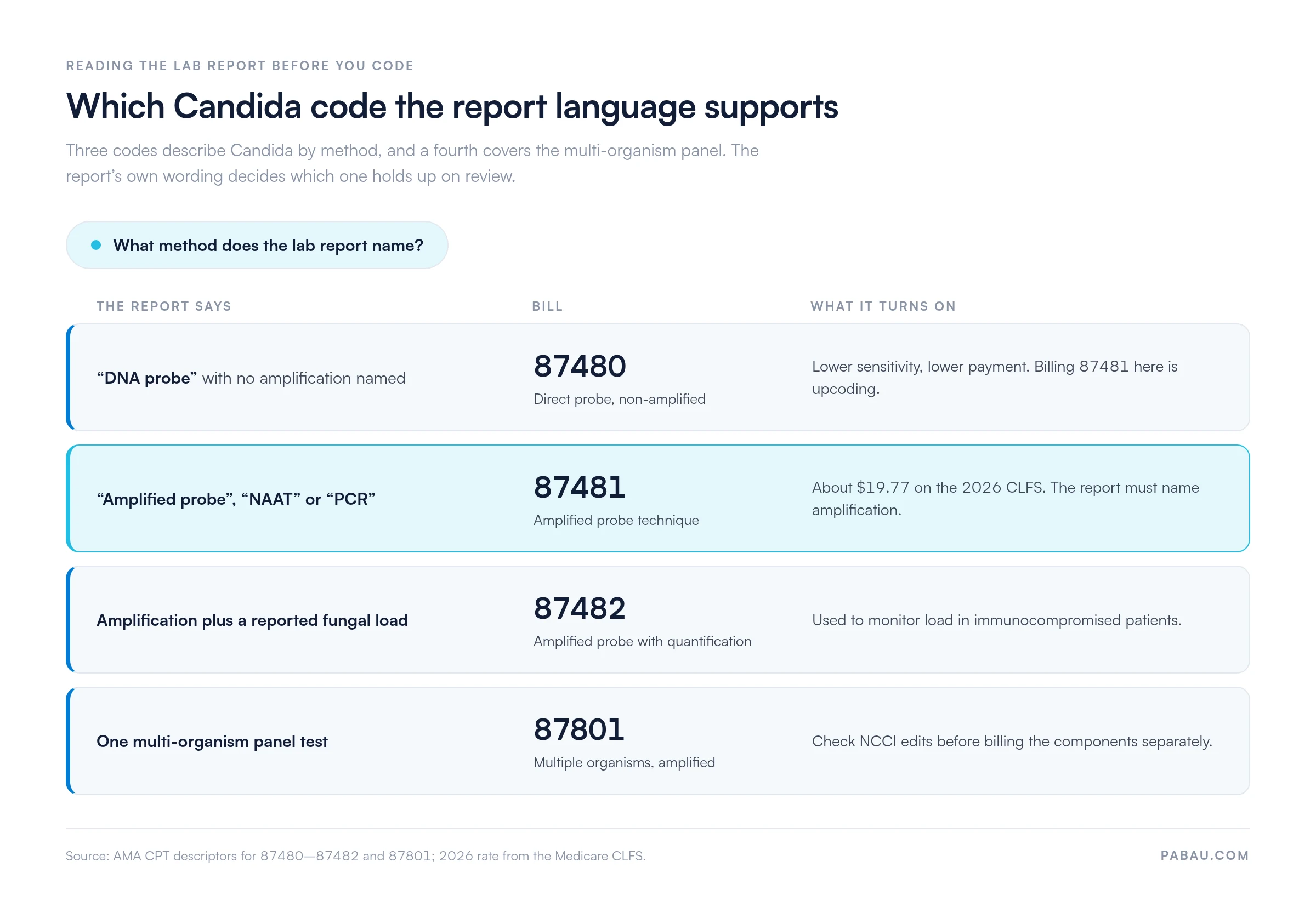
The word that decides the claim is “amplified”. CPT 87480 covers the same organism by direct probe, so method is the only thing separating the two codes. If the lab report never names amplification, a payer has no basis to pay 87481.
CPT Code 87481 is maintained by the American Medical Association (AMA) under the Microbiology subsection of the Pathology and Laboratory chapter. It sits in the 87480 to 87482 Candida series, where each code represents a different analytical method and sensitivity level.
The full AMA descriptor for 87481 is: Infectious agent detection by nucleic acid (DNA or RNA); Candida species, amplified probe technique. The short descriptor used on remittance and claim forms is: Nucleic acid detect Candida amplified.
The 87480 to 87482 series covers one organism, Candida species, through three analytical approaches. Each code carries a different sensitivity and a different payment. Billing the wrong one is among the most cited reasons for molecular lab claim denials.
The amplified qualifier in CPT Code 87481 means the laboratory replicates the target DNA or RNA sequences before detection, most commonly by PCR.
That makes it a higher-complexity test than 87480, and the report has to document the amplification step. Without it, a payer reviewing the claim has no basis to approve 87481 over the lower-paying 87480.
The chart below turns that distinction into a check a coder can run on the report itself.
CPT Code 87481 is appropriate when the clinical scenario calls for high-sensitivity detection of Candida species. A vaginitis panel workup is the most common indication, but the code applies across several patient presentations.
Accepted specimen types include vaginal swabs, which are the most common, along with nail scrapings, skin scrapings and oral swabs. Record the specimen type in the clinical note to support medical necessity. Payer scrutiny is higher for non-vaginal specimens, so that line matters most there.
Document the amplification method and the specimen type in the lab order note, not just the diagnosis. Payers running medical necessity reviews on CPT 87481 ask for that documentation. Its absence is the leading cause of post-payment audits on molecular vaginitis panels.
Correct ICD-10-CM linkage is what establishes medical necessity on a CPT 87481 claim. The diagnosis has to support running an amplification test for Candida, not merely a Candida diagnosis in general. Our ICD-10-CM codes library covers the candidiasis and vaginitis ranges in full, including the codes below.
Always check which ICD-10 codes your payer accepts under its local coverage determination for molecular vaginitis testing.
Aetna’s clinical policy bulletin CPB 0643 and BCBS Mississippi’s nucleic acid probe policy both narrow the covered diagnosis list further than the table above. The CrossCoder CPT-to-ICD-10 crosswalk tool will confirm payer-specific coverage before you submit.
Payment for CPT 87481 comes from the Medicare Clinical Laboratory Fee Schedule (CLFS), not the physician fee schedule. That is the schedule Medicare uses for clinical laboratory tests, and it carries its own published amounts and its own lookup files.
Check the Medicare Clinical Laboratory Fee Schedule for the current year’s amount before you submit claims.
Important disclaimers: the figure above is an approximate national amount drawn from published fee schedule data, and CMS revises it.
Payment in practice also depends on your Medicare Administrative Contractor and on individual payer contracts. Cross-reference the current CLFS file before you publish a fee schedule or quote a patient estimate.
The CLFS pays one amount for CPT 87481 wherever the test runs. So the setting does not change the rate, and the billing question is only who performed the test and who submits the claim.
Private payer reimbursement for CPT 87481 varies widely. Aetna’s clinical policy bulletin CPB 0643 addresses vaginitis diagnosis coding including molecular tests. BCBS Mississippi publishes a nucleic acid probe identification policy that applies to this code family. Both are examples of payer-specific criteria rather than universal coverage.
Medicaid coverage is state-dependent. Some state programs cover molecular vaginitis testing on the same terms as Medicare. Others restrict coverage to culture-based methods or require prior authorization. Confirm coverage with the state program before you order a molecular panel for a Medicaid patient.
Accurate billing for CPT 87481 rests on three checks. The technique has to match the code, and the diagnosis has to support the test. Then the panel bundling rules get read before the claim drops. Most compliance failures on molecular diagnostic codes trace back to one of those three.
Modifier 59 (distinct procedural service) may be needed when 87481 is billed alongside other nucleic acid detection codes on the same date of service.
It tells the payer the codes cover separate specimens or distinct clinical indications. Building a clean claim for this code also means reading the current NCCI edits, which change with every quarterly update.
CPT Code 87481 is rarely ordered alone. Most molecular vaginitis workups add companion codes for other organisms, so one specimen produces several billable components. Knowing the full panel is what makes the bundling risk visible before the claim goes out.
Before you bill a full vaginitis panel covering Candida, Trichomonas and Gardnerella, look at how your laboratory’s test is defined. It maps either to CPT 87801 or to individual organism codes. Submitting the individual codes where a panel code applies triggers NCCI bundling edits and returns a partial or full denial.
A single denied CPT 87481 claim is worth about twenty dollars, which is why these denials rarely get appealed. On a practice running molecular vaginitis panels every week, they accumulate quietly.
Pabau is practice management software with claims management software built in. It catches the coding decision at the lab order rather than at the clearinghouse.
Pabau submits claims through Claim.MD, our US clearinghouse partner. For a practice ordering vaginitis panels routinely, that closes the loop between the lab order and the paid claim.
Pabau’s digital forms capture the clinical indication at intake, so the ICD-10 code is on the record before the claim is generated. Nobody has to reconstruct it after a denial arrives. Order sets for the panel pair each CPT code with the diagnoses that commonly support it. A high-volume practice spends less time per claim as a result.

Pabau attaches ICD-10 codes to lab orders at the point of care, then routes completed claims through Claim.MD for eligibility checks and electronic submission. See how it works in your practice.

CPT Code 87481 gets straightforward once the report is read before the code is chosen. Bill it only where the laboratory amplified the target, and pair it with a diagnosis the payer covers. Then check the NCCI edits whenever the code rides on a panel.
The trade-off is worth holding onto. The extra payment for the amplified code is modest, while an upcoding finding reaches back across every claim in the series. Where the report is ambiguous, coding down is the cheaper mistake.
If your practice orders molecular vaginitis panels regularly, the fix sits upstream of the claim. Book a demo to see how Pabau attaches the diagnosis to the lab order before the claim is built.

Need to understand denial patterns across your lab codes? Denial management in healthcare covers the most common denial triggers and how to build a systematic appeal workflow.
Billing a vaginitis panel under a hospital outpatient setting? Revenue cycle management for medical practices explains where lab codes sit in the wider claim cycle.
Want a structured reference for compliance on lab billing? Medical billing compliance outlines the documentation requirements that prevent audits on molecular diagnostic claims.
Submitting these claims electronically? The 837 file explained walks through the 837P format that carries a lab claim to the payer.
Reconciling the payment once it lands? Electronic remittance advice shows how the 835 file posts payments against the original claim.
CPT Code 87481 covers infectious agent detection by nucleic acid (DNA or RNA) for Candida species using an amplified probe technique (NAAT/PCR). It applies to laboratory testing of clinical specimens where high-sensitivity Candida detection is required, most commonly vaginal swabs in vaginitis panel workups.
The 2026 national Medicare amount for CPT 87481 is approximately $19.77. Payment comes from the Medicare Clinical Laboratory Fee Schedule (CLFS), not the physician fee schedule, so there is no facility or non-facility split. CMS republishes CLFS amounts each year, so check the current CLFS file before submitting claims or setting patient estimates.
87480 uses a direct, non-amplified probe technique for Candida detection and has lower sensitivity. 87481 uses an amplified probe (NAAT/PCR) and detects lower fungal burdens. 87482 adds quantification to the amplified technique, used when monitoring fungal load in immunocompromised patients. Billing 87481 when only a direct probe was performed constitutes upcoding.
Commonly covered ICD-10-CM codes include B37.3 (candidiasis of vulva and vagina), N76.0 (acute vaginitis), B35.1 (onychomycosis), and B37.89 (other sites of candidiasis). The exact list of covered diagnoses depends on your payer’s local coverage determination, so always verify against that policy before submitting.
Yes, but check the NCCI bundling edits first. CPT 87481 is routinely co-billed with 87661 (Trichomonas) and 87591 (Neisseria gonorrhoeae) on vaginitis panels. If the laboratory uses a multi-organism panel test that maps to CPT 87801, billing the individual component codes may trigger bundling edits. Verify the laboratory’s test methodology against current NCCI edits before unbundling.
Medicaid coverage for CPT 87481 is state-dependent. Some state programs cover molecular vaginitis testing on the same basis as Medicare. Others restrict coverage or require prior authorization. Contact your state Medicaid program or managed care organization directly to confirm coverage and prior authorization requirements before ordering the test.
Vaginal swabs are the most common specimen type for CPT 87481 in vaginitis panel workups. Nail scrapings for onychomycosis evaluation, skin scrapings, and oral swabs are also accepted depending on the clinical indication. Record the specimen type in the clinical note, as payers may request it during medical necessity reviews for non-vaginal specimens.