

HCPCS Code L0472: Hyperextension TLSO billing guide
HCPCS code L0472: Official descriptor and device definition HCPCS code L0472 des...

Last Updated: Nov 5, 2026
85014 is the CPT code for a hematocrit, the share of a whole blood sample made up of red blood cells. It's reported when a hematocrit is ordered and run on its own, usually on an automated analyzer.
A spun microhematocrit read from a centrifuge tube uses 85013 instead. When a CBC (85025 or 85027) is billed for the same date, NCCI bundles 85014 into the panel. Medicare pays 85014 under the Clinical Laboratory Fee Schedule, with a 2026 national limit of $2.37.
Let Pabau's smart automation suggest the right codes, reduce claim denials, and keep your practice compliant—effortlessly.
Automate repetitive tasks and focus on what matters most—your patients.
Reduce coding errors and ensure compliance with the latest regulations.
Clean claims, fewer denials, and faster reimbursements.
Powerful insights and reporting to help your practice thrive.
HIPAA compliant SOC 2 certified GDPR-compliant Trusted by 4,000+ clinics worldwide

CPT code 85014 reports a standalone hematocrit run on an automated analyzer, while a spun microhematocrit by centrifuge is CPT 85013.
NCCI bundles 85014 into CBC codes 85025 and 85027 on the same date. However, modifier 59 or 91 applies only to a separate, medically necessary repeat test.
Medicare pays 85014 under the Clinical Laboratory Fee Schedule, with a 2026 national limit of $2.37.
Medical necessity requires a supporting ICD-10-CM diagnosis code, most commonly from the D50–D64 anemia range or D45 polycythemia vera.
Pabau, the practice software we build, checks eligibility through Claim.MD and tracks each 85014 claim through to the remittance.
CPT code 85014 is the code for a standalone hematocrit, maintained by the American Medical Association (AMA) in the 85002-85999 hematology and coagulation subsection. Additionally, its official descriptor is “Blood count; hematocrit (Hct).” Indeed, the code covers one measurement: the share of a whole blood sample made up of red blood cells, expressed as a percentage.
Hematocrit, also called packed cell volume (PCV), gives a clinician a rapid read on a patient’s red cell mass. Instead, it’s ordered when a full blood panel isn’t needed. For example, common indications include anemia screening, monitoring for polycythemia, evaluating dehydration, or checking transfusion thresholds perioperatively.
Specifically, 85014 is the hematocrit measured on an automated or electronic cell counter. In contrast, a spun microhematocrit read from a centrifuge tube has its own code, CPT 85013.
Specifically, CPT 85014 covers exactly one result: the packed cell volume percentage of red blood cells in a whole blood specimen. In fact, every other blood count measure has its own code.
What 85014 covers:
What 85014 does NOT cover:
For example, if a clinician orders hematocrit and hemoglobin together without a full CBC, report 85014 and 85018 on separate lines. Indeed, no two-analyte panel code exists. Therefore, a CBC code applies only when the lab performs a full CBC.
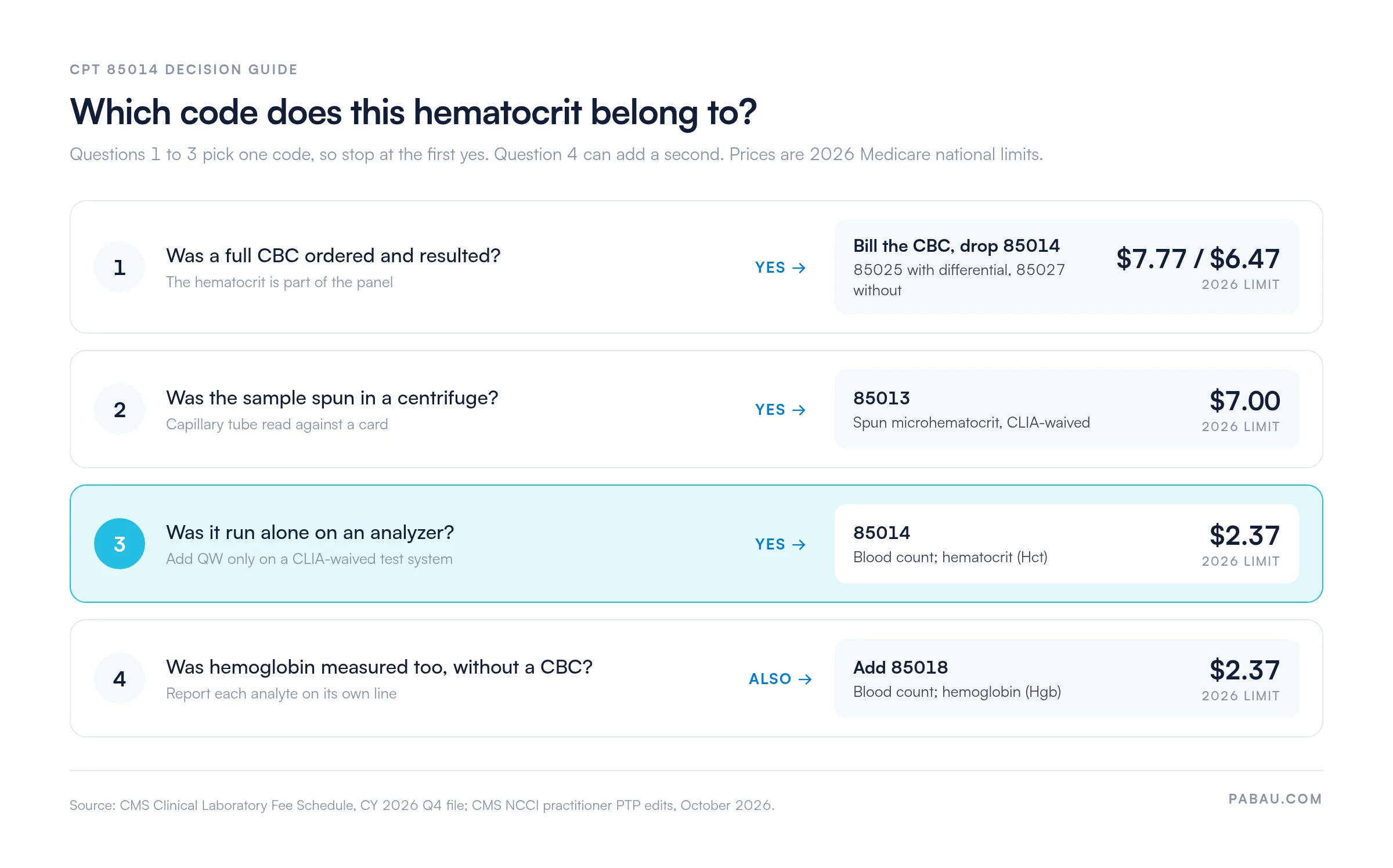
First, the testing method decides both the CPT code and the CLIA certificate you need. For example, a centrifuge result is reported with 85013, and an analyzer result with 85014. Mixing the two up, or holding the wrong certificate for the method, invites denials on audit.
First, blood is drawn into a capillary tube, sealed, and centrifuged for three to five minutes. Then the buffy coat separates out, and staff read the packed red cell percentage against a hematocrit reader card.
As a result, this spun microhematocrit is reported with CPT 85013, not 85014. CMS lists it as a CLIA-waived test that needs no QW modifier, so a Certificate of Waiver covers it. In addition, its 2026 Medicare limit of $7.00 is higher than the $2.37 paid for 85014.
Meanwhile, CPT 85014 is the hematocrit measured on an automated or electronic cell counter. On most hematology analyzers that test is non-waived, so the testing site needs a CLIA Certificate of Compliance or Certificate of Accreditation to bill it.
However, a few FDA-cleared point-of-care systems measure hematocrit as a CLIA-waived test. On those, report 85014 with modifier QW under a Certificate of Waiver. Likewise, if the analyzer runs a full CBC that was ordered, bill the CBC code instead. Therefore, confirm your device’s CLIA complexity before billing standalone 85014.
Documentation the chart must show to support the claim:
In fact, confusing 85014 with a CBC panel code, or with 85013, is a common coding error in hematocrit billing. Specifically, the decision guide below starts from how the result was produced and shows what Medicare pays for each code.
Upcoding warning: billing 85025 when only hematocrit was performed is fraudulent upcoding. Indeed, under the False Claims Act, systematic upcoding of this type exposes the practice to significant civil liability. Overall, always bill the code that matches exactly what was ordered and resulted.
The National Correct Coding Initiative (NCCI) treats hematocrit as a component of both CBC panel codes. When 85014 is billed on the same date of service as 85025 or 85027, NCCI edits bundle 85014 as a column 2 (component) code.
Specifically, a column 2 code isn’t separately payable when its column 1 code is billed for the same patient on the same date. Both edits carry modifier indicator 1 in the CMS NCCI PTP edit tables, so a modifier can bypass them in narrow cases.
However, modifier 59 or 91 fits only when a separate hematocrit was medically necessary later the same day, such as a repeat check after a transfusion. Notably, it can’t unbundle the hematocrit the CBC already produced, or a repeat run to confirm a result.
Therefore, when the hematocrit came from the CBC, bill the panel code (85025 or 85027) and leave 85014 off the claim. Otherwise, if only a hematocrit was performed, bill 85014 alone.
Run a pre-submission NCCI check on every lab claim batch. Specifically, flag any date of service where 85014 appears with 85025 or 85027, and remove 85014 unless the chart documents a separate, medically necessary repeat test. Catching this before submission is cheap. In contrast, catching it after a denial costs staff time and risks timely-filing limits.
CPT 36415 covers routine venipuncture, the act of drawing blood, separately from the laboratory analysis itself. Specifically, for most practices billing 85014, the question is whether 36415 can also be submitted on the same claim.
Notably, under NCCI, 36415 is not a column 2 component of 85014, meaning the two codes are not bundled by default. However, payer policies vary. For example, some commercial payers will deny 36415 when billed alongside low-cost laboratory codes, considering collection incidental. In contrast, others pay both.
Instead, for a fingerstick hematocrit, report capillary blood collection with CPT 36416, not 36415. In fact, submitting 36415 for a fingerstick draw is inaccurate coding that may trigger a post-payment audit.
Every 85014 claim requires a supporting ICD-10-CM diagnosis code that establishes medical necessity. In addition, payers, including Medicare, review claims against Local Coverage Determinations (LCDs) issued by their Medicare Administrative Contractors (MACs). Covered diagnoses vary slightly by MAC jurisdiction, so always verify the LCD for your region.
Next, the most commonly covered ICD-10-CM codes are listed below. Additionally, annual ICD-10-CM updates take effect October 1 each year; verify codes are current before billing.
For example, a diagnosis of anemia alone (D64.9) is generally accepted as medically necessary for hematocrit testing. However, screening codes like Z13.0 may require advance beneficiary notice (ABN) in Medicare patients if the service is considered non-covered under the applicable LCD.
Medicare pays CPT code 85014 under the Clinical Laboratory Fee Schedule (CLFS), which the Centers for Medicare and Medicaid Services (CMS) updates each year. Specifically, the 2026 national limitation amount for 85014 is $2.37, the same as hemoglobin code 85018.
By comparison, a spun microhematocrit under 85013 pays $7.00, and the CBC codes pay $7.77 (85025) and $6.47 (85027). Check the current quarterly CLFS file before quoting expected reimbursement, because CMS can revise these limits each January.
Overall, most 85014 denials fall into five predictable categories. Consequently, a solid denial management workflow catches these at the front end rather than chasing appeals.
Audit your last 90 days of 85014 claims. Then filter by denial reason code CO-97 (bundling) and CO-50 (medical necessity). If CO-97 accounts for more than 10% of 85014 denials, your order-entry workflow is creating same-day conflicts with CBC panel orders. Instead, fix the order protocol at the point of care, not post-denial.
In fact, a clean claim for CPT 85014 requires documentation that satisfies both medical necessity and technical billing requirements. The clean claim requirements for laboratory codes are straightforward, but missing any one element below triggers a preventable denial or post-payment audit finding. Therefore, your superbill should capture each of the following before the claim is submitted.
For instance, without connected billing software, staff retype each lab charge into a clearinghouse portal, check coverage by phone and match remittances by hand. In short, each handoff is a chance for 85014 to go out beside a CBC, or to a payer that won’t cover the test.
Specifically, Pabau links to Claim.MD, our US clearinghouse partner. Its claims management software turns your invoice into an electronic CMS-1500 claim and sends it to thousands of US payers. Additionally, real-time eligibility checks confirm coverage before the specimen is drawn.
In addition, claim statuses and electronic remittance advice (ERA) flow back into Pabau. For example, a CO-97 bundling denial on an 85014 line shows up the day the remittance posts. As a result, your team can fix the order protocol while the date of service is still fresh.

Pabau sends CMS-1500 claims through Claim.MD, checks eligibility in real time and brings remittances back in. See how your team can catch hematocrit denials the day they post.

In short, treat 85014 as the code for one result: a hematocrit run alone on an analyzer. Overall, before any hematocrit claim goes out, check the method in the chart, any same-day CBC and the diagnosis behind the order.
Indeed, the trade-off is small money against avoidable work. At $2.37, an 85014 line rarely justifies an appeal, so a clean first submission is the only fix that pays. In addition, a centrifuge result billed correctly as 85013 earns almost three times as much.
Therefore, if your team still keys lab charges by hand, book a demo to see how Pabau checks eligibility and tracks every hematocrit claim to payment.

Need to understand how clearinghouse scrubbing works before claims reach Medicare? Medical claims clearinghouse guide explains how 837P files are validated before reaching the payer.
Want to reduce the time spent on billing error corrections? Revenue cycle management overview covers the end-to-end process from patient intake to payment posting.
Looking for the denial reason codes behind your 85014 rejections? Denial codes in medical billing decodes CARC and RARC codes and maps common denial patterns to corrective actions.
Coding the anemia behind a falling hematocrit? ICD-10 code D62 covers acute posthemorrhagic anemia, a common reason for post-surgical hematocrit checks.
Monitoring a patient with polycythemia vera? ICD-10 code D45 explains how polycythemia vera is coded on lab and follow-up claims.
CPT code 85014 is the billing code for a standalone hematocrit test. Specifically, it measures packed red blood cell volume as a percentage of whole blood. In addition, it sits in the AMA’s hematology and coagulation subsection (85002-85999). However, it doesn’t include hemoglobin, red cell indices, or any other part of a complete blood count.
Medicare pays CPT code 85014 under the Clinical Laboratory Fee Schedule (CLFS), with a 2026 national limitation amount of $2.37. However, CMS can revise the limit each January, so check the current quarterly CLFS file before quoting expected reimbursement.
Yes. NCCI edits bundle CPT 85014 into CBC codes 85025 and 85027 when they are billed for the same patient on the same date. Specifically, the edits carry modifier indicator 1, so modifier 59 or 91 applies only to a separate, medically necessary repeat hematocrit. Otherwise, remove 85014 and bill only the panel code.
The most commonly accepted ICD-10-CM codes are D50.9 (iron deficiency anemia, unspecified), D64.9 (anemia, unspecified) and D45 (polycythemia vera). In addition, R71.0 (precipitous drop in hematocrit) and D62 (acute posthemorrhagic anemia) are common. Covered diagnoses vary by MAC jurisdiction; always check the applicable Local Coverage Determination before billing a screening code such as Z13.0.



