ICD-10 Code J18.9: Pneumonia, unspecified organism
ICD-10 Code J18.9: Code details and quick reference ICD-10 Code J18.9 is the bil...

Last Updated: Nov 10, 2026
Billable Code Specific Code
D64.9 is the billable ICD-10-CM code for anemia, unspecified. Coders assign it when the provider documents anemia without naming its type or underlying cause.
It sits in the D64 "Other anemias" category (block D60–D64) and is valid for HIPAA-covered transactions. Once the chart names an etiology, such as iron deficiency, CKD or chemotherapy, a more specific code replaces it. When anemia stems from an underlying condition, that condition is usually sequenced first.
Let Pabau's smart automation suggest the right codes, reduce claim denials, and keep your practice compliant—effortlessly.
Automate repetitive tasks and focus on what matters most—your patients.
Reduce coding errors and ensure compliance with the latest regulations.
Clean claims, fewer denials, and faster reimbursements.
Powerful insights and reporting to help your practice thrive.
HIPAA compliant SOC 2 certified GDPR-compliant Trusted by 4,000+ clinics worldwide

D64.9 is billable and valid for HIPAA transactions, but only when anemia is documented without a specified etiology.
A documented anemia type always takes its more specific code, and the D64 Excludes1 note sends refractory anemia to D46.- or C92.0-.
ICD-10-CM coding guidelines require the underlying condition to be sequenced first whenever anemia is secondary to CKD, malignancy, or another chronic disease.
Pabau’s claims management software supports ICD-10-CM code entry and electronic claim submission through Claim.MD, its US clearinghouse partner.
ICD-10 Code D64.9 is the billable ICD-10-CM code for anemia, unspecified. Coders assign it when the provider documents anemia without naming its type or underlying cause.
The CDC/NCHS ICD-10-CM tabular list flags D64.9 as billable and specific, so it can appear on a claim as a valid diagnosis code. The table below summarizes its key administrative attributes.
“Unspecified” in ICD-10-CM means the provider has not documented a cause or type of anemia. It says nothing about what the coder suspects. If the documentation names any etiology (iron deficiency, B12 deficiency, CKD, chemotherapy), a more specific code applies. Treat D64.9 as the last-resort code.
D64.9 is appropriate in a narrow set of clinical scenarios. Use it only when the treating provider documents anemia without specifying its type or underlying cause.
One critical rule comes from the CMS ICD-10-CM Official Guidelines for Coding and Reporting: Coders cannot assign a specific anemia type from lab values alone. A hemoglobin of 9.2 g/dL with low serum ferritin does not automatically produce D50.9 (iron deficiency anemia, unspecified).
The provider must document the type. Without that attestation, D64.9 is the correct choice, even when the lab picture strongly suggests a specific etiology. A required anemia-type field in the EHR note template captures that attestation at the point of care.
The first six rows below are coding-specificity rules, not official Excludes notes. Once the provider documents an anemia type, its more specific code replaces D64.9. The last two rows are the official Excludes1 entries at category D64.
The most frequent D64.9 error is choosing it when the chart documents a more specific anemia. This comparison table covers the codes coders most often weigh when the chart says “anemia.”
The AAPC Codify ICD-10-CM lookup is useful for browsing the full D64 category and its official notes before a final code assignment. Each neighboring code also has its own entry among our ICD-10-CM codes.
The chart must support D64.9 before a coder assigns it. Per the ICD-10-CM Official Guidelines for Coding and Reporting, diagnosis assignment always rests on provider documentation, never on independently interpreted lab results.
What the record must show for D64.9 to be defensible:
Proper clean claim submission starts with documentation that ties the provider’s stated diagnosis to the codes on the claim.
Picture a chart that says “anemia, type TBD” while the payer sees D64.9 paired with a high-cost infusion. That documentation will be audited. Structured EHR templates that prompt providers to specify the anemia type, or attest that it is undetermined, reduce that audit exposure.
Audit D64.9 encounters quarterly. Pull claims where D64.9 paired with an infusion HCPCS code (J1756, J0885, J0888). Confirm each chart includes provider attestation of anemia without a documented type. Missing attestation is a frequent precursor to a medical-necessity denial on infusion claims.
After documentation, sequencing decides whether a D64.9 claim holds up. ICD-10-CM Official Guidelines Section I.C.2.c (anemia associated with malignancy) and the “code first” instruction at category D63 set the rules.
List D64.9 first when anemia is the reason for the outpatient encounter or inpatient admission and no underlying cause has been identified or documented. A patient presenting for evaluation of new-onset anemia with no prior diagnosis of CKD, malignancy, or nutritional deficiency is a straightforward D64.9-first scenario.
When anemia is documented as due to or associated with an underlying condition, the underlying condition sequences first. These are the practical rules for medical billing when anemia is secondary:
The panel below lines those rules up, from the documented cause to the codes in claim order. D64.9 is left for the one case where no cause is named.
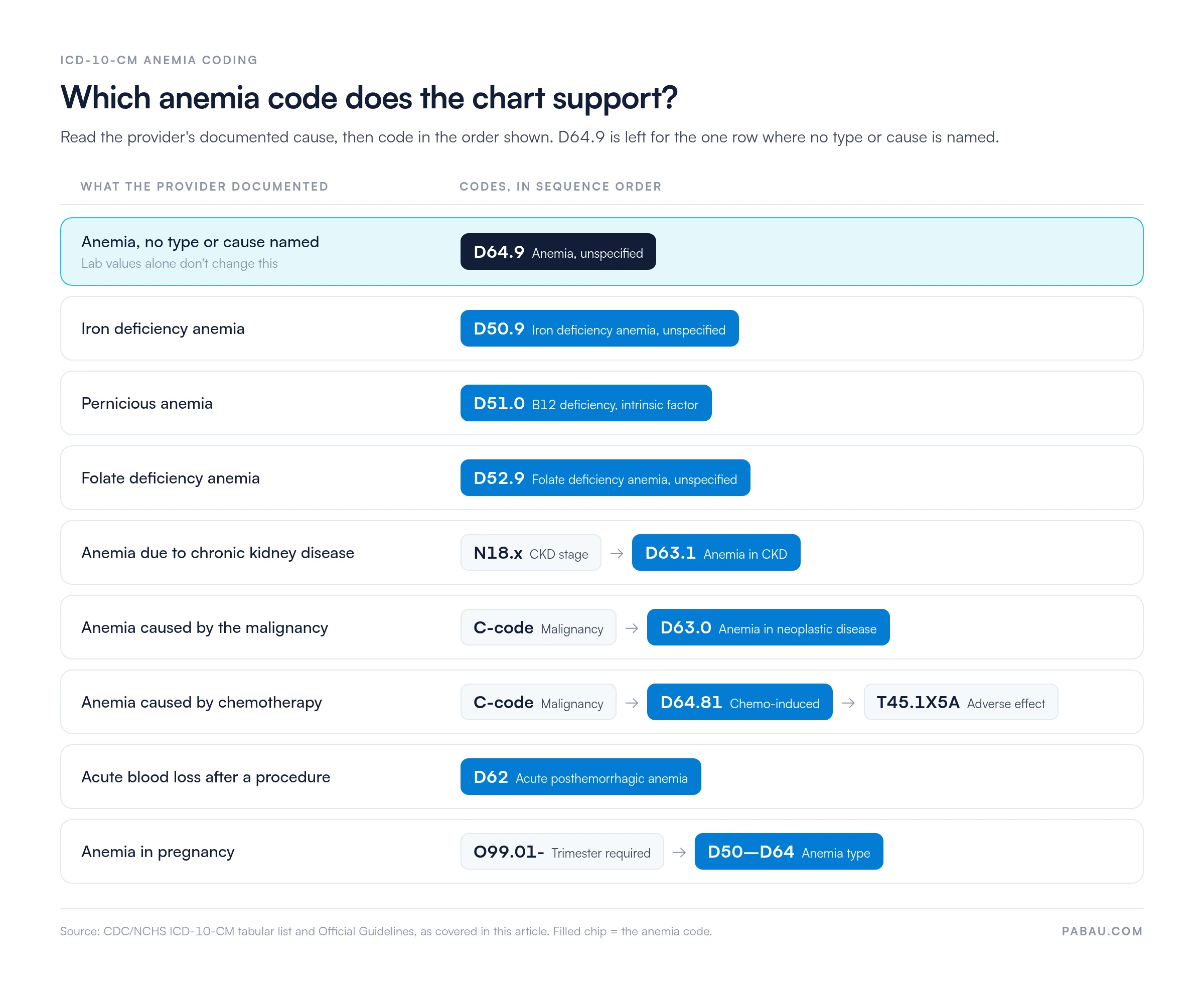
The outpatient vs. inpatient distinction matters in edge cases. Outpatient guidelines direct coders to code to the highest degree of certainty at the encounter. Inpatient guidelines allow coding of uncertain diagnoses as if confirmed. When a provider documents “anemia, possible iron deficiency” in an outpatient chart, code D64.9 (the confirmed anemia), not D50.9 (the possible type).
D64.9 is one of the diagnosis codes that can support iron infusion, erythropoiesis-stimulating agent (ESA) administration, and blood transfusion billing. Payers rarely accept it alone without extra scrutiny.
Practices running IV infusion services should verify their MAC jurisdiction’s LCD for each drug, from J1756 to ESA codes such as J0885. Hemoglobin thresholds for medical necessity vary by payer, so stating one threshold as absolute is a compliance risk.
Practice software such as Pabau submits anemia-related infusion claims electronically through Claim.MD, its US clearinghouse partner. Claim.MD runs eligibility checks and 837P claim validation before submission to payers on Claim.MD’s payer list.
Payer requirements for D64.9-coded claims differ significantly by payer type, MAC jurisdiction, and the procedure being billed. These patterns apply broadly, but always verify against the specific plan’s LCD or benefit policy before submission.
The ICD List reference shows the complete D64 code range alongside its coverage notes.
D64.9 denials fall into five recurring categories, and each has a preventable root cause.
Effective denial management in healthcare catches these patterns before they reach the payer. Build a D64.9 denial work queue sorted by claim adjustment reason code (CARC). Billing teams can then see whether the root cause is documentation, sequencing, or authorization, and fix each one systematically.
Several clinical settings require a coding decision beyond the standard D64.9 vs. specific-code question.
Two distinct anemia types appear in cancer patients, and they code differently. For anemia caused by the malignancy itself (tumor invasion of marrow, cytokine-mediated suppression), sequence the malignancy code first, then D63.0. For anemia caused by chemotherapy, sequence the malignancy first, then D64.81, then T45.1X5A (adverse effect of antineoplastic drug).
D64.9 is not appropriate for either scenario when the etiology is documented. It stays in play only when the provider does not attribute a cancer patient’s anemia to the malignancy or the treatment.
Anemia of CKD is coded D63.1, with the CKD stage (N18.1 through N18.6) sequenced first. Using D64.9 for a documented CKD patient whose anemia is attributed to their kidney disease is a specificity error. It is a frequent one, particularly in outpatient nephrology billing.
Anemia in a pregnant patient moves to the obstetric chapter, which takes sequencing precedence. Code O99.01- (anemia complicating pregnancy, trimester character required) first. Its “use additional code” note then calls for a D50–D64 code to identify the anemia type. That additional code can be D64.9 when no type is documented.
Acute blood-loss anemia following a procedure codes to D62. If the anemia is documented as postoperative but not acute blood loss, D64.89 (other specified anemias) may apply. Neither scenario calls for D64.9.
Query your provider before defaulting to D64.9 on any chart where the patient has an active diagnosis of CKD, active malignancy, or recent surgery. Those three contexts almost never warrant D64.9. A brief provider query that documents ‘anemia type undetermined at this time, unrelated to CKD/malignancy/procedure’ takes seconds and prevents a denial.
When coding and billing run in separate systems, the provider’s assessment, the Hgb result and the infusion record sit in different places. A coder then chases all three before a D64.9 claim can go out.
Pabau keeps the provider’s notes, lab results, ICD-10-CM codes and the claim on one patient record. Its claims management software sends 837P claims through Claim.MD after an eligibility check. Prior authorization codes, dates and sessions are tracked on the case, with a warning when one is missing.
So the documentation a payer audits already sits behind every anemia claim you send, and specificity or authorization problems surface before submission.

Pabau connects diagnosis coding, clinical documentation, and electronic claim submission through Claim.MD. Your team no longer switches systems to get a clean anemia claim out the door.

Treat D64.9 as a narrow code for anemia the provider documented without a type or cause. Before you assign it, check the chart for a named etiology and for an underlying condition that should lead the claim.
Those two checks prevent most specificity and sequencing denials on this code. The trade-off is a little more provider querying up front, which costs far less than reworking denied infusion claims.
Practices billing infusion services alongside D64.9 also need eligibility verification and 837P claim validation before submission. Book a demo to see how Pabau runs both through Claim.MD for your anemia claims.

Is the anemia from chronic blood loss? ICD-10 code D50.0 covers iron deficiency anemia secondary to blood loss, a more specific option than D64.9.
Getting repeated denials on infusion billing? Denial management in healthcare outlines how to build a systematic denial work queue sorted by CARC code.
Want to understand the full claims submission process? Medical billing fundamentals explains the end-to-end workflow from diagnosis coding to payment posting.
ICD-10 Code D64.9 is the billable ICD-10-CM diagnosis code for anemia, unspecified. It is used when a provider documents anemia without identifying its type or underlying cause. It belongs to the D64 “Other anemias” category within block D60-D64 of the ICD-10-CM tabular list and is valid for HIPAA-covered transactions. It is a last-resort code, appropriate only when no specific etiology is documented.
Use D64.9 only when the provider documents “anemia” without specifying the type or cause, and no specific etiology appears anywhere in the medical record. If the documentation contains any reference to iron deficiency, B12 deficiency, CKD, malignancy, or another cause, the corresponding specific code applies instead. Coders cannot assign D64.9 simply because the provider did not name a type. They must also confirm that no etiology is implied elsewhere in the chart.
D64.9 is anemia, unspecified, with no documented cause. D63.1 is anemia in chronic kidney disease, used when the provider documents CKD as the underlying cause of the anemia. When a patient has CKD and anemia and the provider links them, D63.1 applies, with the CKD code sequenced first, and D64.9 does not. D64.9 would only apply to a CKD patient whose anemia the provider explicitly states is unrelated to their kidney disease.
Yes. D64.9 can be the primary diagnosis on an infusion claim when anemia is the documented indication and no underlying cause has been identified. However, many payers and applicable LCDs require additional documentation. That includes hemoglobin lab results and prior authorization for certain drugs such as ESAs. Verify the specific MAC jurisdiction’s LCD and commercial payer policy before submitting D64.9 as the sole supporting diagnosis for high-cost infusion services.
The most common reason is a specificity denial, where a more specific anemia code was available but not used. Next come sequencing errors, where D64.9 led instead of the underlying condition. Missing hemoglobin documentation and missing prior authorization for the infusion or ESA account for the rest. Each denial reason has a distinct corrective action. Identifying which applies means reviewing the CARC code returned on the remittance advice. The denial management guide covers how to build a systematic work queue for these patterns.
Yes, D64.9 is valid for outpatient encounters. In the outpatient setting, coders apply the confirmed diagnosis, anemia as documented, and do not code probable or suspected types. If a provider documents “anemia, probable iron deficiency” in an outpatient visit, code D64.9 (the confirmed anemia) rather than D50.9 (the probable type). The ICD-10-CM outpatient guideline directs coders to the highest degree of certainty, which in this case is the confirmed anemia diagnosis.