

HCPCS Code Q4185: Cellesta flowable amnion billing guide
HCPCS Code Q4185: definition and official descriptor HCPCS Code Q4185 is the Lev...

Last Updated: Nov 20, 2026
85045 is the CPT code for blood count; reticulocyte, automated. It covers a reticulocyte percentage and absolute count run on an automated hematology analyzer, with no additional cellular parameter reported.
Most modern hematology labs run this test on automated analyzers, so coders should pick 85045 over 85044, the manual method code. Choosing the wrong methodology code and missing or incorrect ICD-10-CM medical necessity pointers are common causes of denials. The pointer risk is highest when payers apply a Local Coverage Determination (LCD) that specifies covered diagnoses by MAC jurisdiction.
Let Pabau's smart automation suggest the right codes, reduce claim denials, and keep your practice compliant—effortlessly.
Automate repetitive tasks and focus on what matters most—your patients.
Reduce coding errors and ensure compliance with the latest regulations.
Clean claims, fewer denials, and faster reimbursements.
Powerful insights and reporting to help your practice thrive.
HIPAA compliant SOC 2 certified GDPR-compliant Trusted by 4,000+ clinics worldwide

CPT code 85045 covers an automated reticulocyte count. Code 85044 is the manual method, and 85046 applies when the analyzer also reports a parameter such as CHr, IRF, MRV or RNA content.
The lab’s methodology and the parameters on its report decide the code, not the ordering provider’s preference.
Medical necessity requires a linked ICD-10-CM diagnosis. LCD coverage criteria vary by Medicare Administrative Contractor (MAC) jurisdiction.
Medicare pays 85045 under the Clinical Laboratory Fee Schedule, not the Physician Fee Schedule.
Pabau, the practice management platform we build, keeps lab orders, ICD-10-CM diagnoses and Claim.MD claim submission on one patient record.
CPT code 85045 is the code for an automated reticulocyte count, with the official descriptor Blood count; reticulocyte, automated. The descriptor is set by the AMA’s CPT Editorial Panel, which maintains and updates the CPT code set. Within Pathology and Laboratory, 85045 sits in the Hematology and Coagulation subsection.
The word “automated” is what separates 85045 from 85044, the manual microscopy method. Code 85045 has kept the same descriptor across recent editions of the codebook. Under standard medical billing practice, the code reported reflects the method the performing laboratory used. The method the ordering provider requested does not decide it.
A reticulocyte count measures the proportion of immature red blood cells (reticulocytes) circulating in peripheral blood. Reticulocytes keep residual RNA for one to two days after leaving the bone marrow. Automated analyzers detect that RNA with fluorescent dye or light-scatter technology, which counts far more cells than manual microscopy can.
The result is reported as a percentage of total red blood cells and as an absolute count per microliter. Clinicians interpret both values. The absolute count is less affected by concurrent anemia, so many clinicians prefer it.
Payers require a supported clinical indication before reimbursing CPT code 85045. The ordering provider’s documentation must reflect one of the indications below. The claim must then carry a matching ICD-10-CM code as the medical necessity pointer. An iron deficiency workup, for example, often carries D50.9 until the record documents a more specific cause.
Important: LCD coverage criteria vary by Medicare Administrative Contractor (MAC) jurisdiction. The ICD-10-CM codes above are commonly accepted indications, but a specific MAC’s LCD may include or exclude particular codes. Verify the applicable LCD for your region before submitting claims. The CDC/NCHS ICD-10-CM web tool provides the official codebook for checking code validity and descriptions.
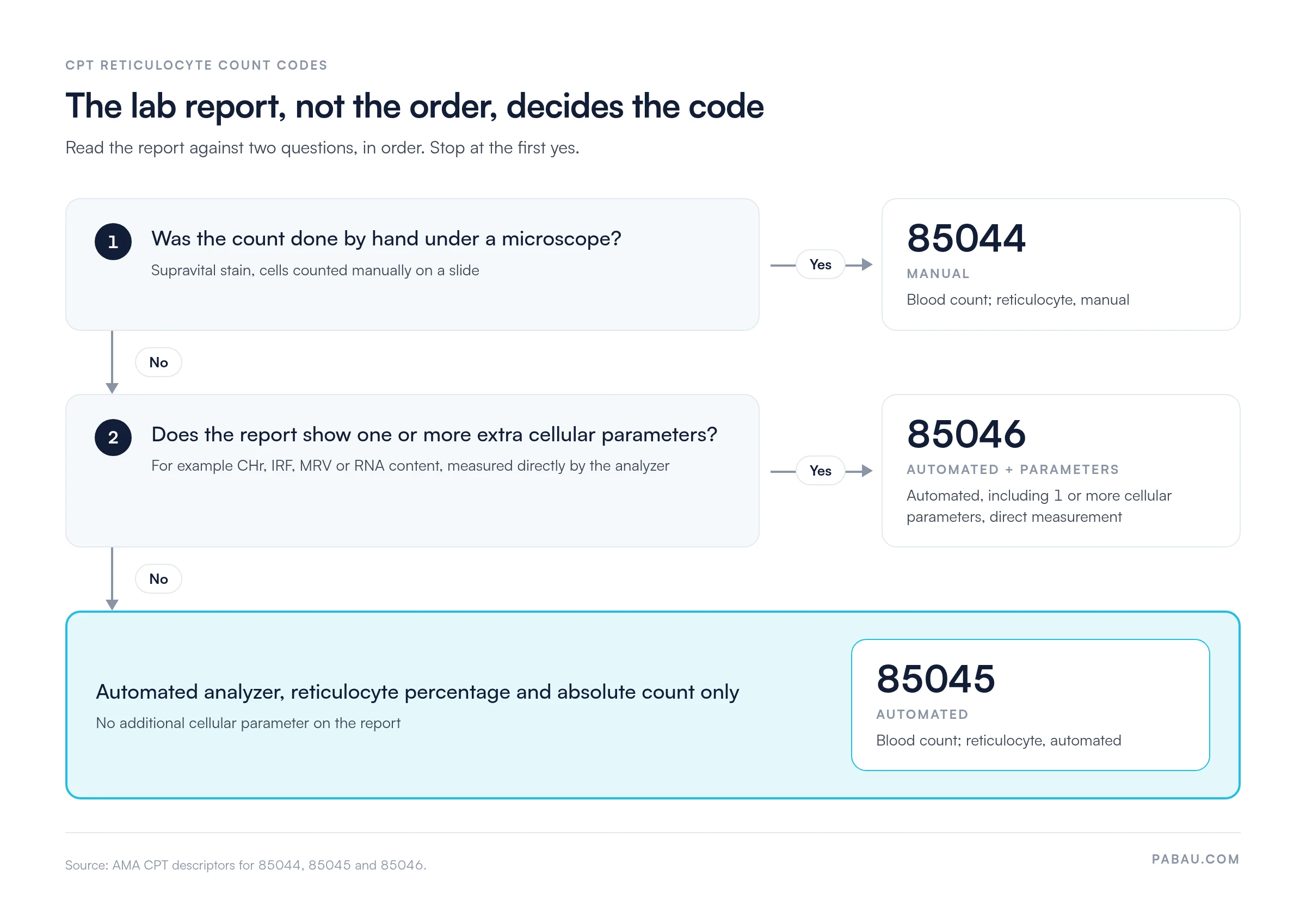
The three reticulocyte count codes differ by methodology and by the data elements the analyzer reports. The performing lab’s equipment and the test it ran determine the correct code. Billing 85046 when the report shows no additional cellular parameter is upcoding, and it is a compliance and audit risk.
Practical rule: If the lab report shows one or more additional cellular parameters, bill 85046. Those include reticulocyte hemoglobin content (CHr), immature reticulocyte fraction (IRF), mean reticulocyte volume (MRV) and RNA content.
If the report shows only the reticulocyte percentage and absolute count, bill CPT code 85045. If the count was performed manually under a microscope, bill 85044. Never select a code from what the physician ordered rather than what the lab reported.
The diagram below runs the same check in the order a coder reads the report.
A reticulocyte count rarely stands alone on a claim. Anemia workups usually pair it with a complete blood count, billed as 85025 with an automated differential or 85027 without one. Co-billing is usually straightforward, but some payer edits call for a modifier to get past a bundling rule.
Medical necessity for CPT code 85045 rests on three linked elements. They are the ordering provider’s clinical notes, the diagnosis recorded in the chart, and the ICD-10-CM pointer on the claim form. All three must align.
A diagnosis code on the 837P that contradicts the documented indication can trigger a denial. It can also raise a compliance question under the False Claims Act.
CLIA regulations under 42 CFR Part 493 require the performing laboratory to hold at least a Certificate of Compliance or a Certificate of Accreditation. An automated reticulocyte count is a non-waived test, so a point-of-care lab holding only a CLIA waiver certificate cannot perform or bill it.
Medical billing compliance programs should verify the CLIA certificate level of every contracted reference lab before routing reticulocyte orders to it.
Before submitting a claim for CPT code 85045, run a quick three-point check. (1) Does the medical record document a clinical indication? (2) Does the ICD-10-CM pointer on the claim match that indication? (3) Does the performing lab hold the right CLIA certificate level for non-waived tests? Catching a mismatch before submission costs far less than working a denied claim.
Medicare reimburses CPT code 85045 under the Clinical Laboratory Fee Schedule (CLFS). The Centers for Medicare and Medicaid Services (CMS) publishes the CLFS each year and posts quarterly updates to it.
The CLFS rate for 85045 is modest, in line with other routine hematology tests. The figure changes with each annual update, so verify the current year’s rate in the CMS Clinical Laboratory Fee Schedule files.
Denials on reticulocyte count claims follow predictable patterns. The table below maps each common denial trigger to its root cause and the corrective action.
Work a denied 85045 claim through these five steps, in order.
Set up a worklist filter in your practice management system that flags every 85045 denial with CARC 50 or CARC 96 for same-day review. These denials are often correctable at the first level of appeal when the medical record clearly documents the clinical indication. They expire if you miss the filing window.
In many practices the lab report and the claim live in separate systems. A biller reads the result, picks 85044, 85045 or 85046, and keys in a diagnosis pointer by hand. Each handoff is a chance for the methodology code or the ICD-10-CM pointer to drift from the record.
In Pabau’s claims management software, the lab order, the documented diagnosis and the claim sit on one patient record. US practices can switch on Quest and Labcorp ordering, with results syncing back to that record. Claims go out as 837P files through Claim.MD, with eligibility checks before the visit and ERA remittances after it.
Your biller codes from the report the lab returned, and the pointer comes from the diagnosis the provider documented. Fewer claims leave with a code or pointer that contradicts the chart, so fewer come back as CARC 50 denials.

Pabau keeps lab orders, ICD-10-CM diagnoses and 837P claim submission on one patient record. See how it supports hematology lab billing from order to ERA.

Getting CPT code 85045 right comes down to two checks. Confirm the lab methodology before coding. Then confirm the ICD-10-CM pointer reflects the documented clinical indication before submitting. Those two checks prevent many avoidable denials on reticulocyte count claims.
If your team still codes from the requisition, switch to coding from the lab report first. The report is what an auditor compares the claim against, and it is the only place an extra cellular parameter shows up.
Pabau supports 837P submission through Claim.MD, eligibility checks and ERA retrieval from the same patient record as the lab order. Book a demo to see how it fits a hematology billing workflow.

Need a full coding reference for related hematology lab denials? Denial codes in medical billing maps common CARC codes to actionable remediation steps across lab and E/M claims.
Submitting claims through a clearinghouse for the first time? The Claim.MD clearinghouse guide explains how 837P electronic claim submission works from practice management software to payer.
Want to understand what a clean claim looks like before submission? Clean claim requirements covers the fields, formats, and documentation standards that prevent front-end rejections.
Coding an anemia workup before the type is confirmed? ICD-10 code D64.9 is the unspecified anemia code, often the first diagnosis on an anemia workup.
CPT code 85045 is the billing code for an automated reticulocyte count. The test measures the percentage and absolute number of immature red blood cells in a peripheral blood sample on an automated analyzer. It sits in the Pathology and Laboratory section of the AMA CPT codebook, under Hematology and Coagulation.
CPT 85044 is a manual reticulocyte count performed under a microscope with supravital staining. CPT code 85045 is an automated count performed on a hematology analyzer. The lab’s methodology decides the code, not the ordering provider’s preference.
CPT 85046 applies when the automated analyzer also reports one or more cellular parameters by direct measurement. Examples are reticulocyte hemoglobin content (CHr), immature reticulocyte fraction (IRF), mean reticulocyte volume (MRV) and RNA content. If the lab report shows only the reticulocyte percentage and absolute count, bill CPT code 85045 instead.
Commonly accepted ICD-10-CM codes include D50.9 (iron deficiency anemia, unspecified) and D59.9 (acquired hemolytic anemia, unspecified). D61.9 (aplastic anemia, unspecified) and D64.81 (anemia due to antineoplastic chemotherapy) are also common. Covered diagnoses vary with each MAC jurisdiction’s LCD. Always verify them against the applicable regional policy.
Yes. CPT code 85045 can be billed on the same date of service as CPT 85025 (CBC with automated differential) or 85027 (CBC without differential). A reticulocyte count is a separate test and is not bundled into the CBC. If a payer’s edit bundles them anyway, append modifier 59 to 85045 with documentation of the distinct clinical purpose.
Medicare reimburses CPT code 85045 under the Clinical Laboratory Fee Schedule (CLFS), not the Physician Fee Schedule. The rate changes annually. Verify the current figure in the CMS Clinical Laboratory Fee Schedule files for the applicable year.
Common reasons include coding 85044 (manual) when the lab used an automated analyzer and a diagnosis pointer that does not meet the payer’s LCD criteria. Incorrect bundling edits with the CBC cause denials too. Billing 85046 when the report shows no additional cellular parameter is an audit risk that can trigger post-payment review.





