



CCSD code G5100: Bypass of duodenum billing guide
CCSD code G5100 bills a bypass that leaves the duodenum in place CCSD code G5100...

Last Updated: Oct 16, 2026

CPT code 85027 describes an automated complete blood count (CBC) without a white blood cell differential, covering Hgb, Hct, RBC, WBC, and platelet count.
If the physician order specifies no differential, bill 85027. Billing 85025 instead is the leading cause of CERT audit recoding on CBC claims.
Medicare reimburses CPT 85027 at approximately $7 to $9 nationally, with rates varying by geographic locality.
Pabau’s claims management software pre-fills claims from the patient record and validates required fields before an 85027 claim is submitted.
CPT code 85027 is the billable code for an automated complete blood count (CBC) performed without a white blood cell differential. It reports hemoglobin, hematocrit, red blood cell count, total white blood cell count, and platelet count. The physician order decides whether 85027 or 85025 applies.
Billing 85025 when the order specified no differential is a known CERT audit recoding finding. This guide covers the code descriptor, the 85025 comparison, ICD-10 pairings, Medicare rates, and documentation.
According to the American Medical Association (AMA), CPT code 85027 is defined as: Blood count; complete (CBC), automated (Hgb, Hct, RBC, WBC and platelet count). It falls under the Hematology and Coagulation subsection of the Pathology and Laboratory section of the CPT manual.
Five parameters are measured and reported under this code. No white blood cell differential is included, and none should be performed if 85027 is the billed code.
Key point: The WBC count in 85027 is a single total figure. It does not break down into neutrophils, lymphocytes, monocytes, eosinophils, and basophils. That breakdown is the differential, and it belongs to CPT code 85025.
Choosing between 85025 and 85027 comes down to one question. Did the physician order a differential? The performed test must match the order, and the billed code must match the performed test. The panel below runs that decision from the order through to what Medicare pays.
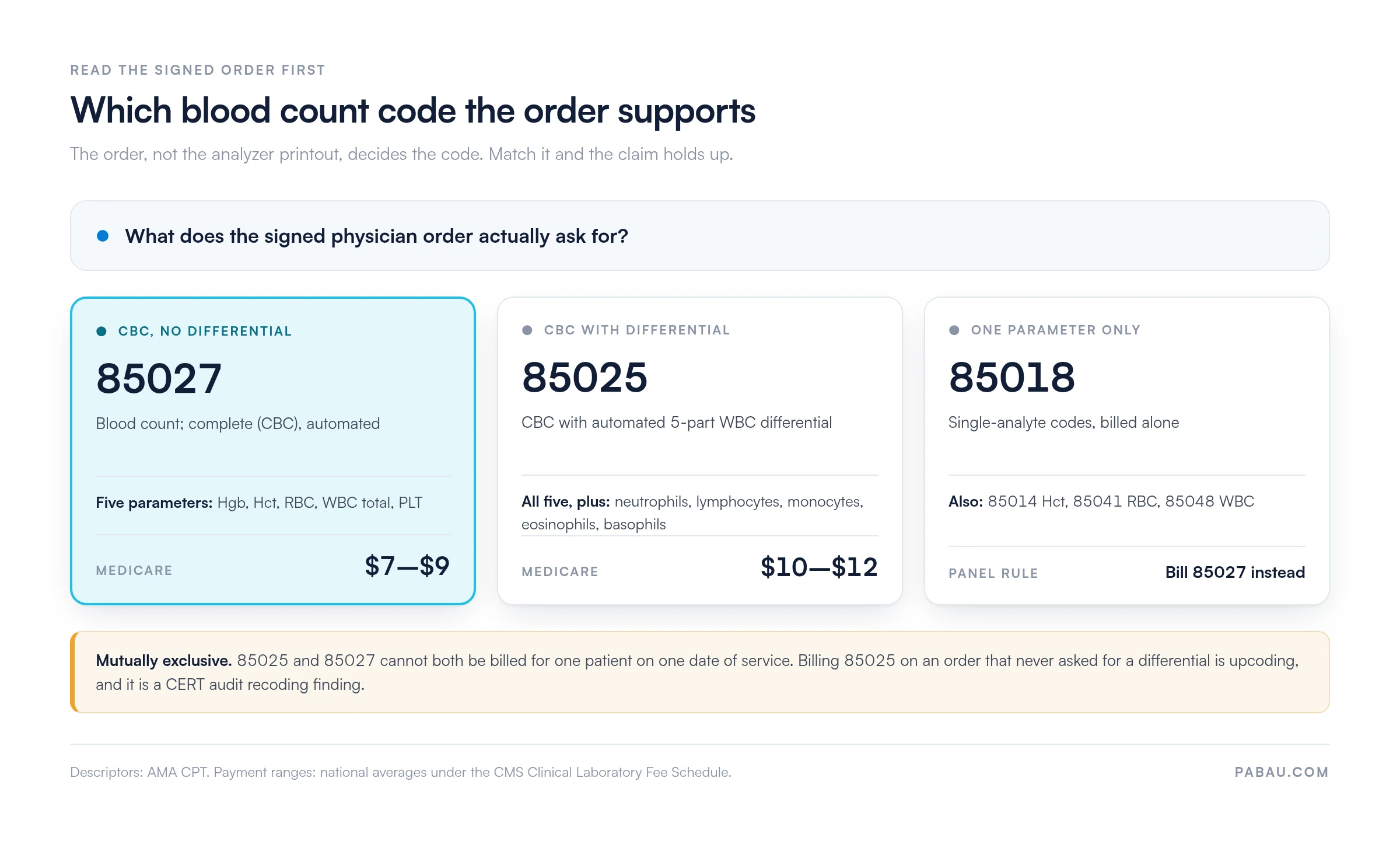
The AAPC Knowledge Center is explicit on this point. If the physician orders only a CBC with no mention of a differential, the correct code is 85027. Billing 85025 in that scenario is upcoding, and it carries CERT audit recoding risk.
CPT code 85027 is appropriate whenever the clinical picture calls for general hematologic assessment without the granular white cell breakdown that a differential provides. Primary care clinicians order it frequently for routine monitoring where a total WBC count is sufficient.
Use 85025 instead when the clinical concern involves infection, suspected leukemia, or neutropenia. It also applies where the distribution of white cell subtypes changes the clinical decision. If the order is ambiguous, clarify with the ordering provider before billing.
Every CPT 85027 claim needs a supporting ICD-10-CM diagnosis code that establishes medical necessity. Payers may have Local Coverage Determinations (LCDs) that restrict which diagnoses support CBC billing in specific regions. Confirm coverage with the relevant payer before assuming a pairing is accepted.
Always use the most specific ICD-10-CM code available. “Anemia, unspecified” (D64.9) is a valid pairing, but if the clinical record supports a more specific code such as iron deficiency anemia (D50.9), use it. Specificity reduces the likelihood of a medical necessity denial.
Medicare Part B covers CPT 85027 as a laboratory service. Lab codes are priced under the CMS Clinical Laboratory Fee Schedule, not the Physician Fee Schedule, so 85027 carries no RVUs.
The national average Medicare payment is approximately $7 to $9. Rates are updated annually, so check the current CLFS amount for your locality before you project 85027 revenue.
Commercial payers negotiate rates separately. Some plans reimburse at Medicare rates, others at a percentage above or below. Practices running high CBC volumes should verify eligibility before the specimen is collected, which prevents non-covered service denials on low-dollar lab claims.
Check your payer contracts annually. Medicare sets a floor. Commercial contracts for lab codes often reference a percentage of the CMS Clinical Laboratory Fee Schedule, not the Physician Fee Schedule. A contract referencing 100% of CLFS and another referencing 85% of CLFS produce very different 85027 reimbursements even in the same zip code.
A clean 85027 claim rests on three documentation pillars. It needs a signed physician order, a clear link to medical necessity, and claim data that matches the order. Missing any one of them invites a denial or a post-payment audit. Documentation works best as a checkpoint at the point of order, rather than a retrospective task.
Three habits keep CBC claims clean. Collect the signed order before specimen collection, then confirm the ICD-10 code sits on the payer’s coverage list. Cross-check the ordering provider’s NPI against their enrollment record before submission. A clean claim gives the payer no reason to query it.
Five recurring problems account for most 85027 claim rejections and recoding findings. Knowing the mechanism behind each one makes prevention possible before the claim goes out.
A working knowledge of medical billing denial codes speeds up the response when a rejection arrives. A CERT recoding finding works differently, because the payment has already been made.
Respond with the original signed order showing no differential was requested, then submit a corrected claim for 85027. Audit your own CBC coding annually so a recoding pattern does not build up unnoticed.
Run a quarterly audit of your CBC claims. Pull all 85025 and 85027 claims side by side and compare the billed code to the original physician order on each. If you find 85025 billed on orders that specified no differential, those are CERT recoding exposure points. Correct them before an auditor finds them.
CPT 85027 sits within a family of hematology codes covering different blood count configurations. Knowing where it fits helps coders avoid unbundling errors and select the right code when the clinical picture calls for a narrower or broader test. The AAPC Codify CPT lookup provides the full 850xx range with short descriptors for cross-reference.
Unbundling reminder: if the lab performs all five components, 85027 is the panel code to bill. Billing 85013, 85018, 85041 and 85048 separately when all five are performed together is unbundling. That triggers a National Correct Coding Initiative (NCCI) edit.
Coding rules are simple to state and harder to apply. Orders, lab results, and billing events pass through different staff and sometimes different systems, which is where 85027 errors accumulate.
Pabau is practice management software for medical and aesthetic practices. Its claims management software tracks every submitted claim on one dashboard, with a status of pending, submitted, processing, paid, or error. A CBC line that lands in error status gets caught the same week, not at month-end.
Each claim is pre-filled from the patient, treatment, and insurer details already in the record, so nobody retypes the date of service. Required fields are validated before submission, so a missing membership number or authorization code is caught in the practice rather than by the payer.
Claims go out through a clearinghouse integration that also returns real-time eligibility checks, which is worth running before the specimen is collected. Insurer price lists sit in the same record, so the expected $7 to $9 on an 85027 line is visible up front. Payment reconciliation then matches what arrived against what was billed.
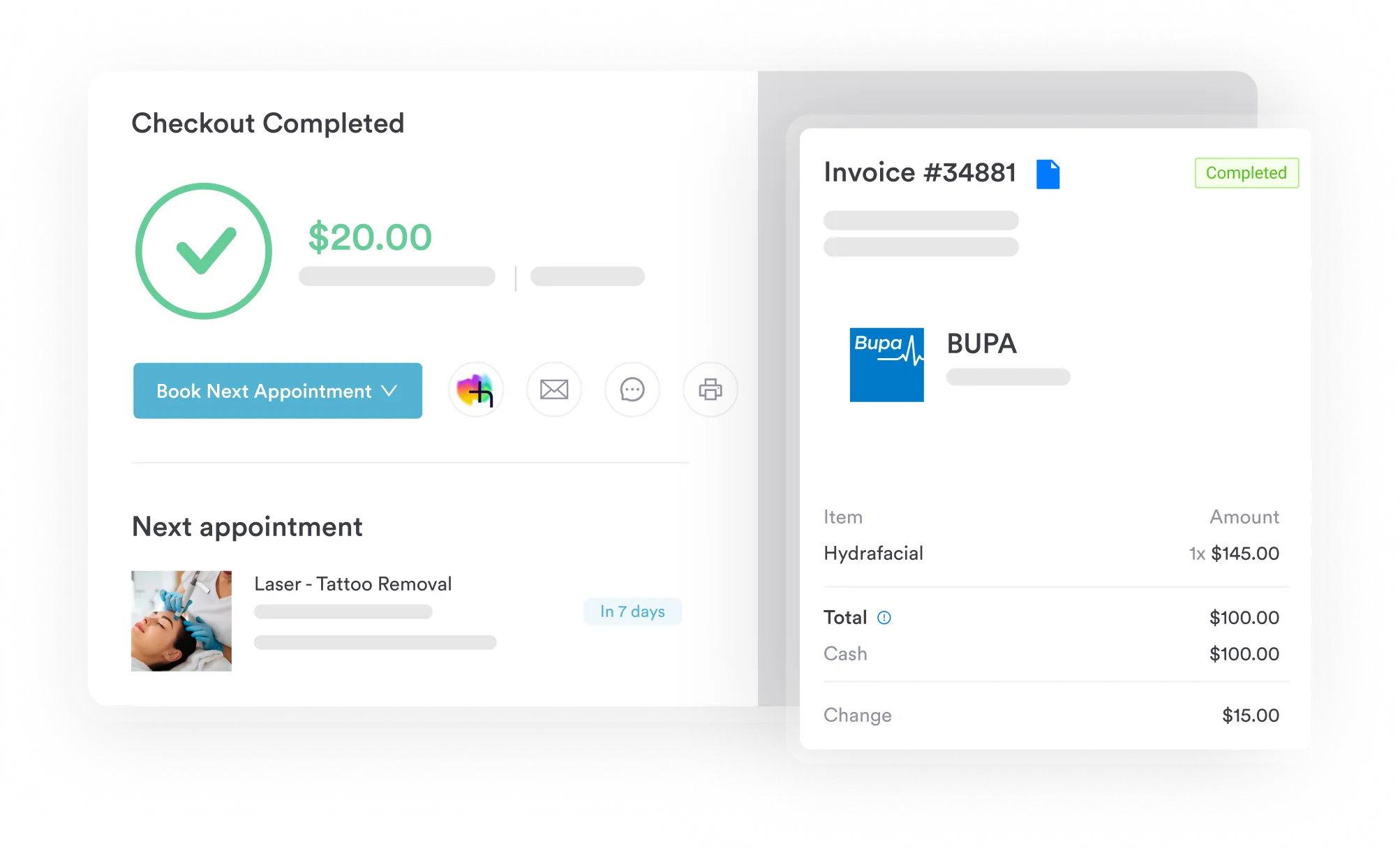

Pabau pre-fills each claim from the patient record, validates the required fields, and tracks it through to payment. Fewer 85027 claims come back for correction.

The order is the control point for CBC coding. Read it before the code is chosen, and 85027 stops being a coding decision at all.
The trade-off worth remembering is that 85027 pays a few dollars less than 85025. Billing the higher code on an order that never asked for a differential is not worth the recoding exposure it creates.
Book a demo to see how Pabau keeps the billed code, the order, and the documentation in step on every CBC claim.

Need a framework for managing claim denials systematically? Denial management in healthcare covers the full workflow from root cause analysis to appeal tracking.
Want to understand what makes a lab claim pass payer scrubbing? Clean claim submission outlines every data element payers validate before processing payment.
Exploring clearinghouse options for your lab billing? Medical claims clearinghouse overview explains how clearinghouses validate, route, and track electronic claims.
CPT code 85027 is an automated complete blood count (CBC) without a white blood cell differential. It measures hemoglobin (Hgb), hematocrit (Hct), red blood cell count (RBC), total white blood cell count (WBC), and platelet count (PLT). It falls under the Hematology and Coagulation subsection of the CPT Pathology and Laboratory section and is maintained by the American Medical Association.
Use 85027 when the physician’s signed order specifies a CBC without a differential. Use 85025 when the order specifically requests a CBC with automated differential. The physician order is the authoritative document. The billed code must match what was ordered and performed. Billing 85025 on an order that did not include a differential is upcoding, and it carries CERT audit recoding risk.
Medicare reimburses CPT 85027 at approximately $7 to $9 nationally, based on the CMS Clinical Laboratory Fee Schedule. Rates are adjusted annually. Check the current amount for your practice’s location with the CMS Clinical Laboratory Fee Schedule lookup before you finalize revenue projections.
No. CPT codes 85025 and 85027 are mutually exclusive and cannot be billed for the same patient on the same date of service. They describe different versions of the same test. Billing both on the same claim will result in one code being denied as a duplicate or bundling conflict.
Frequently paired ICD-10-CM codes include D64.9 (anemia, unspecified), Z00.00 (general adult medical exam without abnormal findings), and D50.9 (iron deficiency anemia, unspecified). R53.83 (other fatigue) and Z79.899 (long-term drug therapy monitoring) are also common. Always verify that the selected diagnosis code is covered under the relevant payer’s Local Coverage Determination before submission.
CPT code 85018 covers a hemoglobin-only test, reporting a single Hgb measurement without hematocrit, RBC count, WBC count, or platelet count. Use 85018 only when the physician specifically orders hemoglobin alone. Use 85027 when the order calls for a full CBC panel without differential. Billing 85027 when only Hgb was ordered and performed would be upcoding.
Required documentation includes a signed physician order specifying CBC without differential. You also need a record entry linking the test to a supporting ICD-10-CM diagnosis. The claim carries the specimen collection date and the ordering provider’s NPI. In-office labs add the practice’s CLIA certificate number. All documents must be retained and retrievable in the event of a payer audit.
Yes, CPT 85027 is covered by Medicare Part B as a laboratory service when medical necessity is established through a supporting ICD-10-CM diagnosis code. Most commercial payers also cover it, though coverage criteria and reimbursement rates vary by contract. Some payers apply Local Coverage Determinations (LCDs) that restrict which diagnosis codes support CBC billing in specific regions.



