CPT Code 27524: Open treatment of patellar fracture
CPT Code 27524: Official descriptor and clinical definition CPT Code 27524 has a...

Last Updated: Nov 6, 2026
CPT code 81228 is the procedure code for cytogenomic constitutional microarray analysis, which detects copy number variants across the genome in a germline specimen. It covers copy number analysis only. Its neighbor, 81229, adds SNP genotyping for loss of heterozygosity and uniparental disomy. Most 81228 denials come down to three issues: Missing prior authorization, a diagnosis outside the payer’s coverage criteria, and confusion with 81229.

CPT code 81228 covers constitutional cytogenomic microarray analysis for copy number variants only. SNP genotyping for LOH or UPD is billed as 81229.
Medicare coverage is governed by MAC-issued Local Coverage Determinations. Accepted indications include intellectual disability, developmental delay, autism spectrum disorder, and congenital anomalies.
Many commercial and Medicare Advantage payers require prior authorization for 81228, and a missing one is the most common denial reason.
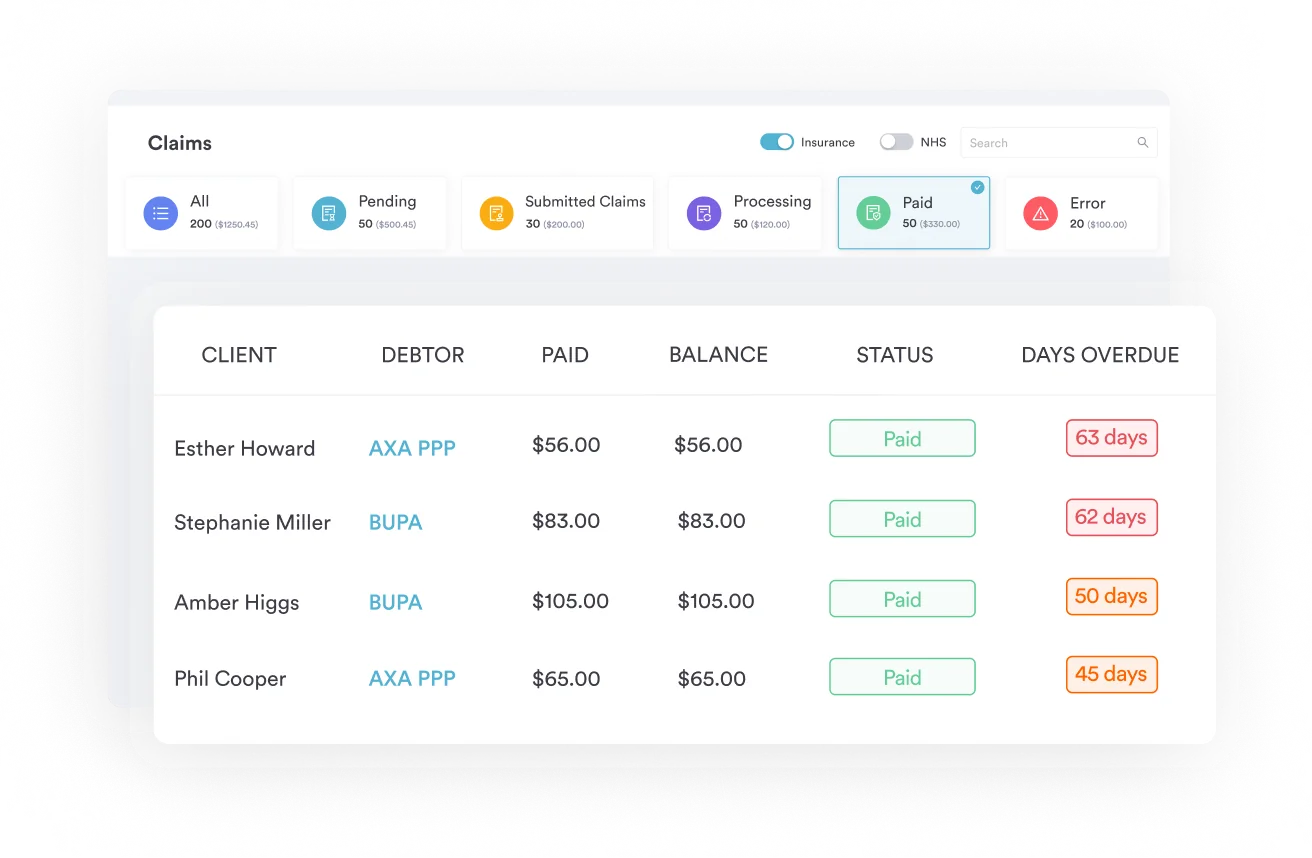
Pabau’s claims management software connects to the Claim.MD clearinghouse to validate CPT and ICD-10 codes before submission, cutting preventable denials on codes like 81228.
CPT code 81228 is a Tier 1 molecular pathology code. It sits within the 81200-81383 Tier 1 molecular pathology range of the CPT code set. The American Medical Association (AMA) sets its official descriptor, quoted word for word in the table below in its two CPT parts. In short, it covers genome-wide microarray testing of germline DNA for copy number variants.
The key clinical boundary is the word “constitutional.” This code applies only when the specimen reflects germline DNA. Typical specimens are peripheral blood, buccal swab, or tissue from a patient whose chromosomal abnormality is expected in every cell. Somatic (acquired) tumor profiling uses different code pathways.
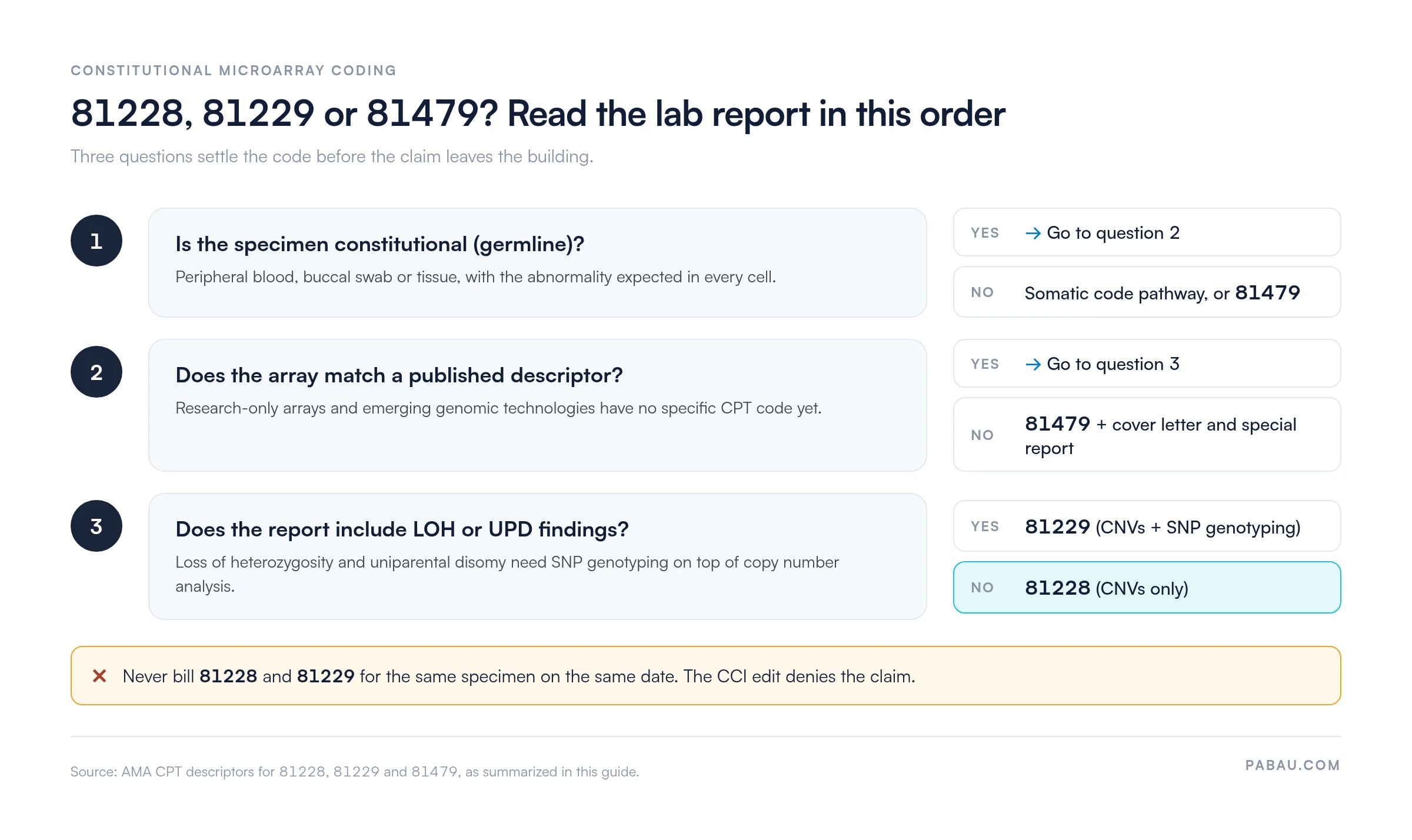
CPT code 81228 covers copy number analysis only. CPT 81229 adds SNP genotyping to detect loss of heterozygosity (LOH) and uniparental disomy (UPD). Choosing the wrong one is the most common technical billing error on constitutional microarray claims.
In practice: If the laboratory report mentions LOH regions or UPD findings, the platform interrogated single nucleotide polymorphisms, and the correct code is 81229. If the report covers copy number gains and losses only, with no SNP-based LOH or UPD component, 81228 is correct.
CPT 81479 is the unlisted molecular pathology procedure code. Use it when the microarray performed doesn’t match the 81228 or 81229 descriptors. Examples include a non-constitutional indication, a research-grade array without clinical validation, or a novel proprietary panel with no specific CPT code.
Billing 81479 requires a cover letter and a special report attached to the claim, explaining what was performed and why no existing code applies. Payers are reluctant to reimburse unlisted codes without this documentation. Some MAC contractors also want the lab’s internal charge, the nearest comparable CPT code, and a clinical reason for not using 81228 or 81229.
Each of the three codes is settled by a question the laboratory report answers, and the questions run in a fixed order.
The linked ICD-10-CM diagnosis code is how payers decide whether the test was medically necessary. A code missing from the payer’s LCD-approved indication list generates a denial, even when the test was clinically appropriate.
Always verify the exact code against the MAC-specific LCD for your billing jurisdiction before submission. LCD criteria for 81228 vary between Noridian, Palmetto GBA, CGS, and Novitas, so a code one MAC accepts may fail another’s criteria.
When autism is the indication, F84.0 is the usual pairing. Back it with the ordering physician’s evaluation notes, because the LCD review reads the record behind the code.
Medicare covers CPT code 81228 under Local Coverage Determinations (LCDs) issued by individual Medicare Administrative Contractors (MACs). There is no national coverage determination (NCD) for constitutional cytogenomic microarray analysis. Coverage rules therefore vary by region, so check the applicable MAC’s LCD before billing.
Reimbursement rates are set annually in the CMS Clinical Laboratory Fee Schedule (CLFS). Payment amounts change each calendar year, so labs should confirm the current-year rate in the fee schedule lookup. Citing a prior-year figure won’t change payment, but budgeting from stale data skews revenue forecasts. The code is billed globally, with no professional or technical component split.
Medicare Advantage (MA) plans follow their own coverage policies, which may differ from traditional Medicare LCDs. MA plans require prior authorization more often than traditional Medicare does. Pabau’s claims software for billers runs real-time eligibility checks through the Claim.MD clearinghouse, so staff can confirm coverage before the specimen is collected.
Check the specific MAC LCD before billing. Not every intellectual disability or developmental delay diagnosis satisfies every MAC’s criteria for 81228. Noridian, Palmetto GBA, and CGS each maintain their own LCD language. Bookmark the CMS LCD database and filter by your billing jurisdiction at the start of each plan year.
Many payers require prior authorization (PA) for CPT code 81228, but requirements vary by payer type, plan, and geography. No blanket rule applies across carriers, so verify each payer’s PA policy individually.
Payer categories and typical PA stance:
Submitting a claim without a required prior authorization is the leading single cause of denials for this code. Labs processing high volumes of 81228 claims should build an eligibility and PA check into order intake, before the specimen is drawn.
Documentation typically required for a PA request:
A clean claim for CPT code 81228 includes all required fields, passes payer edits, and carries documentation that withstands a medical necessity audit. Each missing item below is a cheap fix before submission and an expensive one after.
Following medical billing compliance protocols means filing this documentation in the patient record before the claim goes out. A clean claim checklist run at submission cuts first-pass denials on complex molecular pathology codes like 81228.
A microarray reports copy number variants and does not count CGG repeats, so fragile X testing runs as its own PCR assay. The lab bills that assay as 81243, the FMR1 code for evaluating whether an allele is expanded.
These technical parameters delay payment when they’re wrong, even if the clinical documentation is sound.
Denials on CPT code 81228 cluster around five root causes. Fixing each one before submission costs less than appealing it afterward.
Tracking denial patterns across 81228 claims shows revenue cycle teams which issues are systemic. Our denial codes guide explains the CARC reason codes most often attached to molecular pathology denials. For appeal timelines and escalation, the denial management guide applies to 81228 and other high-scrutiny genetic tests.
Run a monthly query of all 81228 claims denied in the previous 30 days, grouped by denial reason code. If more than 20% show CARC 197 (prior authorization required), your intake workflow is missing a PA check. If CO-50 (not medically necessary) dominates, your ICD-10 pairings need auditing against the current MAC LCD.
Without a check before submission, a missing PA or a mismatched ICD-10 code only surfaces when the remittance comes back. By then the test has been run, and retro-authorization rarely rescues the claim.
Pabau connects to the Claim.MD clearinghouse, so eligibility checks and claim scrubbing happen before the claim goes out. The scrub validates CPT and ICD-10 codes and flags a missing PA before the claim reaches the payer.
ERA remittances, denial reasons included, come back into the same billing workflow. Your team sees which 81228 claims were denied and why, so the monthly denial review starts from data already in the system.

Pabau connects to the Claim.MD clearinghouse to validate CPT and ICD-10 codes, run real-time eligibility checks, and track ERA remittances. Your team catches 81228 issues before the payer does.

The work on 81228 happens before the specimen is drawn. Confirm the PA, match the diagnosis to your MAC’s LCD, and read the lab report for LOH or UPD before choosing between 81228 and 81229.
Building those checks into intake adds a step to every order. On a code where retro-authorization rarely succeeds, that step costs far less than the denials it prevents.
Pabau’s insurance eligibility verification workflow confirms coverage and flags PA requirements at intake. Book a demo to see how it keeps 81228 claims clean in a high-volume genetic testing practice.

Need to understand how clearinghouses process molecular pathology claims? Medical claims clearinghouse guide explains how 837P electronic submissions flow from practice to payer.
Billing 81228 alongside other genetic codes? 837 EDI file structure covers how CPT codes are transmitted in electronic claim files and where sequencing errors cause rejections.
Getting ERA remittances back with denial reason codes? Electronic remittance advice (ERA) explained breaks down how to read CARC and RARC codes on 835 transactions.
Coding a developmental delay indication? ICD-10 code R62.50 covers unspecified lack of expected normal physiological development in childhood.
CPT code 81228 covers cytogenomic constitutional (genome-wide) microarray analysis for copy number variants (CNVs), meaning genomic gains, losses, and amplifications in a germline specimen. It does not include SNP genotyping for loss of heterozygosity or uniparental disomy, which falls under 81229.
CPT 81228 covers copy number variant analysis only. CPT 81229 adds SNP genotyping to detect loss of heterozygosity (LOH) and uniparental disomy (UPD). If the laboratory report includes LOH regions or UPD findings, 81229 is the correct code. The two can’t be billed together for the same specimen, because a CCI edit fires if both are submitted.
Yes. Medicare covers CPT code 81228 under MAC-issued Local Coverage Determinations rather than a national coverage determination. Accepted indications typically include intellectual disability, autism spectrum disorder, developmental delay, and congenital anomalies, though criteria vary by MAC jurisdiction. Verify the LCD for your MAC (Noridian, Palmetto GBA, CGS, or Novitas) before submitting.
The three most common causes are: Missing prior authorization, a diagnosis code outside the MAC’s LCD indication list, and duplicate billing with CPT 81229. A non-covered indication, such as prenatal screening without a qualifying high-risk criterion, is a fourth common cause. No appeal is available for it, and the cost passes to the patient only with a signed ABN on file.
Use CPT 81479, the unlisted molecular pathology procedure code, when the microarray performed doesn’t match the 81228 or 81229 descriptors. That covers a non-constitutional application, a research-grade platform without clinical validation, or an emerging genomic technology with no specific CPT code. Always attach a cover letter and special report to 81479 claims, because most payers deny them without it.
Chromosomal microarray analysis is coded with CPT 81228 or CPT 81229. Use 81228 for copy number variants only, and 81229 when SNP genotyping for LOH and UPD is added. Both are constitutional (germline) codes. Choose based on whether the laboratory report includes LOH or UPD data.