CPT Code 25210: Excision of a single carpal bone
CPT Code 25210: Official descriptor and quick-reference data CPT Code 25210 is a...

Last Updated: Nov 26, 2026
88230 is the CPT code for tissue culture for non-neoplastic disorders; lymphocyte. It covers culturing a patient's peripheral blood lymphocytes so their chromosomes can be analyzed for constitutional disorders such as Turner or Down syndrome.
It is confused most often with CPT 88235, which covers only amniotic fluid or chorionic villus cells. Solid tissue and products of conception go to CPT 88233. The specimen type decides the code, so recording it at order entry prevents the error.
Let Pabau's smart automation suggest the right codes, reduce claim denials, and keep your practice compliant—effortlessly.
Automate repetitive tasks and focus on what matters most—your patients.
Reduce coding errors and ensure compliance with the latest regulations.
Clean claims, fewer denials, and faster reimbursements.
Powerful insights and reporting to help your practice thrive.
HIPAA compliant SOC 2 certified GDPR-compliant Trusted by 4,000+ clinics worldwide

CPT code 88230 covers peripheral blood lymphocyte culture only. Amniotic fluid and chorionic villus cells go to 88235, and solid tissue goes to 88233.
Reimbursement falls under the Medicare Clinical Laboratory Fee Schedule, not the Physician Fee Schedule. Rates change each calendar year.
Commercial payers commonly require prior authorization for cytogenetic testing. Getting it before the specimen is collected prevents the most avoidable denial.
The count (88262), any additional karyotypes or cells, and the interpretation (88291) are billed separately from the culture.
Pabau tracks authorization codes on the patient’s case and sends claims through the Claim.MD clearinghouse, with eligibility checks before the order.
CPT code 88230 is the code for culturing a patient’s peripheral blood lymphocytes so a lab can analyze their chromosomes for constitutional disorders.
Its official descriptor in the AMA’s CPT code set reads “Tissue culture for non-neoplastic disorders; lymphocyte.” It sits in the Cytogenetics subsection of the Pathology and Laboratory chapter (codes 88230-88299).
The procedure covers in-vitro culture of peripheral blood lymphocytes to stimulate cell division, harvest of metaphase chromosomes, and preparation of slides for cytogenetic analysis.
It does not include the chromosome count, karyotyping, or the interpretation report. The count is reported with 88262 and the interpretation with 88291, each on its own claim line.
CPT 88230 reimburses the laboratory work of culturing peripheral blood lymphocytes to reach the metaphase stage, at which chromosomes can be visualized and analyzed. The code is appropriate only for constitutional (germline) chromosome abnormalities, not for acquired mutations in tumor tissue.
Payers and Medicare Administrative Contractors (MACs) publish Local Coverage Determinations (LCDs) listing accepted clinical indications. The following conditions consistently appear across major MAC jurisdictions:
Coverage is diagnosis-driven. Ordering a karyotype without a supported ICD-10 code is the fastest route to a medical-necessity denial. Always verify the ordering physician’s clinical indication against the relevant MAC LCD before the specimen is collected.
CPT 88230 is a narrow code. Several adjacent laboratory services look similar but require completely different billing.
CPT 88230 applies to peripheral blood lymphocyte cultures, and CPT 88235 applies to amniotic fluid or chorionic villus cells. Solid tissue and products of conception go to CPT 88233 instead. The difference is entirely specimen-driven, so billing 88230 for an amniotic fluid culture is a coding error however the order was worded.
When a prenatal patient has blood drawn for a constitutional karyotype (her own chromosomes, not fetal), 88230 is correct. When the specimen comes from amniocentesis or chorionic villus sampling, 88235 applies regardless of the clinical question. The chart below sets out all four specimen routes, plus the codes billed on top of the culture.
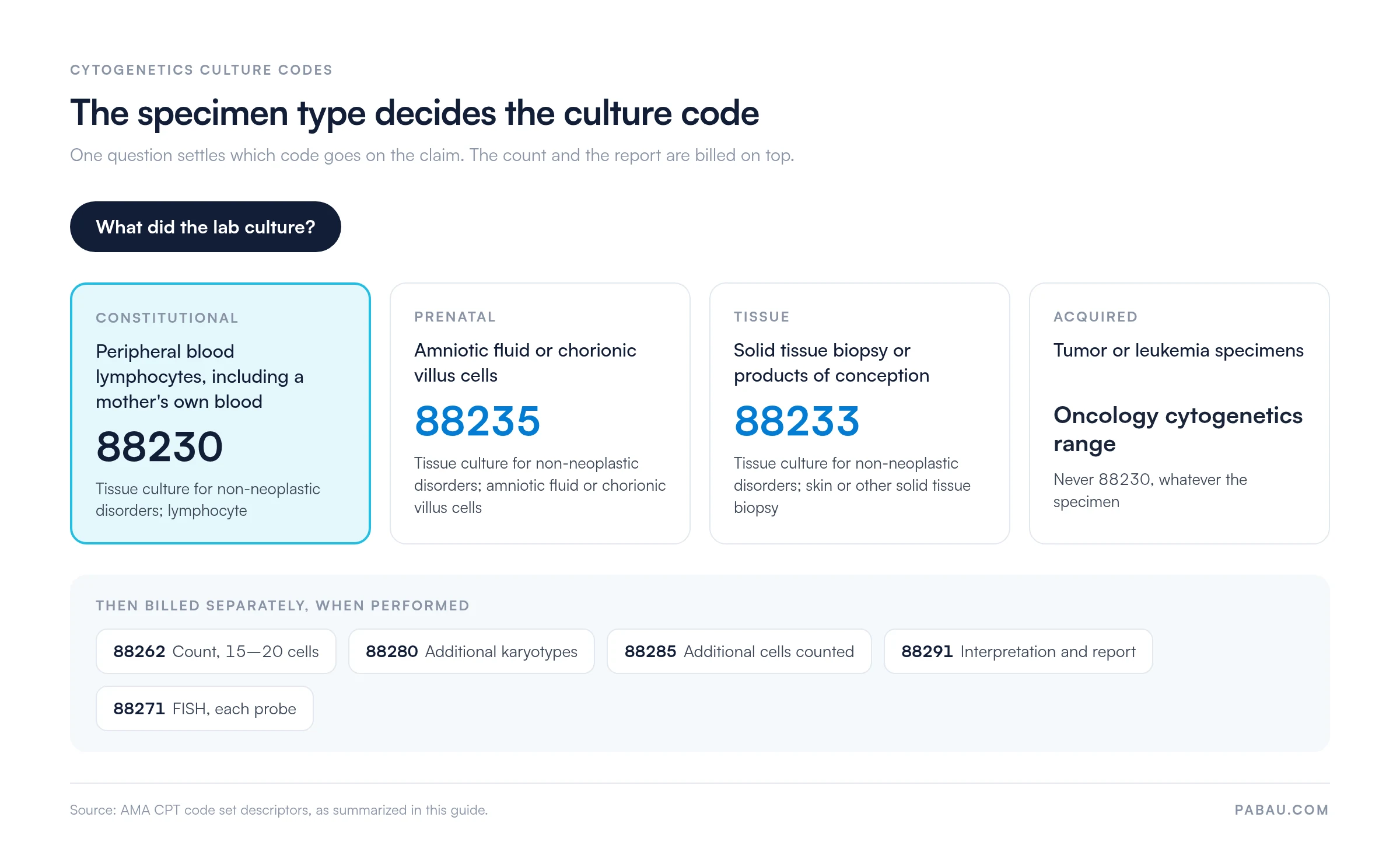
CPT 88230 is a culture-only code. The downstream services of counting, preparing, and interpreting chromosomes each carry separate add-on codes.
Knowing which pairs are permitted on the same date of service under the National Correct Coding Initiative (NCCI) edits prevents unbundling denials. Check the current pairs on the CMS NCCI edits page before billing any combination.
Payers cross-reference the ICD-10-CM code on the claim against the MAC LCD for cytogenetic testing. A diagnosis that falls outside the LCD’s covered list triggers an automatic medical-necessity denial, even when the lab work is clinically appropriate.
The table below lists diagnosis codes commonly paired with 88230. Always verify against the specific LCD in your contractor region before submitting.
Run an ICD-10-to-LCD crosswalk before collecting the specimen, not after. If the ordering diagnosis is missing from your MAC’s covered list, the claim is denied however well the lab work is coded.
CPT code 88230 is reimbursed under the Medicare Clinical Laboratory Fee Schedule (CLFS), not the Physician Fee Schedule. CMS sets CLFS rates annually, and they apply to independently billing clinical laboratories.
Check the current rate on the CMS Clinical Laboratory Fee Schedule page each year. This guide publishes no dollar amount because CLFS rates change every January 1.
Medicaid reimbursement varies significantly by state. Some state programs follow the CLFS rate; others set their own laboratory fee schedules. Contact your state Medicaid fiscal agent for the current rate before assuming Medicare and Medicaid payments are equivalent.
Prior authorization: Many commercial payers require pre-authorization for cytogenetic testing, including 88230. Medicare does not require prior authorization for laboratory services under the CLFS in most circumstances, but Medicare Advantage plans may impose their own requirements. The checklist below covers what commercial payers typically request:
Obtain authorization before the specimen is collected. A claim sent without a required authorization number cannot be fixed after the fact. It is denied, and the appeal typically takes 30-90 days to resolve. Pabau, a practice management platform with built-in insurance billing, checks eligibility through the Claim.MD clearinghouse. Labs can confirm coverage before an order is placed.
Most 88230 denials trace to one of six root causes. The table below maps each reason to its corrective action. Payers report each one with a reason code, which our guide to medical billing denial codes decodes. Sorting your claim volume by those codes shows which process step to fix first.
Pabau’s claims management software tracks the authorization code, dates and sessions on the patient’s case, and warns staff when one is missing. That catches the authorization denial before the claim reaches the payer. For the claims that still come back, denial management workflows cut the time revenue cycle staff spend on appeals.
Incomplete documentation is the leading audit trigger for cytogenetic claims. Payers and their contractors look for the following records when reviewing an 88230 claim:
Keeping these records on the patient’s file from the day of service is what turns an 88230 submission into a clean claim. The claim can then go out as soon as the lab report is final.
Coding guides for CPT code 88230 describe the code. Preventing the errors they list depends on how a lab or ordering practice runs its orders, authorizations and claims.
Three process points account for most 88230 denials:
Software that connects ordering, documentation and billing in one workflow catches each of these before it becomes a denial.
In Pabau, the authorization code, its dates and its sessions sit on the patient’s case, and staff see a warning when one is missing. Insurance eligibility verification runs before the order, so coverage problems surface while the patient is still in the room.
Claims go out as CMS-1500/837P files through the Claim.MD clearinghouse, which reaches thousands of US payers. Electronic remittances come back to the same record, and secondary claims follow from there. Revenue cycle staff work denials from one place instead of matching paper remittances to lab reports.
Audit your 88230 claim volume quarterly. Sort it by denial reason code, then by ordering physician. A high denial rate from one ordering provider usually points to a documentation or diagnosis coding habit. Fix it at order entry rather than through appeals.

Pabau tracks prior authorization codes on each case, checks eligibility and sends claims through the Claim.MD clearinghouse. See how labs and ordering practices keep specialty laboratory claims clean.

Most 88230 claim errors start at order entry. The specimen type goes unrecorded, the diagnosis falls outside the coverage list, or the authorization never gets requested. None of them is a hard coding question.
So start where the order is placed. Record the specimen as peripheral blood, match the diagnosis to your MAC’s coverage list, and get authorization before the draw. A lab that settles those three at order entry spends its billing hours on new claims instead of appeals.
Pabau supports medical billing compliance by keeping authorizations, eligibility checks and claims on one patient record. Book a demo to see how your lab can send 88230 claims that are right the first time.

Need a broader overview of how medical billing works? Medical billing fundamentals covers the full revenue cycle from order to payment posting.
Want to understand how clearinghouse claim submission works? Pabau’s Claim.MD clearinghouse guide explains how electronic 837P claims reach payers and how ERAs come back.
CPT code 88230 covers tissue culture of peripheral blood lymphocytes for chromosome analysis in non-neoplastic (constitutional) disorders. Typical indications include Turner syndrome, Down syndrome, recurrent pregnancy loss, and unexplained developmental delay. The code reimburses the culture preparation step only, not the chromosome count, karyotype, or interpretation.
CPT 88230 applies to peripheral blood lymphocyte cultures, and CPT 88235 applies only to amniotic fluid or chorionic villus cells. Solid tissue and products of conception use CPT 88233. The difference is entirely specimen-driven. Billing 88230 for an amniotic fluid culture is a coding error and a common audit finding.
Yes, Medicare reimburses CPT code 88230 under the Clinical Laboratory Fee Schedule (CLFS), not the Physician Fee Schedule. Rates are updated each January 1 and should be verified on the CMS website before each fiscal year. Medicare Advantage plans may apply additional coverage requirements beyond traditional Medicare.
Prior authorization is commonly required by commercial payers but is not typically required by traditional Medicare for CLFS laboratory services. Medicare Advantage and Medicaid plans vary. Always verify with the specific payer before the specimen is collected, as authorization obtained after collection cannot prevent a denial.
The National Correct Coding Initiative (NCCI) governs whether 88230 and 88262 can be billed together on the same date of service. NCCI edits are updated quarterly, so the current edit table must be verified before submitting both codes. When an edit applies, check whether a modifier override is permitted before adding one.
The first three of the six common denial reasons are a diagnosis missing from the MAC LCD, no prior authorization, and the wrong specimen type. The other three are an NCCI conflict with 88262, a duplicate claim for the same service date, and thin documentation in the record.