CPT code 59612: Vaginal delivery after previous cesarean
CPT code 59612: Official descriptor and procedure overview CPT code 59612 is def...

Last Updated: Nov 26, 2026
88264 is the CPT code for chromosome analysis; analyze 20-25 cells. It reports a chromosome analysis of 20 to 25 cells and names no specimen type, so it is not limited to solid tumors. Tissue culture (88230-88239) and the cytogeneticist's interpretation and report (88291) are billed separately.
The culture code is what tells the payer the specimen type. A leukemic blood study, for example, goes out as 88237 plus 88264. Fewer than 20 cells analyzed takes modifier 52, and cells counted beyond the range add 88285.
Let Pabau's smart automation suggest the right codes, reduce claim denials, and keep your practice compliant—effortlessly.
Automate repetitive tasks and focus on what matters most—your patients.
Reduce coding errors and ensure compliance with the latest regulations.
Clean claims, fewer denials, and faster reimbursements.
Powerful insights and reporting to help your practice thrive.
HIPAA compliant SOC 2 certified GDPR-compliant Trusted by 4,000+ clinics worldwide

CPT code 88264 reports chromosome analysis of 20 to 25 cells. The descriptor names no specimen type, so the code is not limited to solid tumors.
Tissue culture is billed separately under 88230-88239, and that culture line is what tells the payer which specimen was studied.
Fewer than 20 cells analyzed takes modifier 52, while cells counted beyond the range add 88285 and extra karyotypes add 88280.
The cytogenetics report must state the exact number of cells analyzed, because the count is what separates 88264 from 88261, 88262 and 88263.
Billing software such as Pabau sends 88264 claims through its Claim.MD integration, with eligibility checks before the claim leaves the practice.
CPT code 88264 is the Pathology and Laboratory code for “Chromosome analysis; analyze 20-25 cells.” The AAPC summary of CPT 88264 describes a chromosome analysis in which the analyst analyzes 20 to 25 cells. The code sits in the Cytogenetic studies subsection (88230-88299) of the AMA CPT code set.
The descriptor sets a cell range and names no specimen. That means 88264 is not limited to solid tumors, leukemic blood or any other source. ARUP Laboratories, for example, bills its leukemic blood chromosome analysis as 88237 plus 88264.
Prenatal studies have codes of their own. 88267 covers amniotic fluid or chorionic villus cells, and 88269 covers in situ amniotic fluid cell colonies.
88264 pays for the analysis of the cells. Culture, work beyond the descriptor and the physician’s report each go on a line of their own. One study therefore often reaches the payer as three codes or more, as the diagram below lays out.
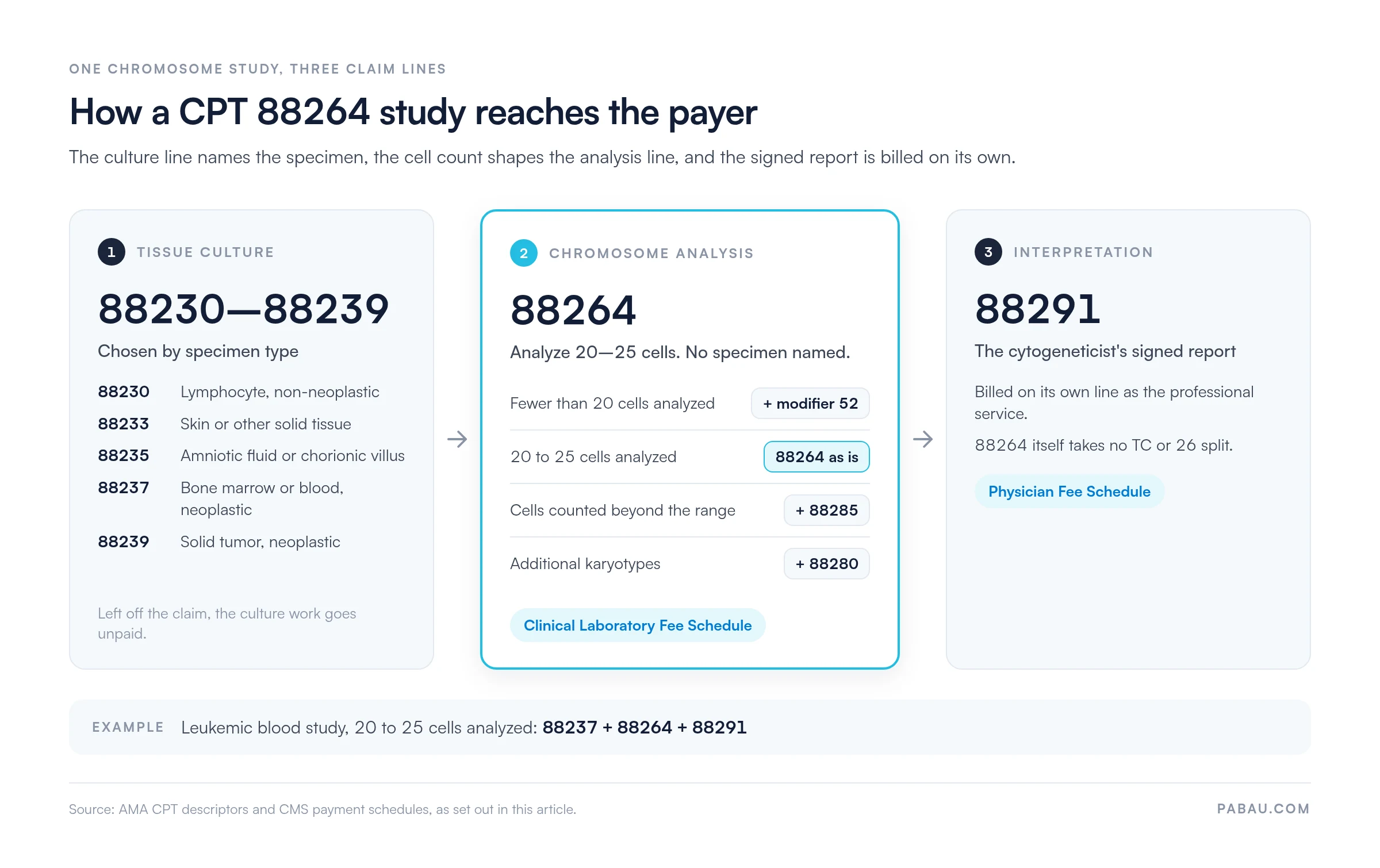
The signed interpretation goes on its own line as CPT 88291. FISH run on the same specimen is reported per probe with CPT 88271, plus the matching analysis code from 88272-88275.
Codes 88373 and 88374 are a different service. They describe computer-assisted morphometric analysis of in situ hybridization, per probe stain, and they never stand in for FISH on a chromosome study.
Because 88264 carries no specimen type, the culture line does that job. The payer reads the specimen from the 88230-88239 code. It then checks that the analysis code fits the count in the report. For a constitutional study on peripheral blood, that culture line is CPT 88230.
A 20-cell neoplastic study on blood or marrow goes out as 88237 plus 88264. The same analysis on a solid tumor changes the culture line to 88239 and leaves 88264 in place. When the culture code is left off, the claim still pays for the analysis, and the culture work goes unbilled.
The chromosome analysis codes split on what the cytogeneticist did with the cells. 88261 to 88263 describe cells counted with a set number of karyotypes. 88264 describes 20 to 25 cells analyzed, so read both the count and the karyotype figure in the report.
A report of 22 cells analyzed supports 88264. A report of 18 cells counted with two karyotypes points to CPT 88262 instead. When the report leaves the count unclear, query the laboratory before the claim goes out.
Most 88264 lines go out without a modifier. The exceptions come from the cell count and from a second study on the same date.
NCCI edits can treat two analysis codes from 88261-88264 on one specimen as alternatives. Report both only when the specimens are distinct, and document that before adding 59 or an X modifier. A clean claim carries a modifier only when the record supports it.
Add a cell-count field to charge entry for cytogenetics. A count under 20 then holds the 88264 line until modifier 52 is added, and a count above 25 prompts the 88285 line.
Medicare covers cytogenetic studies under National Coverage Determination 190.3 when they are reasonable and necessary. The NCD lists genetic disorders in a fetus, failure of sexual development, chronic myelogenous leukemia, acute leukemias and myelodysplasia.
Medicare Administrative Contractors can add covered diagnoses in their own policies. Check the applicable MAC policy before you bill, then link the claim to the most specific code the order supports.
ICD-10-CM codes update every October 1. A diagnosis that has since split into more specific subcodes will fail the payer’s edits, so refresh billing tables each year.
CPT 88264 is a laboratory test, so Medicare prices it on the Clinical Laboratory Fee Schedule rather than the Physician Fee Schedule. The cytogeneticist’s report, 88291, is the professional service and is paid under the Physician Fee Schedule.
CMS updates the CLFS each January, so check the current-year file before you quote a figure.
Traditional Medicare generally does not require prior authorization for cytogenetic testing, as long as the claim meets the coverage criteria. Medicare Advantage plans, commercial insurers and Medicaid managed care plans set their own rules.
A prior authorization request should include the ordering physician’s NPI, the ICD-10-CM code and a short clinical indication. Add the specimen source and collection date, plus any earlier test results that explain the order.
The cytogenetics report carries the 88264 claim. It has to show the count that justifies 88264 over the other analysis codes, and the order has to show why the study was needed.
Pabau’s Claim.MD clearinghouse integration runs real-time eligibility checks (270/271) and sends CMS-1500 or 837P claims.
Most 88264 denials trace back to the cell count, the diagnosis link or a missing authorization. The full list of medical billing denial codes maps each CARC to its corrective action.
In most labs and practices, the cell count travels twice. The cytogeneticist writes it into the report, and someone in billing reads it later to choose the code and any modifier. Any ambiguity in the report turns into a coding decision made days after the study.
Pabau’s claims management software keeps the order, the diagnosis and the codes in one record. Claims go out through the Claim.MD integration, with real-time eligibility checks and 837P submission to thousands of US payers.
Before submission, Pabau’s claim validation checks each claim for missing or invalid details, such as an unlinked diagnosis or an absent modifier. Your team fixes them once, before a denial arrives, so you spend less time on corrected claims.

Pabau’s claims management software captures CPT codes at the point of service and flags missing modifiers before submission. Claims go through Claim.MD, with real-time eligibility checks and 837P submission to thousands of US payers.

Code 88264 from the count in the report, never from the specimen. A figure of 20 to 25 cells analyzed decides the code, and the culture line carries the specimen type.
Build the edge cases into order entry and charge review. A short study takes modifier 52, an extended one adds 88285, and the signed report goes out as 88291. Settle preauth and the diagnosis link before the specimen leaves the practice.
Book a demo to see how Pabau keeps cytogenetics claims matched to the lab report, from order to payment.

Need to understand how clearinghouse submission works? Claim.MD clearinghouse guide explains how 837P electronic claims reach payers and what happens when they don’t.
Confused about electronic remittance and 835 files? Electronic remittance advice explained breaks down how ERA files report payment adjustments and denial reason codes.
Looking for the full denial code reference? Denial codes in medical billing maps every CARC and RARC to its corrective action workflow.
CPT code 88264 covers chromosome analysis of 20 to 25 cells. The AMA descriptor reads “Chromosome analysis; analyze 20-25 cells” and names no specimen type. Tissue culture is billed separately under 88230-88239, and the interpretation and report under 88291.
No. The 88264 descriptor sets a cell range and no specimen type. ARUP Laboratories bills its leukemic blood chromosome analysis as 88237 plus 88264. The culture code, from 88230 to 88239, is what identifies the specimen on the claim.
The difference is the cell work, not the specimen. 88262 covers 15 to 20 cells counted with two karyotypes and banding. 88264 covers 20 to 25 cells analyzed. Neither code is tied to one specimen type, so the count in the report decides.
The descriptor covers 20 to 25 cells analyzed. When fewer than 20 cells are analyzed, add modifier 52. Cells counted beyond the range are reported with add-on code 88285, each study. The report must state the exact count.
A full study usually carries a tissue culture code from 88230-88239 and the interpretation and report code 88291. Add 88280 for additional karyotypes and 88285 for additional cells counted. FISH on the same specimen is reported with 88271-88275.
No. CPT 88264 is a laboratory test, so Medicare pays it under the Clinical Laboratory Fee Schedule. The professional interpretation, 88291, is paid under the Physician Fee Schedule. Check the current CLFS file, because CMS updates the rates each January.
Traditional Medicare generally does not require prior authorization for CPT 88264 when the claim meets the coverage criteria. Medicare Advantage plans, commercial insurers and Medicaid managed care plans often do, so verify with the specific plan before the study.
The usual causes are a cell count missing from the report and fewer than 20 cells billed without modifier 52. A diagnosis outside NCD 190.3 or the MAC policy, or a missing prior authorization, also triggers denials.