HCPCS code P9058: Red blood cells, leukocytes reduced, CMV-negative, irradiated
HCPCS code P9058: Official descriptor and key attributes HCPCS code P9058 report...

Last Updated: Oct 26, 2026
CPT code 81243 covers FMR1 (fragile X messenger ribonucleoprotein 1) gene analysis to detect abnormal, expanded alleles. Put simply, it's the PCR test that counts CGG repeats in the FMR1 gene to diagnose fragile X syndrome or find carriers.
The performing lab bills it under the Clinical Laboratory Fee Schedule, paired with the diagnosis or symptom behind the order. Most denials come from a screening-only diagnosis, missing prior authorization, or a mix-up with 81244. This guide covers the codes to pair, payer rules, and a checklist to run before you submit.
Let Pabau's smart automation suggest the right codes, reduce claim denials, and keep your practice compliant—effortlessly.
Automate repetitive tasks and focus on what matters most—your patients.
Reduce coding errors and ensure compliance with the latest regulations.
Clean claims, fewer denials, and faster reimbursements.
Powerful insights and reporting to help your practice thrive.
HIPAA compliant SOC 2 certified GDPR-compliant Trusted by 4,000+ clinics worldwide

CPT code 81243 is a Tier 1 molecular pathology code for PCR sizing of FMR1 CGG repeats. The lab bills it under the Clinical Laboratory Fee Schedule.
CPT 81244 characterizes abnormal alleles, including methylation status, and many labs add it only as a reflex after an abnormal or intermediate 81243 result.
Code the indication behind the order, such as F84.0 or an intellectual disability code, because Q99.2 fits only a confirmed diagnosis.
Screening codes like Z13.79 are covered less reliably, and Medicare pays for diagnostic genetic testing, not screening.
Check prior authorization and any lab benefit manager before the sample is drawn, since a missing authorization (CARC 197) is hard to appeal.
CPT code 81243 reports FMR1 gene analysis to detect abnormal, expanded alleles. In the AMA’s official wording, it covers:
FMR1 (fragile X messenger ribonucleoprotein 1) (eg, fragile X syndrome, X-linked intellectual disability [XLID]) gene analysis; evaluation to detect abnormal (eg, expanded) alleles.
In plain terms, the lab counts CGG repeats in the FMR1 gene and reports the allele category. It’s a Tier 1 molecular pathology code, part of the 81105-81383 range of specific gene tests. Tier 2 codes (81400-81408) instead group less common tests by complexity level.
Because 81243 is a lab test, Medicare pays it under the Clinical Laboratory Fee Schedule (CLFS), not the Physician Fee Schedule. The performing lab bills it, not the ordering clinician. Still, the ordering provider’s notes decide whether it gets paid. The American Medical Association’s CPT code set overview explains how the code set is maintained.
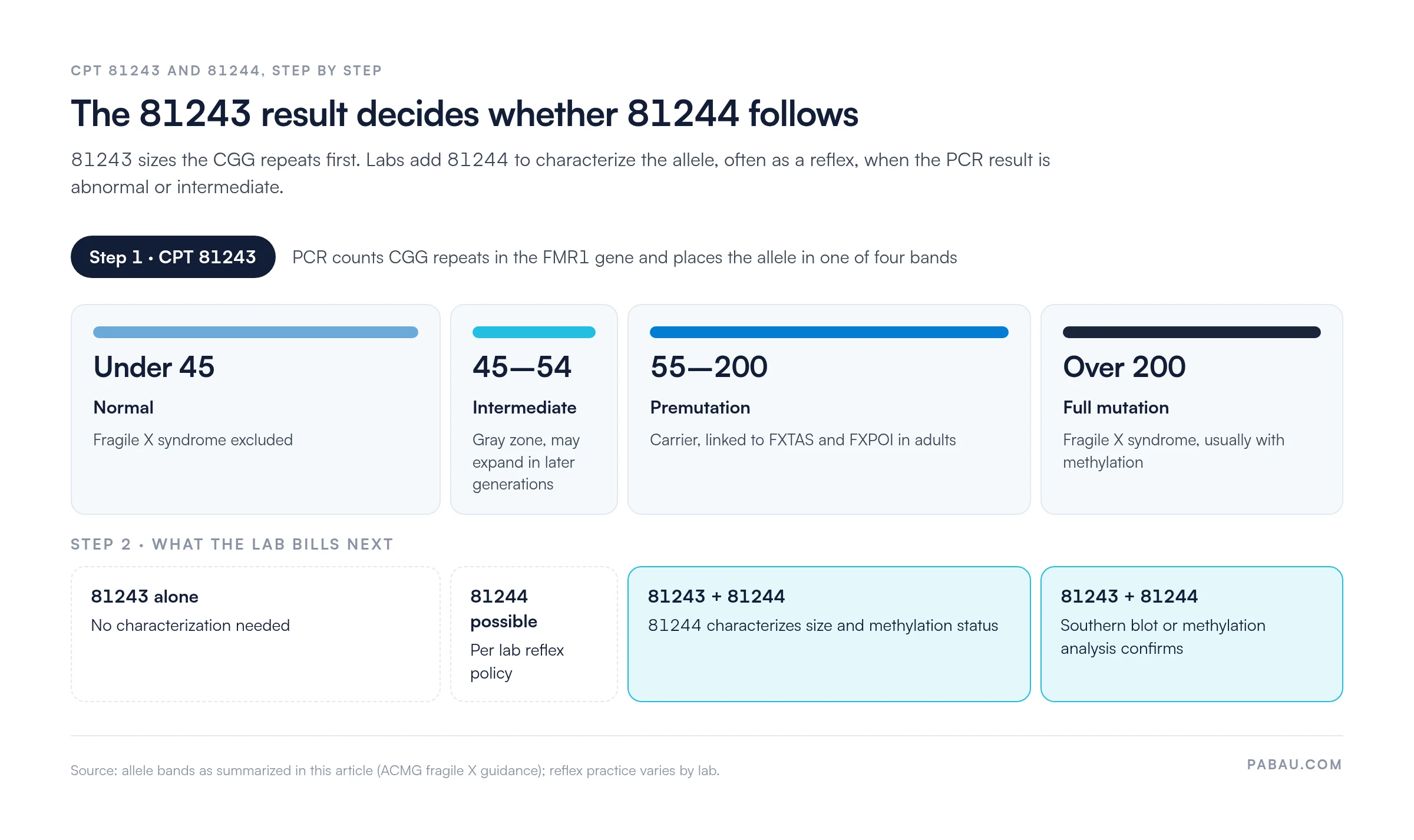
81243 uses polymerase chain reaction (PCR), usually with capillary electrophoresis, to count CGG repeats in FMR1. That count places each allele in one of four categories.
PCR sizes normal, intermediate, and premutation alleles well. Very large full mutations are harder to size, so labs often confirm them with Southern blot or methylation analysis. Interpretation belongs to a genetic counselor or clinical geneticist. The code covers the lab procedure, not that interpretation.
Both codes cover FMR1 gene analysis, but they answer different questions. 81243 asks whether an allele is expanded. 81244 characterizes an abnormal allele, including its expanded size and methylation status.
Many labs add 81244 only as a reflex when the PCR result is abnormal or intermediate. The chart below shows how that decision follows the repeat count.
When both run on the same date of service, check current NCCI edits and the payer’s policy before adding any modifier. Modifier QW doesn’t apply either way, because FMR1 repeat analysis is a high-complexity test under CLIA.
Several neighboring codes cover related but distinct tests. Picking the wrong one gets the claim denied or sent back for correction.
Keep 81479 for an FMR1 method that no specific code describes. Payers price it by hand, so send the test methodology and a comparable code with the claim.
Patients qualify when the record documents an accepted clinical indication before the test is ordered. The indications below are broadly accepted by Medicare and commercial payers. They follow American College of Medical Genetics and Genomics (ACMG) guidance.
Screening indications, coded Z13.79 (encounter for other screening for genetic and chromosomal anomalies), are covered less reliably. Check the payer’s policy before using a screening code as the primary diagnosis.
The diagnosis code drives the coverage decision. Code the indication that prompted the order, at the highest specificity the notes support. Outpatient coding doesn’t code a suspected condition as confirmed, so code the presenting signs instead.
Medicare coverage for CPT code 81243 runs through each Medicare Administrative Contractor (MAC). Their Local Coverage Determinations (LCDs) and billing articles set the rules.
Medicare pays for diagnostic genetic testing, not screening, so a documented indication is the minimum. Check your MAC’s LCD and billing articles for the patient’s state before billing.
Commercial payers publish their own medical policies, listing covered indications and exclusions for FMR1 testing. Run an insurance eligibility verification and confirm whether the plan uses a laboratory benefit or the medical benefit. That answer decides which claims address the lab uses.
Check whether the patient’s plan sends lab tests to a laboratory benefit manager. Many commercial plans carve molecular pathology out to managers such as EviCore or Carelon. A claim sent to the wrong address can be denied after adjudication, even when the coding is correct.
Medicare pays 81243 at a national rate on the Clinical Laboratory Fee Schedule. CMS posts the CLFS files each year and updates them quarterly. Look up the current rate on the CMS Clinical Laboratory Fee Schedule page before you quote expected payment or budget for write-offs.
Hospital outpatient labs are worth a second look. CMS doesn’t package molecular pathology tests into Outpatient Prospective Payment System (OPPS) payments, so 81243 is still paid from the CLFS there.
Commercial rates depend on each lab’s contract with the plan. As a result, the same test can pay differently at a reference lab and a hospital lab.
The lab, not the ordering clinician, submits the claim. That split means both sides own part of the paperwork. Here’s the path a clean claim takes.
The record must show medical necessity at the time of the order. To send a clean claim, keep these on file:
Denials on 81243 claims tend to fall into four groups, each with a prevention step and an appeal path. Prevention is the faster route, since genetic testing appeals can take 45-90 days under commercial plans.
A denial management workflow that tracks denials by code and payer shows which plans return the most CO-50s for 81243. You can then attach clinical notes for those payers on every claim. Our guide to medical billing denial codes explains each reason code you’ll see on a remittance.
Audit your 81243 claims by payer every quarter, sorted by denial code. If CO-50s cluster on one or two plans, compare the ordering notes with each plan’s medical policy. Often the notes are fine, but the ICD-10 code isn’t on the covered list. Where the record supports it, switching from Z13.79 to a diagnostic code such as F84.0 usually resolves it without an appeal.
Many of the errors above start with re-keying. Someone copies the order, diagnosis, and authorization number into a clearinghouse portal, and one field slips.
In Pabau, the practice management platform we build, the claim form is pre-filled from the patient record. The CPT code on the service and the diagnosis codes from the problem list land on the claim. Our claims management software also checks that required fields, such as authorization codes, are complete before you can send.
For US practices, Pabau’s Claim.MD integration submits the 837P electronically and checks eligibility in real time. So you confirm coverage before the sample is drawn, rather than after a denial arrives.


Pabau pre-fills claims from the patient record and, in the US, submits 837P claims through Claim.MD with real-time eligibility checks. That means fewer re-keyed fields on fragile X test claims.

Most fragile X claim denials trace back to three choices made before the sample is drawn. They are when the indication was documented, which ICD-10 code was picked, and whether authorization was in place.
So move the work upstream. Settle the indication, the diagnosis code, and the payer’s authorization rules before the sample leaves the practice. Then adding 81244 after an abnormal result becomes routine paperwork.
Book a demo to see how Pabau pre-fills lab claims and checks eligibility before you submit.

Need to understand how electronic claim submission works end to end? Pabau’s Claim.MD clearinghouse guide explains how 837P files are validated, scrubbed, and sent to payers.
Billing an FMR1 method no specific code describes? CPT 81479 covers unlisted molecular pathology claims and the documentation payers ask for.
Comparing Tier 1 and Tier 2 molecular codes? CPT 81401 shows how a Tier 2 code groups less common genetic tests.
Handling remittances after 81243 claims pay? Electronic remittance advice (ERA) processing covers how 835 files map back to the original claims.
Is the lab enrolled with every payer it bills? How to get credentialed with insurance companies walks through the payer enrollment steps that come before the first claim.
CPT code 81243 is the lab code for FMR1 gene analysis to detect expanded alleles. It’s the PCR test used to diagnose fragile X syndrome and find carriers, billed under the Clinical Laboratory Fee Schedule.
81243 is a Tier 1 molecular pathology code. Tier 1 codes describe specific, commonly performed gene tests. Tier 2 codes, 81400-81408, group less common tests by complexity level, so FMR1 testing doesn’t use them.
Yes. Molecular pathology codes describe the analysis, not the specimen, so FMR1 testing on chorionic villi or amniotic fluid is still 81243. Document the indication, such as a parent’s known carrier status, and check the payer’s prenatal policy.
Usually once. A germline FMR1 result doesn’t change over a lifetime, so many payers limit 81243 to one test per patient. A repeat test needs a documented reason, such as an inconclusive first result.
Some do. Certain commercial policies require pre-test genetic counseling, or an order from a geneticist, before they approve FMR1 testing. Check the policy during prior authorization and keep the counseling note in the record.
Any treating clinician can order it when the result will guide that patient’s care, including pediatricians, neurologists, and OB-GYNs. The lab bills the code, so the ordering clinician’s job is documenting the indication.