HCPCS Code L0472: Hyperextension TLSO billing guide
HCPCS code L0472: Official descriptor and device definition HCPCS code L0472 des...

Last Updated: Nov 5, 2026
77086 is the CPT code for vertebral fracture assessment via dual-energy X-ray absorptiometry (DXA). It covers a stand-alone VFA, in which lateral DXA images of the thoracic and lumbar spine are read for vertebral fractures. No bone density study is included.
When the same session also includes an axial DXA bone density study, report 77085 instead. 77085 already includes the VFA, so 77085 and 77086 are never reported together.
Let Pabau's smart automation suggest the right codes, reduce claim denials, and keep your practice compliant—effortlessly.
Automate repetitive tasks and focus on what matters most—your patients.
Reduce coding errors and ensure compliance with the latest regulations.
Clean claims, fewer denials, and faster reimbursements.
Powerful insights and reporting to help your practice thrive.
HIPAA compliant SOC 2 certified GDPR-compliant Trusted by 4,000+ clinics worldwide

CPT code 77086 reports a stand-alone vertebral fracture assessment (VFA) via DXA, with no bone density study.
When axial DXA and VFA happen in the same session, report 77085, not 77080 plus 77086.
77085 already includes the VFA, so 77085 and 77086 are never reported together.
A 77086 report needs the vertebral levels reviewed and the fracture finding. T-scores are not required.
CPT code 77086 is defined by the American Medical Association as Vertebral fracture assessment via dual-energy X-ray absorptiometry (DXA). It reports a VFA performed on its own, with no bone density study in the same session. The AMA CPT code set overview explains how codes like this one sit within the Radiology section.
During a VFA, the DXA scanner takes lateral images of the thoracic and lumbar spine. The reading provider reviews each vertebra for the loss of height and change in shape that signal a compression fracture. The result goes into a written VFA report.
A stand-alone VFA fits when a recent bone density result is already on file, or when fracture status alone will change the treatment plan. Any bone density figures quoted in the report come from an earlier, separately billed study.
Knowing exactly what 77086 covers prevents the most common coding errors on DXA claims.
Included: Lateral DXA imaging of the thoracic and lumbar spine, plus the reading provider’s interpretation and report on vertebral fractures.
Excluded: Any DXA bone density study. Axial bone density with a VFA in the same session is 77085, and axial bone density alone is 77080. Appendicular sites such as the radius, wrist and heel fall under 77081. Vertebral assessment from CT, MRI or plain X-ray is not reported with 77086.
The four DXA codes turn on two questions. Was bone density measured, and at which sites? Was a VFA read and reported in the same session? The grid below crosses both answers, so each session lands on one code.
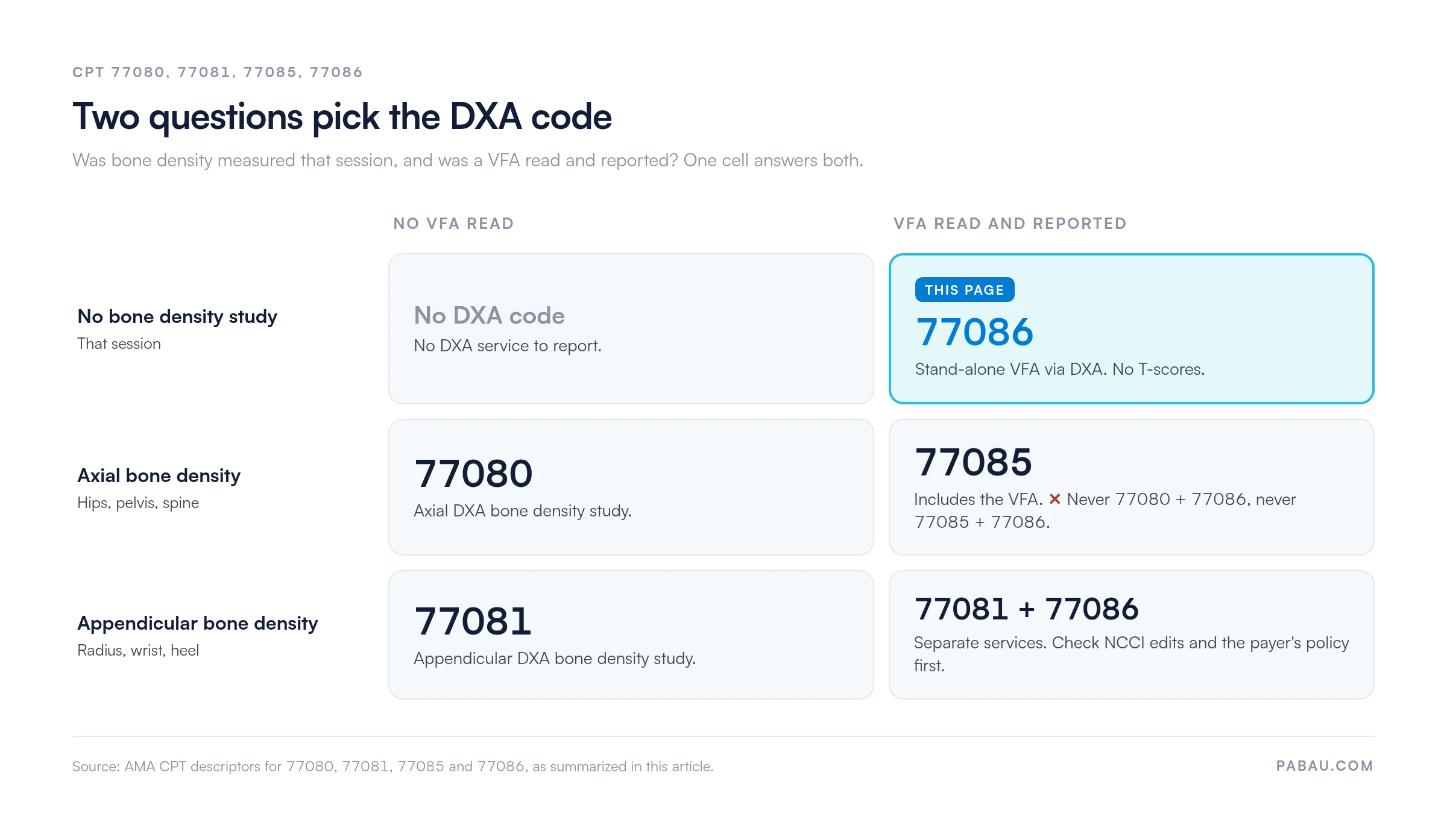
When axial DXA and VFA are performed together, report 77085. Never split that session into 77080 plus 77086, and never add 77086 to 77085. Either combination bills the VFA twice or unbundles a service that one code already describes.
Report 77086 only when the VFA was interpreted and reported. Lateral images that were acquired but never read do not support the code. The AAPC code page for 77086 lists it within the bone/joint studies range.
VFA looks for vertebral fractures that cause no symptoms. A fracture found this way can change both the diagnosis and the treatment plan, which is why payers tie the test to fracture risk.
The International Society for Clinical Densitometry (ISCD) bases its VFA indications on a short list of risk factors. Payer VFA policies often draw on the same list. They usually pair it with low bone mass on a prior DXA, so check the plan’s own criteria before scheduling.
Medical necessity for CPT code 77086 must be supported by a qualifying diagnosis from the ICD-10-CM code set. The CDC ICD-10-CM web tool is the authoritative lookup for current code validity. Lead with the code that explains why fracture status matters for this patient now.
Tip: Avoid submitting M85.80 as the primary diagnosis unless the payer’s policy lists it. Acceptance varies by contractor and by plan.
A VFA images the shape of the vertebrae rather than measuring bone mass. Don’t assume the Medicare bone mass measurement rules that govern 77080 also govern 77086. Coverage for a stand-alone VFA turns on medical necessity under your Medicare Administrative Contractor’s (MAC’s) policy.
Commercial coverage varies more widely. Some plans class DXA vertebral fracture screening as investigational, while others cover it for defined risk groups. Read the member’s plan policy before the appointment, and confirm whether prior authorization applies.
Running insurance eligibility verification at booking surfaces the plan’s rules before the patient arrives. That gives the front desk time to request authorization or reschedule.
Before submitting a 77086 claim to a commercial payer, pull the patient’s specific plan policy and confirm the ordering diagnosis appears in its covered indications. Plan-level coverage can differ from the payer’s published clinical criteria, and the plan document governs.
A 77086 claim needs documentation of the VFA alone. T-scores and Z-scores are not part of this code, because no bone density study is billed. The report should contain the following.
A single line reading “VFA performed” gives the payer little to approve. List the levels reviewed and state the finding at each one.
If the report quotes a bone density result, note the date of the study it came from. That shows bone density was not repeated and billed today. When generating the superbill for a 77086 encounter, confirm the VFA report is attached before submission.
Medicare reimbursement for CPT code 77086 is set annually through the Medicare Physician Fee Schedule (MPFS). Rates vary by geographic practice cost index (GPCI) and differ between the non-facility and facility settings. Use the CMS Physician Fee Schedule lookup to retrieve current-year rates for your MAC locality.
77086 carries both a professional and a technical component. Append modifier 26 when billing the interpretation only, and modifier TC when billing the imaging only.
In the hospital outpatient setting, the Hologic 2025 bone densitometry coding guide lists 77086 with OPPS status indicator Q1. Its payment is packaged when billed on the same date as a code with status S, T or V. 77080 carries status S, which is one more reason the combined session is reported as 77085.
Rates change each January 1. The electronic remittance advice (ERA) returned after adjudication shows the exact allowed amount. Reconcile it against the current fee schedule rate for every 77086 claim.
Denial patterns for CPT code 77086 cluster around a small set of preventable errors. A denial management workflow works best when these triggers are caught at charge entry, not after a remittance lands.
Submitting a clean claim for 77086 means every field matches. The CPT code reflects the service documented, the diagnosis is on the payer’s covered list, and the VFA report is retrievable on request.
77086 with 77080: When axial DXA and VFA are performed in the same session, report 77085 alone. Splitting that work into 77080 plus 77086 unbundles a service CPT already describes with one code.
77086 with 77085: Never report these together. 77085 includes the VFA, so adding 77086 bills it twice. A modifier does not fix this, because the VFA was performed only once.
77086 with 77081: An appendicular DXA and a VFA describe different services. Check the current NCCI edits and the payer’s policy before billing both on one date.
Global period: CPT 77086 carries a global period of XXX, so the global surgery concept does not apply. A significant, separately identifiable E/M service on the same date may be billed separately, typically with modifier 25.
Many 77086 errors start with the order. When the order doesn’t say whether bone density is being measured that day, the coder has to guess between 77085 and 77086. An incomplete order also leads to unsupported diagnoses and missed authorizations.
Pabau, the practice management and billing platform we build, catches these issues before the claim leaves the practice. Its claims management software validates CPT and ICD-10 code pairings at charge entry and tracks prior authorization status.
Claims go out through Pabau’s Claim.MD clearinghouse integration, which connects to thousands of US payers. It also returns eligibility responses before the appointment.
Automated medical billing workflows route a 77086 claim to a review queue when a high-risk condition appears. Examples include a diagnosis missing from the payer’s policy, or a plan that requires prior authorization. Your billing team then reviews exceptions instead of every claim.

Pabau’s claims management software validates CPT and ICD-10 code pairings before submission. It also tracks prior authorization status for bone density and VFA studies.

CPT code 77086 is the VFA on its own, and that one fact settles the rest of the DXA family. Axial bone density alone is 77080 and the peripheral study is 77081. Axial bone density with a VFA in one session is 77085.
Fix the code choice at the order, not at the claim. An order template that asks whether bone density is being measured today removes the guesswork between 77085 and 77086. It also keeps the VFA report focused on what the payer needs to see.
Book a demo to see how Pabau checks DXA and VFA code pairings before each claim goes out.

Need a framework for managing claim denials across your DXA program? Denial management in healthcare walks through the denial lifecycle and how to build a prevention-first workflow.
Want to understand how clearinghouse submissions work end to end? Medical claims clearinghouse guide covers how 837P transactions reach payers and what happens when they bounce.
Looking for the CARC codes behind your 77086 denials? Denial codes in medical billing explains the most common CARC and RARC reason codes and how to action each one.
Billing an axial bone density study without a VFA? CPT code 77080: DXA bone density scan billing guide walks through billing the axial study when no VFA is read.
Measuring bone density by CT instead of DXA? CPT code 77078: Bone density billing guide covers CT bone density billing, modifiers and common denials.
CPT code 77086 covers a stand-alone vertebral fracture assessment (VFA) via dual-energy X-ray absorptiometry (DXA). Lateral images of the thoracic and lumbar spine are read and reported for vertebral fractures. No bone density study is included.
CPT 77085 is an axial DXA bone density study that includes a vertebral fracture assessment. CPT 77086 is the VFA alone, with no bone density study. Report 77085 when both are performed in the same session.
No, not for the same session. When axial DXA and VFA are performed together, report 77085 instead of 77080 plus 77086.
No. 77085 already includes the vertebral fracture assessment, so adding 77086 would bill the VFA twice.
No. CPT 77086 reports the VFA alone, so the report needs the vertebral levels reviewed and the fracture finding. T-scores belong to the bone density codes, such as 77080 and 77085.
Medicare coverage of 77086 depends on medical necessity under your Medicare Administrative Contractor’s policy. Check that policy for covered indications and diagnosis codes before scheduling a stand-alone VFA.
The Medicare Physician Fee Schedule rate for CPT 77086 changes each January 1 and varies by locality and place of service. Retrieve the current rate from the CMS Physician Fee Schedule lookup at cms.gov, using code 77086 and your MAC locality.