HCPCS Code Q4185: Cellesta flowable amnion billing guide
HCPCS Code Q4185: definition and official descriptor HCPCS Code Q4185 is the Lev...

Last Updated: Nov 20, 2026
G0130 is the HCPCS Level II code for a single energy x-ray absorptiometry (SEXA) bone density study. It measures the appendicular skeleton, such as the radius, wrist, or heel.
The scanner technology decides the code. A dual energy (DXA) scan of the same sites is CPT 77081, and a DXA scan of the hip or spine is CPT 77080. Medicare pays G0130 as a bone mass measurement once 23 months have passed since the last one, when a qualifying category is documented. Many commercial payers do not accept HCPCS G codes, so check the payer's policy before the scan.
Let Pabau's smart automation suggest the right codes, reduce claim denials, and keep your practice compliant—effortlessly.
Automate repetitive tasks and focus on what matters most—your patients.
Reduce coding errors and ensure compliance with the latest regulations.
Clean claims, fewer denials, and faster reimbursements.
Powerful insights and reporting to help your practice thrive.
HIPAA compliant SOC 2 certified GDPR-compliant Trusted by 4,000+ clinics worldwide

HCPCS Code G0130 reports a single energy x-ray absorptiometry (SEXA) bone density study of the appendicular skeleton, such as the radius, wrist, or heel.
The scanner technology decides between G0130 and CPT 77081, whoever the payer is. A SEXA scan is G0130, and an appendicular DXA scan is 77081.
Medicare covers a bone mass measurement every 23 months for beneficiaries in a qualifying category, with no Part B deductible or coinsurance.
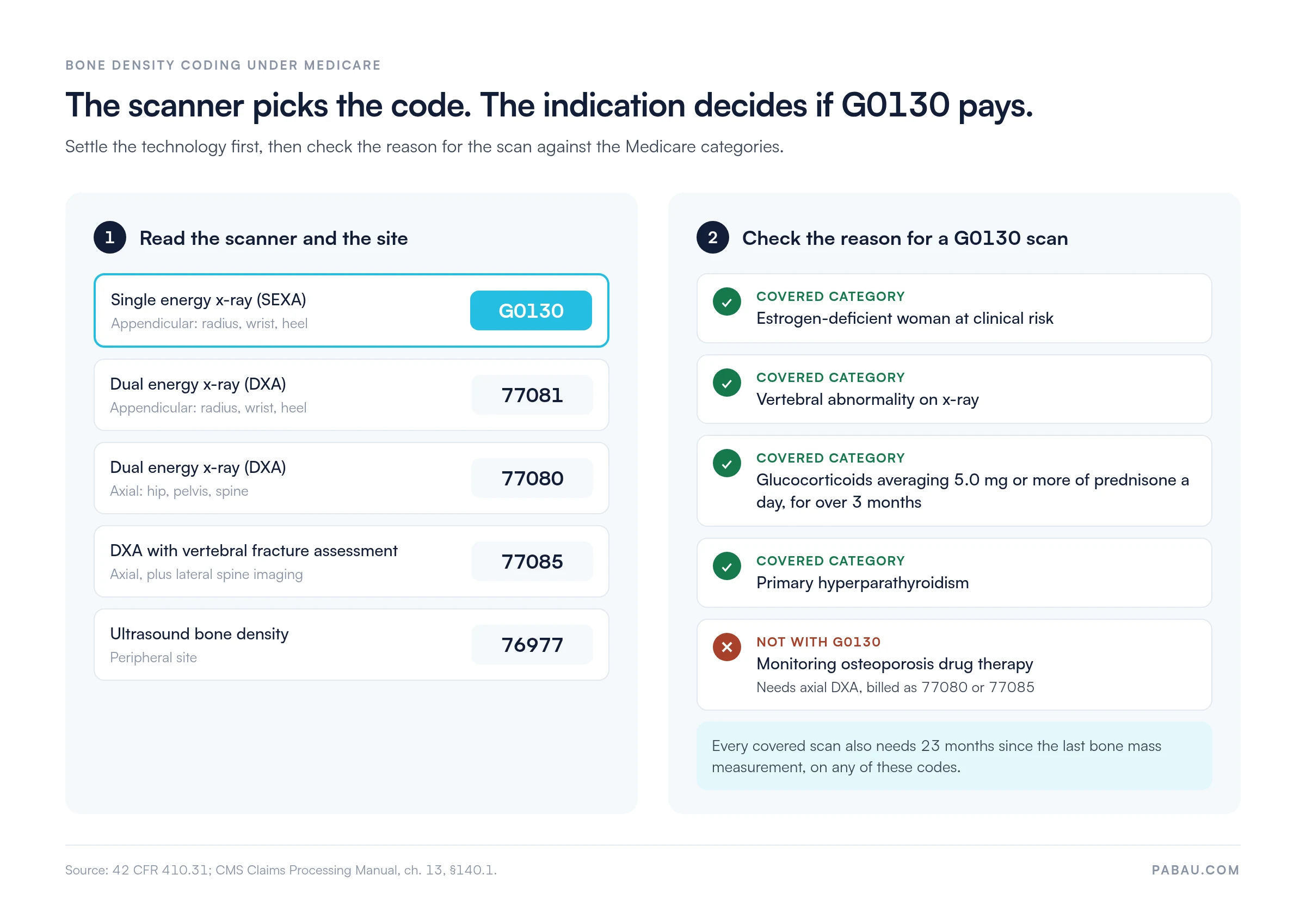
Monitoring FDA-approved osteoporosis drug therapy must use axial DXA, so a G0130 study cannot support that indication.
Many commercial payers do not accept HCPCS G codes, so check the payer’s policy instead of swapping in a DXA code.
HCPCS Code G0130 is a CMS Level II code for a peripheral bone density study. The CMS claims processing manual lists it among Medicare’s bone mass measurement codes. Its official descriptor reads: “Single energy x-ray absorptiometry (SEXA) bone density study, one or more sites; appendicular skeleton (peripheral) (e.g., radius, wrist, heel).”
Two parts of that descriptor decide every coding choice. The technology is single energy x-ray absorptiometry, or SEXA. The site is the appendicular skeleton, meaning the limbs rather than the spine or hip.
G0130 is a CMS HCPCS Level II G-series code. Medicare pays it alongside the CPT densitometry codes. Payer recognition outside Medicare varies, because many commercial plans do not accept HCPCS G codes.
A dual energy scan of the same wrist or heel is a different study, reported with CPT 77081. Other peripheral technologies have their own codes as well. Ultrasound bone density is CPT 76977. The CMS manual also lists radiographic absorptiometry as CPT 77083 and appendicular CT bone mineral density as CPT 77079.
G0130 describes one SEXA study, whether it measures one appendicular site or several. The table separates what belongs under the code from what does not.
Medicare Part B covers bone mass measurements under NCD 150.3 and 42 CFR 410.31. A beneficiary must fall into at least one qualifying category, and the treating practitioner must order the study. Conduct insurance eligibility verification before the appointment.
The five qualifying categories are:
Under Medicare, the Part B deductible and coinsurance do not apply to a covered bone mass measurement. The CMS Claims Processing Manual, Chapter 13, section 140.1 sets that rule. The ordering practitioner must still document the qualifying category in the medical record. A diagnosis code alone is not enough.
G0130 reports a single energy (SEXA) study of the appendicular skeleton. CPT 77081 reports a dual energy (DXA) study of the same appendicular sites, and CPT 77080 reports DXA of the axial skeleton.
The payer never changes that choice. The CMS claims processing manual lists G0130, 77078, 77079, 77080, 77081, 77083, 77085, and 76977 as bone mass measurement codes. Never bill G0130 and 77081 together.
Common mis-code scenario: A commercial plan rejects the G0130 claim from a SEXA forearm scanner, so the biller switches to 77081. That claim now reports a dual energy study that never happened.
The reverse error happens too: a heel DXA scan for a Medicare patient goes out as G0130. Medicare pays 77081 for that study, so code what the scanner measured, then handle payer acceptance. The chart below runs both checks.
Documentation failures cause a large share of G0130 denials. Strong medical billing compliance starts with a chart that supports every element of the claim.
The chart must include:
Medicare contractors keep local lists of valid diagnosis codes for the screening categories. Those lists differ by jurisdiction, so confirm your contractor’s list before you submit.
Billing G0130 correctly means settling the technology question before anything else. For submitting a clean claim, work through each step below in order.
Medicare pays G0130 under the Medicare Physician Fee Schedule (MPFS) when a practitioner or supplier bills it. Rates vary by payment locality and by whether the claim is global, technical only (TC), or professional only (modifier 26). Use the CMS Physician Fee Schedule Lookup Tool for the current amount in your locality.
Bone mass measurement is a Medicare preventive benefit, so the Part B deductible and coinsurance do not apply. The patient owes nothing for a covered study when the provider accepts assignment. A study that fails coverage, such as one inside the 23-month window, is a different matter and needs an ABN.
Payment rates change on January 1 each year with the MPFS update. CMS also applies geographic practice cost indices (GPCIs) that adjust payment by locality. Use the AAPC HCPCS code lookup to cross-check current code status.
Use the CMS Fee Schedule Lookup Tool, filtered by your locality and the current year, to get the exact non-facility and facility rates for G0130. Do it before you update your chargemaster. Never quote rates from prior-year publications.
Medicare covers a bone mass measurement only when at least 23 months have passed since the month of the last one. The limit counts every bone mass measurement code, so a central DXA last year blocks a G0130 study this year.
Medicare may cover a more frequent study when it is medically necessary. Two examples from CMS policy:
A CO-119 denial follows when nobody checks the last bone density date across the full 23 months. Check the patient’s history before scheduling, not after the remittance arrives.
G0130 denials cluster around a handful of predictable failure points. Good denial management strategies catch each one before submission rather than in the appeal queue. Our guide to denial codes for billers defines each CARC in the table below.
Independent imaging centers see a further pattern. The facility bills globally for a study it did not interpret, and the claim denies against the global billing indicator. Settle who performs and who interprets before you assign the modifier.
G0130 rarely appears alone on a claim. Coders need to know which codes can sit alongside it on the same date of service (DOS) and which cannot.
Most G0130 denials start at the front desk, before anyone opens a coding manual. Someone has to know the last scan date, the qualifying reason, and the scanner type before the study runs. In Pabau’s practice management software, those details sit together on one patient record.
Pabau’s digital forms capture the order and the qualifying indication at intake. Past visits sit on the same record, so staff can see when the last bone density study ran before booking another.
Pabau’s claims software for practices submits the claim and tracks the remittance. A CO-50 or CO-119 denial then shows up on the patient record, where your team can act on it.

Pabau keeps the order, the qualifying indication, and past visits on one patient record. Your team submits bone density claims and tracks every remittance from the same place.

G0130 is a technology code. Report it when a single energy x-ray scan measured the wrist, forearm, or heel, and report 77081 when a dual energy scanner did. The payer never changes that answer.
The payer does decide whether the claim pays. Medicare wants a qualifying category, 23 months since the last study, and axial DXA for drug monitoring. Commercial plans may not take G codes at all, so ask before the scan rather than after the denial.
Book a demo to see how Pabau keeps the order, the indication, and the claim on one patient record.

Need to understand how clearinghouses process HCPCS claims? Medical claims clearinghouse guide explains how claims route from practice management systems to payers and where HCPCS G codes get validated.
Getting CO-119 denials on repeat bone density claims? Denial codes in medical billing covers the full CARC denial code list with prevention guidance for each.
Want to see how ERA remittances show G0130 payment decisions? Electronic remittance advice explained walks through how to read 835 remittance files and act on denial reason codes.
HCPCS Code G0130 reports a single energy x-ray absorptiometry (SEXA) bone density study. It covers one or more appendicular sites, such as the radius, wrist, or heel. It describes a technology and a site, not a payer. Medicare pays it as a bone mass measurement when a qualifying category is documented.
The two codes differ in technology and site. G0130 is a single energy scan of the appendicular skeleton, such as the wrist or heel. CPT 77080 is a dual energy (DXA) scan of the axial skeleton, meaning the hip, pelvis, or spine. Code what the scanner measured, whatever the payer.
Medicare covers a bone mass measurement when at least 23 months have passed since the month of the last one. A more frequent study can be covered when medically necessary, such as for glucocorticoid therapy of more than 3 months. A confirmatory axial DXA baseline is another exception when the first test used a different technique.
Recognition varies, and many commercial payers do not accept HCPCS G codes. That does not make CPT 77081 a substitute, because 77081 describes a dual energy (DXA) scan. Ask the payer how it wants a single energy study reported. Never bill G0130 and 77081 together for one study.
Use the CMS Physician Fee Schedule Lookup Tool and search G0130 for your locality and the current year. Rates change each January and differ by locality, place of service, and component. Under Medicare, the Part B deductible and coinsurance do not apply to a covered bone mass measurement.