ICD-10 Code I50.9: Heart failure, unspecified
ICD-10 Code I50.9: Definition and quick-reference data ICD-10 Code I50.9 is the ...

Last Updated: Nov 16, 2026
Billable Code Specific Code
M85.80 is the billable ICD-10-CM code for other specified disorders of bone density and structure, unspecified site. Coders use it most often for physician-documented osteopenia when the record names no skeletal site.
The code sits between normal bone density and osteoporosis. A diagnosis of osteoporosis moves the claim to M81.x, or to M80.x when a pathological fracture is present. A documented site moves it to a site-specific M85.8 code.
Let Pabau's smart automation suggest the right codes, reduce claim denials, and keep your practice compliant—effortlessly.
Automate repetitive tasks and focus on what matters most—your patients.
Reduce coding errors and ensure compliance with the latest regulations.
Clean claims, fewer denials, and faster reimbursements.
Powerful insights and reporting to help your practice thrive.
HIPAA compliant SOC 2 certified GDPR-compliant Trusted by 4,000+ clinics worldwide

M85.80 is billable for the current fiscal year (FY2027) and applies to other specified bone density disorders without site specificity or fracture.
Osteopenia with a T-score between -1.0 and -2.5 typically maps here when documentation supports no further classification.
Coders must distinguish M85.80 from M81.0 (age-related osteoporosis, no fracture) and M80.x (osteoporosis with fracture) using documented T-scores.
Pabau’s claims management software supports ICD-10 code entry, DEXA scan billing workflows, and electronic claim submission through the Claim.MD clearinghouse.
ICD-10 Code M85.80 is a billable diagnosis code for other specified disorders of bone density and structure, unspecified site. It is listed in CMS’s FY2027 ICD-10-CM code files, which apply to encounters from October 1, 2026 through September 30, 2027. The code sits in Chapter 13 (M00-M99), under category M85 and subcategory M85.8.
The “unspecified site” qualifier means the documentation does not identify an anatomical site, or the coder cannot determine one from the record.
The CDC/NCHS ICD-10-CM web tool is the authoritative source for verifying code validity, descriptor text, and any annual updates to M85.80. Coders should check this resource each fiscal year to confirm the code remains active and unchanged.
M85.80 captures bone density and structure disorders that the treating clinician specifies but that map to no more precise ICD-10-CM code. The key phrase is “other specified.” The physician has named the condition, but ICD-10-CM has no dedicated code for it at the unspecified site level.
Conditions appropriately coded here include:
Documentation must support the “other specified” qualifier. The physician’s note needs to identify the condition explicitly, with a DXA result, a T-score, a clinical interpretation, and a diagnostic label. Generic language such as “bone changes” without further characterization will not support M85.80 and may trigger a medical necessity denial.
Always confirm the physician has documented a specific diagnosis label alongside the DXA T-score. A T-score of -1.8 alone does not code itself. The clinician must state ‘osteopenia’ or an equivalent documented finding. When that label is absent, query the provider before assigning M85.80.
Category M85 carries one Excludes1 note. It bars four congenital bone conditions that are coded in Chapter 17 instead: osteogenesis imperfecta, polyostotic fibrous dysplasia, osteopetrosis, and osteopoikilosis. Osteoporosis is not on that list, but it is a different diagnosis with its own codes.
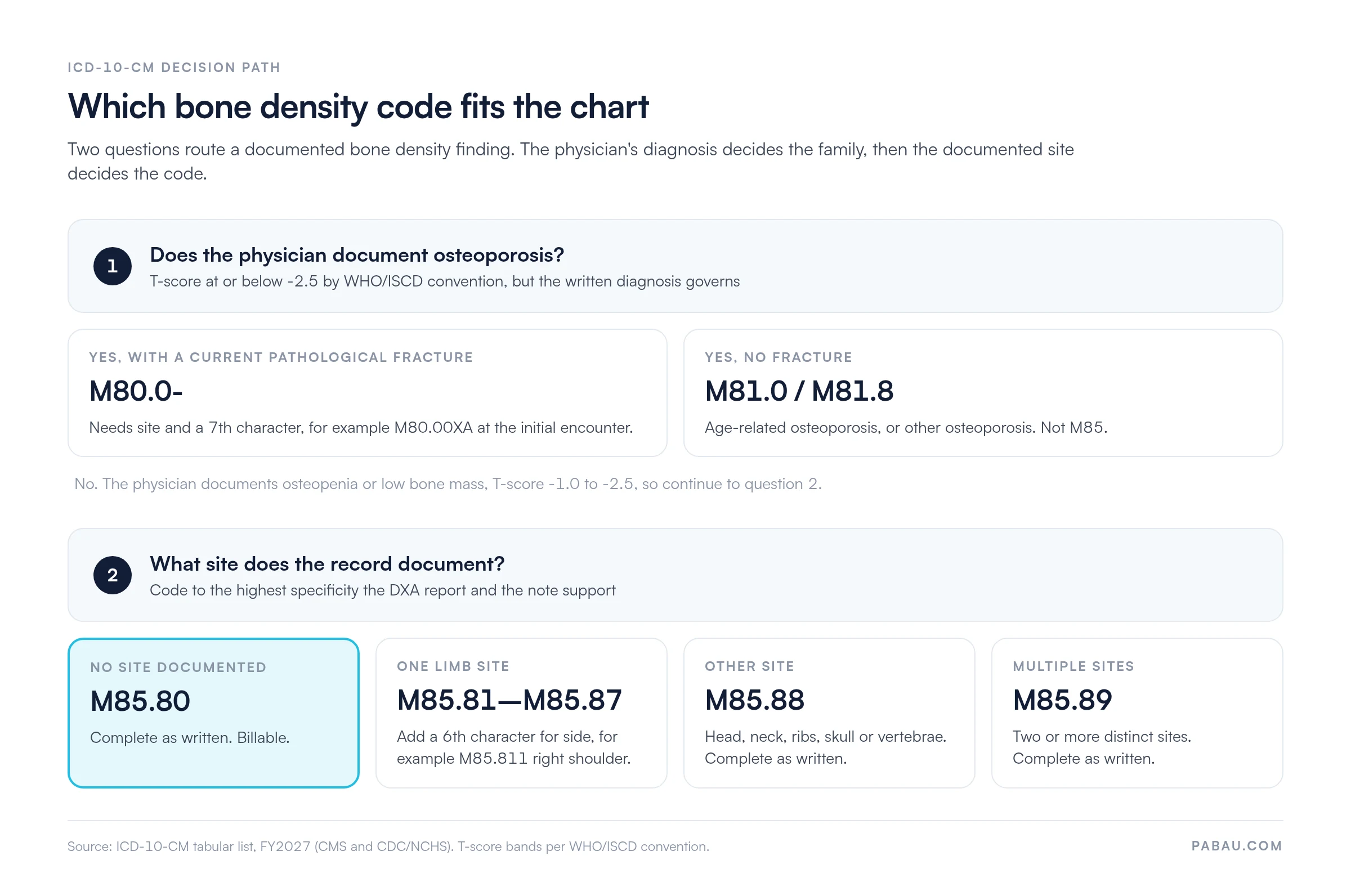
The osteoporosis rows are a matter of diagnosis, not an Excludes note. If the physician documents osteoporosis (T-score at or below -2.5) rather than osteopenia, the correct path is M81.0, M81.8 or M80.-, not M85.80. Coders who assign M85.80 when osteoporosis is documented will face denial on audit.
M85.80 and M85.89 share a category but differ on site. M85.80 applies when the site is unspecified or cannot be determined from documentation. M85.89 applies when the physician documents multiple sites.
M85.81 through M85.87 are not billable as written. Each needs a 6th character for side: 1 for right, 2 for left, 9 for unspecified. Only M85.88 and M85.89 are complete at five characters.
ICD-10-CM coding guidelines require the highest level of specificity supported by documentation. If the DXA report identifies a site, use the matching site-specific code rather than M85.80. Vertebral findings, including the lumbar spine, go to M85.88. Reserve M85.80 for encounters where the clinical record lacks site detail.
Osteopenia and osteoporosis are on the same clinical continuum but map to entirely different ICD-10-CM codes. The T-score is the primary decision point, and the physician must document it explicitly for the coding distinction to hold up on audit.
These thresholds follow WHO and ISCD classification conventions. ICD-10-CM does not instruct coders to use a T-score cutoff, so the physician’s documented diagnosis is always the primary coding driver. When the physician writes “osteoporosis” but the T-score sits at -2.3, query the provider before coding M81.0. The clinical label governs, and a mismatch between the code and the chart puts the claim at risk on audit.
Put together with the site rules above, coding a bone density finding comes down to two questions, mapped below.
Payer audits on M85.80 focus almost entirely on whether the medical record supports both medical necessity and the diagnostic precision the code requires. Sound medical billing fundamentals demand that documentation is captured at the point of care, not reconstructed after a denial. The record must contain all of the following before the code is submitted:
Practices that use structured clinical documentation workflows capture these elements consistently. Pabau, the practice management platform we build, includes claims software for billing teams that records ICD-10 codes at the encounter level. The diagnosis then reaches the claim without manual re-entry, which removes a common source of errors.
DXA scan encounters raise two coding questions at once. One is the procedure code for the scan, usually CPT 77080, and the other is the diagnosis code that justifies it. Getting the pairing wrong is one of the most common reasons M85.80 claims are rejected.
When the encounter purpose is screening, Z13.820 is sequenced first as the reason for the visit. M85.80 is added as a secondary code if the scan confirms the finding. When the visit is a follow-up for a previously diagnosed bone density disorder, M85.80 moves to the primary position. Confirm sequencing requirements with your payer. Some Medicare Administrative Contractors have issued Local Coverage Determinations that affect sequencing for bone density testing.
Medicare covers bone mass measurement under Section 1861(rr) of the Social Security Act. Coverage runs once every 24 months, or more often if medically necessary, according to Medicare’s bone mass measurement coverage page.
Medicare limits eligibility to patients who meet at least one of those conditions.
On Medicare claims, M85.80 is the primary diagnosis when a known bone density disorder is the reason for the encounter. Otherwise it is a secondary result code alongside Z13.820. Insurance eligibility verification before the encounter confirms whether the beneficiary has met the 24-month frequency requirement. It also shows whether the patient’s plan needs prior authorization.
Commercial payer acceptance of M85.80 varies by plan and Local Coverage Determination. Some plans restrict bone density testing to specific eligible populations and require preauthorization. The claim must demonstrate medical necessity through documented risk factors or previous findings. M85.80 alone, with no supporting documentation, is a predictable denial across most payers.
Before submitting a DXA claim with M85.80, run a real-time eligibility check. Confirm the patient has not already hit the 24-month Medicare frequency limit. Submitting a duplicate-frequency claim without medical justification generates an automatic denial that wastes both staff time and appeals capacity. Pabau’s Claim.MD clearinghouse integration supports real-time eligibility checks before submission.
Most M85.80 denials are preventable. Denial management workflows that catch these patterns before submission reduce rework and protect revenue. Submitting through Pabau’s Claim.MD clearinghouse integration adds eligibility checks and edit validation before claims leave the practice.
Reviewing common denial codes alongside payer remittances shows whether M85.80 denials follow a pattern. The usual causes are a frequency limit, missing documentation, or a site-specificity error. Fixing that cause works better than resubmitting the same claim.
M85.80 sits within a cluster of codes that coders and billers frequently cross-reference. Understanding their relationships helps with correct code selection and revenue cycle management for bone density encounters. The AAPC ICD-10-CM lookup tool provides fast reference for the full code descriptors and hierarchy.
Most M85.80 denials trace back to the DXA note: no T-score, no diagnosis label, or a scan inside the 24-month window. Billing teams usually find out from the remittance, weeks after the visit.
Pabau moves those checks to the encounter. Custom note templates prompt the clinician for the T-score, the interpretation, and the diagnosis label. The ICD-10 code entered on the encounter carries onto the claim, so nobody retypes it.
Claims then go out through the Claim.MD clearinghouse integration, and the remittance comes back to the same patient record. Your team sees which M85.80 claims paid and which need a fix, without switching systems.

Pabau’s billing and claims workflows support accurate ICD-10 code entry, DEXA scan encounter documentation, and electronic claim submission. See how practices reduce denials with structured coding tools.

Treat M85.80 as the last stop in the M85.8 subcategory, not the first. It fits only when the physician documents osteopenia or another specified bone density disorder, with no fracture and no site.
If your practice sees repeat M85.80 denials, fix the DXA note before you fight the remittance. An appeal cannot add a T-score or a diagnosis label that was never written. Once the note carries both, the code choice follows from the chart.
Book a demo to see how Pabau carries the diagnosis from the DXA note to a clean claim.

Need a denial resolution framework? Denial management in healthcare covers root-cause analysis and rework reduction strategies for common payer rejections.
Submitting claims electronically? Clean claim submission guidelines outlines the data elements that must be correct before a claim leaves your practice management system.
Looking for a US clearinghouse? Claim.MD clearinghouse overview explains how Pabau’s integration handles 837P transmission, real-time eligibility, and ERA remittances.
Billing the scan itself? CPT 77080 covers DXA bone density scan coding, documentation, and reimbursement.
Has the physician documented osteoporosis instead? ICD-10 Code M81.0 explains when age-related osteoporosis without fracture applies.
ICD-10 Code M85.80 is a billable ICD-10-CM diagnosis code for other specified disorders of bone density and structure at an unspecified site. It is billable for the current fiscal year (FY2027) and falls within Chapter 13 (musculoskeletal system, M00-M99). It is most often used for physician-documented osteopenia after a DXA scan, when the record names no anatomical site.
Use M85.80 when the medical record does not identify a specific skeletal site for the bone density disorder. Use M85.89 when documentation indicates multiple sites. If the DXA report specifies a single site, use the site-specific code instead. Limb sites use M85.81- to M85.87- with a 6th character for side, and vertebral sites use M85.88.
Yes. M85.80 is the conventional ICD-10-CM code for osteopenia at an unspecified site. It applies when the physician documents the diagnosis and the T-score falls between -1.0 and -2.5. This mapping follows WHO/ISCD classification conventions. If the physician documents osteoporosis (T-score at or below -2.5), use M81.0 or M80.x instead.
Yes. Medicare covers bone mass measurement under Section 1861(rr) of the Social Security Act once every 24 months for eligible beneficiaries. It covers more frequent tests when medically necessary. M85.80 can function as the qualifying diagnosis or as a secondary result code paired with Z13.820. Coverage is not universal, so confirm the patient meets the eligibility criteria and has not exceeded the frequency limit before submitting.
Yes, when the encounter is a follow-up for a previously diagnosed bone density disorder rather than a screening visit. For screening encounters, Z13.820 (encounter for screening for osteoporosis) is sequenced as the primary code. M85.80 is added as a secondary code if the result confirms the finding. Confirm sequencing rules with the specific payer, as some Medicare Administrative Contractors have issued Local Coverage Determinations affecting diagnosis sequencing.
The most common M85.80 denial is insufficient documentation, meaning no T-score, no diagnostic label, or no physician interpretation. Close behind are an undocumented indication for the DXA and a scan within 24 months of the last covered test. The fourth is using the unspecified-site code when the DXA report names a site. Each of these is preventable with pre-submission documentation checks and eligibility verification.