HCPCS Code L0472: Hyperextension TLSO billing guide
HCPCS code L0472: Official descriptor and device definition HCPCS code L0472 des...

Last Updated: Nov 5, 2026
67040 is the CPT code for vitrectomy, mechanical, pars plana approach; with endolaser panretinal photocoagulation. It covers one operative session in which the surgeon removes the vitreous through the pars plana and applies panretinal laser with an intraocular probe.
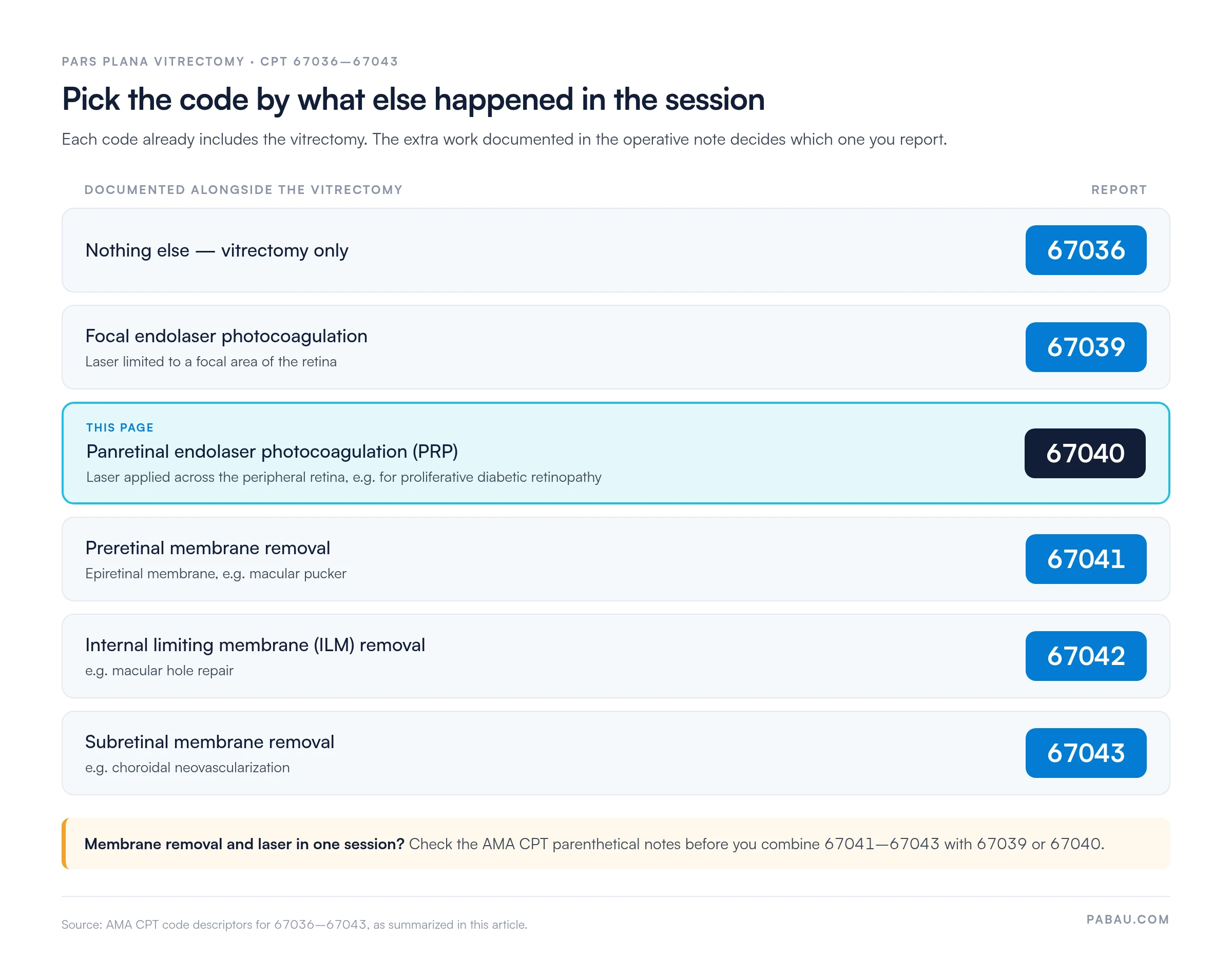
Proliferative diabetic retinopathy is the primary indication. Tractional retinal detachment and vitreous hemorrhage also support the code when documented. Neighboring codes in the 67036–67043 family add focal laser or membrane removal instead, and mixing them up is a common source of unbundling denials.
Let Pabau's smart automation suggest the right codes, reduce claim denials, and keep your practice compliant—effortlessly.
Automate repetitive tasks and focus on what matters most—your patients.
Reduce coding errors and ensure compliance with the latest regulations.
Clean claims, fewer denials, and faster reimbursements.
Powerful insights and reporting to help your practice thrive.
HIPAA compliant SOC 2 certified GDPR-compliant Trusted by 4,000+ clinics worldwide

CPT code 67040 reports pars plana vitrectomy and endolaser panretinal photocoagulation performed in the same session as one code.
Billing 67036 for the vitrectomy and 67145 for the laser, when 67040 describes the session, is a classic unbundling error.
Most payers want an LT or RT modifier on 67040, and Medicare’s bilateral indicator of 1 means a same-session bilateral case takes modifier 50.
Claims software such as Pabau supports modifier tracking and electronic claim submission through the Claim.MD clearinghouse.
CPT code 67040 is the procedure code for “vitrectomy, mechanical, pars plana approach; with endolaser panretinal photocoagulation.” The descriptor comes from the American Medical Association’s CPT code set. It describes a single operative session. The surgeon removes vitreous through the pars plana and applies laser burns to the peripheral retina with an intraocular endolaser probe.
Both components, the mechanical vitrectomy and the endolaser panretinal photocoagulation (PRP), are bundled into this one code. Pabau’s ophthalmology claims management tools support modifier tracking and clean claim assembly across the whole vitrectomy family. The table below places 67040 among its neighbors.
The six pars plana codes, 67036 and 67039 through 67043, were restructured in 2008 to match how vitreoretinal surgery is performed. Before that, coders often assembled the same encounter from several standalone codes, which created systematic unbundling exposure.
Medical necessity for CPT code 67040 is established through the diagnosis codes submitted on the claim. The ICD-10-CM codes below are the primary diagnoses that support this procedure. Payer local coverage determinations (LCDs) may restrict the covered list further, so verify with the applicable MAC before submitting.
Choosing the unspecified-eye variant when laterality is documented in the chart is a coding shortcut that can trigger a payer edit. Always code the most specific laterality available.
Modifier selection for CPT code 67040 affects both payment and audit risk. The table below covers the modifiers most relevant to vitreoretinal surgery claims.
Medicare bilateral billing note: The 2026 Medicare Physician Fee Schedule gives 67040 a bilateral surgery indicator of 1. When both eyes have vitrectomy with endolaser PRP in the same session, Medicare pays 150% of the single-eye amount. Claims Processing Manual Chapter 12, §40.7, has that case reported on one line with modifier 50. ASC claims and some payers use separate RT and LT lines instead, so confirm bilateral rules with the MAC.
Medicare covers CPT code 67040 when the clinical documentation meets the coverage criteria set by the applicable Medicare Administrative Contractor (MAC). Coverage is governed by local coverage determinations for vitreoretinal surgery, which vary by MAC jurisdiction. Before submitting, confirm which MAC covers the provider’s locality and whether a current LCD applies.
Performing insurance eligibility verification before scheduling the procedure can prevent authorization surprises on the back end.
Pull the MAC LCD for vitreoretinal surgery before scheduling. LCDs list the ICD-10 codes considered covered and may require documentation of specific clinical findings, such as fluorescein angiography results or prior laser treatment records. An incomplete chart at claim submission is another frequent source of 67040 denials, alongside missing laterality.
CPT code 67040 carries a 90-day global surgical period under the Medicare Physician Fee Schedule. Postoperative services within that window are typically bundled into the surgical payment. National payment amounts change with each annual MPFS update and vary by geographic locality. Use the CMS Physician Fee Schedule lookup tool to retrieve current facility and non-facility rates for your locality.
For current RVU values, the FastRVU 2026 RVU lookup tool lists the work, practice expense and malpractice RVU components alongside national payment approximations. Treat those figures as planning benchmarks rather than billing expectations, since locality adjustments can shift the final allowed amount.
Submitting 67040 claims electronically through the Claim.MD clearinghouse shortens processing time and allows eligibility checks before the encounter.
A costly coding error on vitreoretinal surgery claims is unbundling 67040 into its component parts. The code already includes both the vitrectomy and the endolaser PRP. Billing 67036 for the vitrectomy and 67145 for the laser on the same date and eye breaks an NCCI edit.
Sound medical billing compliance means selecting the single most comprehensive code for the procedure performed. In this family, the extra work documented alongside the vitrectomy decides which code that is.
The operative note for CPT code 67040 is the record a payer audit team uses to judge whether the claim was legitimate. A clean claim for 67040 needs the note to address each element below.
Prior authorization requirements for CPT code 67040 vary significantly by payer and plan type. Traditional Medicare fee-for-service (FFS) does not require prior authorization for this code, though MAC LCDs still govern coverage criteria. Medicare Advantage plans, commercial carriers, and Medicaid managed care plans each set their own rules, and many require authorization before scheduling.
Denials on CPT code 67040 cluster around a small set of recurring errors, each listed below with a corrective action. A structured denial management workflow that tracks these patterns by denial code surfaces repeat offenders quickly. The CARC and RARC reference explains the remark codes that usually come back on these rejections.
Set a billing rule in your practice management system to flag 67036 and 67145 on the same date of service for the same eye. That rule alone catches the most common CPT 67040 unbundling error before it leaves the practice. Review your eye surgery claims quarterly to spot patterns across the whole 67036-67043 family.
In many ophthalmology practices, a biller still reads each operative note by hand. They pick the code from the vitrectomy family, add LT or RT, and key the claim into a payer portal. Each manual step is a chance for a wrong code or a missing modifier.
Pabau keeps the operative note, the diagnosis codes and the claim on one patient record. Its claims tools track modifiers and send claims electronically through the Claim.MD clearinghouse. Eligibility checks run before the encounter, and ERA posting closes the loop afterward.
The outcome is fewer 67040 claims bounced for laterality or unbundling errors, and a shorter wait between surgery and payment.


Pabau integrates with the Claim.MD clearinghouse to support electronic claim submission, real-time eligibility checks, and ERA posting for vitreoretinal and other surgical codes. See how it works for your practice.

CPT code 67040 is the right code only when the operative note shows a pars plana vitrectomy and panretinal endolaser in one session. If the laser was focal, or a membrane came out, another code in the family fits better.
Most 67040 denials are prevented before billing starts. When surgeons name the laser extent and the eye in every note, the code, the modifier and the diagnosis follow from it.
Book a demo to see how Pabau tracks modifiers and assembles clean vitreoretinal claims for your ophthalmology practice.

Need to understand how clearinghouse submissions work? Claim.MD clearinghouse guide explains how electronic claims reach payers and what happens when they bounce back.
Want a deeper look at ERA and remittance processing? Electronic remittance advice explained covers how 835 files post payments and flag denial reasons automatically.
Credentialing before you bill? Getting credentialed with insurance companies walks through the enrollment steps required before any surgical claim will be accepted.
Peeling the internal limiting membrane instead? CPT code 67042 billing guide covers ILM peel vitrectomy, its RVUs and the modifiers that go with it.
Treating retinal tears with laser alone? CPT code 67145 billing guide explains prophylaxis of retinal detachment by photocoagulation and when it is billed on its own.
CPT code 67040 is the procedure code for pars plana vitrectomy combined with endolaser panretinal photocoagulation. It is billed when both are performed in the same surgical session. It belongs to the vitreoretinal code family the AMA restructured in 2008 (67036 and 67039-67043). It covers posterior segment surgery for conditions such as proliferative diabetic retinopathy and tractional retinal detachment.
CPT 67040 covers vitrectomy with endolaser panretinal photocoagulation. CPT 67041 covers vitrectomy with removal of an epiretinal (preretinal) membrane, such as a macular pucker. When both are performed in one session, the AMA CPT parenthetical notes decide how 67041 combines with 67040.
Most payers require LT (left eye) or RT (right eye) on unilateral eye surgery codes, including 67040. For a same-session bilateral case, Medicare lists 67040 with bilateral indicator 1, so the claim normally carries modifier 50. Confirm bilateral rules with the MAC. Modifiers 78 (unplanned return to the OR), 58 (staged procedure) and 51 (multiple procedures) apply depending on clinical circumstances.
Yes, traditional Medicare covers CPT code 67040 when the clinical documentation meets the criteria in the applicable MAC’s local coverage determination for vitreoretinal surgery. Prior authorization is not required under Medicare FFS, but Medicare Advantage plans typically require it. Documentation must tie the procedure to a covered diagnosis such as proliferative diabetic retinopathy or tractional retinal detachment.
No. CPT 67036 (vitrectomy alone) is an NCCI column 2 component of 67040. Billing both codes for the same eye on the same date triggers an automatic bundling edit and denial. When vitrectomy is performed with endolaser panretinal photocoagulation, 67040 is the single correct code and 67036 is not reported separately.
Anterior vitrectomy is reported with CPT 67005 or 67010. CPT 67005 is partial removal of vitreous by an anterior approach, through an open-sky or limbal incision. CPT 67010 is subtotal removal with mechanical vitrectomy, also by an anterior approach. CPT code 67040 is a posterior segment procedure performed through the pars plana.