CCSD code F4810: Open salivary gland biopsy billing guide
CCSD code F4810 is an open biopsy of a salivary gland lesion CCSD code F4810 is ...

Last Updated: Oct 5, 2026
CPT code 67145 covers prophylaxis of retinal detachment by photocoagulation, performed without drainage of subretinal fluid. A retina surgeon reports it after using laser to wall off a retinal break or an area of lattice degeneration. No incision and no vitrectomy appear in the descriptor, and both omissions decide which code the claim carries.
One date drives most of the confusion on this code. On January 1, 2022 the global period fell from 090 days to 010 days, and 67145 became a minor procedure. A same-day exam now takes modifier -25 instead of -57.
The descriptor and the 010-day window shape every other decision on this claim, from the ICD-10 pairing to the modifier on the E/M line.

CPT code 67145 covers prophylaxis of retinal detachment by photocoagulation, without drainage of subretinal fluid. The descriptor contains no pars plana incision and no vitrectomy.
Technique decides the code, not surgical approach. 67141 is cryotherapy or diathermy, and 67145 is laser photocoagulation.
Both codes moved from a 090-day to a 010-day global period on January 1, 2022. That made them minor procedures, so a same-day exam takes modifier -25 rather than -57.
Medicare allows roughly $245 in the office and $189 in a facility for 2026, on a work RVU of 2.47. Figures above six work RVUs are pre-2022 numbers.
NCCI has bundled 67145 into pars plana vitrectomy code 67036 since 1996. A vitrectomy with endolaser is reported as 67039 instead.
Practice management software like Pabau keeps CPT and ICD-10 libraries beside the claim. The code and its laterality digit get chosen while the note is still open.
The American Medical Association (AMA) publishes the CPT code set. Code 67145 carries this descriptor: Prophylaxis of retinal detachment (eg, retinal break, lattice degeneration) without drainage; photocoagulation.
In plain language, the surgeon aims a laser at the retina through the pupil and burns a ring of small spots around the break. Those spots scar down over the following days and glue the retina to the wall of the eye.
Fluid can then no longer track under the retina and lift it away. No tissue is cut or removed, and no subretinal fluid is drained.
Two words in the descriptor do most of the billing work. Without drainage separates 67145 from the repair codes in the 67101 to 67113 range, which are used once the retina has already detached.
Photocoagulation separates it from 67141, the same prophylaxis performed with cryotherapy or diathermy. CPT 2022 also dropped the old phrase “1 or more sessions” from both descriptors.
Those two words also split one descriptor into two codes. 67141 and 67145 share the opening clause, prophylaxis of retinal detachment without drainage.
What follows the semicolon names the energy used. 67141 is cryotherapy or diathermy, extreme cold or heat applied through the wall of the eye. 67145 is photocoagulation, applied by laser through the pupil.
Neither code involves a pars plana incision, so surgical approach cannot be used to choose between them. Read the technique out of the operative note and code that.
If the note says laser, indirect laser, or slit lamp laser, the code is 67145. Cryo, cryopexy, or diathermy in the note points to 67141.
Technique settles 67141 against 67145. Four other codes sit close enough to catch a coder out, and each one differs from 67145 on a single documented fact.
The deciding point is whether the retina was already detached, whether the vitreous was removed, or whether fluid was drained.
The dividing line between 67145 and 67105 is the state of the retina at the start of the case, rather than the laser itself.
If the note describes attached retina around a break or an area of lattice, prophylaxis applies. A note describing subretinal fluid and a detached retina being flattened points to the repair family.
Once the procedure code is settled, the diagnosis has to support it. Payers want an ICD-10-CM code that describes a break or a degeneration in an attached retina.
Every relevant code carries a laterality digit in the sixth position. The digit is 1 for the right eye, 2 for the left, 3 for bilateral, and 9 for unspecified.
A five-character code such as H33.30 or H33.01 is not billable on its own. Confirm coverage against your MAC’s local coverage determination and each commercial plan’s policy, because criteria are narrower than Medicare’s in places.
The wider current ICD-10-CM codes reference covers the rest of the chapter when the note points outside the retina series.
Match the laterality digit on the diagnosis to the laterality modifier on the CPT line. A right-eye tear coded H33.311 belongs with 67145-RT, and a mismatch between the two draws a denial quickly.
Several commercial plans also require prior authorization for prophylactic retina laser, so check the policy before the eye is scheduled.
Medicare pays about $245 for 67145 in the office and about $189 in a facility for 2026. The office rate is higher because the practice supplies the laser, the room, and the staff. In a facility the practice bills only the professional work, and the ASC or hospital bills its own facility fee.
The CMS Medicare Physician Fee Schedule (MPFS) lookup gives the exact figure for your locality.
These figures are national and unadjusted. Geographic practice cost indices move them up or down by locality, and a Medicare Advantage or commercial contract can sit well above or below them. Check each remittance against the fee schedule rather than assuming the two agree.
Relative value units drive the payment calculation. Since the 2022 revaluation, 67145 carries a work RVU of 2.47, the same as 67141.
Practices that still benchmark this code above six work RVUs are using pre-2022 numbers, from the years when it counted as major surgery.
Clinicians who qualify as participants in an advanced alternative payment model are paid on a slightly higher conversion factor of $33.5675 for 2026.
Both figures change every January, so re-baseline any internal productivity target at the same time.
The global period for 67145 is 010 days. CMS shortened it from 090 days effective January 1, 2022, after a sharp rise in use and a revaluation alongside the other retinal laser codes.
That change reclassified 67145 and 67141 from major surgery to minor procedures. For a billing team, it is the single most consequential fact on this page, and the timeline below shows why.
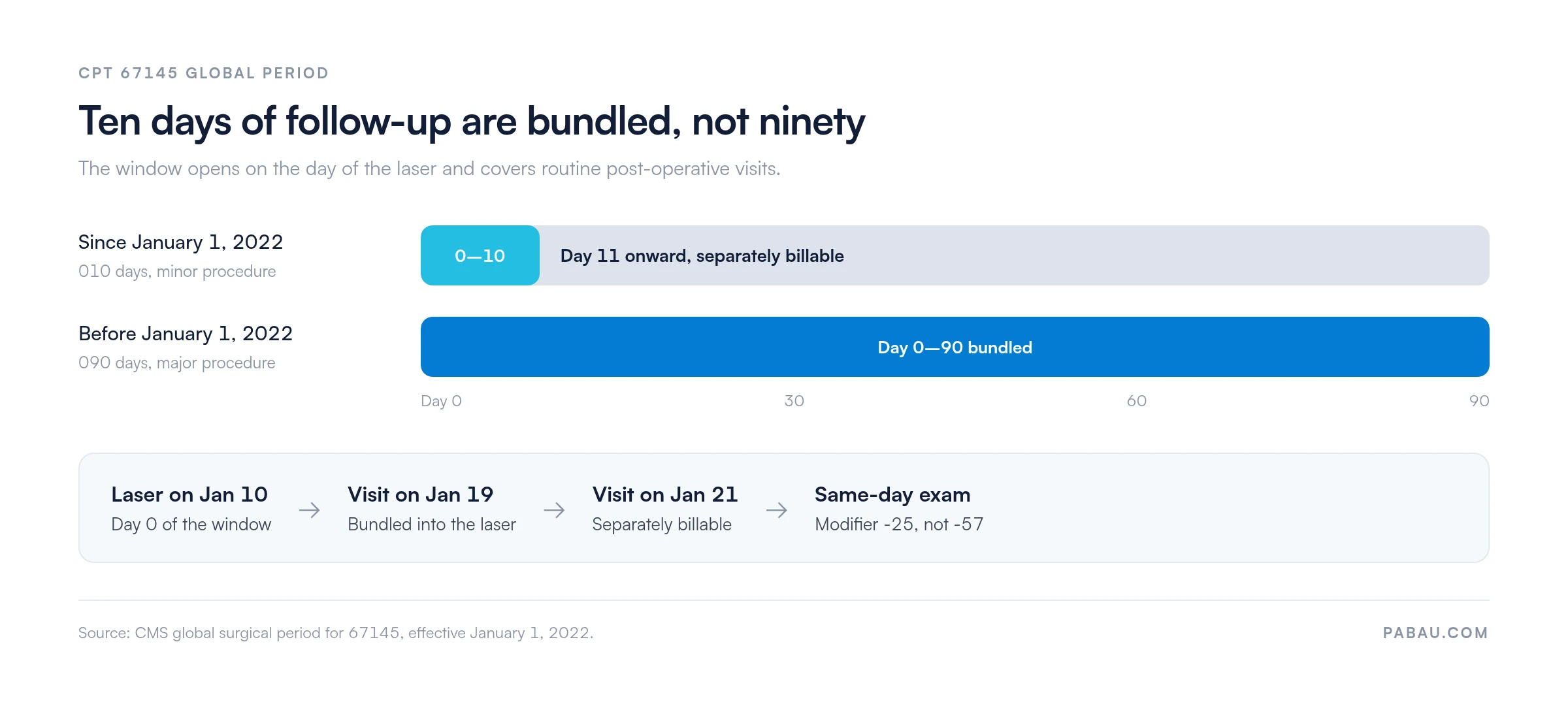
A 010-day global covers the day of the procedure plus the ten days that follow. There is no day-before pre-operative period, because that applies to 090-day codes only. Services rolled into the payment are:
Work outside that list survives the window only with the right modifier on the claim. The next section covers each one and where it belongs.
Modifier -57 no longer belongs anywhere near this code. It marks the decision for major surgery, which means 090-day procedures only. Appending -57 to an exam on the day of a 67145 laser follows a rule that expired at the end of 2021.
One caveat belongs on the payer sheet. The American Academy of Ophthalmology ties the 010-day window to Medicare Part B and to payers that follow CMS. A plan that never adopted the change can still hold the older window, so confirm it before writing off a visit on day thirty.
Count the window from the day of the laser, not the day after. A 010-day global that opens on January 10 closes on January 20. Teams still counting 90 days from the procedure date write off eighty days of legitimate visits on every eye they laser.
Modifiers on 67145 fall into three groups. Laterality comes first, then same-day E/M, then global period status. Laterality is mandatory on eye procedures, and it is the field most often left blank when a claim bounces.
A claim scrubber can flag the empty field, though the choice of modifier stays a coder decision.
Bilateral billing is where ophthalmology practices most often follow the wrong rule. Medicare Part B takes a bilateral surgical procedure on a single claim line.
Submit 67145 with modifier -50, one unit in the units field, and the charge doubled. Medicare then reimburses at 150% of the allowable.
Splitting the eyes onto two lines with -RT and -LT is a commercial payer preference rather than Medicare’s rule. Sending a split pair to a Part B contractor invites a duplicate-line rejection on the second eye.
Keep a payer-by-payer note of which format each plan wants, and default to the single -50 line for Medicare.
Repeat treatment is where the 2022 descriptor change shows up again. CPT 2022 removed the phrase “1 or more sessions” from both 67141 and 67145. Under the old wording, every session for the same break rolled into one payment no matter how far apart the visits fell.
The current descriptor covers a single treatment session.
The Academy’s guidance allows both codes to be reported again on a later date, where the condition recurs or a repeat treatment becomes necessary. Two practical rules follow from that:
Either way, the second note has to show what changed on examination. Record the new or persisting pathology, its location by clock hour, and why more laser was needed. A second claim that reads like a copy of the first is the kind of pattern that draws a post-payment review.
Reviewers reading a 67145 claim look for four things in the procedure note. Miss any one of them and the claim comes back as a medical necessity denial rather than a technical edit.
Documentation carries more weight than usual on a prophylactic procedure. The eye has not been damaged yet, and the payer is being asked to fund prevention instead of repair.
National Correct Coding Initiative edits govern which codes can travel with 67145 on the same claim. The edit tables are refreshed quarterly, so check the current pair before you submit an unusual combination.
Three of them account for most bundling denials:
A pre-submission scrub that flags these pairs is the cheapest denial work a practice can do. Reading the remark codes on a rejection before reworking the claim is the second cheapest.
Five reason codes cover most rejections on retina laser prophylaxis. Each one traces back to a specific step in the workflow rather than to a coding opinion.
Sorting a month of rejections by reason code tells you which step is slipping. That habit sits at the center of denial management in a surgical specialty, where one code can point to four different workflow failures.
Pull 30 days of 67145 denials and sort them by reason code. CO-97 means global period tracking is manual and slipping, or that a laser was billed alongside a vitrectomy. CO-4 means laterality modifiers are being dropped at data entry. CARC 197 means eligibility and authorization checks are not happening before the eye is scheduled. Each pattern maps to one workflow fix rather than to a coding argument.
Here is how a clean case moves. A patient presents on March 3 with flashes and a horseshoe tear at 11 o’clock in the right eye. The retina is attached, and no fluid has tracked underneath it. The surgeon lasers the tear that afternoon in the office laser suite.
The claim goes out as 67145-RT, one unit, against H33.311. That morning’s exam carries modifier -25, because the workup behind the decision to treat was documented separately. The global window then runs March 3 through March 13.
A post-operative check on March 9 falls inside that window, so it is bundled. A visit on March 20 falls outside it and is billable on its own.
Five checks are worth running before any 67145 claim leaves the building:
Tracking one ten-day window is simple. It gets harder when the surgeon lasers twelve eyes in an afternoon and post-operative visits land on day nine for three of them. The denial arrives four weeks later, by which point nobody remembers which encounter it belonged to.
Practice management software like Pabau moves that work to the point of claim creation. Built-in CPT and ICD-10 libraries put 67145 and the H33 series in front of the coder while the note is still open. The code and its laterality digit get chosen together, rather than days apart.
Pabau’s tools for cleaner claims management then check that the required fields are complete before the file goes out. Claims route electronically through Claim.MD, our clearinghouse partner for US practices, and remittances post back against the encounter they came from.
Each encounter keeps its own dated record, so the ten-day window sits with the procedure rather than in a spreadsheet row. At roughly $245 an eye, a claim reworked twice costs more in staff time than it returns.

Pabau’s claims management tools include built-in CPT and ICD-10 code libraries, required-field validation before submission, and a direct Claim.MD connection for electronic claims. Book a demo to see how retina practices tighten up their first-pass rate.

Two facts decide most 67145 claims. The operative note names the technique, and the payment window runs ten days from the day of the laser. Coders who hold both in mind rarely reach for the wrong modifier.
Keeping those two facts attached to the encounter is the harder part, once the surgeon has moved on to the next eye. That is where the money leaks, weeks after the coding decision was made.
Tighten that loop and the first-pass rate follows. Book a demo to see how Pabau keeps code libraries, global-period dates, and claim status on one record for a retina practice.

Wondering what makes a claim clean on the first pass? What is a clean claim in medical billing? sets out the fields a payer checks before it adjudicates.
Sending 67145 claims electronically? What is an 837 file? explains the format your practice management system builds behind the scenes.
Documenting a prophylactic procedure for audit? Medical billing compliance covers the laws, the common violations, and a checklist you can download.
Routing claims through a clearinghouse? Claim.MD clearinghouse review walks through how electronic claims reach a payer for US practices.
Want the wider picture behind RVUs and payment? What is revenue cycle management? shows where coding sits in the cycle from booking to posting.
They treat different problems. 67145 walls off a break or an area of lattice in an attached retina. 67228 treats extensive or progressive retinopathy, usually proliferative diabetic disease, with panretinal photocoagulation. One prevents a detachment, the other manages established disease.
Use POS 11 for an office laser suite, POS 24 for an ambulatory surgery center, and POS 22 for hospital outpatient. The place of service has to agree with the rate billed, facility or non-facility.
Coverage often fails on the diagnosis alone. Payers expect a documented risk factor beside it, such as symptoms, high myopia, pseudophakia, a fellow eye that has detached, or a family history. Record why watchful waiting was rejected.
No. Routine follow-up in the ten days after the laser is already paid inside the procedure. It is billed to neither the payer nor the patient. An unrelated visit in that window takes modifier -24.
An ophthalmologist performs it, in practice usually a retina specialist. CPT sets no specialty restriction, so payer credentialing and state scope of practice decide it. A few states grant optometrists laser privileges, though retinal prophylaxis is rarely included.