CCSD Code V1730: Extraoral fixation of mandible
What is CCSD code V1730? CCSD code V1730 is the UK private medical insurance cod...

Last Updated: Nov 24, 2026
67031 is the CPT code for severing of vitreous strands, vitreous face adhesions, sheets, membranes or opacities by laser surgery, in one or more stages. It reports Nd:YAG laser vitreolysis for symptomatic floaters, billed once per eye per session with an RT or LT modifier.
Medicare coverage is set by each contractor's Local Coverage Determination, so payment varies by jurisdiction. Pars plana vitrectomy has its own code, 67036, and the two are never billed for the same eye on the same date.
Let Pabau's smart automation suggest the right codes, reduce claim denials, and keep your practice compliant—effortlessly.
Automate repetitive tasks and focus on what matters most—your patients.
Reduce coding errors and ensure compliance with the latest regulations.
Clean claims, fewer denials, and faster reimbursements.
Powerful insights and reporting to help your practice thrive.
HIPAA compliant SOC 2 certified GDPR-compliant Trusted by 4,000+ clinics worldwide

CPT code 67031 reports laser severing of vitreous strands or opacities, usually with an Nd:YAG laser, billed once per eye per session.
Medicare coverage depends on the active Local Coverage Determination for your MAC jurisdiction. Some MACs classify the procedure as non-covered or investigational.
An RT or LT modifier goes on every 67031 line, and modifier 25 goes on a same-day E/M code, never on 67031.
Pabau’s claims management software links diagnosis codes to procedures, checks laterality modifiers and routes claims through Claim.MD for eligibility checks.
CPT code 67031 is the procedure code for laser severing of vitreous strands, vitreous face adhesions, sheets, membranes or opacities, in one or more stages. The descriptor belongs to the American Medical Association’s CPT code set, whose editorial panel revises codes several times a year.
In practice, 67031 reports Nd:YAG laser vitreolysis for symptomatic floaters, billed once per eye per session. The phrase “one or more stages” means extra laser passes in the same session are not billed separately. The code covers the whole encounter for one eye, however many vitreous targets are treated.
Several procedures are often confused with CPT code 67031, or billed alongside it in ways that trigger National Correct Coding Initiative (NCCI) edits. Knowing what 67031 excludes stops those denials before the claim goes out.
Coders working in ophthalmology billing frequently need to distinguish CPT code 67031 from adjacent vitreoretinal and injection codes. The table below maps the most common comparison scenarios.
An unsupported diagnosis code is a common reason 67031 claims are denied. Use the laterality-specific H43.3x codes from the CPT-to-ICD-10 crosswalk, and confirm the active MAC LCD accepts them before submitting.
Check the accepted diagnosis list in your MAC’s active LCD before submitting. Noridian and other MACs keep covered-diagnosis lists in their LCDs, and a code accepted in one jurisdiction may be excluded in another.
The H43.3x codes are the standard pairing, but LCD-listed codes take precedence. Reserve H43.9 for records that never name the opacity type, because many LCDs reject it.
Before you schedule a 67031 procedure, run insurance eligibility verification and check whether your MAC’s LCD covers laser treatment of vitreous floaters. Skipping that check is how avoidable CO-50 denials happen.
Documentation decides most 67031 claims. Medicare and most commercial payers cover the procedure only when the record shows functional visual impairment, failed conservative management, and findings that support laser treatment. Payers typically expect every element below.
Use a clean claim submission checklist to confirm each documentation element is present before the claim leaves the practice. A single missing element often triggers a records request that delays payment by 30 to 90 days.
Medicare coverage for CPT code 67031 changes from one region to the next. Local Coverage Determinations from each Medicare Administrative Contractor (MAC) decide whether the procedure is covered in that jurisdiction, and they vary widely.
Noridian and several other MACs have LCDs that classify laser vitreolysis for floaters as non-covered or investigational when done for symptom relief alone. They cite too little peer-reviewed evidence that it works.
Under these LCDs, a claim without an Advance Beneficiary Notice of Noncoverage (ABN) signed by the patient is denied with no appeal recourse. Check the CMS Physician Fee Schedule lookup and your MAC’s LCD database before treating a Medicare patient.
Prior authorization (PA) rules for CPT code 67031 vary by payer type and plan year. Traditional Medicare does not require PA for 67031 as a standard rule. Medicare Advantage plans often set their own PA requirements, and most major commercial plans require PA before the procedure.
A PA request should carry the operative plan, slit-lamp findings, symptom duration and functional impact, evidence of failed conservative management, and any supporting imaging. Run insurance eligibility verification before the encounter, so the PA goes to the right plan and benefit period.
Modifier selection is where 67031 claims most often fail at the line level. Three modifiers apply routinely. A fourth applies when several procedures share one session.
CPT code 67031 is a unilateral code. When both eyes are treated in the same session, bill two line items, 67031-RT and 67031-LT, and never modifier 50. Medicare and most commercial payers treat eye codes as unilateral and expect one line per eye.
Payment for the second eye is typically cut to 50% of the allowable under Medicare’s multiple surgery rule. Medicare applies it automatically when two 67031 lines share a claim and a date of service.
Medicare pays CPT code 67031 from the Physician Fee Schedule (PFS). The payment uses relative value units (RVUs), adjusted by a geographic practice cost index (GPCI) for your locality. Rates change every calendar year and vary by region. Check the CMS Physician Fee Schedule lookup tool for the current year and your MAC locality.
The work RVU for 67031 falls between 3 and 5. RVU values change every year, so confirm the current figure in the FastRVU 2026 lookup tool. Practice expense (PE) and malpractice (MP) RVUs add to the total. The non-facility rate is typically higher, because an office laser suite carries overhead a hospital outpatient department absorbs.
Pabau sends 67031 claims through the Claim.MD clearinghouse, its US clearinghouse integration, which reaches thousands of US payers. It handles real-time eligibility checks, 837P claim transmission and ERA remittance reconciliation. Aligning your fee schedule with RVUs shows when practice charges fall below expected reimbursement.
Run your 67031 fee schedule analysis annually after the CMS Physician Fee Schedule final rule publishes in November. Work RVU reassignments and conversion factor changes can shift your Medicare allowable by 3 to 8 percent year over year. Use the CMS PFS lookup tool filtered by your MAC locality code to get region-specific figures.
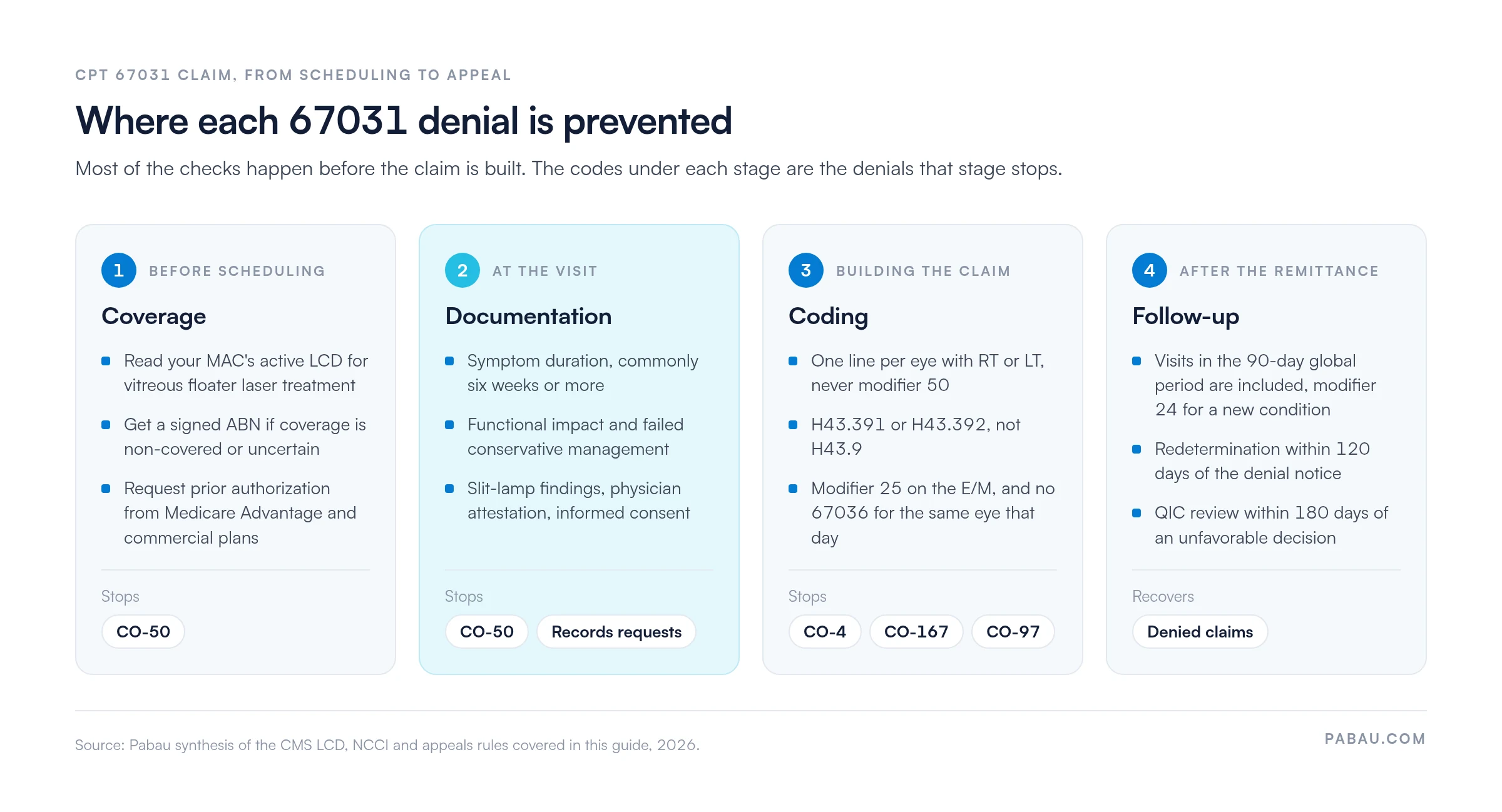
Denials on CPT code 67031 trace back to strict LCD criteria, mandatory laterality modifiers, and coverage that changes by jurisdiction. The table maps the most frequent CARC denial codes to their root cause and the fix for each.
Each of these denials is stopped at a specific stage of the claim, and most of those stages come before the laser is switched on.
A structured appeal answers the payer’s stated denial reason, which a plain resubmission does not. Follow these steps within the filing deadline, which for a Medicare redetermination is 120 days from the denial notice.
Tracking appeals one by one never shows the pattern behind them. Practice-wide denial management shows whether 67031 denials cluster around one payer, one diagnosis code, or one missing note. Fix that upstream step and the appeals stop arriving.
Most ophthalmology practices check 67031 claims by hand. Someone reads the LCD, someone else adds RT or LT at the end of the day, and denials get logged in a spreadsheet weeks later. Each handoff is a chance for a CO-4 or CO-50 to slip through.
Pabau keeps the clinical note and the claim in one record. Its error-checking claims management software links each diagnosis code to the procedure and flags a 67031 line with no laterality modifier before submission. Claims go out through Claim.MD, and ERA remittances post back against the same patient.
The billing team then sees a denial the day it posts, along with the payer and diagnosis code behind it. Fixes happen in the next claim, not the next quarter.

Pabau connects scheduling, clinical notes, and claims in one workflow. Submit 67031 claims through Claim.MD, catch modifier errors before the payer does, and see denial trends across your practice.

A 67031 claim is usually won or lost before the patient sits at the laser. If your MAC’s LCD treats floater vitreolysis as non-covered, the ABN conversation is the billing work, and no modifier rescues the claim later.
Where coverage exists, the trade-off is simple. A few minutes on the six documentation elements and a laterality check saves weeks of appeal work. Build that check into the visit, not the billing queue. Book a demo to see how Pabau flags a 67031 claim missing RT or LT before it reaches the payer.

Looking to understand the broader billing workflow? Superbill documentation covers how encounter-level charge capture connects to clean claim submission for ophthalmic procedures.
Billing an intravitreal injection in the same session? CPT code 67028 covers the injection code and the modifiers that keep it payable alongside 67031.
Comparing laser codes for the retina? CPT code 67040 explains vitrectomy with endolaser photocoagulation and how it differs from vitreolysis.
CPT code 67031 is the procedure code for laser vitreolysis. It covers severing vitreous strands, vitreous face adhesions, sheets, membranes or opacities with laser surgery, in one or more stages, in one eye. The Nd:YAG laser is the usual technology. The code covers the whole encounter for one eye, however many laser passes are performed.
Medicare coverage for CPT code 67031 depends on the Local Coverage Determination issued by your Medicare Administrative Contractor (MAC). Some MACs, including Noridian, classify laser vitreolysis for floaters as non-covered or investigational, while others may cover it under specific medical necessity criteria. Check the CMS LCD database for your MAC’s active LCD before treating a Medicare patient. If coverage is uncertain, obtain an ABN.
CPT 67031 is laser vitreolysis, a non-surgical procedure using Nd:YAG laser energy to fragment vitreous strands and opacities. CPT 67036 is pars plana vitrectomy, a surgical procedure in which vitreous is physically removed through the pars plana. The two codes cannot be billed for the same eye on the same date. NCCI bundling edits treat them as mutually exclusive for one encounter.
Every 67031 claim requires a laterality modifier: RT for the right eye or LT for the left eye. For bilateral same-session treatment, bill two separate line items (67031-RT and 67031-LT) rather than using modifier 50. When a significant, separately identifiable E/M service is performed on the same date, append modifier 25 to the E/M code, not to 67031.
Prior authorization requirements for CPT 67031 vary by payer. Traditional Medicare fee-for-service does not mandate prior authorization for 67031 as a standard rule, but Medicare Advantage plans frequently impose their own PA requirements. Most commercial payers require prior authorization before the procedure, so check with each plan before scheduling.
The primary ICD-10-CM codes paired with CPT 67031 are H43.391 (other vitreous opacities, right eye) and H43.392 (other vitreous opacities, left eye). Use laterality-specific codes rather than H43.399 (unspecified) or H43.9 (unspecified vitreous disorder) where possible, as unspecified codes frequently trigger CO-167 denials. Confirm the accepted diagnosis list against the active MAC LCD for your jurisdiction.
The four most frequent denials are CO-50, CO-97, CO-167 and CO-4. CO-50 means not medically necessary, usually missing LCD documentation or a non-coverage LCD. CO-97 is a bundling edit, often from billing 67031 with 67036. CO-167 is a non-covered diagnosis, typically H43.9 used instead of H43.391 or H43.392. CO-4 is a missing or inconsistent modifier, most often an absent RT or LT.