CPT code 33234: Pacemaker lead removal billing guide
CPT code 33234: Official descriptor and code placement CPT code 33234 is the cod...

Last Updated: Nov 26, 2026
57421 is the CPT code for colposcopy of the entire vagina, with cervix if present, with biopsy(s) of vagina/cervix. It applies when the colposcope examines the full vaginal canal and at least one tissue sample is taken.
The biopsy is the only difference from 57420, which is the same exam without one. You bill 57421 once per session, however many specimens go to pathology. It carries a 0-day global period, so a separate same-day E/M needs modifier 25.
Let Pabau's smart automation suggest the right codes, reduce claim denials, and keep your practice compliant—effortlessly.
Automate repetitive tasks and focus on what matters most—your patients.
Reduce coding errors and ensure compliance with the latest regulations.
Clean claims, fewer denials, and faster reimbursements.
Powerful insights and reporting to help your practice thrive.
HIPAA compliant SOC 2 certified GDPR-compliant Trusted by 4,000+ clinics worldwide

CPT code 57421 is colposcopy of the entire vagina, with cervix if present, with biopsy(s) of vagina/cervix.
It differs from 57420 only because a biopsy was taken, and it is billed once however many specimens are sent.
57421 carries a 0-day global period, so a separately documented same-day E/M is billed with modifier 25.
Pabau sends 57421 claims to US payers through Claim.MD, with eligibility checks and ERA remittances.
CPT code 57421 means colposcopy of the entire vagina, with cervix if present; with biopsy(s) of vagina/cervix.
That wording comes from the AMA’s CPT code set, which the CPT Editorial Panel maintains and updates. “Entire vagina” sets the scope, so the colposcope must examine the full vaginal canal, not only the cervix.
“With biopsy(s)” means at least one tissue sample was taken. The “(s)” matters too. You bill 57421 once per session, whether the physician takes one biopsy or four.
A colposcopy with biopsy usually follows an abnormal cervical or vaginal screening result. Common triggers include ASC-US with a positive high-risk HPV test, LSIL, HSIL and persistent abnormal cytology.
The note should show each step below:
Step five decides the code. Sometimes the physician sees a lesion but decides not to biopsy it. The patient may not tolerate it, or the findings may be equivocal. In that case, 57421 cannot be billed.
Both codes describe the same exam of the entire vagina, with cervix if present. Only the biopsy separates them. Billing 57420 when the note documents a biopsy undercodes the visit. Billing 57421 without biopsy documentation overcodes it, and that invites an audit.
The flow below shows how two questions settle the choice.
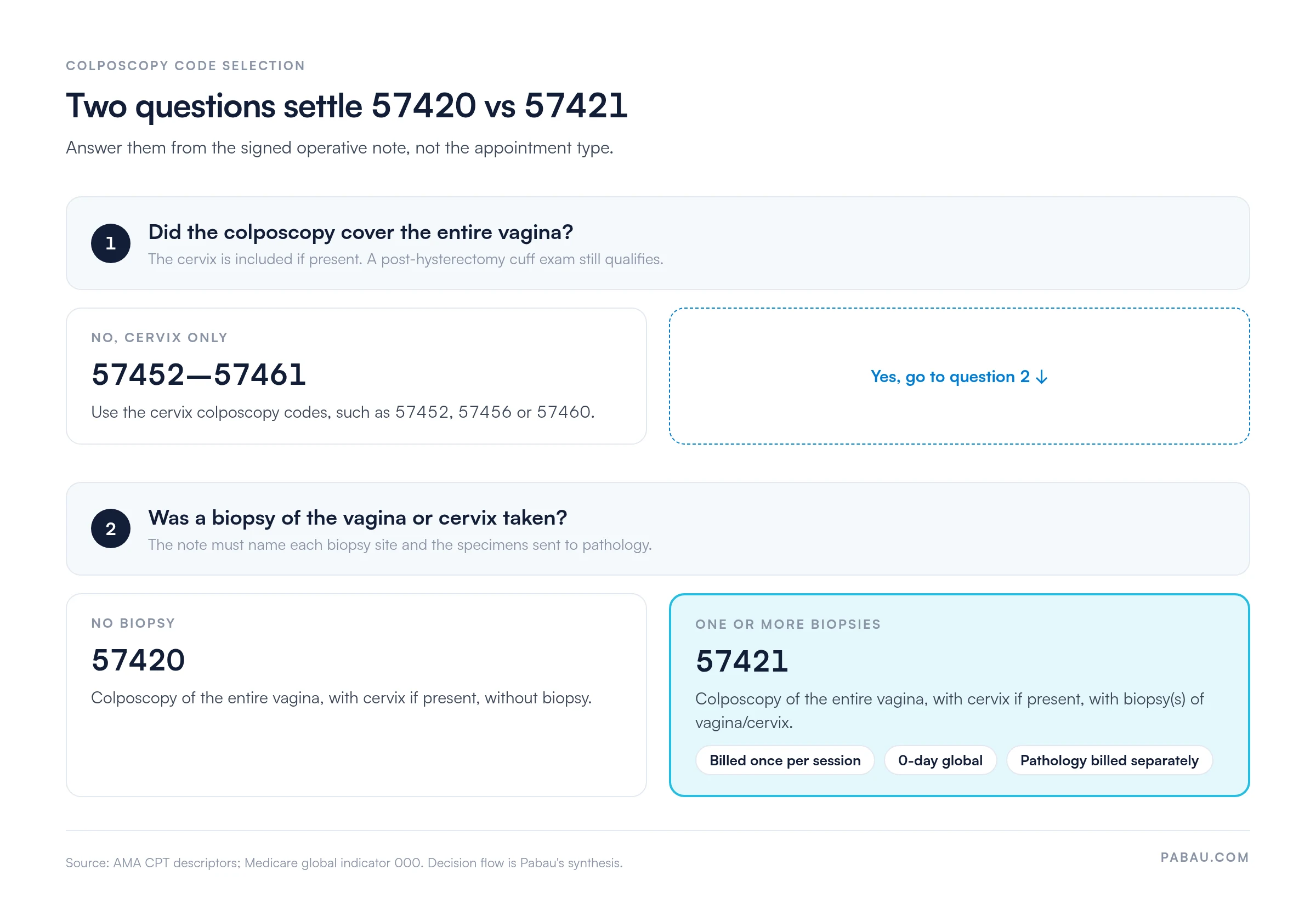
So pick the code when you review the signed operative note, not when the visit is booked. A physician may plan an exam only, then biopsy a lesion they find. Coding from the schedule gets that visit wrong.
Cervix colposcopy has its own codes, 57452-57461, separate from the vaginal pair. 57452 is the cervix exam without a biopsy, and 57456 adds endocervical curettage. Knowing which ones bundle with 57421 prevents both lost revenue and NCCI denials. An endometrial biopsy taken during the same colposcopy is reported with add-on code 58110, listed after 57421.
When the physician moves on to a loop electrode procedure, 57460 replaces 57421 for that session. NCCI edits change every quarter. Check the current edit pairs before each submission run.
A physician may take a vaginal biopsy and also perform endocervical curettage (ECC). Check the NCCI edit table before billing 57421 with any cervix colposcopy code. The right code depends on whether current edits treat the ECC as a separate service.
Medical necessity for 57421 rests on the ICD-10-CM code you link to it. Payers, including CMS, can deny the claim when that code does not support colposcopy with biopsy. Check each code in the ICD-10-CM code library before you use it, because the code set updates every October.
Z12.72, screening for malignant neoplasm of vagina, does not support 57421 on its own. Some Local Coverage Determinations (LCDs) want more than an unspecified code. When the cytology report names a finding, such as ASC-US, LSIL or HSIL, code that finding.
Weak documentation drives most 57421 denials. The signed note should hold each element below before the claim goes out. Individual LCDs may add more.
Post-hysterectomy patients need one extra line. The descriptor says “with cervix if present,” so 57421 still fits a vaginal cuff colposcopy. However, the note should state that the cervix is absent, rather than simply not mentioning it.
Medicare and most commercial payers cover colposcopy with biopsy when the indication matches recognized screening guidelines. Prior authorization rules vary by plan and can change without notice. Confirm them with the payer before the appointment.
These indications most reliably meet medical necessity across payers:
Routine screening colposcopy without an abnormal trigger does not meet medical necessity for 57421. Auditors look for the cytology or HPV result in the chart. Without it, the claim is exposed even when the biopsy was clinically right.
Medicare pays 57421 under the Medicare Physician Fee Schedule (MPFS), which converts relative value units (RVUs) into dollars. A geographic practice cost index (GPCI) then adjusts the amount for each locality.
For current rates, use the CMS MPFS lookup tool. The FastRVU 2026 RVU lookup breaks out the work, practice expense and malpractice RVUs.
In an ASC or hospital outpatient department, the facility bills its own technical component. The physician then receives the lower facility-based professional fee. Fee schedule amounts change every January, so treat this table as structure, not as rates.
Modifiers tell the payer that something about the session affects payment. Applying one wrongly is as damaging as leaving one off. Both create denial risk.
No modifier fixes every 57421 denial. Applying one without documentation raises audit risk instead of lowering it. Payer rules also vary, so check each payer’s billing guidelines before you submit.
Most 57421 denials are predictable and preventable. A denial management workflow that catches these patterns before submission saves rework after the remittance arrives. The table maps each mistake to its fix.
Same-day billing with 57421 follows the National Correct Coding Initiative (NCCI) edits that CMS maintains. The table covers common scenarios. Because NCCI edits update every quarter, check the current status before each submission run.
Pathology reads the biopsy specimens and bills them on its own claim, usually under 88305. Build the visit’s superbill so coders can spot same-day conflicts before the claim leaves, not after a denial comes back.
The 0-day global period for CPT code 57421 means there is no post-operative window that absorbs follow-up visits. A later visit for an unrelated OB/GYN issue is billed as a normal office visit. If the follow-up is directly related to the colposcopy, such as reviewing pathology results, check payer policy on whether that visit is included.
A clean claim for 57421 is settled during note review. Run through this list before the claim reaches the clearinghouse.
Most coding errors on 57421 are caught at note review. The next delay comes after that, when claims are keyed by hand into a clearinghouse portal and remittances are matched line by line.
Pabau, a practice management platform, offers simpler claims management for US practices through Claim.MD. Your team builds CMS-1500/837P claims from the visit and checks eligibility before the appointment. ERA remittances then post back to the patient account.
Coding choices stay with your coders, since Pabau does not pick modifiers or check NCCI edits. What changes is the admin. Coverage is confirmed before the colposcopy, and payment status sits on the same record as the visit.

Pabau sends claims to US payers through Claim.MD, checks eligibility before the visit and posts ERA remittances when payment lands.

The safest habit with 57421 is to code from the signed note and never from the schedule. If the note proves full vaginal scope and names each biopsy site, the code choice is settled. A specific diagnosis then carries medical necessity.
Same-day services are where most remaining risk sits. Check the current NCCI edits rather than relying on memory. Keep modifier 59 for services the note genuinely separates.
Book a demo to see how Pabau sends your colposcopy claims through Claim.MD, with eligibility checks and ERA remittances on one record.

Moving from biopsy to excision? CPT code 57461 covers colposcopy with loop electrode conization of the cervix.
Need to understand how clearinghouse claim routing works? Medical claims clearinghouse guide explains how electronic claim routing reduces denials for outpatient practices.
Matching payments to colposcopy claims? Electronic remittance advice (ERA) overview shows how ERA data helps practices spot and appeal denial patterns.
Want to see how coding compliance fits the revenue cycle? Medical billing compliance guide covers the documentation and audit rules behind gynecology procedure codes.
Building a superbill for gynecology visits? Superbill guide explains what each field needs so same-day codes are clear before billing.
Yes. 57421 covers biopsy of the vagina or cervix only. Endometrial sampling done during the colposcopy is reported with add-on code +58110, listed after the primary colposcopy code.
Use the most definitive diagnosis known when you code. Outpatient guidelines say a postoperative diagnosis confirmed before coding replaces the preoperative one. If pathology is still pending, code the abnormal cytology or HPV finding that prompted the procedure.
Code the confirmed grade. N89.0 is mild vaginal dysplasia (VAIN I) and N89.1 is moderate (VAIN II). Severe dysplasia, VAIN III, is coded as carcinoma in situ of vagina, D07.2.
Yes, where state scope of practice allows the procedure. Medicare pays a nurse practitioner who bills under their own NPI 85% of the physician fee schedule amount.
Medicare requires claims within 12 months of the date of service. Commercial payer deadlines vary by contract and are often shorter, so check each one.