CCSD code XR940: Foreign body retrieval billing guide
CCSD code XR940 is the UK private healthcare code for retrieval of a foreign bod...

Last Updated: Nov 26, 2026
29889 is the CPT code for arthroscopically aided posterior cruciate ligament repair/augmentation or reconstruction. It covers repair, augmentation or graft reconstruction of the PCL, while the anterior cruciate ligament has its own code, 29888.
In the CY2026 Medicare physician fee schedule, 29889 carries a 90-day global period and a facility-only price. Clean claims turn on a PCL-specific diagnosis, matching laterality, and the NCCI edits for other knee arthroscopy codes.
Let Pabau's smart automation suggest the right codes, reduce claim denials, and keep your practice compliant—effortlessly.
Automate repetitive tasks and focus on what matters most—your patients.
Reduce coding errors and ensure compliance with the latest regulations.
Clean claims, fewer denials, and faster reimbursements.
Powerful insights and reporting to help your practice thrive.
HIPAA compliant SOC 2 certified GDPR-compliant Trusted by 4,000+ clinics worldwide

CPT code 29889 reports arthroscopically aided posterior cruciate ligament (PCL) repair, augmentation or reconstruction. The ACL has its own code, 29888.
In the CY2026 Medicare fee schedule, 29889 carries 33.90 facility RVUs and a 90-day global period, and it has no non-facility price.
That works out to a national facility payment of $1,137.94 at the QP conversion factor, or $1,132.29 at the non-QP factor.
NCCI never lets 29874 or 29877 be billed with 29889, while meniscectomy and meniscus repair have no active edit against it.
Support the claim with S83.521A, S83.522A or the M23.62- spontaneous disruption codes, and match the diagnosis laterality to RT or LT.
CPT code 29889 reports arthroscopically aided posterior cruciate ligament (PCL) repair/augmentation or reconstruction. The CMS physician fee schedule relative value file lists it with the short descriptor “Arthrs aid pcl rpr/agmntj” for 2026.
First, the code sits in the endoscopy/arthroscopy section of the musculoskeletal surgery codes, 29800 through 29999. While the American Medical Association owns the CPT descriptor, CMS assigns the payment rules that Medicare applies to it.
Overall, the descriptor covers three kinds of PCL work: primary repair, augmentation of a damaged ligament, and full graft reconstruction. Autograft and allograft cases both map to 29889, and the operative note records which graft was used.
Also, a tendon graft harvested through a separate incision does not add a billable line. NCCI pairs 29889 with 20924, the tendon graft code, at modifier indicator 0. Therefore, no modifier can bypass that edit.
First, the two codes split on the ligament the surgeon treated. 29888 is the anterior cruciate ligament code and 29889 is the posterior cruciate ligament code. Neither descriptor mentions meniscectomy, so the meniscus never decides between them.
For example, a combined ACL and PCL reconstruction on the same knee is reported with both codes. In addition, the October 2026 practitioner PTP file holds no edit pairing 29888 with 29889. Medicare then applies its multiple-procedure rule, paying the higher-valued 29889 in full and 29888 at 50%.
Pick the code from the ligament named in the operative report, because a PCL reconstruction sent out as 29888 is miscoded and no modifier corrects it.
First, the table reads each pairing from the CMS practitioner PTP edit file for October 2026 (version 32.3), plus the arthroscopy rules in Chapter IV of the NCCI Policy Manual for Medicare.
Indicator 1 means a modifier such as 59 or XS can bypass the edit, but only for distinct services the operative report shows. Indicator 0 means no modifier works.
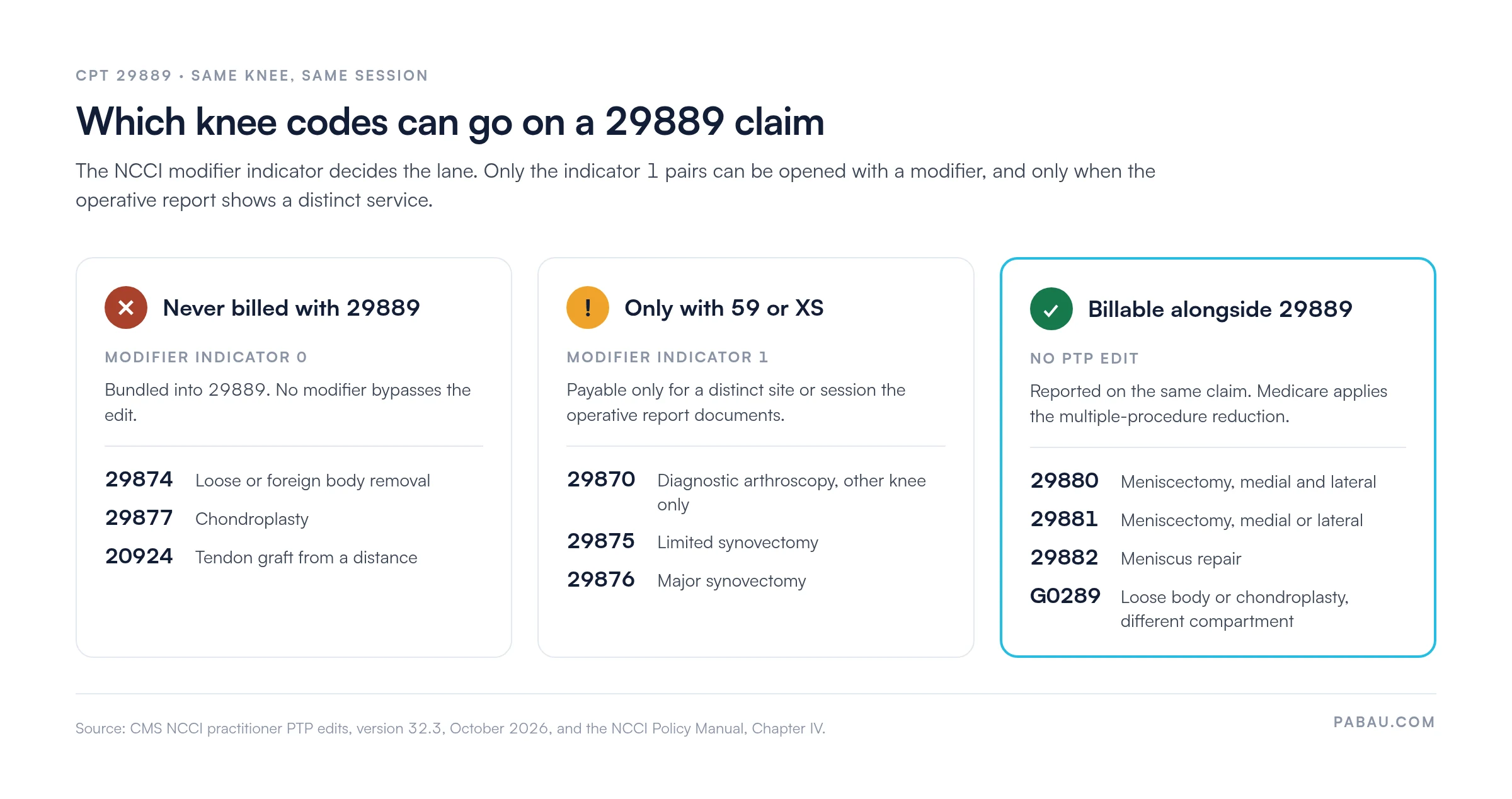
NCCI also lists 27407, 27409 and 27427 through 27429 as column 1 codes with 29889 in column 2, each at indicator 1. Check those pairs before adding an open repair code.
Finally, treat these edits as a pre-submission check in your medical billing workflow, and recheck the PTP file each quarter.
Because the CY2026 fee schedule indicators for 29889 set out which modifiers Medicare will pay on, laterality comes first on every line.
In fact, a missing or mismatched side is the modifier error that recurs most on knee claims. For example, a right-knee modifier paired with a left-knee diagnosis gives the payer an easy reason to deny.
Build one scrubber rule for every 29889 line: if 29874, 29877 or 20924 sits on the same claim for the same knee, stop the claim. Those three pairs carry modifier indicator 0, so no modifier can rescue them after submission.
First, the diagnosis has to name the posterior cruciate ligament. Next, the codes below come from the FY2027 ICD-10-CM code files published by CMS.
ICD-10-CM classifies a ligament tear as a sprain, so a complete PCL rupture still codes to S83.52-. The seventh character A covers active treatment, because surgical reconstruction counts as active treatment.
Also, do not carry the ACL codes across from a 29888 claim. S83.51- and M23.61- describe the anterior ligament, and they will not support a PCL procedure.
First, CMS sets two conversion factors for CY2026. Clinicians who qualify through an Advanced APM (QP) get $33.5675 per RVU, and everyone else gets $33.4009. The figures below are national amounts before any local adjustment.
Each row multiplies the RVU by the conversion factor, so the three components add up to the total. In addition, the values come from the October 2026 release of the CMS national physician fee schedule relative value file.
This is the surgeon’s professional fee only, while the hospital outpatient department or ambulatory surgical center bills its facility fee separately. Likewise, Medicare Advantage and commercial contracts set their own rates.
Finally, the 90-day global period bundles the visit the day before surgery and routine postoperative visits for 90 days. However, a visit for an unrelated problem during that window needs modifier 24 and notes that show the separate problem.
Indeed, the operative report carries the claim. Reviewing the clean claim requirements for surgical procedures shows why. Payers ask for the note before they pay a high-value knee code.
The operative report should record:
Prior authorization: Original Medicare does not require prior authorization for 29889, because the code is not on the CMS list of hospital outpatient services that need it.
However, Medicare Advantage and commercial plans often do require it, and each sets its own criteria. Confirm the requirement before scheduling, then record the authorization number and its dates against the case.
Overall, most 29889 denials trace back to a short list of causes that a pre-submission check can catch. The medical billing denial codes guide explains each reason code in more depth. For the follow-up work, see these denial management workflows.
Audit the ICD-10-CM pick on every 29889 claim against the ligament in the operative note. A PCL claim that inherits an S83.51- or M23.61- code from an ACL template fails for a reason no modifier can fix.
In fact, a PCL reconstruction claim touches several hands. The front desk confirms benefits, someone chases the authorization, and the biller waits on the operative note before the claim goes out.
Pabau, a practice management platform with built-in claims management software, keeps those steps on the patient record. For example, authorization codes, dates and approved sessions sit on the case, and Pabau warns the team when one is missing.
In addition, for US practices, Pabau submits CMS-1500/837P claims through Claim.MD, runs eligibility checks, and posts ERA remittances. The medical claims clearinghouse guide covers how that connection handles secondary claims and denial reasons. Your coders still choose the codes, while Pabau keeps the claim and its payment history in one place.

Pabau tracks the authorization on the case, submits the claim through Claim.MD and posts the remittance when it returns. Your billing team works one record instead of three systems.

CPT 29889 is the posterior cruciate ligament code, and the claim is clean once every line agrees with that. For this reason, the diagnosis, the side and the companion codes all have to point at the same ligament in the same knee.
Two mistakes cost the most because no modifier undoes them. One is an ACL diagnosis on a PCL claim, and the other is a chondroplasty billed into an indicator 0 edit. Check both before submission, then keep routine postoperative visits off the claim for the 90-day global period.
Book a demo to see how Pabau keeps the authorization, the claim and the remittance for each 29889 case on one record.

Repairing the meniscus in the same session? CPT code 29882 covers meniscus repair, which has no active NCCI edit against 29889.
Wondering why chondroplasty drops off the claim? CPT code 29877 covers the knee chondroplasty code that NCCI bundles into 29889 at indicator 0.
Want to stop denials before they happen? Clean claim checklist for surgical specialties outlines the documentation and modifier checks that prevent CO-4, CO-11 and CO-197 denials.
Looking for the full revenue cycle picture? Revenue cycle management guide explains how claim submission fits into the broader patient-encounter-to-payment workflow for surgical practices.
CPT code 29889 describes arthroscopically aided posterior cruciate ligament repair/augmentation or reconstruction. It also covers PCL repair, augmentation and graft reconstruction with autograft or allograft. Anterior cruciate ligament procedures use 29888 instead.
The two codes cover different ligaments. CPT 29888 is arthroscopically aided anterior cruciate ligament (ACL) repair or reconstruction, and 29889 is the same work on the posterior cruciate ligament (PCL). Neither descriptor includes meniscectomy, but 29889 carries more RVUs, 33.90 against 26.63 in the CY2026 facility setting.
Yes. The October 2026 NCCI practitioner PTP file has no edit pairing the two codes, so a combined ACL and PCL reconstruction reports both. Medicare then pays the higher-valued procedure in full and applies its multiple-procedure reduction to the other.
Not for the same knee, because the NCCI Policy Manual states that surgical arthroscopy includes diagnostic arthroscopy. The PTP edit carries modifier indicator 1, so 29870 can be reported separately only when it is performed on the other knee.