

CCSD code XR940: Foreign body retrieval billing guide
CCSD code XR940 is the UK private healthcare code for retrieval of a foreign bod...

Last Updated: Nov 26, 2026
50220 is the CPT code for nephrectomy, including partial ureterectomy, any open approach including rib resection. It reports open removal of the whole kidney with the upper part of the ureter.
Coders often confuse it with CPT 50230, the open radical nephrectomy with regional lymphadenectomy and/or vena caval thrombectomy. The other common mix-up is CPT 50546, the laparoscopic nephrectomy. Approach and operative scope decide which code applies.
Let Pabau's smart automation suggest the right codes, reduce claim denials, and keep your practice compliant—effortlessly.
Automate repetitive tasks and focus on what matters most—your patients.
Reduce coding errors and ensure compliance with the latest regulations.
Clean claims, fewer denials, and faster reimbursements.
Powerful insights and reporting to help your practice thrive.
HIPAA compliant SOC 2 certified GDPR-compliant Trusted by 4,000+ clinics worldwide

CPT code 50220 covers open nephrectomy including partial ureterectomy via any open surgical approach, not laparoscopic or robotic techniques.
A regional lymphadenectomy or vena caval thrombectomy moves the case from 50220 to CPT 50230, the open radical nephrectomy code.
C64.x (renal malignancy) is the most commonly accepted diagnosis for CPT 50220, with N26.1 or N26.9 for a non-functioning kidney.
Pabau, a practice management platform, connects to Claim.MD for 837P claim submission, eligibility checks, and ERA remittances.
CPT code 50220 reports an open nephrectomy that removes the whole kidney with part of the ureter, through any open incision, rib resection included. CMS’s 2026 RVU files list 50220 as an active Medicare-payable surgical code with a 90-day global period. Approach and operative scope are the two variables most likely to send a case to a different code. Confirm both before you build the claim.
The official AMA descriptor for CPT 50220 is: Nephrectomy, including partial ureterectomy, any open approach including rib resection. Per the AMA CPT code set, this code covers the complete open removal of a kidney with the proximal portion of the ureter. The surgeon’s choice of open route does not change the code.
Three points define the procedural scope of this code:
Standard vessel ligation (renal artery and vein), wound closure, and drain placement are also part of the global package for CPT code 50220.
Knowing the surgical steps helps coders read operative reports accurately and query the surgeon before a claim goes out with missing detail. An open nephrectomy typically proceeds through these stages:
The most common indications are renal cell carcinoma (C64.x), a non-functioning or atrophic kidney (N26.1 or N26.9), and living-donor nephrectomy (Z52.4). N28.9, disorder of kidney and ureter, unspecified, is a nonspecific fallback rather than a code for a non-functioning kidney. The operative report must state the clinical indication clearly. A missing or vague indication is one of the top denial triggers for CPT code 50220.
Knowing what is bundled and what is separately billable prevents both undercoding, which leaves revenue on the table, and overcoding, which triggers NCCI edit denials.
The nephrectomy code family spans open, laparoscopic, radical, and partial procedures. Approach is checked first and operative scope second, in the order the decision flow below follows.
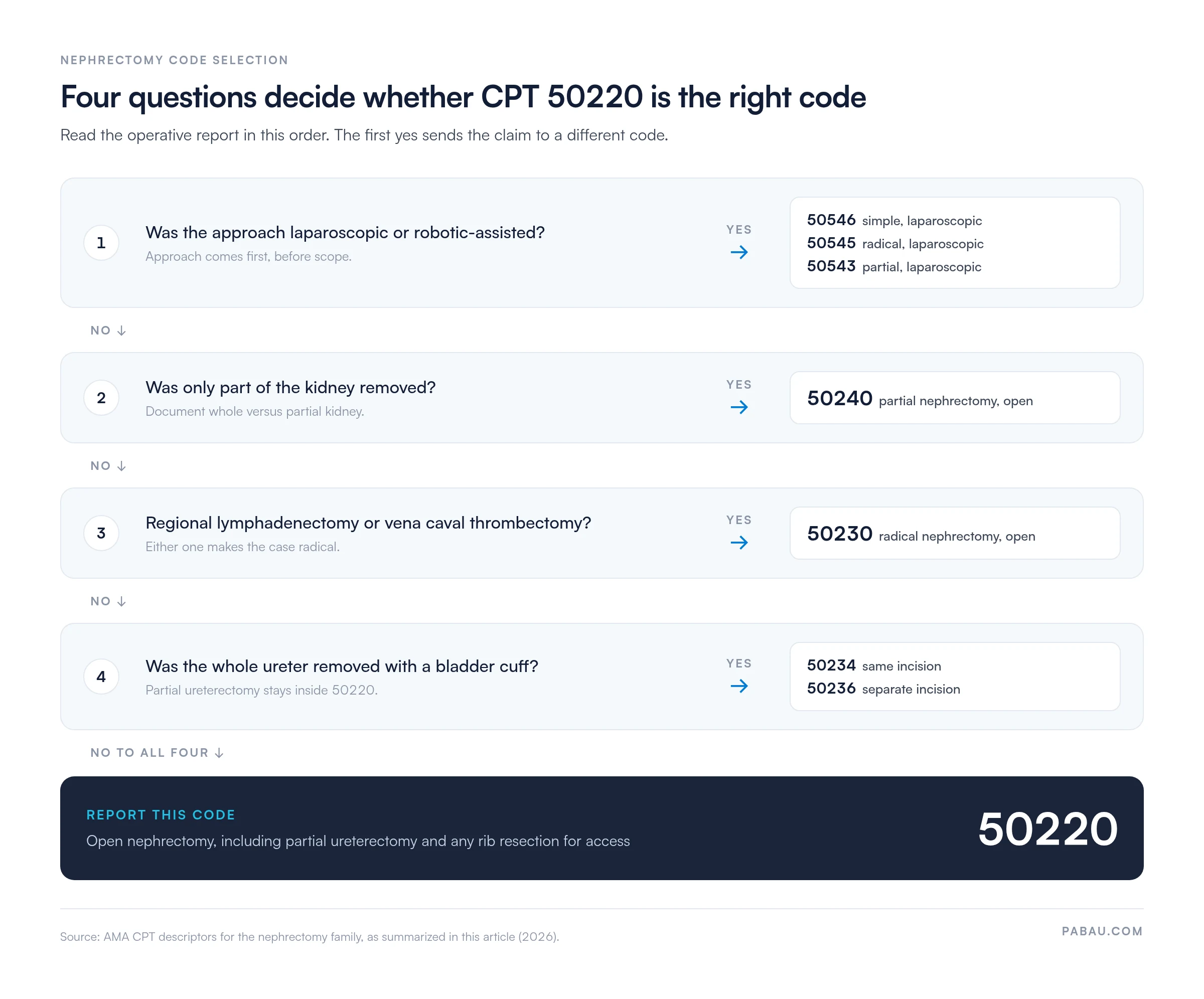
CPT 50230 applies when the operative report documents a regional lymphadenectomy, a vena caval thrombectomy, or both. If neither step was performed and the whole kidney came out through an open approach, 50220 is the correct code.
Op note language that points to 50230 includes a regional lymph node dissection or an excised caval thrombus. An ipsilateral adrenalectomy does not change the code on its own, because NCCI bundles 60540 into the nephrectomy codes. CPT 50240 is a different procedure altogether: a partial nephrectomy, where only part of the kidney is removed.
CPT code 50220 is strictly an open-surgery code. When the operative report documents laparoscopic or robotic-assisted technique, the code moves to 50546, 50545, or 50543. 50546 covers laparoscopic nephrectomy including partial ureterectomy, the direct counterpart of 50220. Billing 50220 for a laparoscopic case is a code and documentation mismatch, so the payer denies or rejects the claim.
Conversion-to-open cases need payer-specific guidance. When a laparoscopic case converts to open surgery during the operation, most payers want the code that reflects the work completed. Verify with the individual MAC or commercial plan before coding a converted case as 50220.
Payers evaluate medical necessity by cross-referencing the CPT code against the submitted ICD-10-CM diagnosis. These are the primary diagnoses accepted for open nephrectomy claims, per AAPC coding guidance and CMS coverage policy:
Use the most specific laterality code available. C64.9 (unspecified) is acceptable when laterality is genuinely unknown at the time of coding. Where the operative report specifies the side, use C64.1 or C64.2.
A complete operative report is the single most important document for a CPT code 50220 claim. Payer auditors and MACs look for these specific elements in the op note and pre-operative record. Reviewing medical billing documentation standards is a useful baseline, but urology surgical claims require additional specifics:
Submitting a clean claim for CPT code 50220 means the op note, the ICD-10 diagnosis, and the modifiers all tell one story.
Medicare does not currently require prior authorization for CPT 50220, but commercial and Medicaid plans frequently do. Authorization requirements vary by payer and change without notice, so verify with the specific plan before the procedure.
Medicare pays CPT code 50220 under the Medicare Physician Fee Schedule (MPFS). In the CMS CY2026 RVU file, 50220 carries 18.21 work RVUs and 28.84 total RVUs. At the $33.4009 conversion factor, that comes to about $963 nationally, before geographic (GPCI) adjustment. Use the CMS MPFS lookup tool for your locality’s rate, or the FastRVU 2026 RVU lookup for a quick cross-check.
Commercial payer rates for CPT code 50220 vary considerably. Contracted rates with large commercial plans often run 120-180% of the Medicare rate depending on the payer and region.
CPT code 50220 claims are denied for a predictable set of reasons, and most are preventable with pre-submission review. Reviewing medical billing denial codes alongside your CARC explanations speeds resolution when denials do occur.
A structured denial management workflow catches most of these issues before the claim reaches the payer. Routing claims through a medical claims clearinghouse also catches format and payer ID errors before submission.
Modifiers communicate procedural detail that the base code does not capture. Surgical billing compliance protocols that include a modifier review step prevent both underpayment and denial. These are the modifiers most commonly appended to CPT code 50220:
Many payers expect -RT or -LT on paired-organ procedures such as 50220, so check each payer’s policy. A missing laterality modifier is a common correctable denial in urology billing, and a corrected claim usually resolves it quickly.
Run a pre-submission modifier audit on every CPT 50220 claim. Confirm the laterality modifier the payer expects, check that the ICD-10 laterality matches it, and look for any secondary procedure codes that need -51. A five-minute review catches the two most common modifier-related denials before they delay payment.
A 50220 claim passes through several hands: the surgeon’s op note, the coder’s code and modifier choice, then submission and remittance. When those steps sit in separate systems, a missing laterality modifier or an unsigned op note surfaces only as a denial weeks later.
Pabau, a practice management platform with streamlined claims management, keeps the procedure record, the claim and the payment on one patient file. US claims go out through Claim.MD, so your team can submit 837P claims, check eligibility and receive ERA remittances without switching tools.
Your coder still chooses the code. What changes is where the outcome lands. A rejected claim or a partial ERA payment shows up on the patient record your billing team already uses.
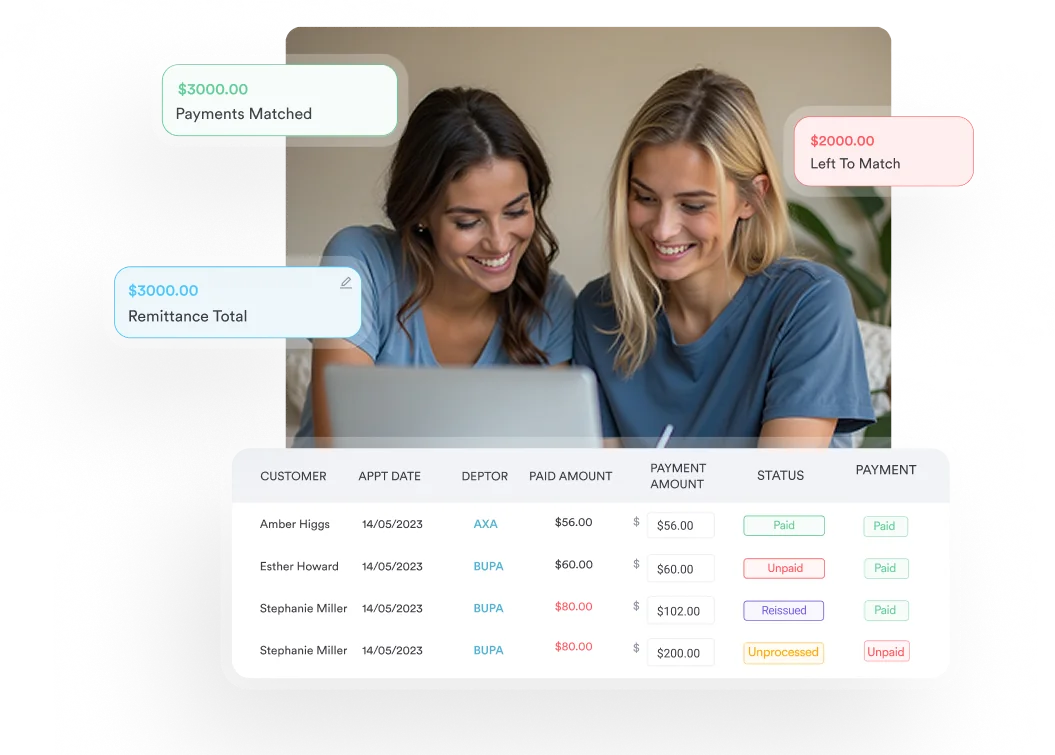

Pabau keeps the procedure record, the claim and the remittance on one patient file. US claims go out through Claim.MD, with 837P submission, eligibility checks and ERA remittances in the same workflow.

CPT code 50220 is a narrow code: open approach, whole kidney, partial ureterectomy, and no regional lymphadenectomy or caval thrombectomy. Read the op note against those four limits before anything else, because each one that fails points to a different code.
The payoff is fewer approach-mismatch and unbundling denials, and fewer weeks spent appealing a claim that was coded wrong from the start. The cost is a few minutes of review per case, which is cheap next to reworking a 90-day global surgery after a denial.
Book a demo to see how Pabau helps urology billing teams submit 837P claims, check eligibility and follow ERA remittances from one patient record.

Coding the same case laparoscopically? CPT 50545 covers laparoscopic radical nephrectomy and how its scope differs from the open codes.
Removing only part of the kidney? CPT 50543 walks through laparoscopic partial nephrectomy coding and documentation.
Want to understand denial codes on nephrectomy claims? Medical billing denial codes breaks down CARC codes and resolution steps for common surgical claim rejections.
Looking to streamline revenue cycle documentation? Revenue cycle management guide covers the end-to-end workflow from patient encounter to payment posting.
CPT code 50220 covers an open nephrectomy, including partial ureterectomy, through any open approach such as flank, transabdominal, or retroperitoneal. The global package includes renal vessel ligation, partial ureteral removal, rib resection for access, and wound closure. A regional lymphadenectomy or vena caval thrombectomy moves the case to CPT 50230. Complete ureter removal with a bladder cuff requires CPT 50234 or 50236.
CPT 50230 is the open radical nephrectomy code, reported when the surgeon also performs a regional lymphadenectomy, a vena caval thrombectomy, or both. CPT 50220 covers the nephrectomy without either step. If the operative report documents lymph node dissection or caval thrombus removal, 50230 is the correct code. CPT 50240 is a separate procedure, a partial nephrectomy.
No. CPT code 50220 is strictly an open-surgery code. A laparoscopic nephrectomy is coded 50546, the laparoscopic counterpart of 50220, or 50545 for radical and 50543 for partial removal. Billing 50220 for a laparoscopic case is a code and documentation mismatch, and the payer denies or rejects the claim. For a case converted to open, confirm the code with your MAC or the commercial payer.
Not separately. NCCI bundles adrenalectomy code 60540 into the nephrectomy codes, so an ipsilateral adrenalectomy in the same session is not reported on its own. Billing 50220 and 60540 together draws a CO-97 bundling denial. If the surgeon also performed a regional lymphadenectomy or vena caval thrombectomy, report the radical code, 50230, instead of 50220.



