

CCSD code XR940: Foreign body retrieval billing guide
CCSD code XR940 is the UK private healthcare code for retrieval of a foreign bod...

Last Updated: Nov 26, 2026
49521 is the CPT code for repair recurrent inguinal hernia, any age; incarcerated or strangulated. It covers the open repair of a hernia that has returned at a previously repaired groin site and is now trapped or strangulated.
Two documentation errors commonly cause 49521 downcodes and denials. A coder bills 49521 when the operative note describes a reducible hernia, which is 49520. Or the note never confirms that the hernia is a recurrence rather than an initial repair.
Let Pabau's smart automation suggest the right codes, reduce claim denials, and keep your practice compliant—effortlessly.
Automate repetitive tasks and focus on what matters most—your patients.
Reduce coding errors and ensure compliance with the latest regulations.
Clean claims, fewer denials, and faster reimbursements.
Powerful insights and reporting to help your practice thrive.
HIPAA compliant SOC 2 certified GDPR-compliant Trusted by 4,000+ clinics worldwide

CPT code 49521 covers open repair of a recurrent inguinal hernia that is incarcerated or strangulated, in a patient of any age.
A reducible recurrent hernia is 49520, a first-time repair takes an initial-repair code, and a laparoscopic recurrent repair is 49651.
The operative note must document the prior repair, the incarceration or strangulation, and the open approach, or the claim risks a downcode or denial.
Pair 49521 with a recurrent K40 code such as K40.31, K40.41, K40.01 or K40.11. Codes not specified as recurrent cause a mismatch denial.
Pabau, a practice management platform with built-in claims management, submits 49521 claims electronically and tracks each one through payment.
CPT code 49521 is the open repair of a recurrent inguinal hernia that is incarcerated or strangulated, in a patient of any age. The official descriptor reads Repair recurrent inguinal hernia, any age; incarcerated or strangulated, as reprinted in an American College of Surgeons coding column. The AMA maintains the CPT code set, and each element of that descriptor sets a billing requirement.
The “any age” qualifier means the recurrent inguinal codes have no age split. Surgeons report 49521 for a child or an adult, while initial inguinal repairs do split by age.
49521 covers the open work of reducing an incarcerated or strangulated recurrent inguinal hernia back into the abdominal cavity. It also covers reinforcing the defect, commonly with prosthetic mesh, and closing the wound. Mesh placement is included and is not separately reportable.
Included within 49521:
Excluded from 49521 (requires a separate code or a different code selection):
The split between 49521 and 49520 causes the most confusion for general surgery coders. Both describe open recurrent inguinal hernia repair in patients of any age, and reducibility is the only clinical distinction. Three questions answered from the operative note settle the choice, in the order shown below.
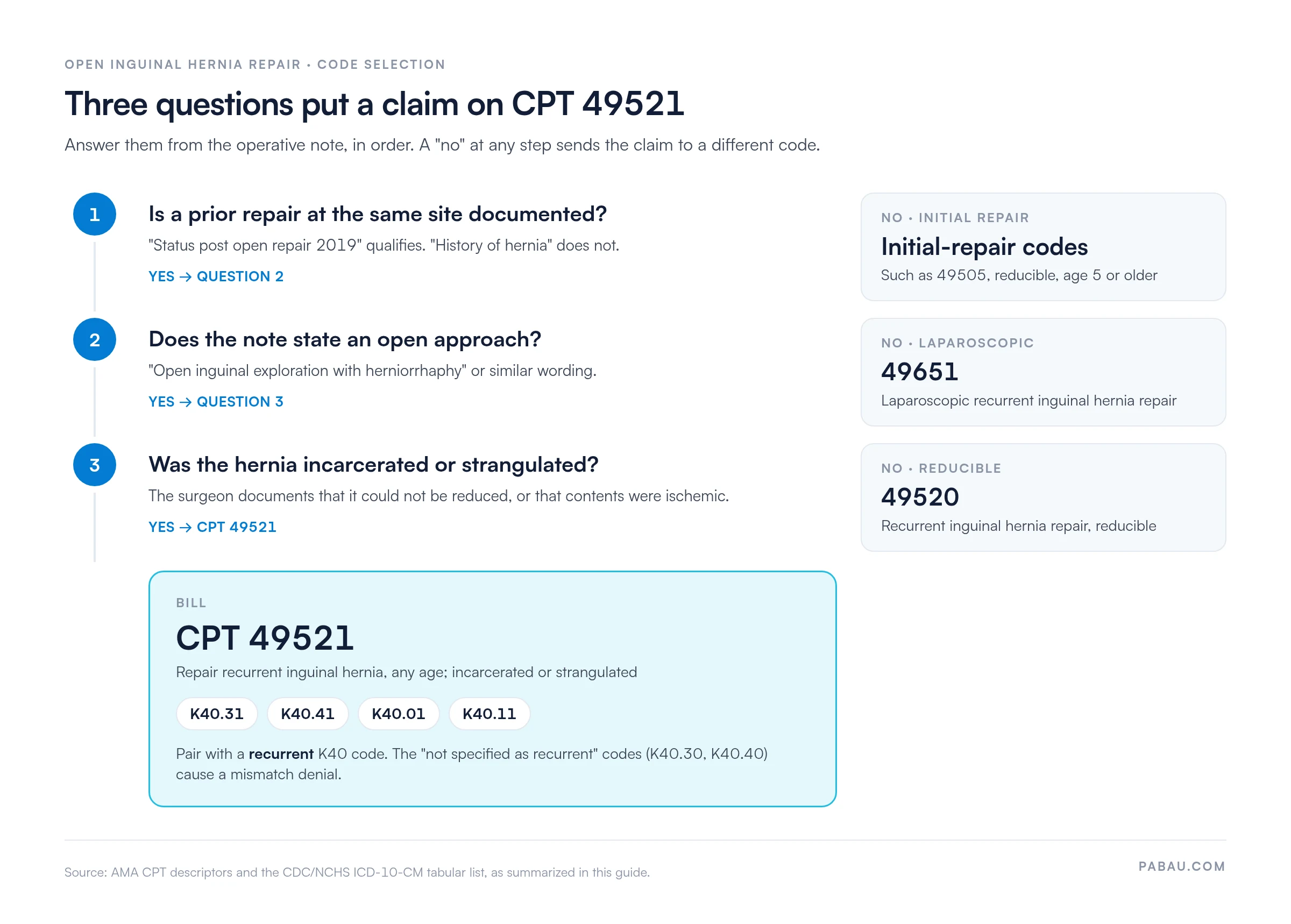
Dictation wording creates the audit risk. Suppose the note opens with “the hernia was reducible with gentle manipulation,” and strangulation is confirmed only at exploration. That wording supports 49520, not 49521, even when 49521 matches the surgery performed. Coders should request an addendum when the final intraoperative finding contradicts the opening language.
A clean claim submission for 49521 starts with an operative note that answers four specific questions. Missing any one of them gives a payer grounds to downcode or deny.
Keeping billing compliance documentation at this level protects against post-payment audits. Payers running targeted surgical reviews request the operative report, not just the claim form.
Before submitting a 49521 claim, check three points in the note. Look for (1) a prior repair reference, (2) the incarceration or strangulation finding, and (3) an explicit open approach. If any item is missing, request a surgeon addendum before billing. Addendums added after a denial are harder to defend than those added pre-submission.
The diagnosis for 49521 must be a recurrent inguinal hernia code with obstruction or gangrene. K40.31 and K40.41 cover a unilateral or unspecified recurrent hernia, and K40.01 and K40.11 cover a bilateral recurrent one. The codes “not specified as recurrent,” such as K40.30 and K40.40, cause an ICD-10 mismatch denial when paired with 49521.
Confirm current-year code validity in the CDC/NCHS ICD-10-CM web tool before submission, since the code set is updated each October.
Several modifiers apply to 49521, each with its own documentation requirement. Appending a modifier without supporting documentation invites an audit, just as leaving off a warranted one costs payment.
Modifier 22 needs specific attention on strangulated presentations. Some payers require a written justification letter with the claim, while others run modifier 22 through automated review. Check each payer’s policy before counting on a payment uplift.
Medicare classifies CPT code 49521 as a major surgical procedure under the Physician Fee Schedule. The CMS Physician Fee Schedule Lookup Tool lists its current work RVU, total RVU, and national payment rates. It shows both facility (hospital inpatient, ASC) and non-facility settings.
CMS updates rates every year and adjusts them by locality through the Geographic Practice Cost Index (GPCI). A dollar figure printed here would soon be out of date. Three variables set the payment a practice receives.
When the electronic remittance advice arrives, compare the allowed amount with the locality rate for the place of service you billed. A mismatch there usually points to a wrong POS code or a missed modifier.
Traditional Medicare generally does not require prior authorization for CPT 49521. Medicare Advantage plans and most commercial payers are different, and prior authorization for elective and semi-elective hernia repair is standard practice there.
When a PA is typically required: a known incarcerated recurrent hernia is scheduled electively while the patient is clinically stable. The payer will request clinical notes confirming the recurrence history, the degree of incarceration, and the planned surgical approach.
Emergency exception: strangulation with bowel compromise is a surgical emergency. Most payers have an emergency bypass that lets the procedure go ahead without the standard PA timeline. The operative documentation must reflect the emergency presentation. Submit the concurrent notification or retrospective request within the payer’s post-service window, typically 24 to 72 hours.
The National Correct Coding Initiative (NCCI) publishes quarterly bundling edits that govern which codes can be billed with CPT 49521. The CMS NCCI Policy Manual is the authoritative reference for current edit pairs.
Four bundling rules shape a 49521 claim.
NCCI edits change every quarter. Confirm the current edit tables in the CMS NCCI tool before billing any code combination you have not verified before.
Understanding denial management workflows for surgical codes starts with knowing which denials come up most. For CPT code 49521, six patterns are among the most common causes of rejected claims.
When a 49521 claim is rejected, the ERA carries CARC and RARC reason codes. The guide to medical billing denial codes explains what each one means.
CPT code 49521 carries a 90-day global surgical period under the Medicare Physician Fee Schedule. The surgeon’s fee covers routine follow-up care for 90 days after the procedure date. Knowing what is included and what can be billed separately avoids both underpayment and overpayment.
Included in the 90-day global period (not separately billable):
Separately billable during the global period:
The 90-day global period begins on the day of surgery, not the day of the pre-operative visit. For major procedures, a pre-operative visit on the day before surgery is included in the global package. In revenue cycle management for high-volume surgical schedules, tracking each patient’s global period dates prevents billing of bundled post-op visits.
Set a global period flag in your practice management system the day each 49521 procedure is performed. Flag the end date 90 days forward. Any E&M or procedure billed for that patient within the window should trigger a modifier review before the claim is submitted. This catches bundling errors before they reach the payer rather than after a denial.
A 49521 claim passes through several hands before it is paid. The coder reads the operative note, the biller builds the claim, and someone matches the remittance to the surgery weeks later. When those steps sit in separate tools, a missing laterality modifier or authorization number surfaces only on the denial.
Pabau keeps those steps on the patient record. Its claims software for surgical practices submits CMS-1500 (837P) claims through Claim.MD, Pabau’s US clearinghouse integration, which connects to thousands of US payers. Your team can track submitted claims and import ERA remittances into the billing workflow.
Prior authorization sits on the patient’s case as well. The auth code, dates and sessions are recorded there, with a warning when one is missing. For an elective 49521 under a Medicare Advantage or commercial plan, that warning arrives before the surgery date rather than after the denial.


Pabau submits CPT 49521 claims electronically, tracks each one through payment, and imports ERA remittances into billing. Prior authorizations stay on the patient’s case, with a warning when one is missing.

Getting CPT code 49521 right comes down to the operative note and the ICD-10 pair. When surgeons document recurrence, incarceration or strangulation, and the open approach, and coders pick a recurrent K40 code, far fewer denials occur.
The trade-off sits at the coding step. An addendum request before submission costs a day, while a downcode to 49520 lowers the payment and starts an appeal. Hold any 49521 claim whose note leaves recurrence or reducibility in doubt.
With Pabau, general surgery practices submit claims electronically and track their status through payment, rather than chasing denials after the fact. To see how it works for surgical billing, book a demo with the Pabau team.

Billing a first-time incarcerated hernia instead? CPT code 49507 covers the open initial repair of an incarcerated or strangulated inguinal hernia.
Trying to reduce surgical billing denials systematically? Denial management in healthcare covers the frameworks practices use to track, appeal, and prevent recurring claim rejections across procedure code families.
Want a reference for clean claim standards? Clean claim submission outlines what payers look for before processing a surgical claim and the most common technical errors that delay payment.
CPT code 49521 covers open repair of a recurrent inguinal hernia that is incarcerated or strangulated, in a patient of any age. It includes reduction of the trapped contents, bowel viability assessment, mesh placement when performed, and wound closure. It does not cover reducible recurrent hernias (CPT 49520), laparoscopic repairs (CPT 49651), or initial repairs (CPT 49505 or 49507).
Reducibility is the only clinical distinction. CPT 49520 covers a recurrent inguinal hernia that is reducible, meaning it can be pushed back into the abdominal cavity. CPT 49521 covers one that is incarcerated (cannot be reduced) or strangulated (blood supply compromised). Both apply to open repair at any age. Billing 49521 when the operative note describes a reducible hernia is a common cause of downcodes on this code family.
Modifier 22 reports increased complexity, such as strangulation requiring bowel resection or a heavily scarred reoperative field. Modifier 50 reports a bilateral simultaneous repair, and modifier 51 reports multiple procedures on the same date. LT and RT report laterality. Modifiers 78 and 79 cover a return to the OR for a complication and an unrelated procedure during the global period. Each one needs supporting operative documentation.
Not for the same hernia. CPT 49521 and 49520 describe the same open recurrent inguinal repair, differentiated only by presentation. A single hernia cannot be both reducible and incarcerated at once. With bilateral recurrent hernias, one reducible and one incarcerated, bill 49520 and 49521 together with LT and RT modifiers. The documentation must confirm the different presentation on each side.



