

CCSD Code D1010: Radical mastoidectomy including meatoplasty
CCSD Code D1010: Definition and clinical scope CCSD Code D1010 is the UK private...

Last Updated: Nov 25, 2026
57456 is the CPT code for colposcopy of the cervix including upper/adjacent vagina, with endocervical curettage (ECC). It covers the magnified exam and the ECC in one session, with no cervical biopsy.
When a directed biopsy is also taken, the correct code is 57454, not 57455 and 57456 billed together. The claim also needs a supporting ICD-10-CM diagnosis, and a same-day E/M visit takes modifier -25 on the E/M line.
Let Pabau's smart automation suggest the right codes, reduce claim denials, and keep your practice compliant—effortlessly.
Automate repetitive tasks and focus on what matters most—your patients.
Reduce coding errors and ensure compliance with the latest regulations.
Clean claims, fewer denials, and faster reimbursements.
Powerful insights and reporting to help your practice thrive.
HIPAA compliant SOC 2 certified GDPR-compliant Trusted by 4,000+ clinics worldwide

CPT code 57456 covers colposcopy of the cervix and upper vagina with endocervical curettage (ECC), and no cervical biopsy.
A directed biopsy in the same session moves the claim to 57455 (biopsy alone) or 57454 (biopsy plus ECC).
The 0-day global period lets a separately identifiable E/M be billed the same day, with modifier -25 on the E/M code rather than on 57456.
Pair 57456 with a supporting ICD-10 diagnosis such as R87.610 (ASCUS) or R87.613 (HSIL), because a non-matching diagnosis is the top denial trigger.
Practice software such as Pabau sends 57456 claims through Claim.MD, our US clearinghouse, which also handles eligibility checks and ERA remittances.
CPT code 57456 covers colposcopy of the cervix including upper/adjacent vagina, with endocervical curettage (ECC), in a single session. That descriptor comes from the AMA’s CPT code set, which the American Medical Association’s CPT Editorial Panel maintains. Both parts must be performed and documented in the same encounter for 57456 to apply.
The procedure combines magnified visualization of the cervix and upper vaginal vault with a Kevorkian or similar curette to scrape cells from the endocervical canal. The tissue goes to pathology as a separate specimen. If the colposcopy is done without the curettage, 57456 is the wrong code and 57452 applies. An ECC done without the colposcopic exam is reported with 57505 instead.
Payers and coders frequently bundle or unbundle this code incorrectly. Knowing what is and is not inside the descriptor prevents both undercoding and audit exposure.
Included in 57456:
Not included, so report separately:
Medical necessity is the gatekeeping issue for 57456. The clinical indication must be documented in the encounter note and reflected in the paired ICD-10 diagnosis code. Without that match, payers routinely deny the claim.
Record the indication in the procedure note in the same terms the diagnosis code uses, so the chart and the claim describe one encounter. Common triggers for colposcopy with ECC include:
ECC is specifically indicated when the squamocolumnar junction is not fully visible (unsatisfactory colposcopy). It also applies when the clinician needs to rule out endocervical neoplasia that the ectocervix alone cannot show. Documenting this clinical reasoning in the operative note strengthens the medical necessity record.
Document the reason ECC was performed in the same note as the colposcopy findings. A note that reads ‘Colposcopy performed; ECC obtained’ without stating why ECC was clinically indicated is a common audit flag. Add one sentence: for example, ‘ECC performed due to unsatisfactory colposcopy with endocervical junction not fully visualized.’
These two codes are the most frequently confused pair in the colposcopy family. The wrong choice costs the practice reimbursement or triggers a bundling denial.
The key distinction between 57455 and 57456 is tissue type. Code 57455 captures an ectocervical biopsy (a directed punch biopsy of a visible lesion), while 57456 captures endocervical curettage. If both a directed biopsy and ECC were performed, 57454 is the correct code. Billing 57455 and 57456 together on the same claim will trigger an NCCI bundling edit.
A loop electrode biopsy under colposcopy is a different procedure, reported with 57460. The whole choice comes down to two questions about the procedure note, in the order the diagram below sets out.
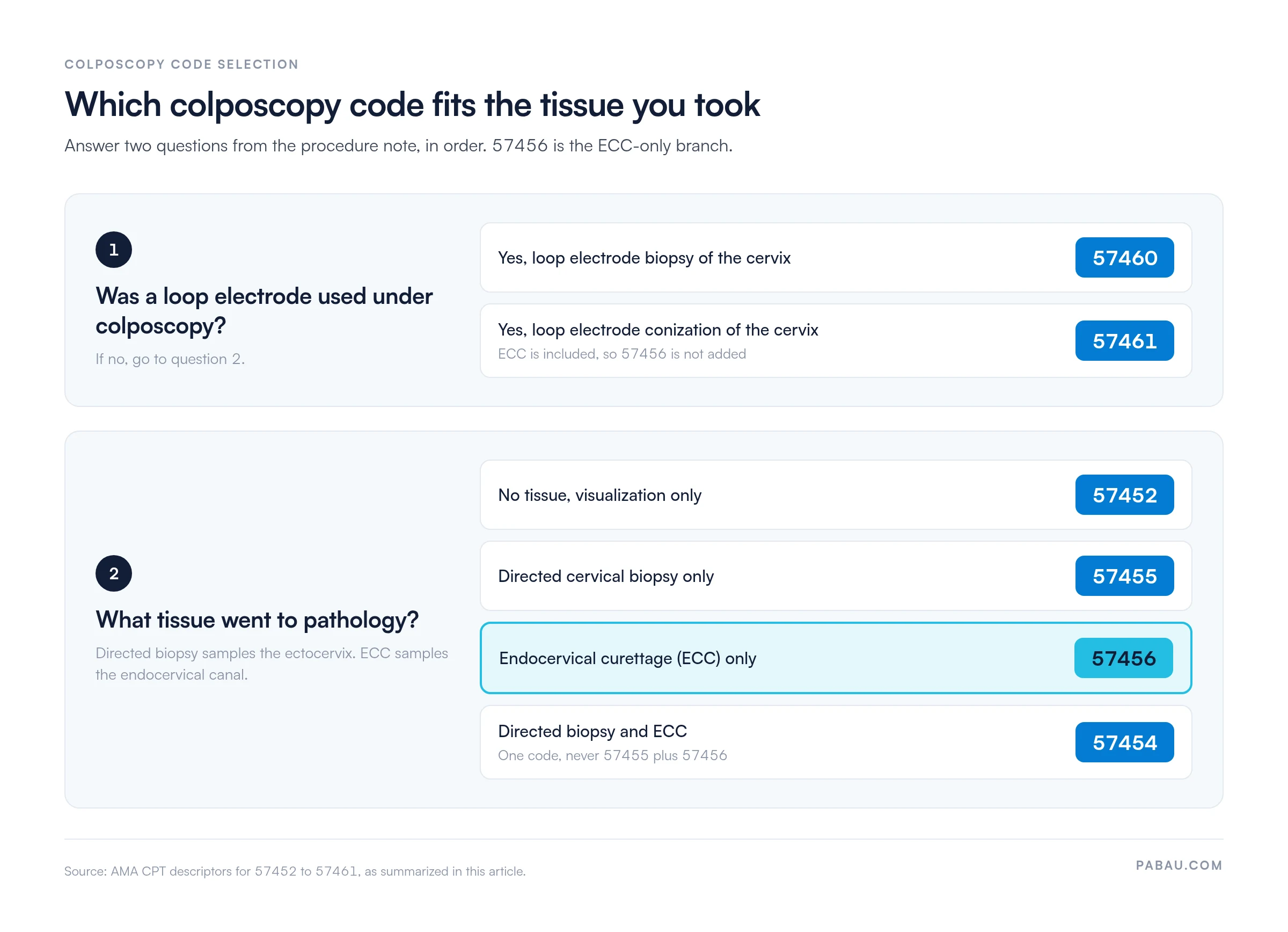
Every CPT 57456 claim needs an ICD-10-CM diagnosis code that documents why the procedure was medically necessary. Use the most specific code that matches the clinical record. Payers cross-reference the diagnosis against their local coverage determination (LCD) for colposcopy. A mismatch is the single most common reason this code is denied.
Use the CrossCoder CPT-to-ICD-10 crosswalk tool to check your chosen diagnosis code before submitting the claim. It shows whether your MAC’s LCD for colposcopy recognizes that code as a supported indication.
Modifier selection determines whether a claim clears or denies. The 0-day global period on CPT code 57456 means post-operative follow-up is not bundled into the payment. Modifier choices are therefore mostly about separating same-day services and reporting a reduced service. Proper modifier use is a core part of medical billing compliance for gynecology practices.
Medicare payment for CPT code 57456 is calculated from the relative value units (RVUs) assigned in the CMS Medicare Physician Fee Schedule (MPFS). Payment rates change with each fiscal year update and vary by Medicare Administrative Contractor (MAC) locality. The MPFS Look-Up Tool, run with the current year and your practice’s locality, gives the non-facility and facility payment amounts. Pabau’s gynecology claims management sends claims through Claim.MD, our US clearinghouse, which handles CMS-1500/837P claims, eligibility checks and ERA remittances.
Key reimbursement facts for 57456:
Never hardcode a specific dollar reimbursement amount into your charge master without a dated reference to the CMS MPFS. Rates change annually on January 1 and can shift mid-year with conversion factor adjustments.
A clean 57456 claim consistently clears payer edits before adjudication. The steps below reflect the standard workflow for office-based colposcopy with ECC. Practices using Pabau send claims through Claim.MD, our US clearinghouse, which handles CMS-1500/837P claims, eligibility checks and ERA remittances.
Tracking first-pass rate, days in accounts receivable (AR) and denial rate by code helps practices spot a recurring 57456 problem before it compounds.
Run a quarterly audit on all 57456 claims submitted in the past 90 days. Pull the denial reason codes alongside the paired ICD-10. If the same non-covered diagnosis keeps appearing, the issue is upstream. Clinical documentation is not capturing the specific indication that justifies ECC. Fix the intake or consult template, not just the billing queue.
Most 57456 denials are preventable. A denial management workflow that tracks the CARC (Claim Adjustment Reason Code) alongside the specific CPT/ICD-10 pair makes patterns visible quickly.
Yes, an E/M service can be billed on the same date as CPT 57456, but only under specific conditions. The 0-day global period means visits after the procedure date are billed separately. Same-day E/M work falls under a separate rule, the modifier -25 test below.
CMS and most commercial payers require that a same-day E/M meet both of these tests:
Modifier -25 goes on the E/M code, not on CPT 57456. Applying -25 to the wrong line is one of the more common billing errors in gynecology offices. The insurance eligibility verification step before the encounter is a good time to check one more detail. Some plans need separate authorization for a same-day E/M plus procedure.
In many gynecology offices, the colposcopy note lives in one system and the claim is built in another. A biller reads the note days later and decides whether a biopsy was taken. That handoff is where an ECC-only visit gets billed as 57454, or a biopsy plus ECC goes out as two separate codes.
Pabau holds the treatment note and the insurance claim on the same patient record, so the biller codes from the note the clinician wrote. Claims go out through Claim.MD, our US clearinghouse, which handles CMS-1500/837P claims, eligibility checks and ERA remittances. Where a commercial plan needs prior authorization for colposcopy, the auth code, dates and sessions are tracked on the case. Pabau warns staff when one is missing.
The outcome is fewer 57456 claims coded from memory, and a procedure note that is ready when a payer asks for records.

Pabau keeps the colposcopy note, the ICD-10 diagnosis and the claim on one patient record. US claims go out through Claim.MD, with eligibility checks and ERA remittances alongside.

Accurate billing for CPT 57456 turns on one question, asked before the claim is built. Did tissue come from the ectocervix, the endocervical canal, or both? The most expensive errors are billing 57456 when 57454 applies and skipping modifier -25 on a same-day E/M visit. Both start with a note that leaves the answer vague.
So fix the note template before the billing queue. A procedure note that names the curette, the specimen sent to pathology and the reason for ECC makes the code choice mechanical. It also answers a records request without a call back to the clinician.
To see how Pabau keeps the colposcopy note and the 57456 claim on one record, book a demo.

Need the code when the colposcopy ends in a LEEP cone? CPT code 57461 covers colposcopy with loop electrode conization, where the ECC is already included.
Billing the HPV test that sent the patient to colposcopy? CPT code 87624 explains how high-risk HPV DNA testing is coded and paired with cervical screening diagnoses.
Looking for denial pattern reporting by CPT code? Denial management in healthcare covers how to build a denial tracking workflow that surfaces the root cause faster than claim-by-claim review.
Want to see how the 837 file carries your CPT and diagnosis data to payers? Understanding the 837 file format explains how claim transactions are structured and where 57456 coding errors surface during transmission.
Aiming for a higher first-pass rate on gynecology claims? What is a clean claim sets out the fields and checks a claim needs to clear payer edits on first submission.
CPT code 57456 covers colposcopy of the cervix and upper vagina with endocervical curettage (ECC) performed in the same session. It does not include a cervical biopsy. If a directed biopsy is also taken, the correct code is 57454, which covers both ECC and biopsy together.
CPT 57455 covers colposcopy with a directed cervical biopsy but no ECC, while CPT 57456 covers colposcopy with ECC but no biopsy. The two codes should never be billed together, because that triggers an NCCI bundling edit. If both procedures were performed, use 57454 instead.
The most common paired diagnoses are R87.610 (ASCUS on cervical cytology), R87.612 (LSIL), R87.613 (HSIL), N87.1 (moderate cervical dysplasia), and N87.0 (mild cervical dysplasia). The chosen code must appear on your MAC’s LCD for colposcopy. A non-covered diagnosis is the top denial trigger.
Yes, provided the E/M addresses a separate and distinctly documented problem beyond the colposcopy indication. Apply modifier -25 to the E/M code, not to CPT 57456. The clinical note must separately document the additional history, exam, and decision-making that justify the E/M charge.
The most common reason is a diagnosis code missing from the payer’s covered indication list. Next comes an NCCI bundling edit from billing 57455 and 57456 on one claim. Missing modifier -25 on a same-day E/M also causes denials. So does an operative note that does not describe the ECC and where the specimen went.
Medicare reimbursement for CPT 57456 varies by year, MAC locality, and place of service, and the non-facility office rate is higher than the facility rate. Use the CMS Medicare Physician Fee Schedule Look-Up Tool with the current year and your practice location to get the exact payment amount.




