

HCPCS Code L0472: Hyperextension TLSO billing guide
HCPCS code L0472: Official descriptor and device definition HCPCS code L0472 des...

Last Updated: Nov 5, 2026
57282 is the CPT code for colpopexy, vaginal; extra-peritoneal approach (sacrospinous, iliococcygeus). It reports suspension of the vaginal apex to the sacrospinous ligament or the iliococcygeus fascia without entering the peritoneal cavity.
The approach decides the code. A colpopexy with peritoneal entry, such as uterosacral ligament suspension, is reported with 57283 instead. Culdoplasty done in the same session is bundled into 57282 and is not billed on its own.
Let Pabau's smart automation suggest the right codes, reduce claim denials, and keep your practice compliant—effortlessly.
Automate repetitive tasks and focus on what matters most—your patients.
Reduce coding errors and ensure compliance with the latest regulations.
Clean claims, fewer denials, and faster reimbursements.
Powerful insights and reporting to help your practice thrive.
HIPAA compliant SOC 2 certified GDPR-compliant Trusted by 4,000+ clinics worldwide

CPT code 57282 reports vaginal colpopexy by the extra-peritoneal approach, usually sacrospinous or iliococcygeus fixation of the vaginal apex.
The operative note has to state that the peritoneum was not entered, because peritoneal entry moves the case to CPT 57283.
Culdoplasty done with the colpopexy is never billed separately, and a same-session vaginal hysterectomy needs modifier 59 plus supporting documentation.
Pair the claim with the most specific N81 code, or N99.3 for vault prolapse after hysterectomy, because N81.9 invites medical necessity denials.
57282 carries a 90-day global period, so an unrelated visit or procedure in that window needs modifier 24 or 79.
CPT code 57282 reports a vaginal colpopexy performed through an extra-peritoneal approach. The American Medical Association publishes the official descriptor, which reads: Colpopexy, vaginal; extra-peritoneal approach (sacrospinous, iliococcygeus). The parenthetical names the two fixation points the code covers.
Extra-peritoneal means the surgeon never enters the peritoneal cavity. Access is through the vaginal wall, and the vaginal apex is suspended to the sacrospinous ligament or the iliococcygeus fascia. The operative note must state the approach, the fixation point, and the suture material used. Auditors look for those three details first on a 57282 claim.
Urogynecologists and female pelvic medicine and reconstructive surgery (FPMRS) specialists perform most of these repairs. The code sits in the Surgery section of the CPT code set, among the repair procedures on the vagina (57200-57335).
Bundling rules decide which same-session services you can bill and which modifier each one needs. Misreading them causes underbilling in one direction and unbundling denials in the other.
NCCI edits update quarterly. Verify bundling status against the current CMS NCCI edit tables before submitting any concurrent procedure combination.
CPT 57283 is the intra-peritoneal colpopexy code. It covers uterosacral ligament suspension performed through the vagina with peritoneal entry. Whether the peritoneum was entered decides the code, whichever ligament the surgeon uses.
When the operative note leaves the approach unclear, coders often default to 57282 because it is billed more often. If the note describes entering the peritoneal cavity to reach the uterosacral ligament, 57283 is correct. Payers audit this pairing closely, because the claim and the record must agree on the approach.
Payers expect a diagnosis from the N81 family (female genital prolapse), or N99.3 when the vault has prolapsed after a hysterectomy. The specificity of the code you select affects both approval rates and audit risk.
Many payers also require documentation of failed conservative treatment, such as pelvic floor physical therapy or a pessary trial, before they authorize surgery. Code to the highest specificity the physician’s documentation supports.
CPT code 57282 carries a 90-day global surgical period in the Medicare Physician Fee Schedule. All postoperative care within that window is bundled into the global payment.
Use the FastRVU 2026 lookup tool to retrieve the work RVU, practice expense RVU, and locality-adjusted payment for your MAC region. Rates change each January 1, so verify them before quoting expected reimbursement to surgeons or practice administrators.
Applying the wrong modifier to CPT code 57282 is a fast route to a denial or a post-payment audit. The table below covers the modifiers coders meet most often on colpopexy claims.
Prior authorization requirements for CPT code 57282 vary by payer and change without notice, so never assume a case is exempt. When prior auth is triggered, payers usually ask for the documentation elements below.
Traditional Medicare does not require prior authorization for most elective pelvic floor surgeries, but Medicare Advantage and commercial plans may. Verify at the time of scheduling, not at pre-admission. Working from a standard prior authorization form keeps each request in the same order, so no element on the list goes missing.
Coding references usually list what a clean claim needs. An auditor reads the operative note instead, and the elements below decide whether a 57282 claim pays on first submission or lands in medical review.
Run a quarterly audit of all 57282 claims returned with remittance reason code CO-97 (payment included in the allowance for another service). This code flags bundling conflicts. If CO-97 appears on culdoplasty or perineorrhaphy line items alongside 57282, review NCCI edits for the current quarter. NCCI edit tables update on January 1, April 1, July 1, and October 1.
The five denial patterns below come up repeatedly on colpopexy claims, and each one can be caught before the claim goes out.
A denial management routine that reviews each remittance code within days of receipt shortens the time between a denial and the corrected claim.
Pelvic floor reconstruction frequently involves more than one procedure in a single operative session. Every code billed alongside CPT code 57282 must reflect a distinct surgical service, documented separately in the operative note.
When two or more surgical codes appear on the same claim, Medicare applies a multiple procedure reduction. The highest-valued code is paid at 100%, and each additional code at 50%. The matrix below sorts each same-session service by what you should report.
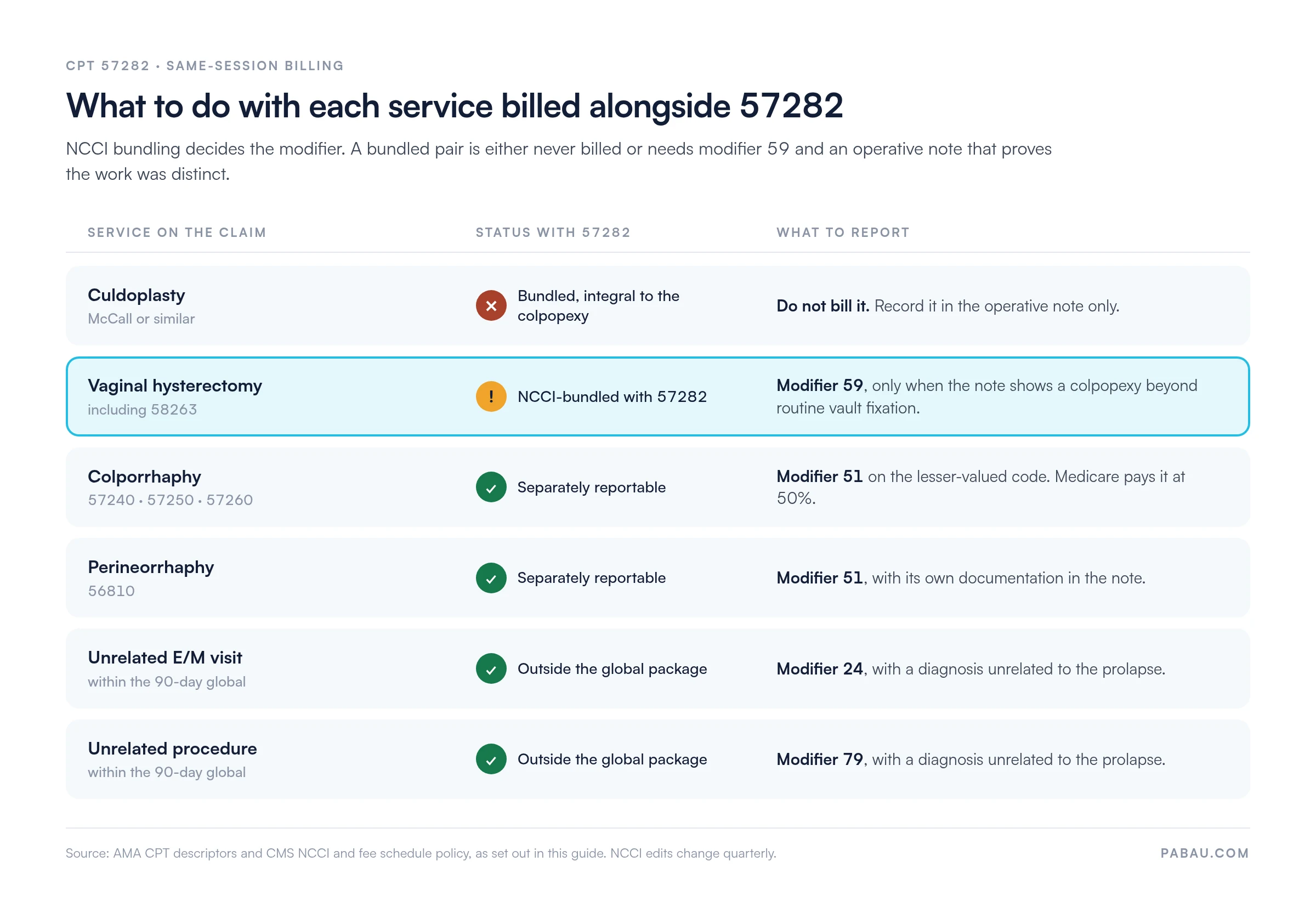
The AAPC Codify platform lists current NCCI edit pairs and MUE values for each CPT combination. Confirm current clean claim requirements with your MAC before submitting complex multi-code prolapse cases.
Many 57282 denials start with one missing detail. The note never stated the approach, the authorization number was left off, or a bundled service went out as its own line. Catching those by hand means rereading each claim against the operative note.
Pabau, the practice management platform we build for medical practices, keeps the patient record and the claim in one system. Its claims management software validates every claim for missing or invalid details before submission. A rejected claim is flagged Needs action, with a link to the field that needs correcting.
In the US, claims go out through Claim.MD to thousands of US payers. Pabau checks eligibility before the visit, stores each prior authorization against the appointment, and settles payments from electronic remittance advice (ERA) files.

Pabau’s claims management software validates 57282 claims before submission and routes them through Claim.MD to thousands of US payers. See how it works for your women’s health practice.

A 57282 claim succeeds or fails on whether the operative note and the claim tell the same story. The approach, the fixation point, and the diagnosis all have to match what the surgeon wrote.
Two traps deserve a second look before submission. The first is an approach mismatch with 57283, and the second is a same-session hysterectomy billed without modifier 59 and the note to support it.
A medical billing process with a pre-submission check catches both before a payer does. Book a demo to see how Pabau validates colpopexy claims before they reach the payer.

Sending colpopexy claims through Claim.MD? Pabau’s Claim.MD clearinghouse guide explains how claims, eligibility checks, and remittances move between your practice and the clearinghouse.
Struggling with denial tracking across multiple colpopexy cases? Denial codes in medical billing breaks down the most common remittance reason codes and what each one requires to resolve.
Looking to understand how 837P claims flow from your practice to the payer? What is an 837 file covers the electronic claim format used for professional CPT submissions, including 57282.
Repairing the vault laparoscopically instead? CPT code 57425 covers laparoscopic colpopexy and how its documentation differs from a vaginal repair.
Treating stress incontinence in the same patient population? CPT code 57288 covers sling operations for stress incontinence and their billing rules.
CPT code 57282 is the AMA procedure code for vaginal colpopexy by the extra-peritoneal approach. It reports repair of vaginal vault prolapse when the surgeon suspends the apex to the sacrospinous ligament or iliococcygeus fascia. The peritoneal cavity is not entered.
CPT 57282 is the extra-peritoneal approach, most often sacrospinous ligament fixation. CPT 57283 is the intra-peritoneal approach, usually uterosacral ligament suspension. The operative note must state whether the surgeon entered the peritoneal cavity, because that decides the code.
Yes. Culdoplasty performed with the colpopexy is integral to 57282, so NCCI edits bundle it into the code. Document it in the operative report for clinical completeness, but do not add it as a separate billing line.
N99.3 (prolapse of vaginal vault after hysterectomy) is the usual diagnosis for a post-hysterectomy vault repair. With the uterus in place, use N81.2, N81.3 or N81.4, and N81.5 for vaginal enterocele. N81.6 (rectocele) is added when a posterior repair is performed. Avoid N81.9, which frequently triggers medical necessity denials.
Prior authorization requirements vary by payer. Traditional Medicare generally does not require prior auth for 57282, but Medicare Advantage and commercial plans commonly do. Verify at scheduling, and send documentation of failed conservative treatment, such as pelvic floor PT or a pessary trial, with the request.
Modifier 51 goes on the lesser-valued code when 57282 is billed with a separately reportable procedure, such as a colporrhaphy. Modifier 59 applies to an NCCI-bundled pair, such as a same-session vaginal hysterectomy, when documentation shows distinct work. Modifier 22 covers an unusually complex repair. Modifiers 24 and 79 cover unrelated services within the 90-day global period.



