

HCPCS Code G0163: Skilled nursing observation and assessment
What is HCPCS Code G0163? HCPCS Code G0163 is a deleted Level II code for skille...

Last Updated: Oct 15, 2026
57283 is the CPT code for colpopexy, vaginal, using an intra-peritoneal approach (uterosacral, levator myorrhaphy). Surgeons use it to repair apical vaginal vault prolapse by suspending the vault from inside the peritoneal cavity, most often from the uterosacral ligaments.
Coders often confuse it with CPT 57282, the vaginal, extra-peritoneal colpopexy (sacrospinous, iliococcygeus). The approach and the anchor point differ, so payers treat the two codes as non-interchangeable. Thin operative notes, mismatched ICD-10 linkage and NCCI bundling errors are common causes of rejection.
Let Pabau's smart automation suggest the right codes, reduce claim denials, and keep your practice compliant—effortlessly.
Automate repetitive tasks and focus on what matters most—your patients.
Reduce coding errors and ensure compliance with the latest regulations.
Clean claims, fewer denials, and faster reimbursements.
Powerful insights and reporting to help your practice thrive.
HIPAA compliant SOC 2 certified GDPR-compliant Trusted by 4,000+ clinics worldwide

CPT 57283 covers vaginal colpopexy by an intra-peritoneal approach, while 57282 covers the extra-peritoneal sacrospinous or iliococcygeus approach.
The code carries a 90-day global surgery period, so related post-op visits inside that window are bundled unless a modifier applies.
ICD-10-CM codes N81.2, N81.3, N81.4, N81.6, and N99.3 are the primary diagnosis codes used to justify 57283 on a claim.
NCCI edits bundle several concurrent procedures, but modifier 59 or XS/XU may allow separate reporting where the edit permits it.
Pabau’s claims management software supports OB/GYN billing workflows, including clearinghouse submission via Claim.MD.
CPT code 57283 describes colpopexy, vaginal; intra-peritoneal approach (uterosacral, levator myorrhaphy). It is maintained by the American Medical Association’s CPT Editorial Panel and falls within the Female genital system subsection of the Surgery section. The procedure corrects apical vaginal vault prolapse by anchoring the vaginal apex to both uterosacral ligaments, working inside the peritoneum through the vagina.
The key anatomical distinction: Uterosacral ligament suspension places sutures into the uterosacral ligaments posteriorly in the pelvis, near the sacrum. Sacrospinous ligament fixation (57282) is different. It is an extra-peritoneal repair that anchors the vault to the sacrospinous ligament in the lateral pelvis. Both are vaginal-approach apical repairs, but they are not interchangeable for coding purposes.
The 57283 surgical package bundles certain pre-operative and intraoperative services by default. Understanding scope prevents both under-coding (missing separately reportable services) and over-coding (billing for bundled work).
Included in the 57283 package:
Potentially separately reportable (verify NCCI edits first):
The operative note must distinguish each repair as a separate, medically necessary procedure with distinct documentation if you intend to bill multiple codes.
CPT 57282 is a vaginal colpopexy by an extra-peritoneal approach (sacrospinous, iliococcygeus). CPT 57283 uses an intra-peritoneal approach (uterosacral, levator myorrhaphy). Both repair apical prolapse through the vagina, but they are not interchangeable. The approach and the anchor point determine the correct code, and the wrong one is miscoding that may trigger a payer audit.
The decision tree below shows how the approach documented in the operative note points to one colpopexy code.
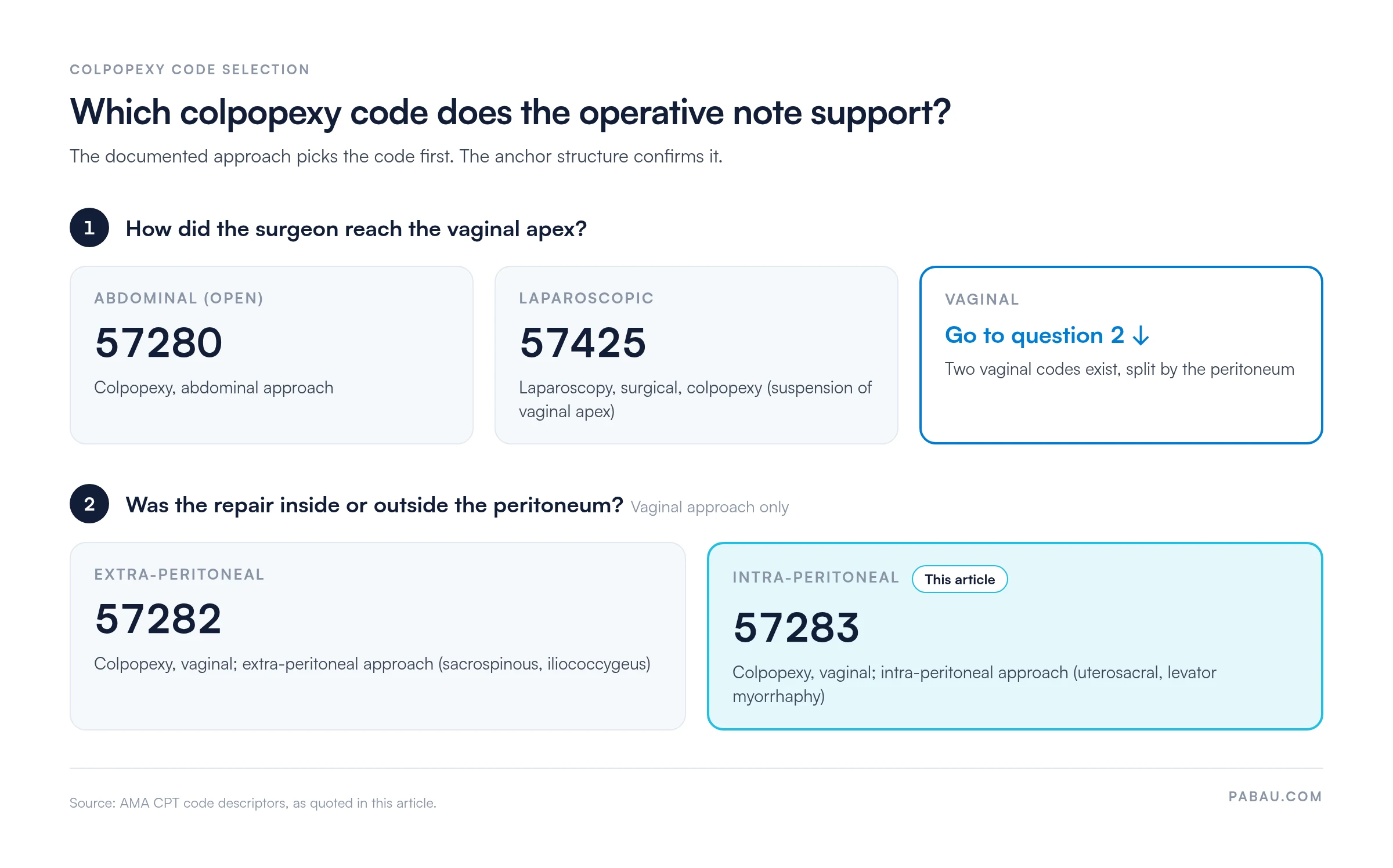
When a surgeon performs both techniques in the same session (uncommon but possible in complex cases), check the current NCCI tables before submitting both codes. The AAPC’s CPT code reference adds coding guidance for the pair.
CPT 57283 rarely appears on a claim in isolation. OB/GYN billing staff need to understand the full code family to apply bundling rules correctly and to identify which concurrent procedures are separately reportable.
A colpopexy done laparoscopically is not 57280, even though it reaches the apex from above. It is reported with 57425, so the operative approach also separates the abdominal and laparoscopic codes.
Every claim for CPT 57283 requires a supporting ICD-10-CM diagnosis code that confirms medical necessity. Payers match the procedure code against the diagnosis. A mismatch, such as a non-prolapse diagnosis linked to a vault suspension code, triggers automatic denial.
For post-hysterectomy patients, N99.3 is typically the primary diagnosis. Check specificity too. N81.4 (unspecified) is accepted, but most payers prefer N81.2 or N81.3, which support medical necessity more robustly.
Medicare payment for CPT 57283 is calculated under the CMS Medicare Physician Fee Schedule. Each of the three RVU components is adjusted by a geographic practice cost index (GPCI) for the Medicare Administrative Contractor (MAC) locality. The adjusted total is then multiplied by the annual conversion factor.
RVU values and the conversion factor are updated annually. Verify current figures through the CMS fee schedule lookup or the FastRVU 2026 RVU lookup tool before contract negotiations or payer reporting. When the procedure is performed in a hospital or ambulatory surgery center, the facility rate applies. It is lower than the non-facility rate because the facility bills the overhead separately.
Before finalizing OB/GYN payer contracts, pull the current wRVU for CPT 57283 from the Medicare Physician Fee Schedule. Compare it against your commercial payer’s contracted rate. Contracts that pay below 100% of Medicare may undervalue this procedure relative to its surgical complexity. Run this check every January, when the new conversion factor takes effect.
CPT 57283 carries a 90-day global surgery period. This means a defined set of pre-operative and post-operative services are bundled into the single surgical fee and cannot be billed separately during that window.
Services bundled in the 90-day global package:
Services separately billable within the global period:
Modifier 54 signals the performing surgeon is billing only for the surgery itself. Modifier 55 signals a second provider is billing for the post-operative management. Both providers must coordinate so the combined payment does not exceed 100% of the global fee.
The CMS National Correct Coding Initiative (NCCI) publishes quarterly edits that determine which code pairs cannot be billed together. For CPT 57283, the edits that matter most affect concurrent pelvic repair procedures. Check the current Procedure-to-Procedure (PTP) edit tables at CMS before every multi-code claim. Consistent medical billing compliance depends on that habit.
Use modifier 59, or the more specific X-modifiers, to bypass an NCCI edit only when the documentation supports a separate service. XS marks a separate structure, and XU marks an unusual non-overlapping service. Appending a modifier without documentation support is improper billing. The CrossCoder procedure-to-diagnosis crosswalk tool can help identify NCCI edit relationships and local coverage determination (LCD) policies for pelvic repair code combinations.
A thin operative note is one of the most preventable causes of 57283 claim denial. Payers audit operative notes for the elements that justify both the code selection and any separately reported concurrent procedures. A structured operative note template that prompts the surgeon for each element below keeps those details from being left out.
Required operative note elements for CPT 57283:
Prior authorization (PA) checklist, for payers that require it:
Submitting a complete, well-documented claim the first time reduces denials and accelerates payment. Learn how submitting a clean claim affects your practice’s cash flow and denial rate.
Most 57283 denials fall into a handful of recurring categories. The table below maps each denial reason to its root cause and the corrective action to take.
For a comprehensive reference on denial reason codes, see the guide to medical billing denial codes and the broader denial management workflow for surgical practices.
Set up a pre-submission checklist for 57283 claims. Confirm the ICD-10 code is N81.x or N99.3 and matches the operative note diagnosis. Attach the prior auth number for payers that require it. Make sure no NCCI-bundled companion code goes out without a modifier and supporting documentation. Check that the operative note names the uterosacral ligaments and confirms bilateral suture placement. Running this check before submission catches the most common causes of initial denials on this code.
Many OB/GYN billing teams code 57283 from a typed operative note, check NCCI edits by hand and rework rejected claims one at a time. Each handoff is a chance to lose the approach detail that separates 57283 from 57282.
Pabau’s claims software for gynecologists keeps the operative note, the ICD-10 diagnosis and the claim in one workflow. Your coder sees the documented approach and the linked diagnosis before the code goes on the claim.
Claims then go out electronically through Pabau’s Claim.MD integration, which supports real-time eligibility checks and electronic remittance advice (ERA). Our guide to the Claim.MD clearinghouse walks through how those claims reach payers. The result is fewer rejections for a missing approach, a mismatched diagnosis or an unflagged NCCI pair, so your team spends less time on appeals.

Pabau connects operative note documentation, ICD-10 coding and electronic claim submission in one place. Your billing team spends less time chasing denials and more time getting paid.

Code 57283 from the operative note, not from habit. If the note doesn’t name an intra-peritoneal approach and the uterosacral ligaments or a levator myorrhaphy, query the surgeon before the claim goes out. A corrected note costs a day, while a denied claim costs an appeal cycle.
Treat a second apical code in the same session as a warning sign until the current PTP table clears it. The same goes for any non-prolapse diagnosis linked to the claim.
Book a demo to see how Pabau links the operative note, the diagnosis and the claim, so 57283 goes out right the first time.

Billing cystoscopy alongside a vault suspension? CPT code 52000 covers diagnostic cystoscopy and when it can be reported on its own.
New to the billing cycle as a whole? What is medical billing explains the end-to-end billing cycle and where denials typically enter the process.
Wondering how clearinghouse claim submission works in practice? Claim.MD clearinghouse guide walks through how electronic claims reach payers and how remittance data flows back.
CPT code 57283 covers colpopexy, vaginal, by an intra-peritoneal approach (uterosacral, levator myorrhaphy) to repair apical pelvic organ prolapse. In a uterosacral ligament suspension, the surgeon anchors the vaginal vault to both uterosacral ligaments through the vagina.
CPT 57282 is a vaginal colpopexy by an extra-peritoneal approach (sacrospinous, iliococcygeus), typically anchoring the vault to one sacrospinous ligament. CPT 57283 uses an intra-peritoneal approach (uterosacral, levator myorrhaphy), typically suspending the vault from both uterosacral ligaments. Both are vaginal apical repairs, but they are not interchangeable. The operative note must state the approach and the structure used.
CPT 57283 is generally reported once, without a bilateral modifier. Uterosacral ligament suspension places sutures in the ligaments on both sides of the pelvis, and that bilateral work is part of the code itself. Sacrospinous fixation (57282), by contrast, is usually performed on one side. Verify with your payer and operative documentation before applying or omitting a modifier.
Medicare reimbursement for CPT 57283 starts from the total RVU value, adjusted by the geographic practice cost index (GPCI) for your MAC locality. That figure is multiplied by the current-year conversion factor. Rates change each January when CMS publishes the updated Physician Fee Schedule. Always look up the current figure using the CMS MPFS search tool or a current-year RVU calculator rather than relying on static published rates.
Prior authorization requirements for CPT 57283 vary by payer and plan. Medicare generally does not require prior authorization (PA) for this procedure, but many commercial insurers and Medicaid plans do. They typically want documentation of conservative treatment failure (pessary, pelvic floor physical therapy) and a confirmed prolapse diagnosis. Always verify PA requirements with the specific payer before scheduling surgery.
Yes. Modifier 51 (multiple procedures) may apply when CPT 57283 is performed with other surgical procedures in the same session. A sling procedure (57288) for concurrent stress incontinence is one example. The highest-valued procedure is billed without modifier 51. Subsequent procedures carry modifier 51, which triggers a reimbursement reduction per payer policy. Confirm modifier 51 exemption status against the current AMA CPT Appendix E before applying it.




