

HCPCS Code L0472: Hyperextension TLSO billing guide
HCPCS code L0472: Official descriptor and device definition HCPCS code L0472 des...

Last Updated: Nov 5, 2026
54100 is the CPT code for biopsy of penis; (separate procedure). It covers a superficial punch, shave or incisional sample of a penile lesion, with local anesthesia and simple closure included. A deep biopsy that needs dissection into deeper structures is reported with 54105 instead.
54100 carries a 000 global period, so there's no post-op follow-up window. As a separate procedure, it isn't reported when the biopsy is part of a larger procedure through the same site. Pathology on the specimen is billed separately, usually by the pathology group.
Let Pabau's smart automation suggest the right codes, reduce claim denials, and keep your practice compliant—effortlessly.
Automate repetitive tasks and focus on what matters most—your patients.
Reduce coding errors and ensure compliance with the latest regulations.
Clean claims, fewer denials, and faster reimbursements.
Powerful insights and reporting to help your practice thrive.
HIPAA compliant SOC 2 certified GDPR-compliant Trusted by 4,000+ clinics worldwide

CPT 54100 covers a superficial biopsy of the penis, while a deep biopsy that needs dissection into deeper structures is reported with 54105.
54100 has a 000 global period, so there is no post-op window, and a significant, separate same-day E/M visit takes modifier -25.
Pathology (CPT 88300-88309) is billed by whoever interprets the specimen, which is usually the pathology group on its own claim.
The most defensible ICD-10 pairings are C60.x, D07.4 and N48.0, with N48.89 kept as a last resort.
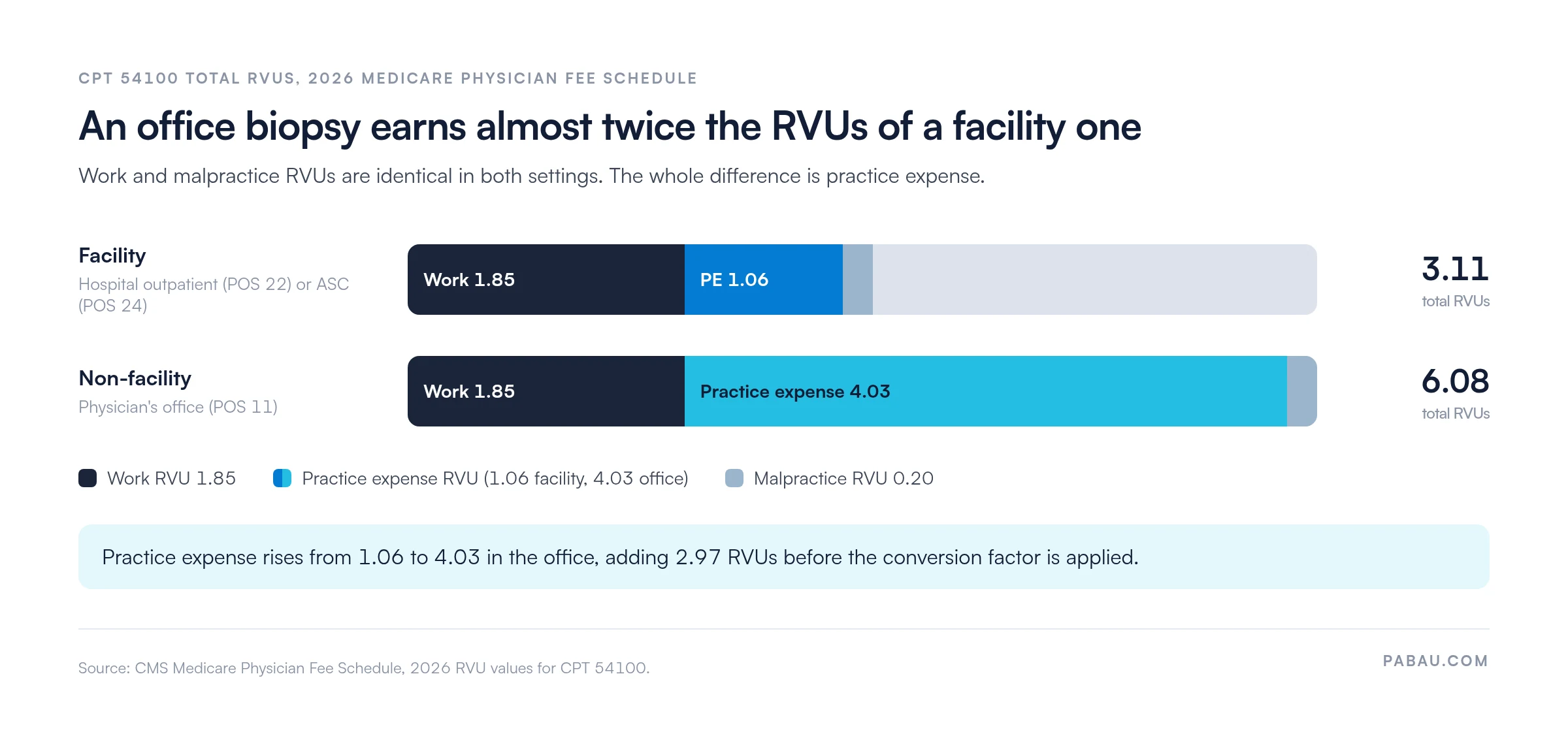
In 2026, 54100 carries 6.08 total RVUs in the office and 3.11 in a facility, so the setting nearly doubles physician payment.
CPT code 54100 is the code for a biopsy of the penis. Its official descriptor is Biopsy of penis; (separate procedure), from the American Medical Association’s CPT code set. It covers punch, shave and incisional biopsies of a penile lesion at the skin or just below it. However, extensive dissection into deeper tissue planes belongs to 54105.
In practice, the “separate procedure” label matters on the claim. It means 54100 isn’t reported when the biopsy is part of a larger procedure performed through the same site. Report it on its own when it’s the only procedure, or when it’s done at a separate site or session.
The code sits in the Male Genital System section of CPT (54000-55899), under the Penis subsection. It includes local anesthesia, the biopsy itself and routine wound closure. It doesn’t include the pathology examination of the specimen that follows.
CPT 54105 describes a biopsy of the deep structures of the penis, so the depth of tissue sampling is what separates the two codes. If the operative note documents entry into the corpus spongiosum or corpora cavernosa, 54105 applies. Likewise, a note describing blunt and sharp dissection through several tissue layers to reach the lesion. A punch or shave biopsy of penile skin uses 54100.
Therefore, the operative note is the deciding document. Payers routinely request it when 54105 is billed on an office claim, since deep biopsies performed in a physician’s office raise flags. Document dissection layers explicitly if 54105 is the accurate code.
The procedure code 54100 covers the complete surgical encounter for the biopsy, from anesthesia injection through wound closure. Knowing where that boundary sits prevents both undercoding and overbundling on the claim.
Included in 54100:
Not included and reported separately:
Pathology is normally billed by the pathology group on its own claim. However, billing 88305 under the surgeon’s NPI is only correct if the surgeon’s practice performed the interpretation, for example through an in-office lab. When the practice only collected and sent the specimen, the pathology code stays off the surgical claim.
Selecting the most specific available ICD-10 diagnosis code is the main lever for establishing medical necessity when billing CPT code 54100. Indeed, vague or non-specific codes are the leading cause of payer denials on this procedure. Check each pairing below against the full ICD-10-CM code set before the charge posts.
For example, medical necessity documentation in the progress note or operative report must match the chosen ICD-10 code. Stating “penile mass, rule out malignancy” while billing C60.9 is a common mismatch. The note describes a suspected lesion, but the code asserts confirmed malignancy. Instead, use the code that reflects what is known at the time of the biopsy, not what you are ruling out.
Building that check into your revenue cycle management workflow captures the right diagnosis during the pre-biopsy workup, before the claim is built.
Payers pulling charts for CPT code 54100 look for a handful of specific elements in the operative or procedure note. Consequently, missing any one of them is enough to trigger a medical necessity denial on post-payment audit.
Keep a copy of the pathology requisition linked to the encounter. Otherwise, payers auditing 54100 claims sometimes ask for proof that tissue was sent for analysis.
Surgical pathology codes (88300-88309) are reported separately from CPT code 54100, normally by the pathology group on its own claim. However, NCCI has no edit that bars the two from being billed for the same patient and date. Who bills the pathology depends on who performed the interpretation.
For most penile biopsies performed under CPT 54100, the pathologist reports 88305. Billing it under the surgeon’s NPI is only correct if the surgeon’s practice performed the interpretation. Otherwise the pathologist bills it under their own NPI and tax ID, while 54100 stays on the urologist’s claim.
Two modifiers come up most often with CPT code 54100, and a third is sometimes appended in error. Applying the wrong modifier, or leaving one off when it’s required, are both common denial triggers.
Still, modifier -59 needs particular care. Using it to unbundle procedures that NCCI bundles, without a documented clinical rationale, is an audit risk. Check the NCCI edit tables and document the separate anatomical site or encounter in the operative note before you append it.
Run a monthly NCCI edit check on your urology procedure pairs. Pairs with a modifier indicator of 0 can’t be unbundled by any modifier. Knowing this before submission prevents denials that look like modifier errors but are edit conflicts.
CPT code 54100 carries a 000 global period under the CMS Medicare Physician Fee Schedule (MPFS). That covers the day of the procedure only, with no post-operative period. By contrast, its deep-biopsy sibling 54105 is the code with a 10-day (010) global, which is where the two often get mixed up. Verify the current assignment in the CMS Physician Fee Schedule lookup tool, as global periods can change with annual updates.
With a 000 global, same-day and follow-up services bill like this:
Also, the decision to biopsy, made at the same visit, is part of the procedure’s payment. Modifier -25 therefore needs documentation of an evaluation that goes beyond that decision.
Under the 2026 MPFS, CPT code 54100 carries 3.11 total RVUs in a facility and 6.08 in a physician’s office. Then the Medicare conversion factor, updated annually, multiplies the total RVU to produce the payment rate. Facility rates are lower because the facility bears the overhead, not the physician.
The whole difference between the two settings is practice expense, as the chart below shows.
Verify current figures using the FastRVU 2026 RVU lookup or the CMS MPFS search tool, as values are updated each January. However, commercial payers negotiate their own fee schedules and may pay above or below the MPFS amount.
Prior authorization (PA) requirements for CPT code 54100 vary by payer type and plan design. Traditional Medicare, however, doesn’t require PA for this procedure. Medicare Advantage plans, Medicaid managed care organizations and commercial payers may require it. That is most likely when the procedure is performed in an ASC rather than an office.
When a payer does require PA for 54100, the documentation that most reliably supports approval includes:
Submit the PA request with the procedure and diagnosis codes together. For example, say the PA was approved under N48.89 but the claim is billed with C60.9. That mismatch can still result in a denial, even with an authorization on file. A medical billing compliance check before submission catches these mismatches.
Most CPT 54100 denials fall into a predictable set of patterns. Urology billing teams that track denial reason codes (CARCs) by category resolve them faster, so they stop them recurring.
A denial management workflow built for urology biopsy codes cuts first-pass denials. Its checklist covers ICD-10 specificity, POS, modifier review and PA status. Reviewing clean claim criteria with coding staff before 54100 encounter forms are built catches the problem earlier in the revenue cycle.
Create a CPT 54100 encounter form pre-populated with the six most common ICD-10 pairings: C60.1, C60.2, D07.4, N48.0, N48.89 and the C60.9 fallback. Add a required field for biopsy technique. The documenting clinician then has to select a specific diagnosis before the charge is posted. That removes the most common cause of 54100 denials at source.
Place of service (POS) affects the physician’s reimbursement rate for CPT code 54100 because CMS uses different practice expense RVUs for facility and non-facility settings. The distinction also affects prior authorization requirements and coverage decisions for many commercial payers.
The billing implication is simple. First, a penile biopsy in your office (POS 11) generates a higher physician payment, because the practice expense RVUs are larger. Second, moving the procedure to an ASC lowers the physician’s payment, but the ASC bills its own facility fee.
Therefore, straightforward 54100 biopsies suit the office setting, where they earn more at the physician level than they would in a facility.
In fact, most 54100 denials start upstream, at the encounter form, the eligibility check or the POS field. Pabau, the practice management platform we build, connects to the Claim.MD clearinghouse so those checks happen in the system you already chart and invoice in.
Before the biopsy, your front desk runs a real-time eligibility check on the patient’s coverage. Afterward, the invoice becomes an electronic CMS-1500 claim sent to thousands of US payers through the Claim.MD clearinghouse. Pabau’s claims management software then matches ERAs to submitted claims and flags denied claims for rework.
So a denied biopsy claim doesn’t sit unnoticed in a payer portal. Instead, it shows up on one dashboard with its status, and your billing team can correct the POS or diagnosis and resubmit.
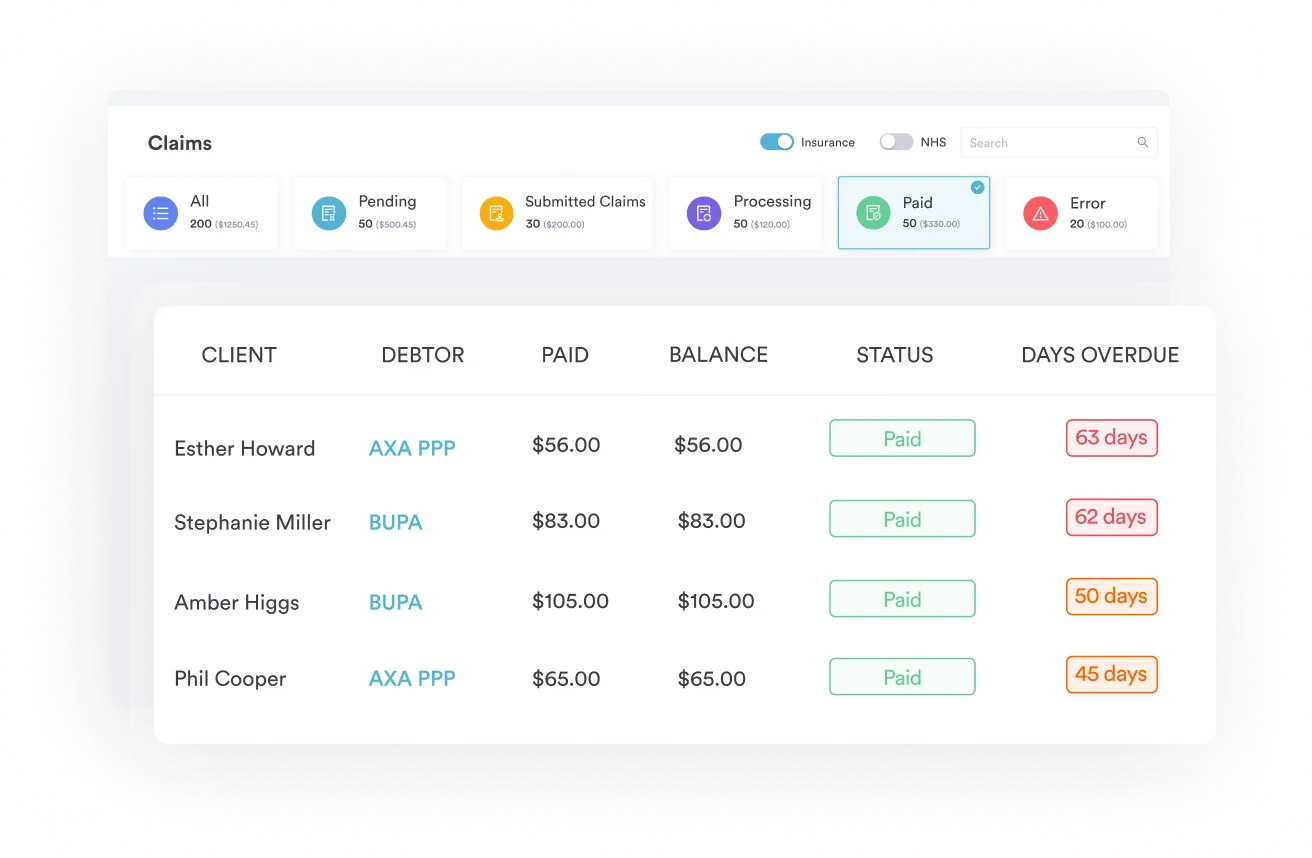

Pabau connects with Claim.MD to check eligibility before the procedure, submit CPT 54100 claims electronically and match ERAs to each claim. Denied claims are flagged for rework, so your team spends less time on manual follow-up.

CPT code 54100 is straightforward to bill once a few decisions are made before the charge posts. Confirm the biopsy was superficial, pick the most specific ICD-10 code the note supports, and match the POS to where the work happened.
The trade-off worth remembering is setting. An office biopsy earns almost twice the RVUs of a facility one. However, that only holds when the claim says POS 11 and the practice did the work there. A structured encounter form that forces these choices is the cheapest fix available to a urology practice.
Book a demo to see how Pabau checks eligibility, submits 54100 claims and flags denials for rework in one place.

Need to understand how clearinghouses process CPT claims? Medical claims clearinghouse guide covers how claims are scrubbed, routed and adjudicated before reaching payers.
Want to reduce urology claim denials systematically? Denial codes in medical billing explains the CARC and RARC codes your team will see on 54100 remittances.
Looking for insurance eligibility verification tools? Insurance eligibility verification explains how to confirm patient coverage before a biopsy is performed.
New to the billing side of a urology practice? What is medical billing walks through the claim cycle from charge capture to payment.
CPT code 54100 covers a biopsy of the penis, and its official AMA descriptor is Biopsy of penis; (separate procedure). It includes local anesthesia, superficial tissue sampling by punch, shave or incisional technique, and routine wound closure. Surgical pathology is billed separately using CPT 88300-88309, typically 88305.
CPT 54100 covers a superficial biopsy of the penis (punch, shave or simple incisional technique at the skin level). CPT 54105 covers a biopsy of the deep structures, which requires dissection into deeper tissue planes such as the corpus spongiosum. The operative note must document the tissue depth to support whichever code is billed.
The Medicare payment for CPT 54100 is the total RVU multiplied by the annual CMS conversion factor. For 2026 the total is 6.08 RVUs non-facility and 3.11 facility, with a work RVU of 1.85 in both. Payment amounts change each January, so verify current rates in the CMS fee schedule lookup tool or FastRVU.
Modifier -51 (multiple procedures) applies when 54100 is billed alongside another surgical procedure in the same session. Modifier -59 (distinct procedural service) applies when 54100 is performed at a separate site from another code that would otherwise be bundled. Modifier -50 (bilateral) doesn’t apply, because the penis is a single midline structure. A significant, separate same-day E/M visit takes modifier -25.



