HCPCS Code Q4185: Cellesta flowable amnion billing guide
HCPCS Code Q4185: definition and official descriptor HCPCS Code Q4185 is the Lev...

Last Updated: Nov 20, 2026
54060 is the CPT code for destruction of lesion(s), penis (eg, condyloma, papilloma, molluscum contagiosum, herpetic vesicle), simple; surgical excision. It covers simple destruction of benign penile lesions when the method is surgical excision, while extensive destruction by any method is reported with 54065.
The code sits in the 54050-54065 penile destruction family, where the method picks the code. Chemical destruction is 54050, electrodesiccation 54055, cryosurgery 54056 and laser 54057, so the method named in the operative note decides the claim.
Let Pabau's smart automation suggest the right codes, reduce claim denials, and keep your practice compliant—effortlessly.
Automate repetitive tasks and focus on what matters most—your patients.
Reduce coding errors and ensure compliance with the latest regulations.
Clean claims, fewer denials, and faster reimbursements.
Powerful insights and reporting to help your practice thrive.
HIPAA compliant SOC 2 certified GDPR-compliant Trusted by 4,000+ clinics worldwide

CPT code 54060 reports simple destruction of penile lesions, such as condyloma, when the method is surgical excision. A63.0 is the most common ICD-10 pairing.
The method picks the code in the 54050-54065 family: 54050 chemical, 54055 electrodesiccation, 54056 cryosurgery, 54057 laser and 54060 surgical excision. Extensive destruction by any method is 54065.
The 2026 Medicare work RVU for 54060 is 1.93, with national payments of about $201 non-facility and $123 facility.
Missing operative-note documentation of lesion type, site, count and excision method is the top denial trigger for CPT 54060 claims.
Pabau’s claims management software checks eligibility and submits 54060 claims through the Claim.MD clearinghouse, with remittances posted back to the patient record.
CPT code 54060 reports simple destruction of one or more penile lesions when the method is surgical excision. It belongs to the AMA’s CPT code set, in the Surgery section, Male Genital System, under “Destruction Procedures on the Penis.”
The official descriptor reads: Destruction of lesion(s), penis (eg, condyloma, papilloma, molluscum contagiosum, herpetic vesicle), simple; surgical excision.
The parenthetical examples are illustrative, not exhaustive. Any benign penile lesion destroyed by simple surgical excision can be reported with this code, provided the note supports it. What decides the code is the anatomical site and the method, not the specific pathology.
“Surgical excision” is the method, and it is what separates 54060 from its four siblings. Chemical, electrosurgical, cryosurgical and laser destruction each have their own code in the same range. “Simple” separates it from 54065, which covers extensive destruction by any method.
The most common coding error with CPT 54060 is picking the wrong method code inside the penile destruction family. The family has one code per method for simple destruction and one code for extensive destruction. The operative note decides which one applies, so the method has to be named in plain words.
Practical rule: Start with the site, then the extent, then the method. A penile lesion goes to the 54050-54065 range before anyone asks how it was treated. Extensive destruction goes to 54065 whatever the method. For simple destruction, a lesion snipped or cut away is 54060. Acid, cautery and laser each take their own code, and freezing is billed with 54056. The chart below runs the three questions in order.
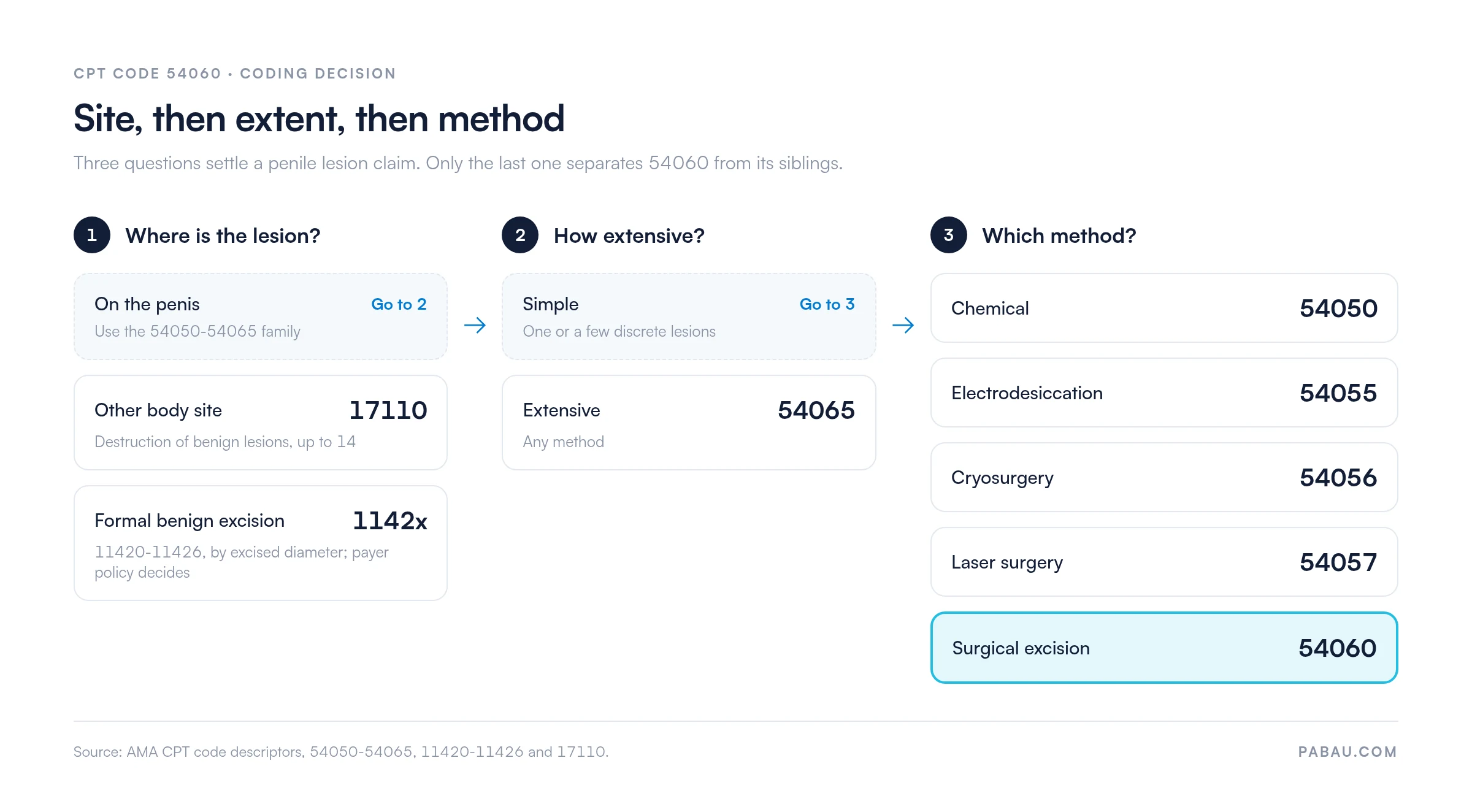
The 11420-11426 excision codes sit outside that family and are reported by the excised diameter, lesion plus margins. An excised diameter of 1.1-2.0 cm on the genitalia is 11422, and 3.1-4.0 cm is 11424. Payers differ on when a penile lesion counts as a formal benign excision rather than destruction by excision.
Check your payer’s policy, and make sure the note records the excised diameter if you report an 11420-series code.
Before you code a penile lesion removal, read the method line of the operative note. “Excised,” “snipped” or “shave removed” points to 54060. “Treated with TCA,” “fulgurated,” “frozen” or “lasered” each point to a different code in the 54050-54057 range.
Every CPT 54060 claim needs a supporting ICD-10-CM diagnosis code that reflects the documented lesion type. Missing or mismatched diagnosis codes are a leading cause of medical necessity denials. Check each payer’s accepted CPT-to-ICD-10 pairings before submission, since commercial policies differ from Medicare.
A63.0 is the most common pairing for condyloma acuminata on a 54060 claim. If the documented lesion is anything other than condyloma or one of the descriptor examples, confirm coverage via your MAC’s Local Coverage Determination before filing.
Payer review of CPT 54060 claims focuses on the operative note. A claim whose note misses one of these elements risks a records request or a denial.
Billing-ready documentation starts at the point of care. Take a note that reads “four condylomata on the penile shaft, each about 3 mm, excised with fine scissors, simple.” That one line covers the method, site, count and size.
RVU values set Medicare payment rates, and CMS publishes them every year. The table below shows the 2026 national values at the $33.4009 conversion factor. Use the CMS PFS Lookup Tool to confirm figures for your locality, since geographic practice cost indices (GPCIs) adjust the final payment.
The non-facility rate applies when the procedure is done in a physician office. The facility rate applies in a hospital outpatient department or ambulatory surgery center.
FastRVU’s 2026 entry for 54060 lists the same national figures from the CMS relative value file. RVUs change every calendar year, so check the active fee schedule before quoting rates.
Medicare covers CPT 54060 when medical necessity is established by the documented diagnosis and clinical indication. There is no national coverage determination (NCD) specific to this code, so coverage is governed by Medicare Administrative Contractor (MAC) Local Coverage Determinations. Check your MAC’s LCD database for any active policies on penile lesion destruction before submitting.
Four points decide whether a Medicare or commercial claim for 54060 pays as billed.
Incorrect modifier use is a steady denial trigger for surgical codes in the male genital system. The table below covers the modifiers most likely to matter on a CPT 54060 claim.
Knowing why CPT 54060 claims fail is the fastest way to protect revenue in a urology or sexual health practice that treats penile lesions often. These patterns account for most of the rejections coders see.
Run a pre-submission NCCI edit check on every 54060 claim billed with an E/M or a second procedure on the same date. Clearinghouse scrubbing catches most unbundling errors before they reach the payer.
Practices billing CPT 54060 tend to hit the same two problems. The note never names the method, or the code comes from the wrong row of the family. Pabau, a practice management platform with insurance billing built in, deals with both before the claim leaves the practice.
Its claims software for practices connects to Claim.MD, Pabau’s US clearinghouse partner. The billing team checks eligibility before the visit and sends the claim electronically in 837P format. ERA remittances (835 files) come back for payment posting against the same patient record.
Pabau’s clinical forms help practitioners capture the note elements that support 54060: lesion type, site, count and the excision method. When the note is complete at the point of care, the billing team is not chasing records before the filing deadline. That is the shortest route to a clean claim submission.

Pabau’s claims management software checks eligibility and submits claims through the Claim.MD clearinghouse. Clinical forms capture the excision method, site and lesion count before the claim is built.

CPT 54060 is narrower than it looks. It covers one method, surgical excision, on one site, the penis, at one level of extent, simple. Every claim that goes wrong breaks one of those three limits, and the operative note is where each one is proven.
A note that names the method in plain words settles most of the coding before the claim is built. Book a demo to see how Pabau keeps operative documentation and claim submission in one workflow.

Looking for structured claim submission guidance? 837 file overview explains the electronic transaction format used for submitting CPT claims to payers and clearinghouses.
Want to understand what happens after a claim is paid? Electronic remittance advice (ERA) explains how 835 remittance files map payment back to individual CPT codes including 54060.
CPT code 54060 reports destruction of lesion(s) on the penis, simple, by surgical excision. Typical lesions include condyloma, papilloma, molluscum contagiosum and herpetic vesicles. It sits in the 54050-54065 Destruction Procedures on the Penis family of the AMA’s Surgery section, Male Genital System.
CPT 54060 reports simple destruction of penile lesions by surgical excision, inside the penis-specific 54050-54065 family. CPT 11424 reports excision of a benign lesion on the scalp, neck, hands, feet or genitalia with an excised diameter of 3.1 to 4.0 cm. The 11420-series codes are chosen by measured excised diameter, so payer policy and the note decide which applies.
The primary ICD-10-CM pairing is A63.0 (anogenital venereal warts), which covers condyloma acuminata. Other pairings include B08.1 (molluscum contagiosum), B00.1 (herpesviral vesicular dermatitis) and D29.0 (benign neoplasm of penis). N48.89 (other specified disorders of penis) applies when no more specific code fits.
Yes, Medicare covers CPT 54060 when the documented diagnosis and clinical indication establish medical necessity. There is no national coverage determination for this code, so your MAC’s Local Coverage Determinations apply. The 2026 national payment is about $201 non-facility and $123 facility, before your locality’s GPCI adjustment.
Use CPT 54060 for simple destruction of one or a few discrete penile lesions by surgical excision. Use CPT 54065 when the note documents extensive destruction, by any method, such as a large confluent area or numerous lesions. The AMA publishes no lesion count that separates the two, so the note must record the number, size and extent.
The most common reasons are a wrong method code, such as 54060 billed for cryosurgery or chemical destruction, and 17110 used for a penile lesion. Others are a diagnosis the payer does not accept and a note missing the method or site. A same-day E/M without modifier 25, or unrelated work in a prior global period without modifier 79, also draws denials.