CPT code 52648: Laser ablation of the prostate billing guide
What CPT code 52648 covers, and what it bundles in CPT code 52648 is the code fo...

Last Updated: Oct 21, 2026
55899 is the CPT code for unlisted procedure, male genital system.
Unlike codes that carry published RVU values, 55899 requires individual payer review on every claim. That means documentation errors that would earn a simple rework request on a standard code will often earn an outright denial here. For urology billers managing men's health practice workflows, understanding the rules around 55899 is the difference between a paid claim and a write-off.
Let Pabau's smart automation suggest the right codes, reduce claim denials, and keep your practice compliant—effortlessly.
Automate repetitive tasks and focus on what matters most—your patients.
Reduce coding errors and ensure compliance with the latest regulations.
Clean claims, fewer denials, and faster reimbursements.
Powerful insights and reporting to help your practice thrive.
HIPAA compliant SOC 2 certified GDPR-compliant Trusted by 4,000+ clinics worldwide

CPT code 55899 reports a male genital system procedure only when no specific or Category III CPT code describes the service.
Every 55899 claim needs an operative report, a cover letter naming the closest analogous code, and a medical necessity statement.
Medicare publishes no national rate for 55899, so a reviewer prices each claim against the analogous code you propose.
Many commercial payers expect prior authorization for unlisted codes, so confirm it in writing before the procedure.
Check codes such as 55874, 55876, 55880 and 51798 first, because billing 55899 when one fits is a coding error.
CPT code 55899 is the code you report for a male genital system procedure that no specific CPT code describes. The American Medical Association (AMA) lists it as Unlisted procedure, male genital system. It closes the 55700-55899 prostate subsection, the last block of the 54000-55899 male genital system range.
The AMA puts an unlisted code at the end of each body-system section for a simple reason. When a physician performs a new, experimental or uncommon procedure, the coder can still report it accurately. Nobody has to force the service into a descriptor that doesn’t fit.
CPT code 55899 covers male genital system procedures that the current CPT codebook doesn’t describe. In practice, that means new prostate techniques, investigational devices and some newer urodynamic tests.
Here’s a documented example. In June 2019, the AMA’s CPT Assistant told coders to report a laparoscopic robotic-assisted simple prostatectomy with 55899. No specific code described that approach at the time.
UroCuff testing is the other well-known case. The device measures voiding pressure through a noninvasive penile cuff, and no CPT or HCPCS code describes it. Practices have used 55899 to capture the service, which makes it a high-scrutiny claim with payers.
It isn’t the only route billers have tried. Some report 51728 with modifier 52, the reduced-services modifier, instead. However, the AUA’s 2017 coding brief judged 51728-52 inappropriate for the voiding pressure study. Urology Times reports that some Medicare contractors direct 55899 with set Box 19 wording. Other payers may ask for 53899, the urinary system unlisted code, so confirm the choice in writing.
What 55899 doesn’t cover: any procedure that already has a specific CPT code. Billing 55899 when a specific code exists is a coding error and a common audit target. Check Category III codes as well, because CPT directs coders to report one before an unlisted code.
A common 55899 error is billing it for a procedure that already has its own code. The table below shows codes from the prostate and urinary CPT ranges that coders most often confuse with 55899, along with the key distinction.
Billing 55899 for a SpaceOAR hydrogel placement or a HIFU ablation creates both a coding error and an audit flag. Fiducial marker placement has its own code too, 55876. Check the AAPC’s CPT code range for the full 54000-55899 listing before you default to 55899.
Weak documentation drives many CPT code 55899 denials. Payers can’t price an unlisted code from a fee schedule, so a medical reviewer compares it to a similar procedure instead.
That reviewer needs three documents for a clean claim submission.
A missing or weak cover letter is a frequent cause of denials. Payer medical reviewers look for five elements, in roughly this order.
Hold every CPT code 55899 claim for a manual check before submission. Compare the operative report, cover letter and medical necessity statement against the claim. A missing attachment usually means a records request and a longer wait for payment.
Prior authorization (PA) rules for CPT code 55899 vary by payer and plan, and no universal rule applies. Many commercial payers treat unlisted codes as high-scrutiny services and require PA before the procedure. Skip it when it’s required, and the denial is very hard to reverse on appeal.
If your practice manages medical billing compliance across several payers, treat PA as required for every 55899 claim. Drop that step only when the payer contract confirms otherwise in writing.
Medicare handling is summarized in the Medicare section below.
Medicare doesn’t publish a national fee schedule rate for CPT code 55899 or any other unlisted code. Instead, the Centers for Medicare and Medicaid Services (CMS) prices each claim through individual medical review.
The reviewer compares the service to the most analogous specific code. That code’s Medicare Physician Fee Schedule (MPFS) rate becomes the basis for payment.
Urodynamic services add another layer. The urodynamic LCDs published by the individual Medicare Administrative Contractors (MACs) shape how Medicare reviews a 55899 claim for a service such as UroCuff testing.
Check your own MAC’s article for the current rules. Then use the CMS Physician Fee Schedule lookup tool to price the analogous code.
Unlisted codes are excluded from the standard fee schedule, so CPT code 55899 has no published 2026 RVU value or MPFS rate. Payment for each claim depends on which analogous code the payer’s reviewer accepts as the pricing basis.
In practice, reimbursement usually lands near the analogous procedure’s fee. A procedure likened to 55880 would generally be priced close to that code’s local rate.
Use the FastRVU 2026 RVU lookup to check the Work, Practice Expense and Malpractice RVUs for the code you’ll cite. For physician compensation, the analogous code’s wRVU works as the benchmark.
Any dollar figure from a payer or lookup tool reflects the rate for the analogous code, not a published 55899 rate. Note the source and date whenever you quote one, so nobody confuses the two during an appeal.
A 55899 claim takes a longer route than a claim with a fixed rate. Each stage adds a check that a standard code skips, and each one has its own way of failing.
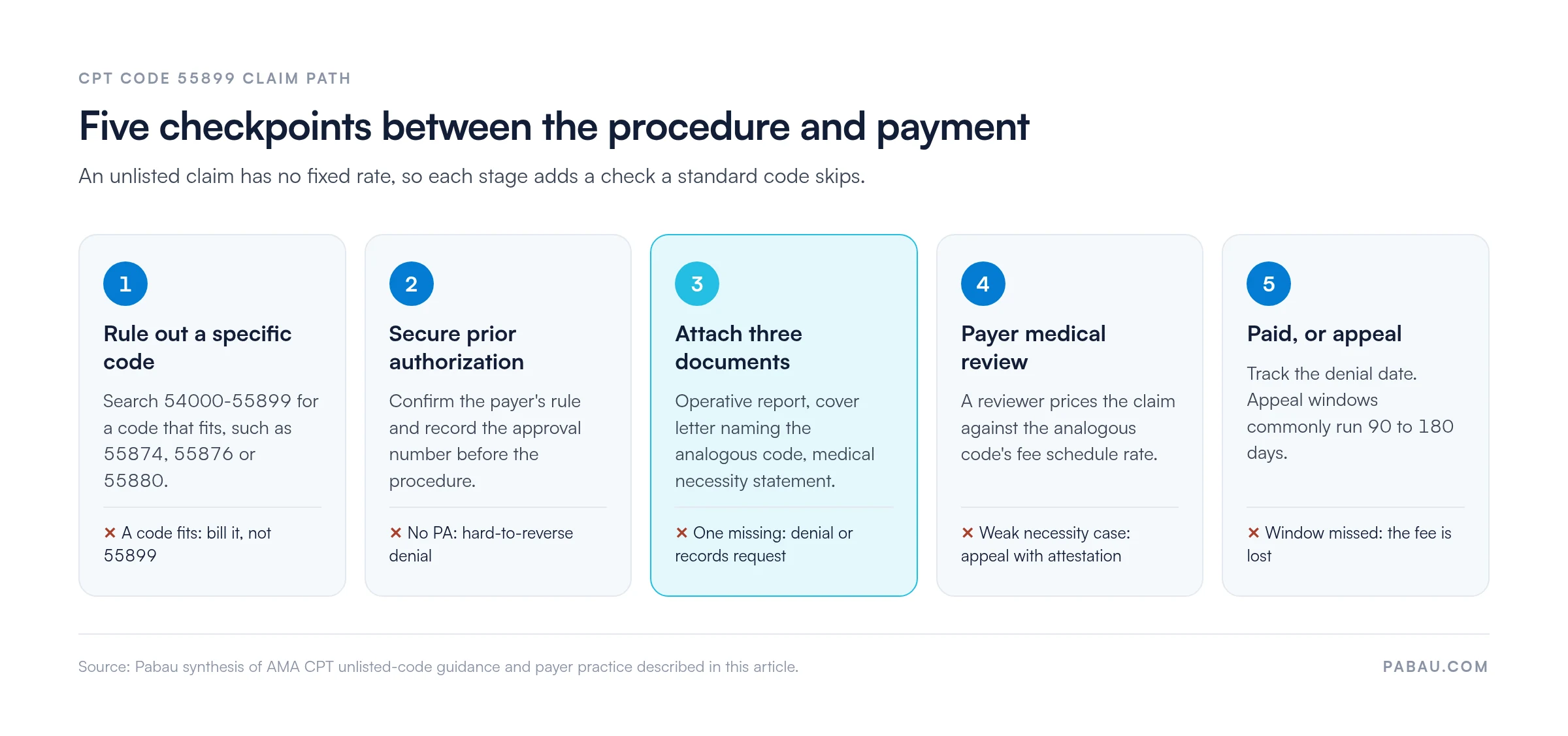
Before the claim leaves your office, run through this checklist.
These steps slot into your wider revenue cycle management process. Attaching documents before submission prevents the most avoidable 55899 denials, the ones caused by missing paperwork.
Payers deny CPT code 55899 claims more often than claims for specific codes, because they see unlisted codes as higher risk for overuse. Knowing the pattern lets your billing team fix the root cause instead of resubmitting the same claim.
A denial management workflow pays off quickly if you bill unlisted codes regularly. The five denial scenarios below are among the most common reasons for 55899 rejections.
For appeals, timing matters as much as content. Appeal windows vary by payer, commonly 90 to 180 days, so check each contract. Start with the denial reason code on the remittance, which our guide to medical billing denial codes explains. Then log the denial date and set a reminder for the appeal deadline.
Audit every CPT code 55899 claim from the past 90 days once a month. Check that the cover letter went with the claim, the PA number is recorded, and no appeal deadline has passed. Catching a missing document on a current claim is cheap. Finding it after the appeal window closes can cost the whole fee.
Getting the code right is only part of the job. The rest of the medical billing process happens between the operative note and the payer, and that’s where unlisted claims stall.
Pabau, the practice management platform we build, handles that stretch through its claims management software. Claims are pre-filled from the invoice, so your team isn’t retyping codes and patient details.
Each claim is validated, then submitted through the integrated Claim.MD clearinghouse, which connects to thousands of US payers.
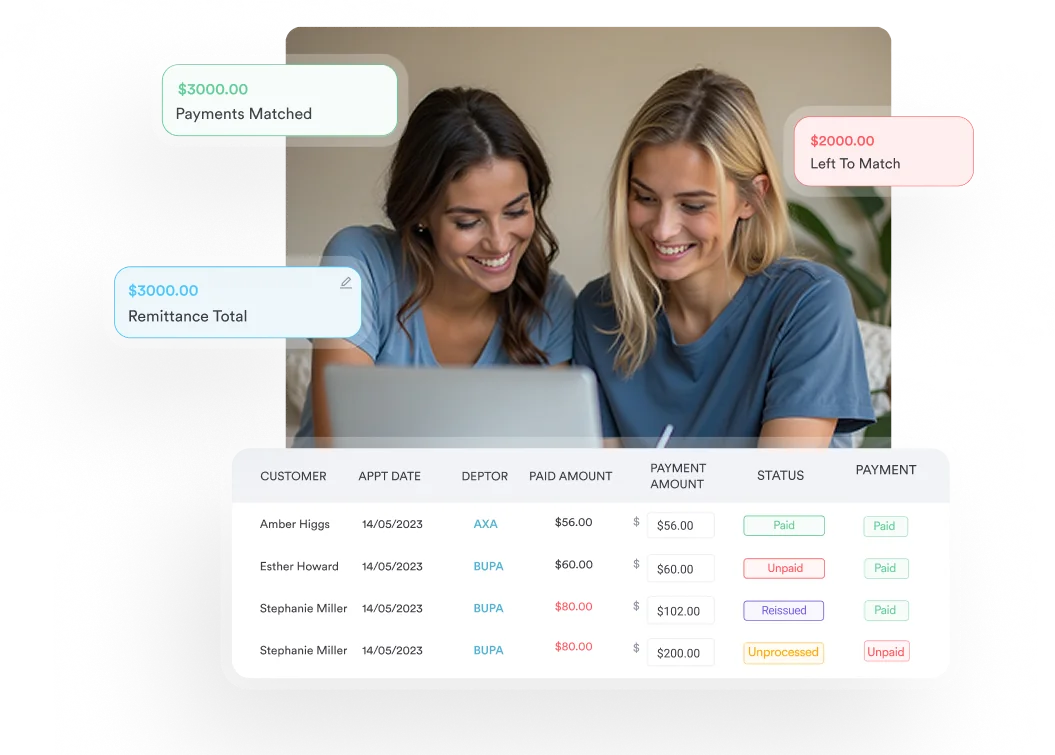
Once a claim is out, status tracking shows where it stands, and a “Needs action” flag marks any claim your team has to deal with. You can also attach an insurer authorization case to the booking. That way, the PA approval sits with the appointment it covers.

Pabau pre-fills claims from the invoice, validates them, and submits them through Claim.MD to thousands of US payers. Status tracking flags any 55899 claim that needs action, so nothing sits unnoticed.

Treat CPT code 55899 as a last resort that still needs a full case behind it. Before every claim, ask two questions. Does a specific or Category III code fit? If not, could a reviewer price this procedure from your paperwork alone?
When both answers point to 55899, the work shifts to process. Attach the full package, get PA in writing and track every appeal deadline. That turns a high-scrutiny code into a predictable one. The trade-off is time up front, which costs far less than a written-off procedure.
A pre-submission checklist holds this together, and your billing software should make it easy to follow. Book a demo to see how Pabau tracks unlisted-code claims from invoice to payment.

Coding a robotic radical prostatectomy instead? CPT code 55866 covers the laparoscopic radical procedure, which has its own specific code.
Billing a post-void residual alongside a urodynamic study? CPT code 51798 explains when the bladder scan is reported on its own.
Need a framework for reducing claim denials across billing codes? Denial management in healthcare covers the workflow steps that prevent rejections before claims go out.
Want to understand how the broader billing system fits together? Revenue cycle management explained walks through the process from eligibility to payment posting.
Decoding a denial on an unlisted claim? Denial codes in medical billing explains CARC reason codes and how to read them for an appeal.
No. A reduced-service modifier on a radical prostatectomy code misdescribes a simple prostatectomy. CPT Assistant (June 2019) directs coders to 55899 when no specific code describes the procedure.
Yes. If a Category III code describes the service, report it instead of 55899. Category III codes track emerging technology, so check them whenever a procedure seems too new for Category I.
CPT code 55899 carries a YYY global indicator. The payer sets the global period case by case, so confirm it before you schedule follow-up visits.
Box 19 is the claim’s narrative field, so briefly name the procedure performed there. Some Medicare contractors set exact wording for certain services, so check your MAC’s article. Keep the wording identical across claims.
A payer reviewer picks the most analogous specific code and pays from that code’s contracted or MPFS rate. Propose that code in your cover letter and explain any complexity differences. Confirm its descriptor first with the AAPC CPT code range tool.
Yes. CPT code 53899 is the unlisted procedure code for the urinary system. Use it when the procedure involves the bladder or urethra rather than the male genital organs, and confirm the choice with the payer.