

HCPCS Code L0472: Hyperextension TLSO billing guide
HCPCS code L0472: Official descriptor and device definition HCPCS code L0472 des...

Last Updated: Nov 5, 2026
46275 is the CPT code for surgical treatment of anal fistula (fistulectomy/fistulotomy); intersphincteric. It reports laying open or excising a fistula tract that crosses the internal sphincter and runs between the internal and external sphincters.
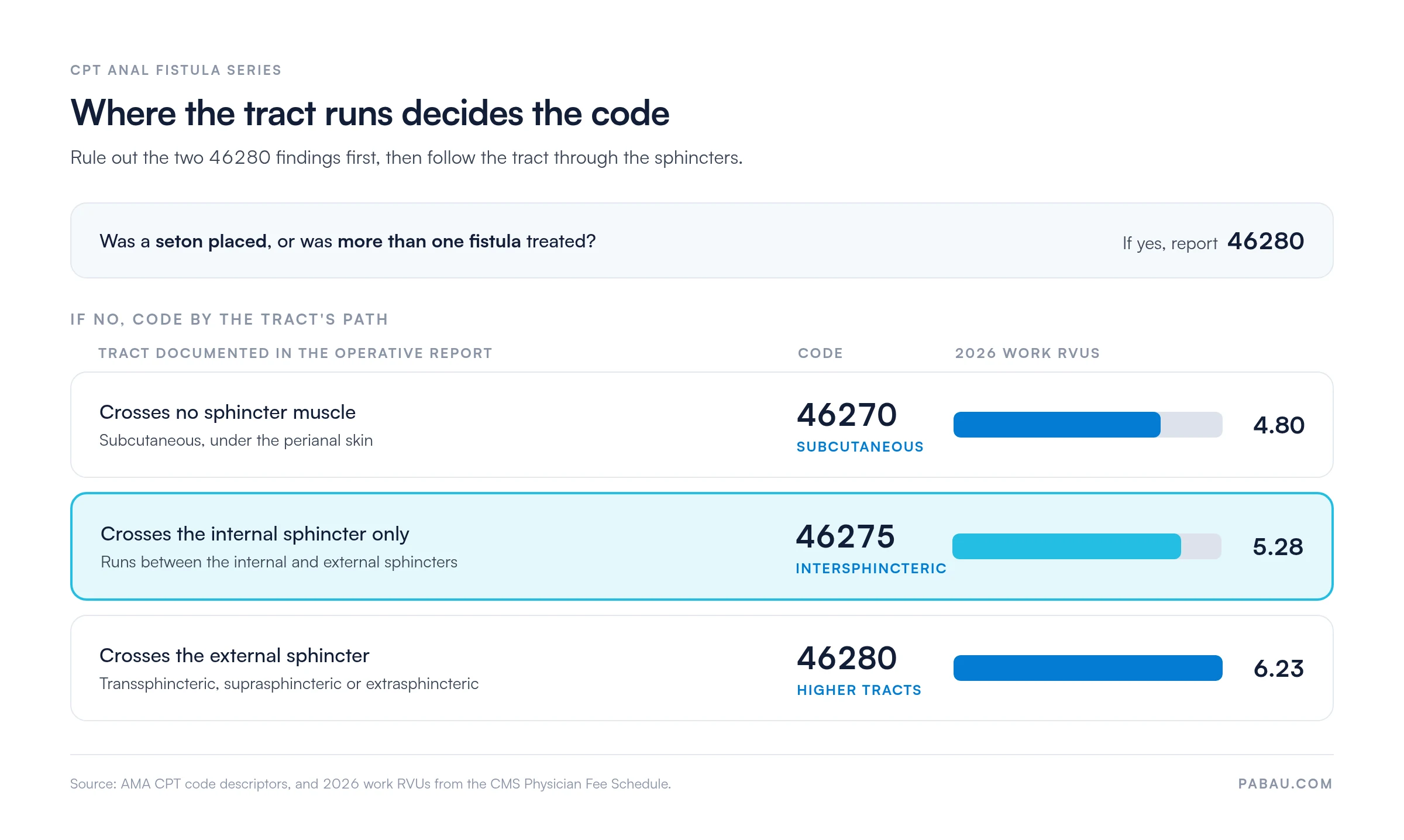
The code sits between 46270, for a subcutaneous tract, and 46280, for transsphincteric, suprasphincteric, extrasphincteric or multiple fistulas and seton placement. Assignment turns on the tract anatomy the operative report documents.
Let Pabau's smart automation suggest the right codes, reduce claim denials, and keep your practice compliant—effortlessly.
Automate repetitive tasks and focus on what matters most—your patients.
Reduce coding errors and ensure compliance with the latest regulations.
Clean claims, fewer denials, and faster reimbursements.
Powerful insights and reporting to help your practice thrive.
HIPAA compliant SOC 2 certified GDPR-compliant Trusted by 4,000+ clinics worldwide

CPT code 46275 reports fistulotomy or fistulectomy for an intersphincteric anal fistula, a tract that runs between the internal and external sphincters.
A subcutaneous tract goes to 46270, while transsphincteric, suprasphincteric, extrasphincteric or multiple fistulas, and seton placement, go to 46280.
For 2026, CMS gives 46275 a work RVU of 5.28, 12.73 total facility RVUs and a 90-day global period.
The operative report must name the tract as intersphincteric and say which sphincter fibers were divided, or the claim can’t defend the code.
Pabau’s claims management software, integrated with the Claim.MD clearinghouse, scrubs 46275 claims for NCCI edits and payer rules before submission.
CPT code 46275 describes “Surgical treatment of anal fistula (fistulectomy/fistulotomy); intersphincteric,” according to the AMA’s CPT code set. CMS lists it under the short descriptor “Remove anal fist inter.” It is a Category I surgical code maintained by the AMA CPT Editorial Panel.
An intersphincteric fistula runs from the anal canal through the internal sphincter, then down the plane between the two sphincters to the perianal skin. It doesn’t cross the external sphincter, and that anatomy is what earns 46275.
The code covers both fistulotomy (laying the tract open) and fistulectomy (excising it), so the surgeon’s choice between the two doesn’t change it. What changes the code is where the tract runs: A subcutaneous tract is 46270, and one crossing the external sphincter is 46280.
Fistulotomy for an intersphincteric fistula follows a consistent sequence. Coders need this clinical context to match the operative note against the descriptor, and to spot a case that belongs to 46270 or 46280 instead.
The operative report must mirror this sequence. A note that states only “fistulotomy performed,” without naming the tract’s relation to the sphincters, leaves the payer free to treat the case as 46270.
The anal fistula series sorts codes by where the tract runs relative to the sphincter muscles. Picking the wrong level is the most common reason a 46275 claim is recoded on review.
Two findings move a case out of 46275 entirely. If the surgeon treats more than one fistula or places a seton, report 46280, whose descriptor includes multiple fistulas and seton placement when performed. The chart below puts those checks ahead of the tract’s path.
When 46040 and 46275 are both performed at the same operative session, check the NCCI edits before reporting them together. Modifier 59 may allow separate billing, but only when the abscess and the fistula are anatomically distinct and each is fully documented.
Current ICD-10-CM splits anal fistula (K60.3) into simple and complex subcategories, each with a sixth character for initial, persistent, recurrent or unspecified. Report the most specific code available, because the K60.3 header alone isn’t billable. Use K60.30 (anal fistula, unspecified) when the note doesn’t call the fistula simple or complex.
The simple/complex axis in ICD-10-CM is a clinical label, and it doesn’t pick the CPT code. If the surgeon calls an intersphincteric fistula complex, the diagnosis can be K60.32- while the procedure stays 46275, because CPT follows the tract’s anatomy.
Verify the subcategory list against the ICD-10-CM tabular list for the claim’s date of service before submitting. Payer crosswalk tables vary, and a commercial payer’s system may lag behind the current code set.
CPT code 46275 carries a 90-day major surgery global period under the CMS Physician Fee Schedule. The 2026 values below come from the CMS PPRRVU file as listed on FastRVU. Payment varies by locality, so confirm current figures in the Medicare Physician Fee Schedule (MPFS) Look-Up Tool before fee negotiations or budget planning.
The national payment figures use the 2026 conversion factor of $33.4009. For comparison, 46270 carries a 2026 work RVU of 4.80 and 46280 carries 6.23.
The 0.48 step down to 46270 and the 0.95 step up to 46280 are why the anatomy in the note matters to payment. Most 46275 procedures occur in an ASC or hospital outpatient setting, so the surgeon is paid at the facility rate. The facility bills separately under the CMS Outpatient Prospective Payment System (OPPS) or the ASC payment system.
Use the FastRVU lookup tool or the CMS MPFS Look-Up to retrieve current-year locality-adjusted rates before contracting or fee schedule analysis.
Many commercial payers and Medicare Advantage plans require prior authorization for CPT 46275, though requirements vary by payer and plan year. There is no universal rule, so verify with the specific payer before scheduling the procedure.
When prior authorization is required, payers typically ask for this documentation:
A denial for missing prior authorization (CO-197) is preventable. A medical claims clearinghouse with eligibility verification can flag auth requirements at scheduling rather than at claim submission. Build the auth check into your intake workflow for every scheduled colorectal surgery case rather than relying on the surgeon’s office to flag it.
Several modifiers apply to CPT 46275 depending on operative circumstances. The National Correct Coding Initiative (NCCI) also defines column-1/column-2 pairs that govern what can be billed alongside 46275 in the same session.
Dividing the internal sphincter fibers that the tract crosses is part of laying an intersphincteric fistula open. That division is included in 46275, so reporting a separate sphincterotomy code for the same muscle invites an NCCI denial.
Verify the current NCCI edits via the AAPC Codify tool or the CMS NCCI Policy Manual before submitting combined claims, since bundling pairs change quarterly. Checking the edit tables every quarter is part of medical billing compliance, so give the task a named owner.
The operative report is the only document that defends CPT 46275 against a recoding challenge. Payers and Recovery Audit Contractors (RACs) routinely pull operative notes for anorectal surgery claims, and a thin note is a fast denial.
Every operative report supporting a clean claim submission for 46275 should contain these elements:
Audit three to five recent 46275 operative reports before your next payer review. Check each one for the word intersphincteric and a statement on which sphincter fibers were divided. Any note missing either is a recode waiting to happen, so fix the template before the auditor finds it.
Denials on CPT 46275 cluster around a short list of root causes, most of which are preventable. A structured denial management workflow that traces each claim adjustment reason code (CARC) back to an upstream documentation or authorization failure reduces rework.
For what each code means across specialties, see our denial code reference. Tracking 46275 denials by CARC each month shows whether a new NCCI edit or payer policy is driving a spike. That lets you fix the cause before it turns into a backlog.
Billing CPT 46275 accurately takes three moving parts: A complete operative report, a verified prior auth, and a claim that passes NCCI edit checks. Manual workflows fail at any of those three points. A practice management system with built-in claims management software runs that scrub automatically, so denials are caught before submission rather than after adjudication.
Pabau’s billing software sends claims through its Claim.MD clearinghouse integration, which submits electronic CMS-1500 claims to thousands of US payers. It also runs real-time eligibility checks and posts electronic remittance advice (ERA) files with their claim adjustment reason codes.
For a colorectal surgery practice billing 46275 regularly, eligibility problems surface at scheduling and NCCI edit warnings appear before the claim goes out. When a denial does come back, the CARC on the ERA tells your team which documentation or authorization step to fix.
If you’re tracing where a surgical practice loses revenue before claims reach the clearinghouse, start with the full medical billing workflow around the coding step.

Pabau’s integrated claims workflow checks payer rules, runs eligibility checks and submits clean claims through the Claim.MD clearinghouse. Your billing team spends less time reworking 46275 denials.

The most preventable source of CPT 46275 revenue loss is an operative note that never says where the tract ran. Without the word “intersphincteric” and a statement on sphincter division, a payer can recode the case to 46270 or deny it.
The opposite error costs just as much. A case with multiple fistulas or a seton belongs to 46280, and billing it as 46275 leaves 0.95 work RVUs unclaimed. Make tract anatomy the first question in your coding review, and the right code follows from the note.
Is your billing team spending more time on 46275 rework than on new claims? Book a demo to see how Pabau catches these errors before submission.

Need to understand how clearinghouse claim submission works? Claim.MD clearinghouse overview explains how electronic claim routing, ERA posting, and real-time eligibility verification work together in a surgical billing workflow.
Want to see how a surgical claim is structured electronically? 837 file submission guide covers how the 837P transaction set structures surgical claims and where formatting errors trigger preventable rejections.
Billing the same procedure for a UK private patient? CCSD code H5510 covers laying open a low anal fistula in the UK private-insurer code set.
Want to verify payer eligibility before scheduling fistulotomy? Insurance eligibility verification walks through how real-time eligibility checks confirm coverage and prior auth requirements before the patient arrives.
CPT code 46275 covers surgical treatment of an intersphincteric anal fistula by fistulotomy or fistulectomy. The tract crosses the internal sphincter and runs between the internal and external sphincters to the skin. A subcutaneous tract goes to 46270, and a transsphincteric or higher tract goes to 46280.
The three codes follow the tract’s anatomy. 46270 is a subcutaneous fistula that crosses no sphincter muscle. 46275 is an intersphincteric fistula that crosses only the internal sphincter. 46280 covers transsphincteric, suprasphincteric, extrasphincteric or multiple fistulas, including seton placement when performed.
No. Seton placement during anal fistula surgery is included in 46280, whose descriptor covers seton placement when performed. If the surgeon places a seton or treats more than one fistula, report 46280 instead of 46275.
Pair 46275 with the most specific anal fistula code available, because the K60.3 header alone isn’t billable. K60.31- covers a simple fistula and K60.32- a complex one, with a sixth character for initial, persistent, recurrent or unspecified. K60.30 covers an anal fistula the surgeon doesn’t label simple or complex. When the fistula involves both anal and rectal components, use K60.50 (unspecified), K60.511-K60.519 (simple) or K60.521-K60.529 (complex).
CPT 46275 carries a 90-day (090) global surgery period under the CMS Medicare Physician Fee Schedule. Routine postoperative care within that window is included in the procedure payment and can’t be billed separately. Billable exceptions include a staged procedure (modifier 58), an unplanned return to the OR for a complication (modifier 78), and care for an unrelated problem.
No. Dividing the internal sphincter fibers that the tract crosses is part of the fistulotomy and is bundled into CPT 46275. Billing a separate sphincterotomy code for the same division triggers a CO-97 denial. A sphincterotomy at a distinct site for an unrelated indication may be separately reportable with modifier 59 and full documentation.
The 2026 work RVU for CPT 46275 is 5.28 under the CMS Medicare Physician Fee Schedule. Total RVUs are 12.73 in a facility setting and 18.88 in a non-facility setting. Confirm current values and the locality-adjusted payment in the CMS MPFS Look-Up Tool before fee negotiations.



