

HCPCS Code Q4175: Billing, coverage, and documentation guide
HCPCS code Q4175: Code description and product identity HCPCS Code Q4175 is the ...

Last Updated: Nov 20, 2026
Billable Code
46999 is the CPT code for an unlisted procedure on the anus. It is reported only when no other code in the 46020-46999 anus range accurately describes the procedure performed.
Common uses include single-column transanal hemorrhoidal dearterialization (THD), non-thermal direct-current hemorrhoid ablation, and investigational anal techniques. THD of two or more columns has its own code, 46948. Because 46999 has no fixed Medicare rate, payers price each claim from the operative report and a comparable listed code.
Let Pabau's smart automation suggest the right codes, reduce claim denials, and keep your practice compliant—effortlessly.
Automate repetitive tasks and focus on what matters most—your patients.
Reduce coding errors and ensure compliance with the latest regulations.
Clean claims, fewer denials, and faster reimbursements.
Powerful insights and reporting to help your practice thrive.
HIPAA compliant SOC 2 certified GDPR-compliant Trusted by 4,000+ clinics worldwide

CPT code 46999 is the anus catch-all, used only when no specific 46020-46999 code fits the procedure performed.
THD of two or more hemorrhoid columns has its own code, 46948, so 46999 covers single-column THD and non-thermal ablation.
Most payers want the operative report attached before adjudication, so send it with the first submission.
Payment is set by comparison to a similar listed code, because there is no published RVU or national Medicare rate.
Pabau’s practice management software flags denied or rejected claims as “Needs action” with the reason, so billing staff can correct and resubmit them.
CPT code 46999 is the code for an unlisted procedure on the anus. It is reported only when no other code in the 46020-46999 anus subsection describes the procedure performed. CMS’s NCCI policy manual places unlisted codes at the end of each CPT section or subsection. It directs that a service no other code accurately describes is reported with the unlisted code.
The American Medical Association, whose CPT Editorial Panel maintains the code set, gives 46999 the descriptor “Unlisted procedure, anus.” Reporting it when a specific code exists, to skip documentation or to seek higher payment, is incorrect coding and raises audit risk.
CPT code 46999 applies when the anorectal procedure performed has no specific descriptor in the 46020-46999 range. Three scenarios account for most 46999 claims in colorectal and general surgery practices.
THD uses Doppler-guided suture ligation to cut off the arterial blood supply feeding hemorrhoidal tissue, without excision. Since 2020, CPT 46948 has described THD of two or more hemorrhoid columns or groups, replacing the old Category III code 0249T. No code describes THD of a single column, so practices report that case with CPT code 46999.
Payer policies on single-column THD vary. Some commercial plans cover it with appropriate documentation, while others classify it as investigational and deny the claim. Link the claim to the hemorrhoid diagnosis from K64.0-K64.9 that matches what the surgeon documented. Prior authorization before the procedure is the most reliable way to avoid a post-service denial.
Direct-current non-thermal hemorrhoid ablation destroys hemorrhoidal tissue with controlled electrical current rather than heat. CPT 46930 covers only thermal methods, such as infrared coagulation, cautery, and radiofrequency, so a non-thermal technique does not map to it. CPT code 46999 is the right code, provided the operative note separates the method from thermal approaches. The note should also document why the non-thermal route was medically necessary.
Any anorectal surgical technique too new or too rarely performed to have its own CPT descriptor falls here. Examples include newer modifications of stapled hemorrhoidopexy that no existing code describes, and emerging tissue-ablation technologies used at the anus. CPT code 46999 is correct for these cases. Always attach a detailed operative report and a letter of medical necessity.
CPT code 46999 is never used when a specific anus-range code accurately describes the procedure. A common colorectal coding error starts with a thermal hemorrhoid destruction, documented as such. The practice then bills 46999 instead of 46930 to avoid prior authorization. Payers catch this during adjudication, and the claim either denies or triggers a post-payment audit.
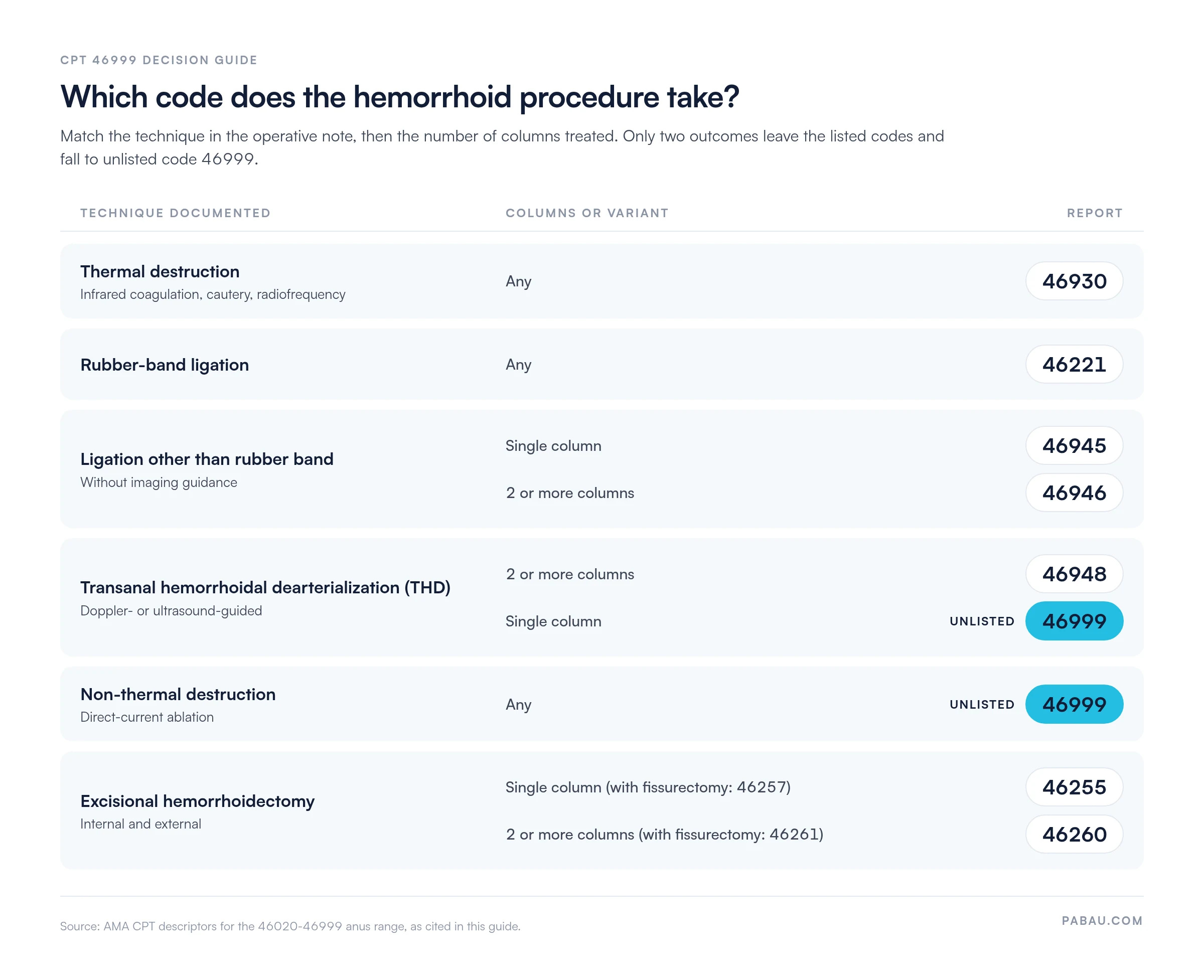
The decision rule is simple. Search the 46020-46999 range first, and use any descriptor that fits the documented procedure. CPT code 46999 is the final option, not the default. The guide below maps each hemorrhoid technique to its code, and only two of them fall to 46999.
Documentation decides whether a CPT code 46999 claim pays or denies. The code carries no descriptor beyond “unlisted procedure, anus,” so the payer’s reviewer can price it only from what the provider submits. Attach every supporting document at first submission. Appealing a denial later takes far more time than sending a complete packet up front.
Strong medical billing compliance starts with a complete record. Use this five-element checklist for every 46999 submission.
Send the packet with the claim rather than faxing it separately, so the payer never receives the claim without its evidence. A clean claim submission means the operative report, the comparable-code narrative, and the medical necessity letter all travel together on the first attempt. When a claim still comes back, Pabau’s claims software for billers flags it as “Needs action” with the payer’s reason. Your team can then correct and resubmit it.
Draft a reusable narrative template for each unlisted procedure your practice performs regularly, such as single-column THD or non-thermal ablation. Keep it in your billing system as a starting document. Each submission still needs the patient-specific operative details. The payer-facing structure can be standardized, though: the comparable code, the reason it doesn’t fit, and the medical necessity framing.
Most commercial payers require prior authorization for unlisted procedure codes, including CPT code 46999. Without a standard descriptor, the payer has no automated pricing logic to apply. Medicare does not use a universal prior authorization requirement for unlisted surgical codes, but Medicare Advantage plans and commercial insurers generally do. Check each payer’s policy before scheduling the procedure, not after.
A consistent prior authorization workflow starts with a standard packet. For a CPT code 46999 request, it typically includes these elements.
Allow 5 to 10 business days for a prior authorization decision. Urgent cases can often be expedited with a peer-to-peer review request. If authorization is denied, appeal with additional clinical documentation before rescheduling the case. Performing the procedure without authorization, then billing 46999, is another common cause of denial for this code.
Modifiers on CPT code 46999 give the payer’s reviewer additional clinical context. Because the code has no intrinsic descriptor, the modifier carries more interpretive weight here than it does on most listed codes. Apply only the modifiers that accurately reflect the documented encounter.
Modifier 22 deserves special attention. When a practice bills CPT code 46999 with modifier 22, the payer expects the operative report to quantify the increased complexity. That usually means comparing the procedural time or difficulty with what the comparable listed code would normally require. Without that comparison, the modifier gives no leverage in negotiation and may be stripped during adjudication.
CPT code 46999 has no published Relative Value Unit (RVU) or national Medicare rate in the CMS Physician Fee Schedule. The same is true of every unlisted procedure code. With no standard descriptor, CMS has nothing to measure work, practice expense, and malpractice against. Each claim is priced individually by the payer’s reviewer, based on the comparable listed code the practice cites.
Payment for a 46999 claim typically falls within the range of the comparable code named in the documentation. FastRVU’s 2026 RVU lookup shows the current Medicare payment for that comparable code, which works as a benchmark when negotiating with commercial payers. Through Claim.MD, the US clearinghouse Pabau connects to, practices can route 46999 claims to thousands of US payers. Electronic remittance advice then shows how each payer priced the claim.
Use a revenue cycle management framework to track 46999 payment rates by payer over time. When a commercial payer consistently pays below the Medicare rate for the comparable code, that data supports a contract renegotiation.
Every CPT code 46999 claim goes to manual review, which gives payers more chances to deny it than an automatically priced code. Five denial patterns come up most often.
Structured denial management workflows decide whether denied revenue is recovered or written off. For each denied 46999 claim, log the CARC denial reason code, the payer, and the missing documentation element. Repeat denials from one payer often trace back to a single missing document. The whole practice can add it once, instead of appealing claim by claim.
Our guide to denial codes for billers explains the CARC codes most often returned on unlisted procedure claims. Cross-reference the CARC on each 46999 denial against it before drafting the appeal letter.
Run a quarterly audit on every CPT 46999 claim submitted in the past 90 days. Pull the denial rate by payer and by denial reason. If one payer keeps denying for ‘no comparable code cited’, your documentation template for that payer is missing a required element. Fix the template once, rather than appealing each claim.
A 46999 claim often lives in three places at once. The authorization sits in a payer portal, the documentation packet sits in a shared drive, and the denial arrives as a line on a remittance. Each handoff is a point where the claim can stall.
In Pabau, the authorization code, dates, and approved sessions are recorded on the patient’s case, with a warning when one is missing. US claims go out as CMS-1500/837P claims through Claim.MD, with eligibility checks before the visit and ERA remittances after it. A denied or rejected claim is flagged “Needs action” with the reason shown, so your billing team can correct and resubmit it.
Your team then works from one list of claims that need attention, instead of rebuilding each case from emails and portal logins. A single-column THD claim and its authorization stay in the same record from scheduling to remittance.

Pabau records prior authorizations on the patient’s case and flags denied or rejected claims as Needs action, with the reason shown. Your team corrects and resubmits 46999 claims from one place.

Reach for CPT code 46999 last, after checking 46948, 46930, 46221, and the excision codes against the operative note. The column count and the technique the surgeon recorded usually settle it. When 46999 is the right code, the claim is only as strong as the packet behind it.
Get the prior authorization before the procedure, and send the operative report and comparable-code narrative with the first submission. Then log every denial by payer and reason. That costs more work up front, and it saves far more in appeals later.
Book a demo to see how Pabau keeps authorizations, claims, and denial reasons for unlisted procedures in one record.

Excising a thrombosed external hemorrhoid? CPT code 46320 covers billing for the excision, a procedure the 46083 incision code does not describe.
Confused by which CARC codes appear on surgical denials? Denial codes in medical billing explains the most frequent CARC codes and how to respond to each.
Want to understand how the 837 file carries your claim data to payers? 837 file guide covers the EDI transaction format payers use to receive and adjudicate claims.
CPT code 46999 is the unlisted procedure code for the anus. It is used when no other code in the 46020-46999 range accurately describes the anorectal procedure performed. It requires manual payer review and should always be submitted with an operative report and a comparable-code narrative.
Use CPT code 46999 only when no specific code in the anus range describes the performed procedure. Thermal hemorrhoid destruction is 46930, and ligation other than rubber band is 46945 or 46946. THD of two or more columns uses 46948. Reserve 46999 for single-column THD and non-thermal ablation, which have no dedicated descriptor.
The claim must include the full operative report and a medical necessity letter. It also needs a written narrative naming the most similar listed CPT code and explaining why that code does not fully describe the procedure. Some payers also require physician attestation that no specific code exists for the service.
Most commercial payers require prior authorization for CPT code 46999 because unlisted codes have no automated pricing logic. Medicare fee-for-service does not mandate universal prior auth for unlisted surgical codes, but Medicare Advantage plans typically do. Verify each payer’s policy before scheduling the procedure.
There is no published Medicare rate for CPT code 46999, because CMS assigns no RVU to unlisted procedure codes. The payer’s reviewer sets payment using the comparable listed code the practice cites in its documentation. Use the CMS Physician Fee Schedule lookup to find the current rate for that comparable code.
Yes, CPT code 46999 is the right code for non-thermal direct-current hemorrhoid ablation, because CPT 46930 covers only thermal destruction methods. The operative note must clearly separate the technique from thermal approaches and document medical necessity for the non-thermal route.





