

HCPCS Code L0472: Hyperextension TLSO billing guide
HCPCS code L0472: Official descriptor and device definition HCPCS code L0472 des...

Last Updated: Nov 5, 2026
46080 is the CPT code for sphincterotomy, anal, division of sphincter (separate procedure). It covers surgical division of the internal anal sphincter, most often a lateral internal sphincterotomy for a chronic anal fissure, by open or closed technique.
As a separate procedure, 46080 bundles into a more comprehensive anorectal procedure on the same date, such as fissurectomy (46200) or hemorrhoidectomy. Medicare assigns it a 10-day global period. Most denials come from billing it alongside those codes, or from a diagnosis that the payer's medical-necessity policy does not accept.
Let Pabau's smart automation suggest the right codes, reduce claim denials, and keep your practice compliant—effortlessly.
Automate repetitive tasks and focus on what matters most—your patients.
Reduce coding errors and ensure compliance with the latest regulations.
Clean claims, fewer denials, and faster reimbursements.
Powerful insights and reporting to help your practice thrive.
HIPAA compliant SOC 2 certified GDPR-compliant Trusted by 4,000+ clinics worldwide

CPT 46080 describes anal sphincterotomy, which is division of the internal sphincter. Repair and excision belong to different code families.
The “(separate procedure)” label means 46080 bundles into a more comprehensive anorectal procedure on the same date unless modifier -59 or an XS/XU modifier applies.
Medicare assigns 46080 a 10-day global period, so a same-day E/M needs modifier -25 and an unrelated visit in the window needs -24.
In 2026, 46080 carries 2.46 work RVUs, with 9.45 total RVUs in the office and 4.49 in a facility.
Pabau, the practice software we build, submits and tracks 46080 claims through Claim.MD, while NCCI and modifier checks stay with your coder or biller.
CPT code 46080 is classified under Incision Procedures on the Anus in the AMA’s CPT code set. The full official descriptor is: Sphincterotomy, anal, division of sphincter (separate procedure).
Understanding each element of that descriptor prevents miscoding. The table below breaks down what each term signals for billing and documentation purposes.
The procedure cuts a portion of the internal anal sphincter to relieve elevated resting pressure. It is most often an open or closed lateral internal sphincterotomy (LIS). UK private insurers see the same operation billed as H5620 under the CCSD schedule.
In the open technique, the surgeon divides the distal internal sphincter under direct vision. The closed technique uses a small stab incision and a retractable blade. The approach does not change the code, because CPT 46080 covers both techniques.
The primary indication for CPT 46080 is a chronic anal fissure that has failed conservative management. Payers require documented evidence of failed conservative treatment before approving the procedure, so the operative note must reflect the timeline.
Secondary or less common indications include internal sphincter hypertrophy causing obstructed defecation and certain post-surgical stenosis scenarios. These require stronger medical-necessity documentation because the diagnosis-code pairing is less straightforward for payer review.
The operative note is the document a payer reads when it reviews a 46080 claim. It should confirm four elements.
A note that says only “sphincterotomy performed” leaves out the sphincter layer, approach, and extent, so it cannot support the code on review. Standard medical billing workflows link the operative note to the claim step. That shortens the delay between documentation and coding, which is where these omissions creep in.
The 46xxx anorectal series contains several codes that share clinical territory with 46080. Using the wrong code is a frequent denial trigger. The table below covers the most frequently confused pairings, sourced from AAPC’s CPT code reference.
The distinction that matters most is between 46080 and 46200. When a fissurectomy (46200) is the primary procedure, sphincterotomy is already part of its descriptor. Billing both codes on the same date without documented justification for separate services is a classic NCCI bundling violation.
Diagnosis specificity drives claim acceptance for 46080. For a fissure that has outlasted conservative treatment, K60.1 is the code that supports surgical necessity. Using the unspecified fissure code when the note supports a more specific one is an avoidable denial that wastes appeal time.
Modifier selection on CPT code 46080 affects both reimbursement and denial risk. A wrong modifier draws a denial just as an omitted one does.
Medicare reimburses CPT code 46080 using relative value units (RVUs) multiplied by the annual conversion factor, adjusted for geographic locality. The CMS Physician Fee Schedule look-up tool provides the current national unadjusted rates; use it with your practice’s locality code for accurate estimates.
The values below reflect the national non-facility and facility split as published in the Medicare Physician Fee Schedule.
These are the 2026 national values. CY2026 has two conversion factors: $33.5675 for qualifying APM participants and $33.4009 for every other physician. Each RVU component is then adjusted by your locality’s Geographic Practice Cost Index (GPCI).
You can cross-check the 2026 values by locality with the FastRVU look-up tool. Verify every figure against the published fee schedule before you use it in contract talks or financial projections. Practice expense accounts for almost the entire gap between the two settings, as the breakdown below shows.
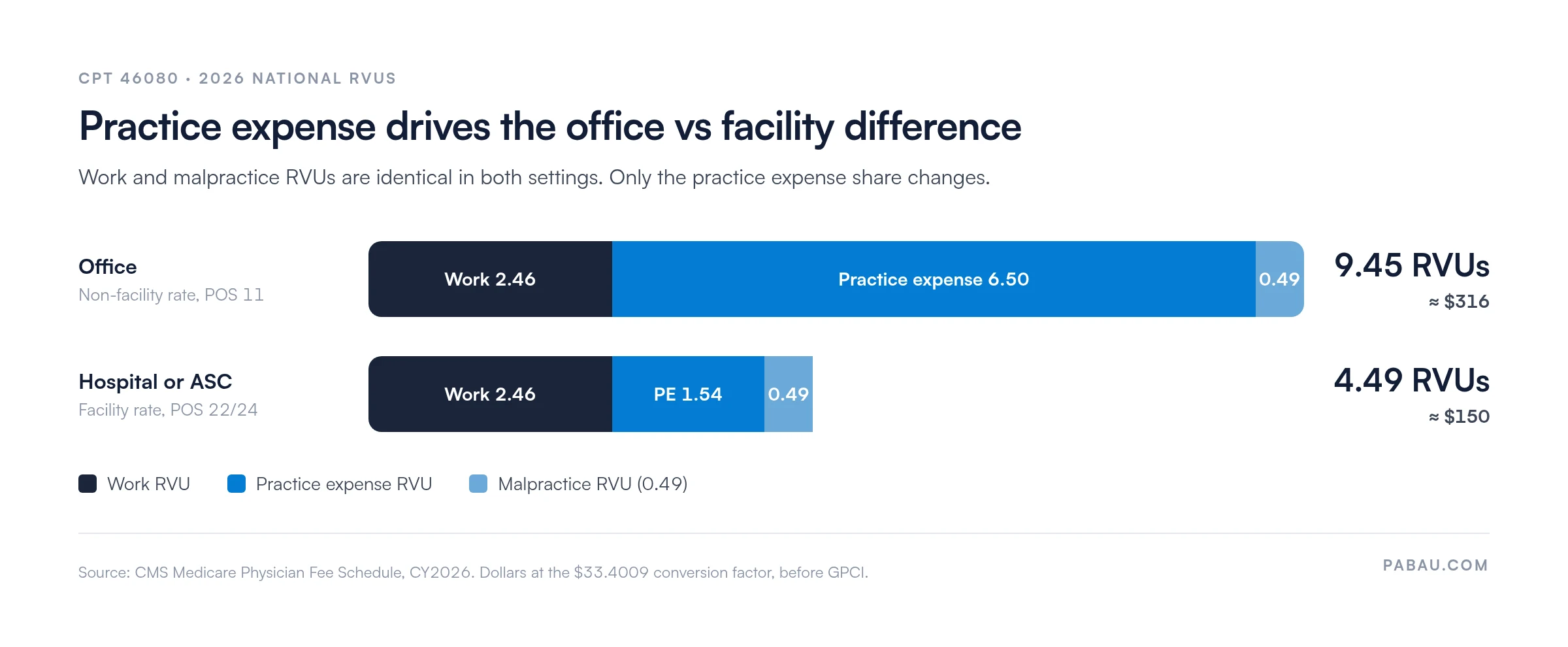
Perform 46080 in the office rather than a hospital outpatient department when it is clinically safe. The non-facility professional fee is materially higher because the practice keeps the practice expense component. At the $33.4009 conversion factor that is about $316 versus $150, before GPCI. In a hospital or ASC, that overhead component moves to the facility claim. Run a break-even comparison using your locality GPCI before defaulting to a facility setting.
CPT 46080 carries a 10-day global surgical period under Medicare (global indicator 010), so routine postoperative care is included in the procedure fee. A standard follow-up visit billed in that 10-day window without a modifier will be denied.
Commercial insurers do not all follow Medicare’s 10-day global period. Some apply a longer global or none at all, so check each payer’s provider manual before billing post-op visits.
Prior authorization requirements for CPT 46080 vary by payer class and plan. No universal rule applies, so check each payer before scheduling.
A denial for a missing PA can be difficult or impossible to overturn at some payers. Build a PA check into scheduling for every 46080 case covered by commercial or Medicaid insurance. Pabau’s Claim.MD integration supports eligibility checks before the patient arrives.
Most CPT 46080 denials fall into five categories, and each one can be caught before the claim is submitted. The list below pairs each cause with its prevention step.
Once a denial lands, this denial management guide covers appeal workflows by denial category. The reference on medical billing denial codes maps each claim adjustment reason code (CARC) to its fix.
The place of service code on the claim determines which reimbursement rate applies and who bills for which component. Getting the POS wrong is a frequent denial trigger for surgical codes.
Surgeons performing 46080 in a freestanding office procedure room should ensure the room meets their state’s outpatient surgery facility requirements. Billing POS 11 for a procedure done in a space licensed as an ASC is a compliance exposure. It can also flag the claim for payer audit.
A superbill that pre-fills the POS code from the scheduled location prevents most of these errors.
Under CMS’s National Correct Coding Initiative, CPT 46080 is a column 2 code for several primary anorectal procedures. A column 2 designation means the code bundles into the column 1 primary code by default. That applies when both appear on one claim for the same patient and date.
Your coder or biller runs the NCCI check before the claim is built. A medical billing compliance framework treats NCCI edit monitoring as part of a wider compliance program. The goal is a clean claim that reaches the payer with the modifier and its supporting note already matched.
A 46080 claim often passes through three hands. The surgeon writes the note, a coder reads it for bundling and modifiers, and someone re-keys the charge into a clearinghouse portal. Each hand-off is a chance to drop a modifier or a PA number.
In Pabau’s claims management software, the claim is built from the invoice you already raised. US claims go out as CMS-1500s through Claim.MD, which also runs real-time eligibility checks before the visit. Each prior authorization is stored as a case against the appointment, so the PA number is on file when the claim is built.
Your coder still owns the NCCI and modifier decisions. What changes is that nobody re-types them, and denied claims come back flagged for rework in one dashboard.
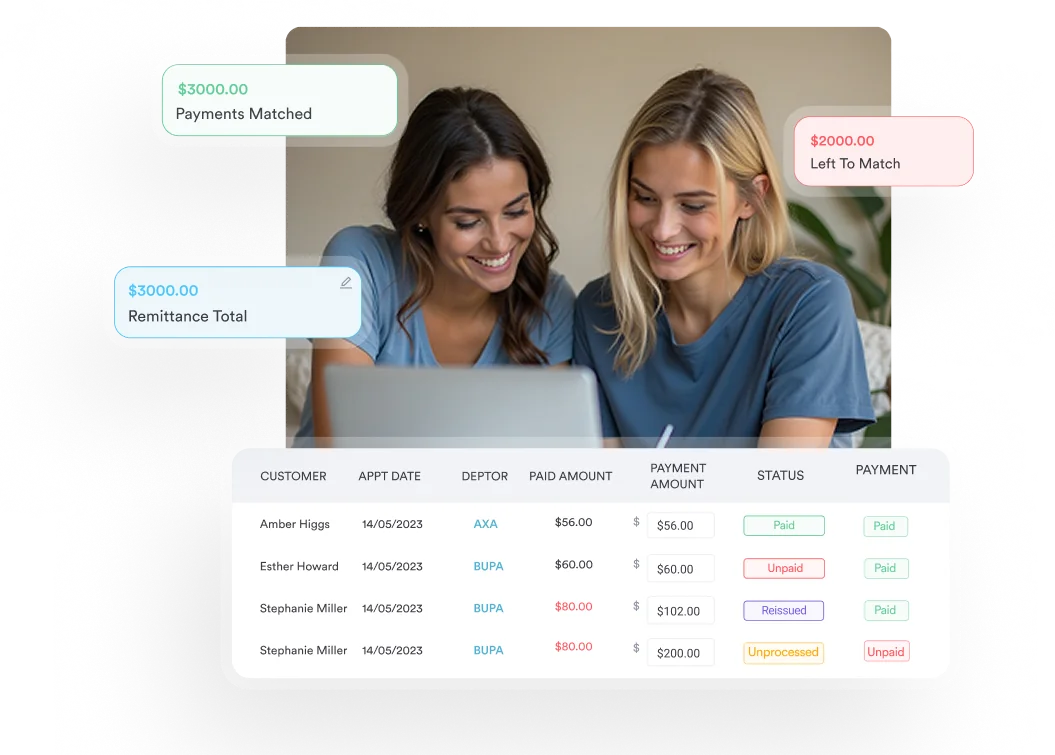

Pabau turns each invoice into a CMS-1500 claim, checks eligibility through Claim.MD, and tracks every claim to payment. Book a demo to see how your coder’s work reaches the payer unchanged.

CPT 46080 is easy to describe and easy to lose. Its “separate procedure” label means the claim lives or dies on the operative note. A modifier added after the fact cannot rescue a note that never explains why the sphincterotomy was distinct.
So fix the note first. Ask surgeons to record the sphincter layer, the approach, and the clinical reason for every sphincterotomy billed beside another anorectal code. Then decide the setting on the numbers. The office rate is roughly double the facility rate, but only if your procedure room carries the overhead that justifies it.
Want your coder’s modifiers to reach the payer without being re-keyed? Book a demo to see how Pabau builds, submits, and tracks 46080 claims from the invoice.

Need a structured approach to clean claim submission? Clean claim best practices covers the pre-submission validation steps that reduce surgical procedure denials.
Managing multiple denial types across your anorectal surgery claims? Denial codes in medical billing maps the most common CARC codes to corrective actions.
Exploring the revenue cycle context for surgical codes? Revenue cycle management fundamentals explains how procedure codes flow from documentation through payment posting.
CPT code 46080 covers sphincterotomy of the anal canal, meaning surgical division of the internal anal sphincter to relieve elevated resting pressure. The AMA labels it a separate procedure. It bundles into a more comprehensive anorectal procedure on the same date unless a valid modifier and distinct clinical documentation support it.
Medicare reimbursement for CPT 46080 varies by locality and by where the procedure is performed. In 2026 the work RVU is 2.46, and total RVUs are 9.45 in the office and 4.49 in a facility. At the $33.4009 conversion factor that is about $316 versus $150 before GPCI. Use the CMS Physician Fee Schedule look-up tool with your locality code for the exact allowed amount.
CPT 46200 is a fissurectomy, which excises the fissure tissue, and its descriptor states that sphincterotomy is included when performed. Billing 46080 alongside 46200 on the same claim without documented justification for a distinct service is an NCCI bundling violation. Use 46200 when fissure excision is the primary goal, and 46080 only when sphincterotomy alone is the procedure.
Traditional Medicare fee-for-service does not list CPT 46080 for mandatory prior authorization. Medicare Advantage and most commercial plans do require PA with documentation of failed conservative treatment. Medicaid requirements vary by state. Check each payer individually before scheduling the procedure.



