HCPCS Code J1110: Dihydroergotamine mesylate injection billing guide
HCPCS Code J1110: Official descriptor and drug overview HCPCS Code J1110 is the ...

Last Updated: Oct 29, 2026
31296 is the CPT code for nasal/sinus endoscopy, surgical, with dilation (eg, balloon dilation) of the frontal sinus ostium. It covers balloon catheter dilation of the frontal ostium under endoscopic guidance, with no removal of bone or tissue.
It sits in the 31295-31298 family, where each code covers a different sinus site. Frontal and sphenoid dilation in one session is reported as 31298, and bilateral frontal work takes modifier 50.
Let Pabau's smart automation suggest the right codes, reduce claim denials, and keep your practice compliant—effortlessly.
Automate repetitive tasks and focus on what matters most—your patients.
Reduce coding errors and ensure compliance with the latest regulations.
Clean claims, fewer denials, and faster reimbursements.
Powerful insights and reporting to help your practice thrive.
HIPAA compliant SOC 2 certified GDPR-compliant Trusted by 4,000+ clinics worldwide

CPT 31296 covers endoscopic dilation of the frontal sinus ostium only. Maxillary (31295), sphenoid (31297) and combined frontal and sphenoid work (31298) each have their own code.
Most payers require prior authorization and documented failed conservative therapy before they approve a balloon sinuplasty claim.
Bilateral frontal dilation takes modifier 50, which Medicare pays at 150% of the single-procedure rate. Check each commercial payer’s own rule first.
All four balloon dilation codes carry a 0-day (000) global period, so visits after the day of surgery are billed separately.
Pabau’s claims management software attaches prior authorization codes to the booking and sends CPT 31296 claims through Claim.MD after an eligibility check.
CPT code 31296 describes nasal/sinus endoscopy, surgical, with dilation (eg, balloon dilation) of the frontal sinus ostium.
It belongs to the 31295-31298 family, where each code covers a different paranasal sinus site. Reporting the wrong site is one of the commonest reasons claims in this family are rejected.
The 0-day (000) global period means the pre- and post-operative work on the day of surgery is bundled. Later visits are billed separately. Modifier 24 applies only if an unrelated E/M falls inside a global window. Confirm the global indicator for 31296 in the current CMS Medicare Physician Fee Schedule file, because assignments can change with annual updates.
Frontal sinus balloon dilation uses a flexible endoscope and a catheter-mounted balloon to dilate the frontal sinus ostium without removing bone or tissue. The surgeon advances the balloon catheter under endoscopic and often fluoroscopic guidance, inflates it to open the narrowed ostium, then deflates and withdraws it. No mucosal resection occurs, which is the key distinction from conventional functional endoscopic sinus surgery (FESS).
Chronic frontal sinusitis with documented failed medical therapy supports a CPT 31296 claim. So do recurrent acute frontal sinusitis that meets payer frequency thresholds and frontal ostial stenosis confirmed on CT. Diagnostic nasal endoscopy (CPT 31231) in the same session is bundled into 31296 and is not reported separately.
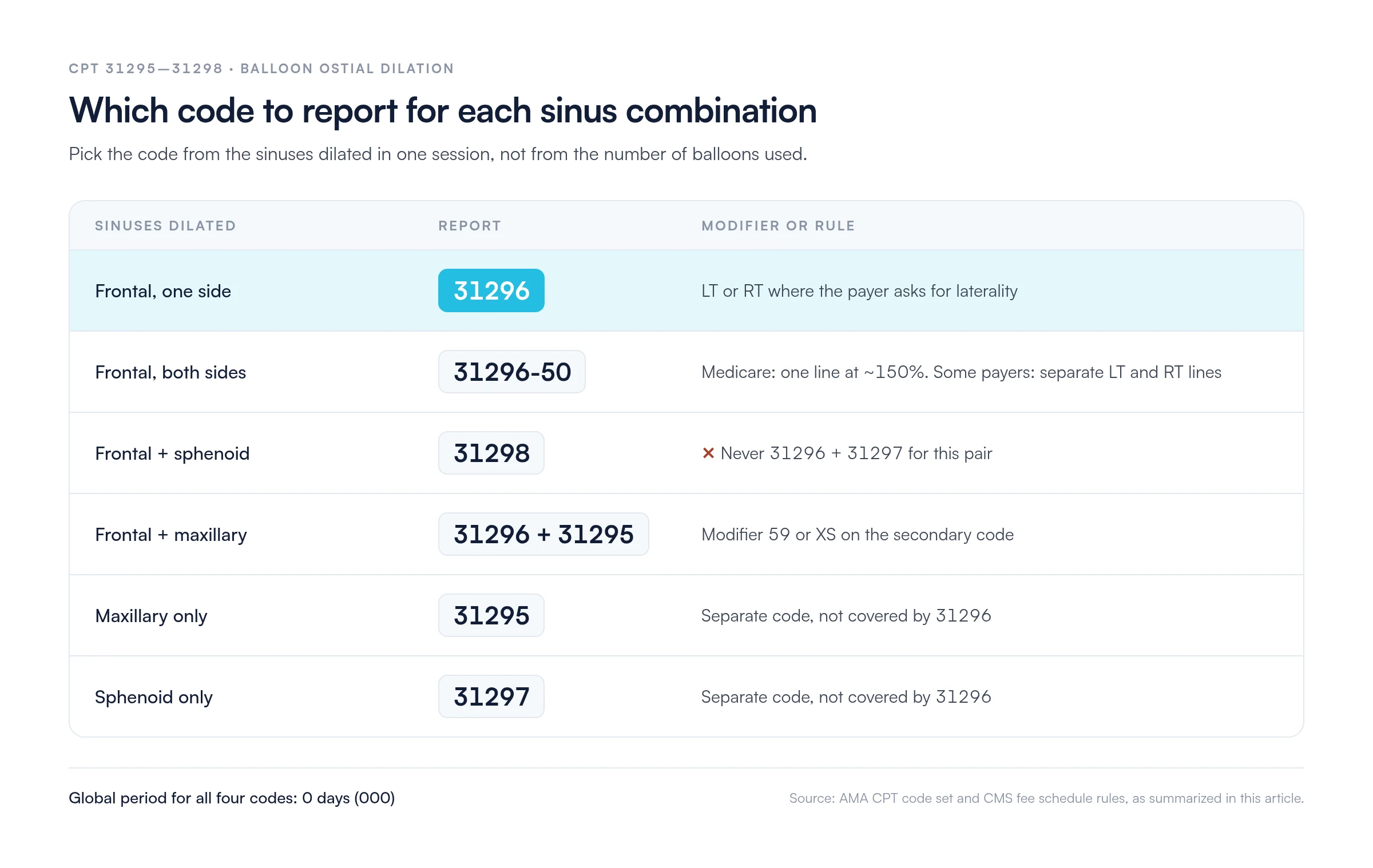
CPT 31296 covers the frontal sinus only. Dilating another sinus in the same session is reported with that sinus’s own code, or with 31298 when the second sinus is the sphenoid. The grid below maps each sinus combination to the code a payer expects.
NCCI (National Correct Coding Initiative) edits define which services are bundled with 31296 and cannot be reported on their own without a modifier.
Modifier 59 (distinct procedural service) or its XS subset (separate structure) overrides NCCI bundling. Use it when 31295 is reported with 31296 or 31297 on a different sinus. When the frontal and sphenoid ostia are both dilated, report 31298 rather than 31296 + 31297, with no modifier. NCCI edits update quarterly, so check the current Procedure-to-Procedure (PTP) edits table before billing a multi-sinus session.
When billing 31296 with 31295 in the same session, list the primary code first and append modifier 59 or XS to the secondary code. If the sphenoid was dilated as well as the frontal sinus, report 31298 rather than 31296 + 31297. Document each sinus site in its own operative paragraph so auditors can confirm distinct anatomical work.
Pairing CPT 31296 with the wrong ICD-10 code is a fast route to denial. The diagnosis must point to the frontal sinus specifically. Codes for maxillary sinusitis or pansinusitis without documented frontal involvement do not meet payer medical necessity criteria for this code.
ICD-10-CM codes update annually on October 1. Confirm that J32.1 and J01.10 remain valid and active in the current fiscal year’s tabular list before filing claims. Local coverage determinations (LCDs) issued by Medicare Administrative Contractors (MACs) specify which diagnosis codes are covered in each jurisdiction. A diagnosis that satisfies one MAC may not satisfy another.
When the surgeon dilates the frontal sinus ostium bilaterally in the same session, modifier 50 is appended to CPT 31296. Medicare’s standard bilateral surgery rule reimburses bilateral procedures at 150% of the single-code rate. The claim is filed on one line with modifier 50, and the Medicare Physician Fee Schedule (MPFS) applies the adjustment automatically.
Commercial payers do not uniformly follow the Medicare bilateral rule. Some require two separate line items with LT (left side) and RT (right side) modifiers instead of a single modifier-50 line. Check the payer’s provider manual or contact their provider relations line before submitting bilateral 31296 claims to avoid preventable rejections.
Most payer classes require prior authorization for balloon sinuplasty. A claim filed without authorization is one of the top denial triggers for CPT 31296. So is a claim whose dates or laterality don’t match the authorization. Tracking auth status alongside the scheduled procedure date is essential for good revenue cycle management.
Payer medical policies (such as Highmark’s and Centene/HomeState Health’s) and MAC LCDs require the following criteria to be documented before the procedure is authorized. These criteria are representative, so check each payer’s current policy and the LCD for your MAC jurisdiction.
Running insurance eligibility verification at scheduling prevents most authorization-related denials. It confirms active coverage and prior authorization requirements before the patient is booked.
CPT 31296 reimbursement under the Medicare Physician Fee Schedule reflects the work intensity of a surgical endoscopy with balloon catheter placement. The values below are reference notes only, because rates change with each annual January fee schedule update. Always verify current rates using the CMS Physician Fee Schedule lookup tool or the FastRVU 2026 RVU lookup before contracting or fee schedule negotiations.
An operative note that omits laterality or never confirms endoscopic visualization of the frontal ostium is weak. It gives payers and auditors grounds to deny or recoup the claim. Good medical billing compliance for surgical endoscopy codes starts with a complete, site-specific operative note. A clean claim submission for CPT 31296 requires all of the following elements in the medical record.
Payer LCDs differ by MAC jurisdiction in how much failed-therapy documentation they require. Some specify a minimum number of antibiotic courses; others require a minimum symptom duration before surgery is authorized. Obtain the applicable LCD from your MAC before performing the procedure.
Build a standard CPT 31296 operative note template that prompts for every required element. That means sinus site, laterality, catheter placement, dilation method, imaging date, and a failed-therapy summary. A standardized template cuts documentation time and stops notes going out with required fields left blank.
CPT 31296 denials cluster around predictable, fixable errors. Solid denial management workflow starts with knowing the patterns. The table below pairs each denial type with the corrective action that resolves it upstream.
A medical-necessity appeal is strongest when the letter attaches three documents. Include the operative note, the CT imaging report, and a timeline of failed conservative therapy. Review the applicable denial codes in medical billing to understand the payer’s specific rejection reason before drafting an appeal.
Many ENT billing teams track a balloon sinuplasty claim across three tools. The authorization number sits in a payer portal, the operative note in the EHR, and the claim in a clearinghouse login. Each handoff is a chance for dates, laterality or the sinus site to drift apart.
In Pabau, the practice software we build, each insurer authorization is stored as a case. You attach the case when booking, and the authorization code follows the appointment through to the claim. Eligibility checks run through Claim.MD, our US clearinghouse partner, before the visit.
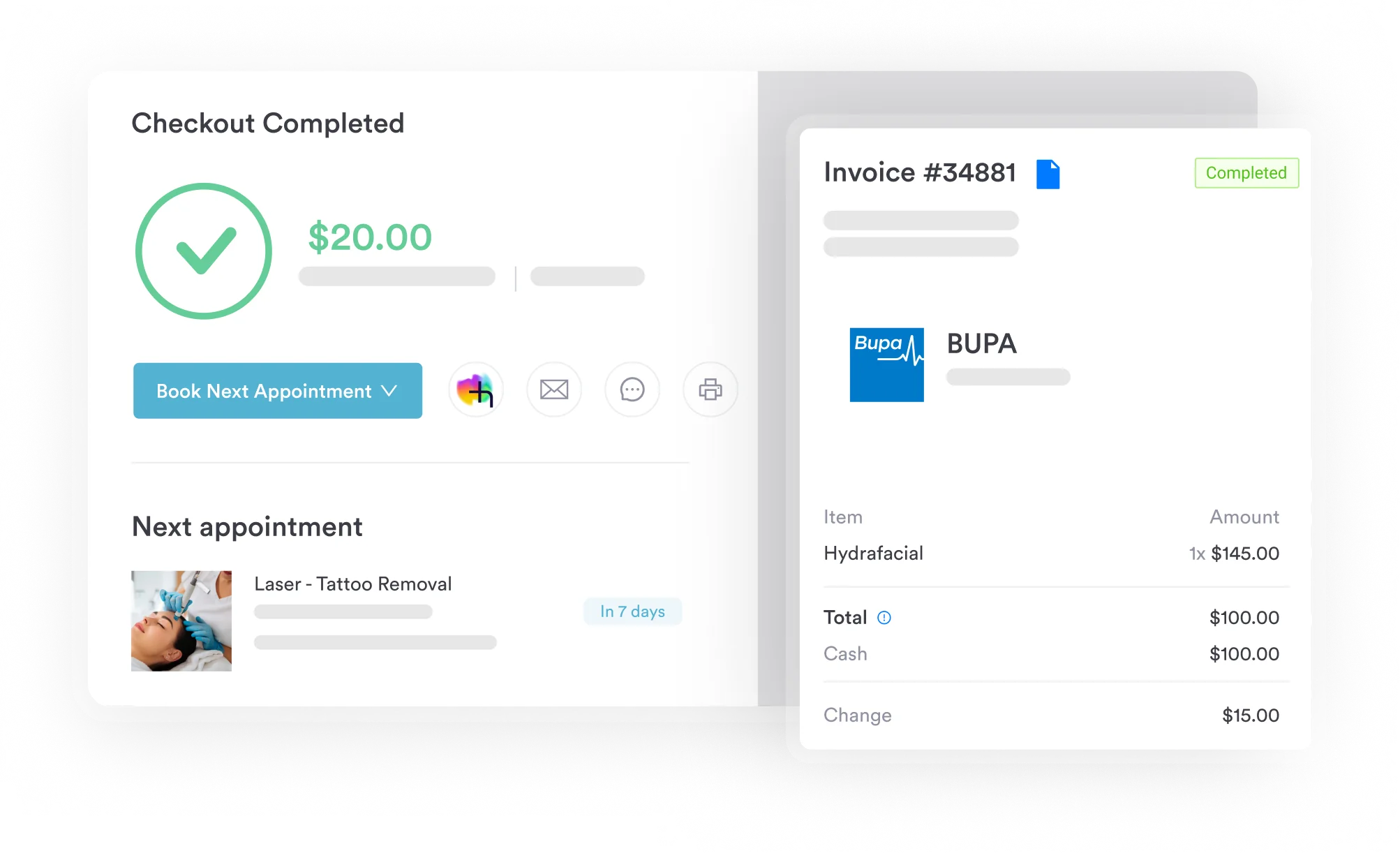
Pabau’s claim validation software checks every claim for missing or invalid details before it leaves the system. The claim then goes out as an electronic CMS-1500 to thousands of US payers. A rejection is flagged as Needs action, so your team corrects it while the encounter is still fresh.

Pabau attaches prior authorization codes to bookings, validates claims before submission, and tracks each CPT 31296 claim to payment. Your team spends less time chasing denials and more time on patient care.

Treat CPT 31296 as a site decision before it becomes a billing decision. Confirm which sinuses were dilated and on which side, then choose 31296, 31298 or a 59/XS pair from that record.
Clear the authorization and the failed-therapy history before the procedure date, not after a denial arrives. Building those checks into the operative note template and the booking workflow removes the same rework from every future claim.
The trade-off is a few extra minutes of documentation per case, against an appeal that has to rebuild the same evidence later. Book a demo to see how Pabau keeps authorization codes, operative notes and CPT 31296 claims in one workflow.

Dilating the maxillary sinus in the same session? CPT code 31295 covers the maxillary balloon dilation code and how it pairs with 31296.
Opening the frontal sinus rather than dilating it? CPT code 31276 explains the frontal sinus exploration code used in conventional FESS.
Want to reduce claim rejections across your ENT practice? Clean claim submission walks through the checklist every billing team needs before sending a surgical claim.
Need a full picture of the claims workflow from submission to payment? What is medical billing covers the end-to-end process for practice managers new to surgical billing.
Tracking denials and appeals across multiple providers? Denial management in healthcare outlines the workflows that turn rejected claims into recovered revenue.
CPT code 31296 is the procedure code for nasal/sinus endoscopy, surgical, with dilation (eg, balloon dilation) of the frontal sinus ostium. It covers balloon catheter dilation of the frontal ostium under endoscopic guidance. Bilateral dilation in the same session takes modifier 50.
CPT 31295 covers balloon dilation of the maxillary sinus ostium, while CPT 31296 covers the frontal sinus ostium. The code must match the documented sinus site. Using 31295 when the frontal sinus was dilated is a coding error that triggers denials.
No. When the frontal and sphenoid ostia are dilated in the same session, report the combination code 31298 instead. Modifier 59 or XS applies only when 31295 is reported with 31296 or 31297.
CPT 31296 has a 0-day (000) global period. Only the pre- and post-operative work on the day of surgery is bundled, so later follow-up visits are billed separately.
Yes. For Medicare, append modifier 50 and bill one line, paid at about 150% of the single-procedure rate. Many commercial payers want two line items with LT and RT modifiers instead, so check the payer’s provider manual first.
The main supporting diagnoses are J32.1 (chronic frontal sinusitis), J01.10 (acute frontal sinusitis, unspecified), and J01.11 (acute recurrent frontal sinusitis). J32.0 (chronic maxillary sinusitis) does not support 31296. J32.4 (chronic pansinusitis) supports it only when frontal involvement is documented.
Yes, for most payer classes. Medicare Advantage plans, commercial insurers, and many Medicaid managed care plans require prior authorization for balloon sinuplasty. Expect to supply a CT scan showing frontal sinus disease, failed conservative therapy records, and a symptom duration that meets the policy threshold.
CMS sets the RVUs for CPT 31296 in the Medicare Physician Fee Schedule, and they change each January. Use the CMS MPFS lookup tool or the AAPC Codify database for current work, practice expense, and total RVUs. Figures in static references can go out of date within weeks of an update.