ICD-10 code Y83.0: Surgical operation with whole organ transplant
ICD-10 code Y83.0 names the transplant as the cause, not the problem ICD-10 code...

Last Updated: Nov 19, 2026
Billable Code Specific Code
J01.90 is the billable ICD-10-CM code for acute sinusitis, unspecified. It applies when the provider documents an acute episode without naming the affected sinus.
The code is valid for FY2027 and sits under J01.9, a non-billable subcategory with two billable codes. J01.90 covers a single acute episode, and J01.91 covers recurrent acute sinusitis, unspecified. Submitting the parent J01.9 instead gets the claim rejected.
Let Pabau's smart automation suggest the right codes, reduce claim denials, and keep your practice compliant—effortlessly.
Automate repetitive tasks and focus on what matters most—your patients.
Reduce coding errors and ensure compliance with the latest regulations.
Clean claims, fewer denials, and faster reimbursements.
Powerful insights and reporting to help your practice thrive.
HIPAA compliant SOC 2 certified GDPR-compliant Trusted by 4,000+ clinics worldwide

J01.90 is one of two billable codes under the non-billable J01.9 subcategory, alongside J01.91 for recurrent acute sinusitis, unspecified.
Category J01 lists sinusitis NOS (J32.9) as Excludes1. Chronic sinusitis (J32.0-J32.8) is Excludes2, so it can be coded alongside J01.90 when both are documented.
Symptoms lasting under four weeks typically separate acute sinusitis (J01.90) from chronic sinusitis, though payer policies may define the window differently.
A recurrent acute episode with no sinus named takes J01.91, and a documented sinus site takes its own J01 code.
Pabau’s claims management submits CMS-1500/837P claims through Claim.MD and warns when a prior authorization is missing from the case.
ICD-10 Code J01.90 is the billable ICD-10-CM code for acute sinusitis, unspecified, used when the provider documents acute sinusitis without naming the affected sinus. The CDC’s FY2027 ICD-10-CM tabular list places it under J01.9 in Chapter 10, within the J00-J06 block for acute upper respiratory infections. The code is valid for FY2027 (October 1, 2026 through September 30, 2027) and carries no seventh-character requirement.
The code also captures acute rhinosinusitis when the sinus site is not documented, because the ICD-10-CM index sends rhinosinusitis to the sinusitis entries. When the provider specifies a sinus site, coders must move to a more specific J01 code. A recurrent episode with no site named moves to J01.91.
The J01 category carries an “Includes” note that extends coverage beyond the literal descriptor. J01.90 applies to any of the following when the sinus site is unspecified and the episode is not documented as recurrent.
The clinical use case is straightforward. A primary care physician documents “acute sinusitis” in the assessment with no mention of a specific sinus. Or an ENT note says “rhinosinusitis” without imaging that confirms which sinus is infected. J01.90 is the correct code in both scenarios.
What J01.90 does not cover is equally important. It does not capture sinusitis documented as chronic or lasting longer than roughly four weeks. Recurrent acute episodes take J01.91, and a named sinus site takes its own J01 code.
J01.90 carries no Excludes notes of its own. The notes that govern it sit at category J01 in the ICD-10-CM tabular list, and the two types work differently.
An Excludes1 note means the two codes are never reported together for the same condition. At J01, it covers sinusitis NOS (J32.9), the code for sinusitis documented with no acute or chronic qualifier. Report either J01.90 or J32.9 for the episode, never both.
An Excludes2 note is different. The excluded condition is not part of J01.90, but a patient can have both at the same time. At J01, it covers chronic sinusitis, J32.0 through J32.8. When the provider documents an acute episode on top of chronic sinusitis, both codes may be reported together. The J32 category carries a matching Excludes2 note for acute sinusitis (J01.-).
J01.9 is a non-billable subcategory, and J01.90 is one of its two billable codes, alongside J01.91 for recurrent acute sinusitis, unspecified. Submitting J01.9 on a claim produces an automatic rejection. The clearinghouse returns it before the payer sees it, so there is no denial to appeal.
The confusion is compounded by EHR search bars. Some systems surface J01.9 in autocomplete because the descriptor text matches a coder’s search term. Always confirm the full code, five characters (six with the decimal point), before saving to the encounter.
J01.90 applies only when the sinus site is undocumented. When the record specifies the affected sinus, coders must use the site-specific code. The J01 family follows one pattern: a final 0 marks a single acute episode, and a final 1 marks a recurrent one. The grid below maps all 12 billable codes by sinus and episode.
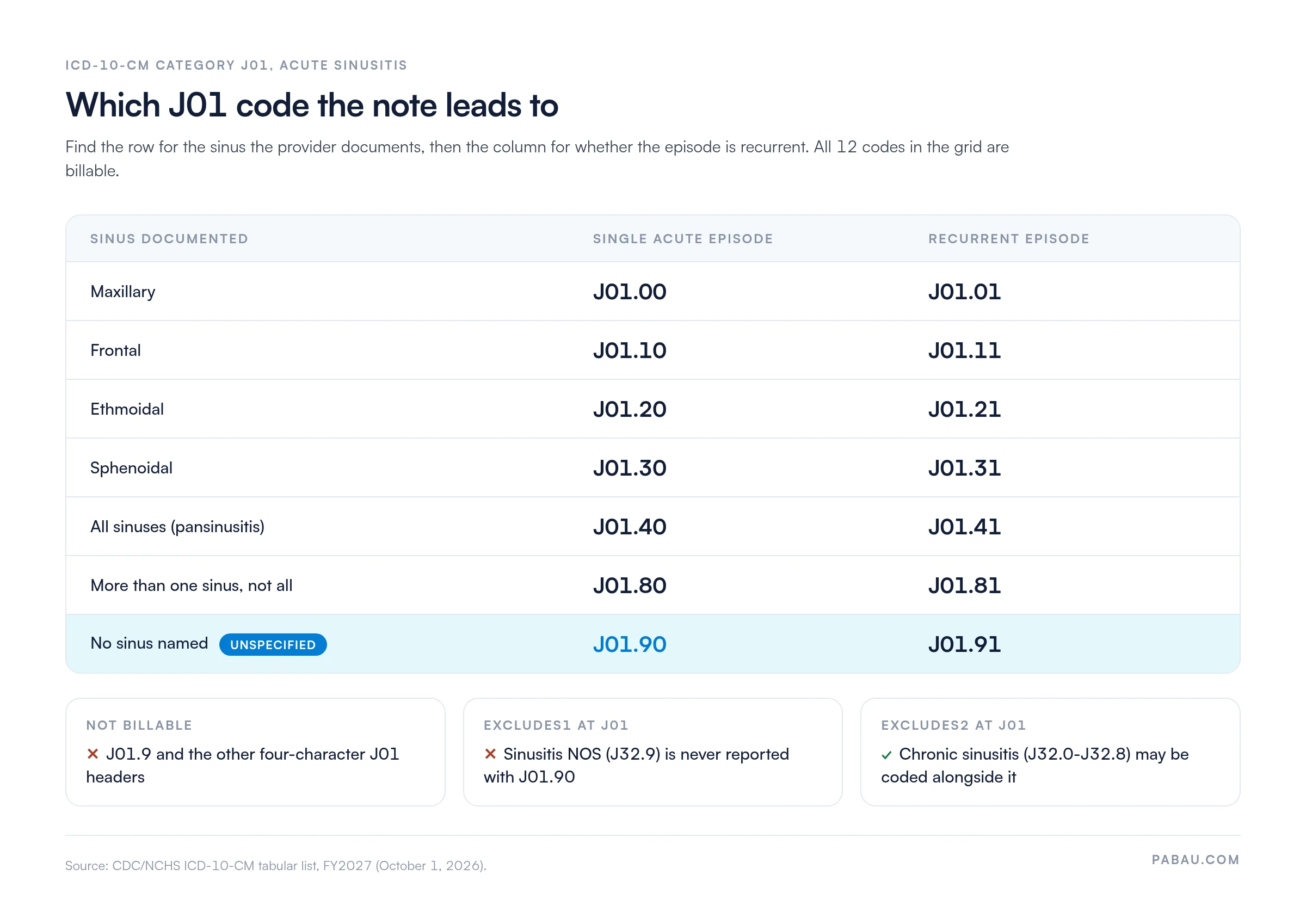
The table gives the full descriptor for each code.
A coder reviewing a note that says “acute maxillary sinusitis confirmed on CT” should report J01.00, not J01.90. Coders must code to the highest level of specificity the documentation supports. For a neighboring diagnosis outside J01, start from the ICD-10-CM library for coders.
J32.9 is the unspecified chronic sinusitis code, the chronic counterpart to J01.90. The deciding factor is symptom duration. The code set published on the CMS ICD-10 codes page sets no duration threshold, so the clinical criteria do that work.
Under American Academy of Otolaryngology (AAO-HNS) criteria, acute sinusitis typically involves symptoms lasting fewer than four weeks. Chronic sinusitis persists for 12 weeks or longer with persistent inflammation. The four-to-twelve-week middle ground is subacute sinusitis, which some payer policies treat differently. Check the payer’s policy before coding that window.
Never code a documented chronic case as J01.90 to avoid authorization. That misrepresents the clinical situation on the claim, and the documentation should always drive the code.
Medical necessity for ICD-10 Code J01.90 rests on what appears in the medical record, not on the code itself. CMS and commercial payers expect the following elements to be present for the claim to survive audit or retrospective review. Meeting clean claim standards from the start reduces the need for appeals.
Under HIPAA transaction standards, ICD-10-CM codes on electronic claims must reflect the physician’s documented clinical assessment. Coders who assign J01.90 from a documented provider diagnosis are on solid ground. Coders who infer the diagnosis from symptom descriptions, without a provider statement, are not.
ICD-10 Code J01.90 appears on claims alongside a range of CPT codes, depending on the encounter type, provider specialty, and services performed. Each CPT line should point to the diagnosis that supports it.
When building a sinusitis superbill, include both the diagnostic and imaging CPT codes where applicable. Verify current reimbursement values using the CMS Physician Fee Schedule lookup for the service area.
Standard office visits coded with J01.90 typically do not require prior authorization under Medicare or most commercial plans. The visit counts as medically necessary when the documentation criteria are met. Procedures and imaging attached to the same encounter are where authorization requirements emerge. Review billing compliance requirements relevant to your payer mix before ordering imaging alongside J01.90.
Medicare Administrative Contractors (MACs) publish Local Coverage Determinations for sinusitis-related procedures. Three points hold across most MAC jurisdictions.
Always verify the current LCD for the relevant MAC jurisdiction, because these policies change.
Commercial payers do not uniformly accept the four-week duration standard. Some define acute sinusitis as symptoms lasting seven to ten days with no improvement, while others follow the AAO-HNS threshold. A J01.90 claim for a patient with two days of symptoms may draw a medical necessity audit from one payer and pass with another. Add a duration check to your pre-claim checklist for high-volume sinusitis payers.
Before submitting any J01.90 claim with imaging, run a prior authorization check against the specific payer and plan. Medicare Advantage plans can set requirements that differ from traditional Medicare. The same CPT code on the same diagnosis can carry different authorization rules from one plan to the next.
J01.90 denials tend to trace back to five root causes. Building denial management workflows around these patterns eliminates the majority of avoidable rejections.
The AAPC Codify ICD-10-CM lookup provides real-time Excludes1 and Excludes2 annotations at the point of coding – useful for training new coders on the J01/J32 boundary.
Accurate ICD-10 Code J01.90 entry follows a consistent workflow regardless of which EHR or practice management system the practice uses. The steps below apply to any system that surfaces ICD-10-CM codes during charge capture.
Each step maps to a stage of the wider claim cycle, which medical billing basics walks through from charge capture to payment.
Several J01.90 rejections in the denial table are clerical, such as the J01.9 parent code or a missing imaging authorization. Each one is cheaper to catch before the claim leaves the practice.
Pabau, the practice management platform we build, handles US claims through its claims software for practices. It submits CMS-1500/837P claims through Claim.MD, runs eligibility checks, and posts ERA remittances when payment comes back.
Prior authorization codes, dates and sessions are tracked on the patient’s case, and Pabau warns when one is missing. Your team learns that a sinus CT has no authorization on file before that claim goes out, rather than after the denial.
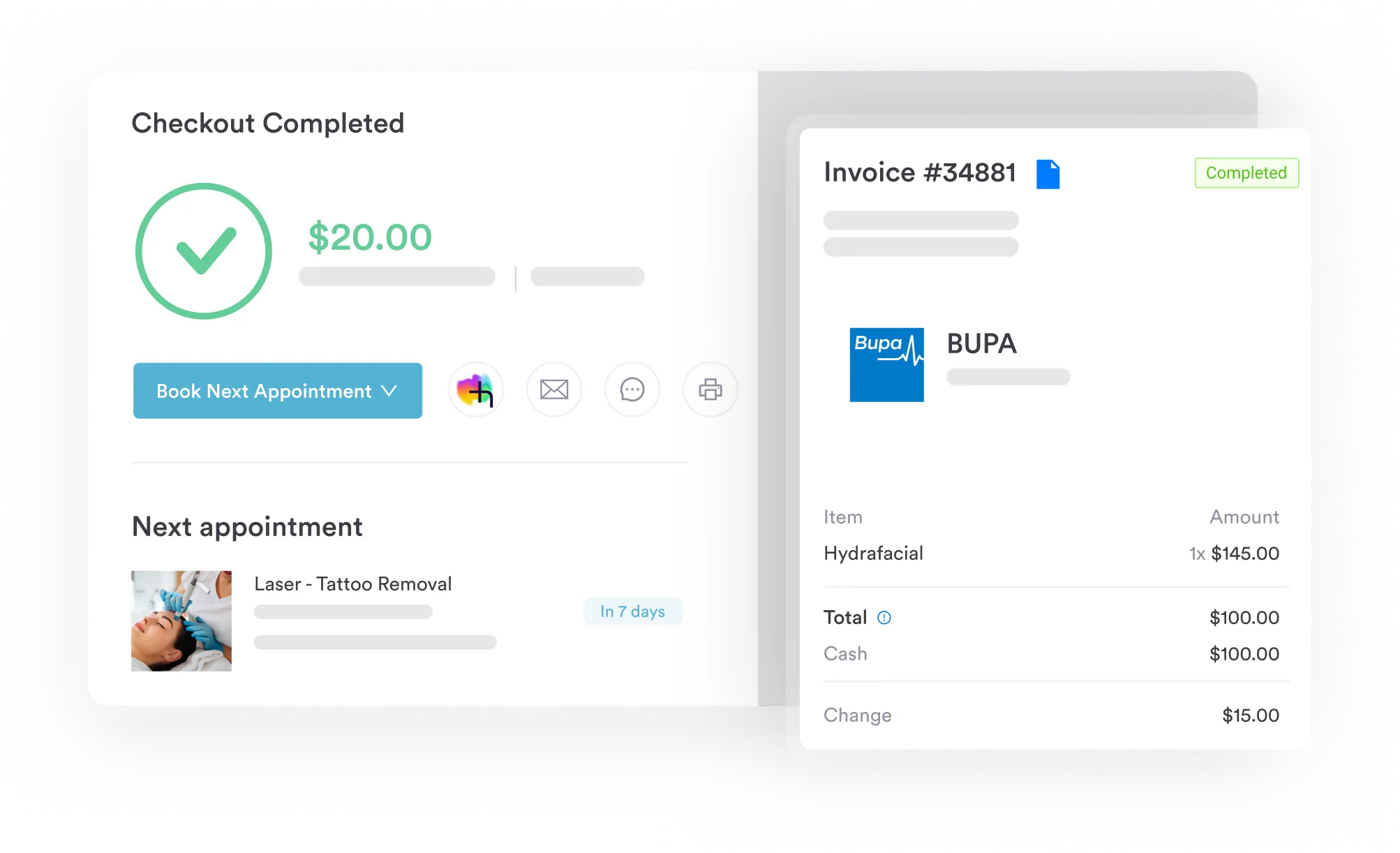

Pabau’s claims management submits CMS-1500/837P claims through Claim.MD, with eligibility checks and ERA remittances. Prior authorization codes are tracked on the case, with a warning when one is missing.

J01.90 is a fallback code, and it holds up best when the note leaves no better choice. Before you report it, check the note for a named sinus, a recurrent episode, and any chronic history.
A named sinus or a recurrent episode moves the claim to another J01 code. A chronic history does not rule J01.90 out, because chronic sinusitis is Excludes2 and can sit beside it. Only sinusitis NOS (J32.9) blocks it outright.
Get those checks into the charge-capture habit and the remaining risk is clerical. Book a demo to see how Pabau tracks eligibility and prior authorizations before your sinusitis claims go out.

Need a step-by-step guide to medical claim submission? Claim.MD clearinghouse guide explains how electronic claims move from your EHR to the payer.
Confused by denial codes on your remittance? Denial codes in medical billing maps common CARC and RARC codes to their fix actions.
Want to understand ERA and payment posting? Electronic remittance advice covers how 835 ERA files work and how to reconcile payments automatically.
Coding a chronic case instead? ICD-10 code J32.9 covers chronic sinusitis, unspecified, and the documentation that supports it.
ICD-10 Code J01.90 is the billable ICD-10-CM diagnosis code for acute sinusitis, unspecified. The provider has documented acute sinusitis without naming the affected sinus (maxillary, frontal, ethmoidal, or sphenoidal). It also covers acute rhinosinusitis when no sinus site is documented and the episode is not recurrent.
J01.9 is a non-billable subcategory that cannot be reported on a claim. J01.90 is one of its two billable codes, alongside J01.91 for recurrent acute sinusitis, unspecified. Submitting J01.9 on an 837P claim produces an automatic rejection before the payer processes it. Confirm the full code, five characters (six with the decimal point), before saving.
Yes. J01.90 is billable for FY2027 (October 1, 2026 through September 30, 2027) and valid on Medicare and commercial claims. It requires no seventh character and no additional code qualifier. Within the J01.9 subcategory, only the parent J01.9 is non-billable, and J01.91 is the other billable code.
No. Chronic sinusitis takes a J32 code, such as J32.9 for chronic sinusitis, unspecified. Chronic sinusitis (J32.0-J32.8) is Excludes2 at category J01, so it can be reported alongside J01.90 when an acute episode is also documented. Sinusitis NOS (J32.9) is Excludes1, so it is never reported with J01.90.
J01.90 describes acute sinusitis, typically under four weeks. J32.9 describes chronic sinusitis, unspecified, typically 12 weeks or longer with persistent inflammation. Category J01 lists sinusitis NOS (J32.9) as Excludes1, so the two codes do not appear together on a claim. In the subacute range of four to twelve weeks, check the payer’s policy before selecting a code.